The short answer
The two main types of cats are moggies (mixed-ancestry cats, listed by shelters as domestic shorthair, domestic medium hair or domestic longhair) and pedigree breeds. Most cats in Australian rescues are moggies. The Coordinating Cat Council of Australia lists 46 breed standards (checked 10 November 2026), which fall into four rough families: longhairs such as the Persian, Ragdoll and Maine Coon; the Siamese and Oriental family; shorthairs such as the British Shorthair, Burmese and Russian Blue; and unusual coats, the curly Devon and Cornish Rex and the hairless Sphynx. Tabby, black, ginger, calico, tortoiseshell and tuxedo are colours and patterns, not breeds. No type of cat is hypoallergenic.
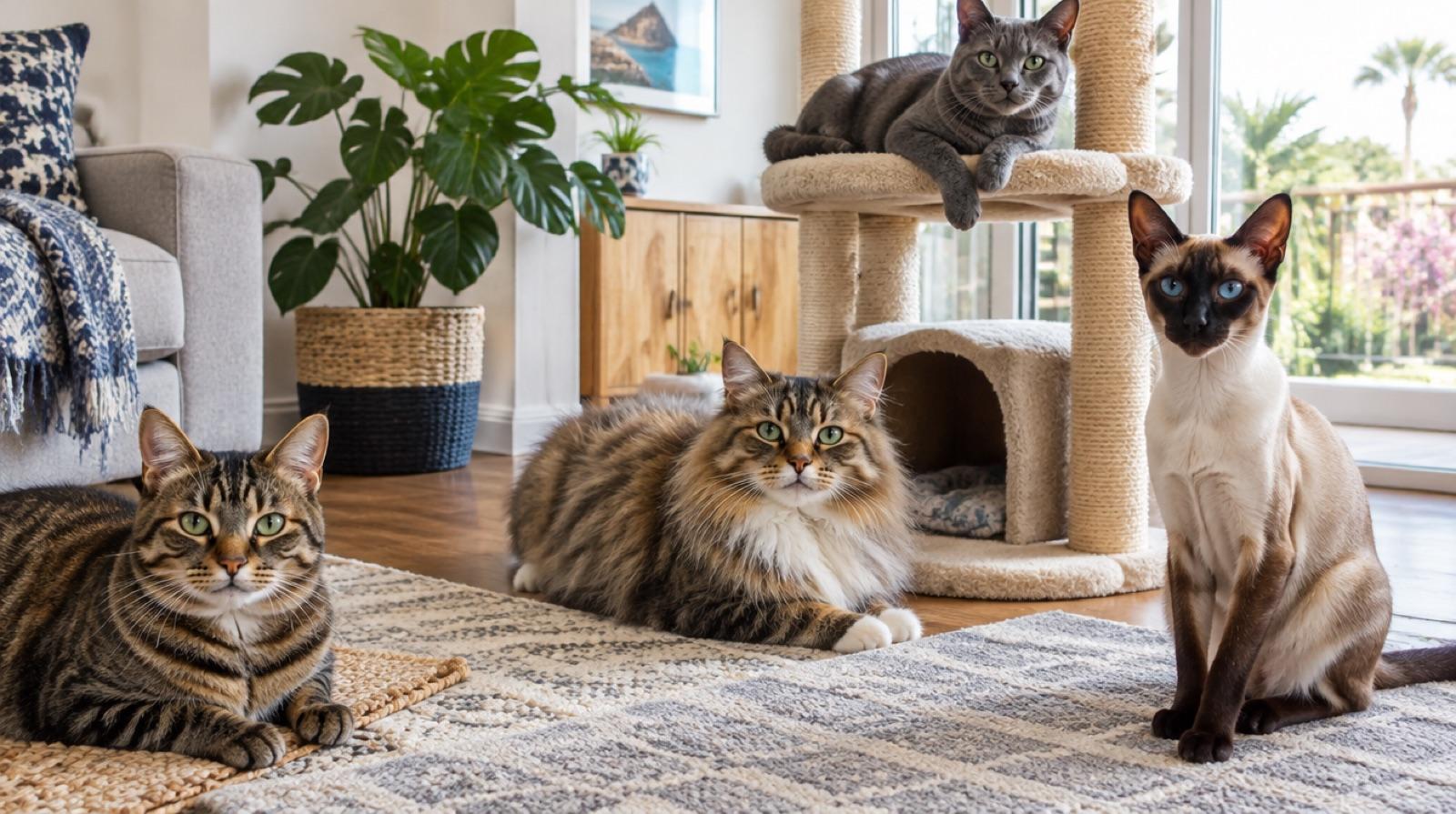
What are the main types of cats?
The first split is simple: a cat is either a moggy or a pedigree. A moggy has mixed or unknown ancestry. A pedigree cat has registered parents of the same breed and papers from a cat council to prove it. Everything else, from coat length to colour, describes a cat without telling you which of those two it is.
Inside the pedigree world, breeds fall into a few families. Australia's Coordinating Cat Council of Australia (CCCA) publishes its breed standards in four groups. The page does not label them, but the pattern is clear when you read the lists: Group 1 holds the longhaired and semi-longhaired breeds, Group 2 the Siamese and Oriental family, Group 3 the other breeds (mostly shorthairs, including the rex and hairless cats), and Group 4 a single standard for domestic cats.
| Type | What it means | Examples | How common in rescue |
|---|---|---|---|
| Moggy (domestic cat) | Mixed or unknown ancestry; named by coat length | Domestic shorthair, domestic medium hair, domestic longhair | Most rescue cats |
| Longhaired breeds | Long or semi-long coats; CCCA Group 1 | Persian, Ragdoll, Maine Coon, Birman | Uncommon |
| Siamese and Oriental | Fine-boned, fine-coated, talkative; CCCA Group 2 | Siamese, Oriental Shorthair | Uncommon |
| Shorthaired breeds | Short coats of many textures; CCCA Group 3 | British Shorthair, Burmese, Russian Blue, Bengal | Uncommon |
| Rex and hairless | Curly, wavy or almost no coat; also CCCA Group 3 | Devon Rex, Cornish Rex, Sphynx | Rare |
Groups are as listed on the CCCA standards page, read on 10 November 2026. How common each type is in rescue is drawn from the rescue listings LocalPetFinder aggregates; see the live breed pages for what is listed today.
What is a moggy, and why are most cats one?
Moggy is the everyday Australian word for a mixed-breed cat. Shelters list moggies by coat length: domestic shorthair (DSH), domestic medium hair (DMH) and domestic longhair (DLH). These labels describe the coat, not the ancestry. RSPCA South Australia puts it plainly: moggies are common in rescue centres, and purebred cats only occasionally come through.
A moggy is not a lesser cat. RSPCA Pet Insurance notes that because domestic shorthairs come from such varied backgrounds there is no single personality type, and that they generally have fewer breed-specific hereditary conditions than many pedigree cats (they still get the common cat illnesses, such as dental and kidney disease). The CCCA even keeps a standard for domestic cats in its Group 4, so a well-presented moggy has a place at a cat show.
For the full explanation of the label, see what is a domestic shorthair.
Cat breeds list: which breeds are there, by type?
The tables below list the pedigree breeds that have a breed page on LocalPetFinder, grouped by type. Each page shows any cats of that breed (or that look like it) listed by rescues right now. Coat descriptions and temperament notes come from the CCCA standards and the Cat Fanciers' Association (CFA) breed profiles. Registry descriptions are written by breed enthusiasts, so read them as what the breed is selected for, not a promise about one cat.
Longhaired and semi-longhaired breeds
Long coats look effortless in photos and are not. The CFA says Siberians may need weekly grooming to prevent mats, and calls the Persian a serious grooming commitment. The Norwegian Forest Cat and Siberian carry heavy winter coats that thin in warm weather.
| Breed | Coat | CCCA group | What the standard or registry says |
|---|---|---|---|
| Birman | Semi-long, silky; white feet | 1 | The CCCA standard calls the coat of such texture that it will not mat, and says the white feet are characteristic of the breed. |
| Maine Coon | Long, shaggy, with a frontal ruff | 1 | The CCCA standard calls it the largest of all pedigreed cats. |
| Norwegian Forest Cat | Thick double coat, water-repellent top coat | 1 | The CFA says it is independent and not clingy, and its coat is generally tangle free for a longhair. |
| Persian | Long, full; heavy grooming | 1 | The CFA describes a sweet, quiet cat and a serious grooming commitment. |
| Ragdoll | Semi-long; pointed with blue eyes | 1 | The CFA describes it as gentle, calm and loving without being demanding. |
| Siberian | Moderately long to long triple coat | 1 | The CFA describes it as sociable, curious and easygoing. |
The Siamese and Oriental family
These are the talkers. The CFA describes the Oriental as a Siamese-style cat without the pointed markings, in over 150 colours and patterns, and says both are people-focused and vocal. The 2019 Finnish study of 5,726 cats by Salonen and colleagues found Oriental-group cats likely to seek contact with people, but also more likely to groom excessively. Our guide to applehead vs modern Siamese explains the two looks.
| Breed | Coat | CCCA group | What the standard or registry says |
|---|---|---|---|
| Siamese | Short, fine; colourpoint | 2 | The CFA describes a vocal, affectionate, active cat that can be insistent. |
| Oriental Shorthair | Short, fine, glossy; also a longhair variety | 2 | The CFA calls it a Siamese-style cat without the pointed markings, in over 150 colours and patterns. |
Shorthaired breeds
The biggest group, and the most varied: from the stocky American Shorthair to the busy Abyssinian. Shorthaired breeds are the easiest to groom, and the type most often mistaken for a moggy (and the other way round).
| Breed | Coat | CCCA group | What the standard or registry says |
|---|---|---|---|
| Abyssinian | Short, ticked | 3 | The CFA describes an extremely active, affectionate cat that rarely stays in a lap for long. |
| American Shorthair | Short, thick, hard-textured | 3 | The CFA calls it solidly built, easygoing and relatively sedate. |
| Bengal | Short, spotted or marbled | 3 | The CFA says Bengals keep a kitten-like energy well into their senior years. |
| British Shorthair | Short, very dense, crisp | 3 | The CFA describes a calm, quiet, extremely patient cat that does not like being carried. |
| Burmese | Short, satin-like | 3 | The CCCA standard describes an outgoing, sociable, lively cat of medium size. |
| Manx | Short or longhair double coat; tailless | 3 | The CFA describes a quiet, gentle cat and warns of Manx syndrome: problems with the hind legs, bladder and bowel in some tailless cats. |
| Russian Blue | Short, plush double coat | 3 | The CFA describes a graceful, playful, quiet cat that may be shy at first. |
| Tonkinese | Short, soft | 3 | The CFA describes an outgoing, gregarious and talkative cat. |
Curly, hairless and other unusual cats
These breeds are defined by a single striking feature: a wavy coat, no coat, folded ears or short legs. That feature is usually caused by one gene, and some of those genes bring health questions. The UK's Governing Council of the Cat Fancy (GCCF) refuses to register the Scottish Fold and the dwarf breeds such as the Munchkin for that reason, while the CCCA publishes standards for both. Read the breed page and ask a vet before you choose one.
| Breed | Coat | CCCA group | What the standard or registry says |
|---|---|---|---|
| Devon Rex | Short, soft, wavy | 3 | The CFA says Devons shed less than most cats but are not hypoallergenic. |
| Cornish Rex | Short, tight waves, no guard hairs | 3 | The CFA describes an active, racy, affectionate cat. |
| Sphynx | Hairless or near-hairless; oily skin | 3 | The CFA says the skin needs regular bathing and that the Sphynx is not a low-allergen cat. |
| Scottish Fold | Folded ears | 3 | Recognised by the CCCA, but the UK GCCF will not register it because of osteochondrodysplasia, a bone and joint disease. |
| Munchkin | Short legs | 3 | Recognised by the CCCA, but the GCCF rules dwarf breeds ineligible because of reported health problems. |
Coat and temperament wording from the CCCA standards and the CFA profiles for each breed (for example Cornish Rex, Devon Rex, Sphynx, Manx, Maine Coon); welfare positions from the GCCF. All read on 10 November 2026.
The CCCA also lists breeds without a LocalPetFinder page because they almost never appear in Australian rescue, among them the Exotic, Turkish Van, Turkish Angora, Neva Masquerade, Balinese, Peterbald, Singapura, Somali, Ocicat, Korat, Egyptian Mau, Burmilla, Selkirk Rex, LaPerm, American Curl, Australian Mist and Toyger. If you want one of these, you are looking for a registered breeder, not a rescue.
Every type of cat, listed by real rescues
Domestic shorthairs, longhairs and the occasional pedigree from Sydney and NSW rescues, refreshed regularly, each linking straight to the rescue.
See cats in Sydney →What are the coat types of cats?
Coat is the quickest way to sort any cat, moggy or pedigree, and it decides how much grooming you are signing up for.
- Short: the domestic shorthair and most breeds. A weekly brush is plenty for most. Textures vary, from the plush British Shorthair to the satin Burmese.
- Medium: the domestic medium hair, a common rescue cat. RSPCA Pet Insurance suggests brushing two to three times a week, with an eye out for mats behind the ears and on the chest and belly.
- Long and semi-long: the Persian, Maine Coon, Ragdoll, Birman, Norwegian Forest Cat, Siberian and the domestic longhair. Regular brushing for life, and the most for a Persian. Browse long-haired cats in Sydney.
- Rex (curly or wavy): the Devon Rex and Cornish Rex. Soft, short and low-shedding, but not allergy-free.
- Hairless: the Sphynx. No brushing, but regular baths for oily skin, protection from sun and cold, and still a source of allergens.
If allergies are the reason you are looking at coat type, read this first: the Australasian Society of Clinical Immunology and Allergy (ASCIA) says all cat breeds can cause allergies, because all cats have sebaceous (skin) glands; hairless does not mean allergen-free. Our guide to hypoallergenic cats in Australia explains why, and how to test your reaction to a particular cat.
Are tabby, ginger and tuxedo types of cats?
No. They are colours and patterns, and any type of cat can carry them. People often search “types of cats” meaning these looks, so here is how they fit:
| Look | What it is | Guide | Listed now (Sydney) |
|---|---|---|---|
| Tabby | A pattern; the CCCA recognises four: classic, mackerel, spotted and ticked | Tabby cat patterns | Tabby cats |
| Black | A solid colour; some black coats can look rusty | Black cats | Black cats |
| Ginger (orange) | A colour carried on the X chromosome; most ginger cats are male | Ginger cats | Orange cats |
| Calico | Black and orange in patches with white; almost always female | Calico cats | Calico cats |
| Tortoiseshell | Black and orange mixed, little or no white; almost always female | Tortoiseshell cats | Tortoiseshell cats |
| Tuxedo | A black cat with white spotting, not a breed | Tuxedo cats | Tuxedo cats |
| Grey, white, cream | Grey (blue) is a diluted black; cream a diluted ginger; white masks the colour beneath | Moggy colours and patterns | Grey, white, cream |
Each colour guide cites the genetics papers and registry pages behind these one-line summaries.
Who decides what counts as a cat breed in Australia?
There is no single national authority. Several cat councils register pedigree cats and publish breed standards, each with member clubs in the states:
- Coordinating Cat Council of Australia (CCCA): its member bodies include Cats Queensland, the NSW Cat Fanciers Association, the Feline Control Council of Victoria and the Feline Association of South Australia. Its standards page lists 46 breeds plus domestic cats, and tells readers to check with their own registering body which breeds it recognises.
- Australian Cat Federation (ACF): member bodies include Cats NSW, the Queensland Feline Association, the Governing Council of the Cat Fancy in Victoria and in South Australia, and Cats WA.
- Australian National Cats (ANCATS): describes itself as the only national registry for cats in Australia and has a public tool to check a member.
- Cats Australia: a charter club of TICA, the international cat registry.
Overseas registries add to the confusion. FIFe in Europe, TICA and the CFA in North America, and the GCCF in the UK each keep their own lists, and they disagree on some breeds. The Scottish Fold and Munchkin are the clearest example: Australian standards exist for both, while the GCCF refuses them on welfare grounds. Another is the Thai, the old-style Siamese, which the ACF and CCCA standards lists do not carry.
The practical point: if you buy a pedigree kitten, the breeder should name the council their cats are registered with, and you can check the membership yourself. The RSPCA's cat buyer's guide sets out what to ask a breeder before you pay anything. Our guide to kittens for sale: adopt or buy covers state breeder rules and scam red flags.
Which type of cat suits you?
Type tells you about coat and likely energy; it does not tell you about the cat in front of you. The Finnish breed study found real differences between breeds, but it also found behaviour traits only moderately heritable in the breeds it measured, so individual cats differ. Use type to narrow the field:
- Little time to groom: any shorthair, moggy or pedigree.
- Want a quiet cat: the CFA describes the British Shorthair, Russian Blue and Persian as quiet; the Siamese, Oriental and Tonkinese as talkers.
- Want a big cat: see the largest cat breeds; for petite cats, the small cat breeds.
- Want the friendliest: see the best cat breeds, matched to apartments, children and busy homes.
- Not sure: the what cat breed am I quiz matches your routine to cat types in a few minutes.
Then choose the individual. Many rescue cats live in foster homes, so the person caring for the cat can tell you whether it is a lap cat, how it handles visitors and whether it has lived with children or dogs. That is information no breed label can give you.
Can you adopt a pedigree cat, or should you buy?
Adopt first if you can. The RSPCA says rescues do sometimes have particular breeds and that some breed-specific rescues exist, and advises that if you cannot find the right cat over time, a responsible breeder is another option. A moggy of the colour and coat you like is almost always listed somewhere nearby; a specific pedigree may take months. For dated breeder prices, health tests and what rescue versions look like, see the breed guides: Ragdoll, Maine Coon, Bengal, British Shorthair, Burmese, Birman, Siamese, Persian, Russian Blue, Tonkinese, Devon Rex and Sphynx.
Think your rescue cat might be a breed? Our guide to is my cat a Maine Coon shows how to tell a big fluffy moggy from the real thing.
Find a cat near you
Each city page lists rescue cats and kittens of every type, refreshed regularly, with every listing linking straight to the rescue.
| City | All cats | Long-haired | Kittens | Indoor cats |
|---|---|---|---|---|
| Sydney | Cats | Long-haired | Kittens | Indoor |
| Melbourne | Cats | Long-haired | Kittens | Indoor |
| Brisbane | Cats | Long-haired | Kittens | Indoor |
| Perth | Cats | Long-haired | Kittens | Indoor |
| Adelaide | Cats | Long-haired | Kittens | Indoor |
Still deciding between a cat and a dog? Take the dog or cat quiz or the adoption readiness check, and budget with our guide to what a cat costs in Australia. The male or female cat guide covers the next question most adopters ask.
Frequently asked questions
How many types of cats are there?▼
It depends on who is counting. The Coordinating Cat Council of Australia lists 46 breed standards plus one for domestic cats (checked 10 November 2026), and other registries recognise a different set. In everyday terms there are two big types: moggies, the mixed-ancestry cats shelters call domestic shorthair, medium hair or longhair, and pedigree breeds. Most cats in Australian rescues are moggies.
What are the main types of cats?▼
Start with moggy versus pedigree. Moggies are labelled by coat length: domestic shorthair, domestic medium hair and domestic longhair. Pedigree breeds fall into rough families: longhaired and semi-longhaired breeds such as the Persian, Ragdoll and Maine Coon; the Siamese and Oriental family; the shorthaired breeds such as the British Shorthair and Burmese; and the unusual coats, meaning the curly rex breeds and the hairless Sphynx.
What is a moggy?▼
Moggy is the Australian word for a mixed-breed cat. Shelters list moggies as domestic shorthair, domestic medium hair or domestic longhair, which describe the coat, not a breed. They come in every colour, pattern and personality, and they make up most of the cats Australian rescues list.
Is a tabby a breed?▼
No. Tabby is a coat pattern, not a breed, and it turns up in moggies and in many pedigree breeds. The Coordinating Cat Council of Australia recognises four tabby patterns: classic, mackerel, spotted and ticked. The same goes for black, ginger, calico, tortoiseshell and tuxedo: they are colours and patterns that any type of cat can carry.
What is the difference between a domestic shorthair and a British Shorthair?▼
A British Shorthair is a pedigree breed with a written standard: a round, massive head and a short, very dense, crisp coat. Domestic shorthair is a shelter label for any short-coated cat of mixed or unknown ancestry. A grey moggy can look a little like a British Blue, but it is not one without pedigree papers from a breeder registered with a cat council.
Which cat breeds have long hair?▼
The main longhaired and semi-longhaired breeds are the Persian, Maine Coon, Ragdoll, Birman, Norwegian Forest Cat and Siberian, which all sit in Group 1 of the Coordinating Cat Council of Australia standards. Most longhaired cats in rescue are domestic medium hairs or longhairs rather than these breeds. Any long coat needs regular brushing, and the Cat Fanciers' Association calls the Persian a serious grooming commitment.
Which cats are hairless or curly-coated?▼
The Sphynx is the hairless breed most people know; the Cat Fanciers' Association says its oily skin needs regular bathing. The Devon Rex and Cornish Rex have short, wavy coats; the Cornish has no guard hairs at all. All three are rare in Australian rescue, and none of them is allergy-free.
Is there a hypoallergenic type of cat?▼
No. The Australasian Society of Clinical Immunology and Allergy (ASCIA) says all cat breeds can cause allergies because all cats have sebaceous (skin) glands, so the hairless Sphynx is no exception; the Cat Fanciers' Association also says the Sphynx is not a low-allergen cat. ASCIA also says up to 50% of allergic people do not react straight away, so spend repeated, long visits with the individual cat before you commit.
Who recognises cat breeds in Australia?▼
Several cat councils, not one. The Coordinating Cat Council of Australia and the Australian Cat Federation each have member bodies in the states, Australian National Cats (ANCATS) describes itself as the only national registry for cats in Australia, and Cats Australia is a charter club of the international registry TICA. They do not all recognise the same breeds, so a breeder should say which body their cats are registered with.
Why is the Scottish Fold not recognised everywhere?▼
Because the gene that folds the ears also affects cartilage and bone. The UK's Governing Council of the Cat Fancy (GCCF) will not register Scottish Folds, citing osteochondrodysplasia and joint pain in middle to old age. The Coordinating Cat Council of Australia does publish a Scottish Fold standard. If you are considering one, talk to a vet about the joint disease first.
Can I find a pedigree cat in rescue?▼
Sometimes, but rarely. RSPCA South Australia says moggies are common in rescue and purebred cats only occasionally come through. The breed pages on LocalPetFinder show any pedigree cats listed right now, and an alert tells you when one appears, but expect to wait and to move quickly.
How can I tell what type of cat I have?▼
Look at the coat length first (short, medium or long), then the colour and pattern. That tells you whether your cat is a domestic shorthair, medium hair or longhair, and that is the right answer for most cats. Only pedigree papers prove a breed. Our Maine Coon guide shows how to tell a big longhaired moggy from the real breed.
Sources
- Coordinating Cat Council of Australia: Breed standards (Groups 1 to 4)
- Coordinating Cat Council of Australia: Member bodies
- Australian Cat Federation
- Australian National Cats (ANCATS)
- Cats Australia (TICA charter club)
- FIFe: Recognised breeds
- GCCF: Unrecognised breeds and why
- Cat Fanciers' Association: breed profiles (American Shorthair, Manx, Oriental, Norwegian Forest Cat, Siberian, Cornish Rex, Devon Rex, Persian, Maine Coon, Sphynx)
- Salonen et al. (2019): Breed differences of heritable behaviour traits in cats, Scientific Reports
- ASCIA: Pet allergy
- RSPCA South Australia: Misconceptions about rescue cats
- RSPCA Pet Insurance: Popular cat breeds in Australia
- RSPCA Australia: Smart Kitten and Cat Buyer's Guide (2024)
Keep reading
What cat breed am I?
A short quiz that matches your home, routine and energy to the types of cat that suit them.
Best cat breeds
The friendliest and most affectionate breeds, and what a large breed-behaviour study found.
What is a domestic shorthair?
The cat most Australian rescues list, what the label means, and why it is not a breed.
Adopting a cat in Australia
The steps, the fees in every state and the cat laws to know before you bring one home.