The short answer
Calico is a coat pattern, not a breed: white plus patches of orange and black. The orange gene sits on the X chromosome, so a cat needs two X chromosomes, one carrying orange and one carrying black, to show both colours. That is why calicos are almost always female. A male calico usually has an extra X (XXY): 16 of 25 male calicos and torties in a classic 1975 study were XXY, and almost all were sterile. The popular “1 in 3,000” figure is widely repeated but we could not trace it to a published count. Female calicos are common in rescue, and fees are set by age, not colour (RSPCA NSW lists $220 for an adult cat, checked 10 November 2026; a reference, not a quote).
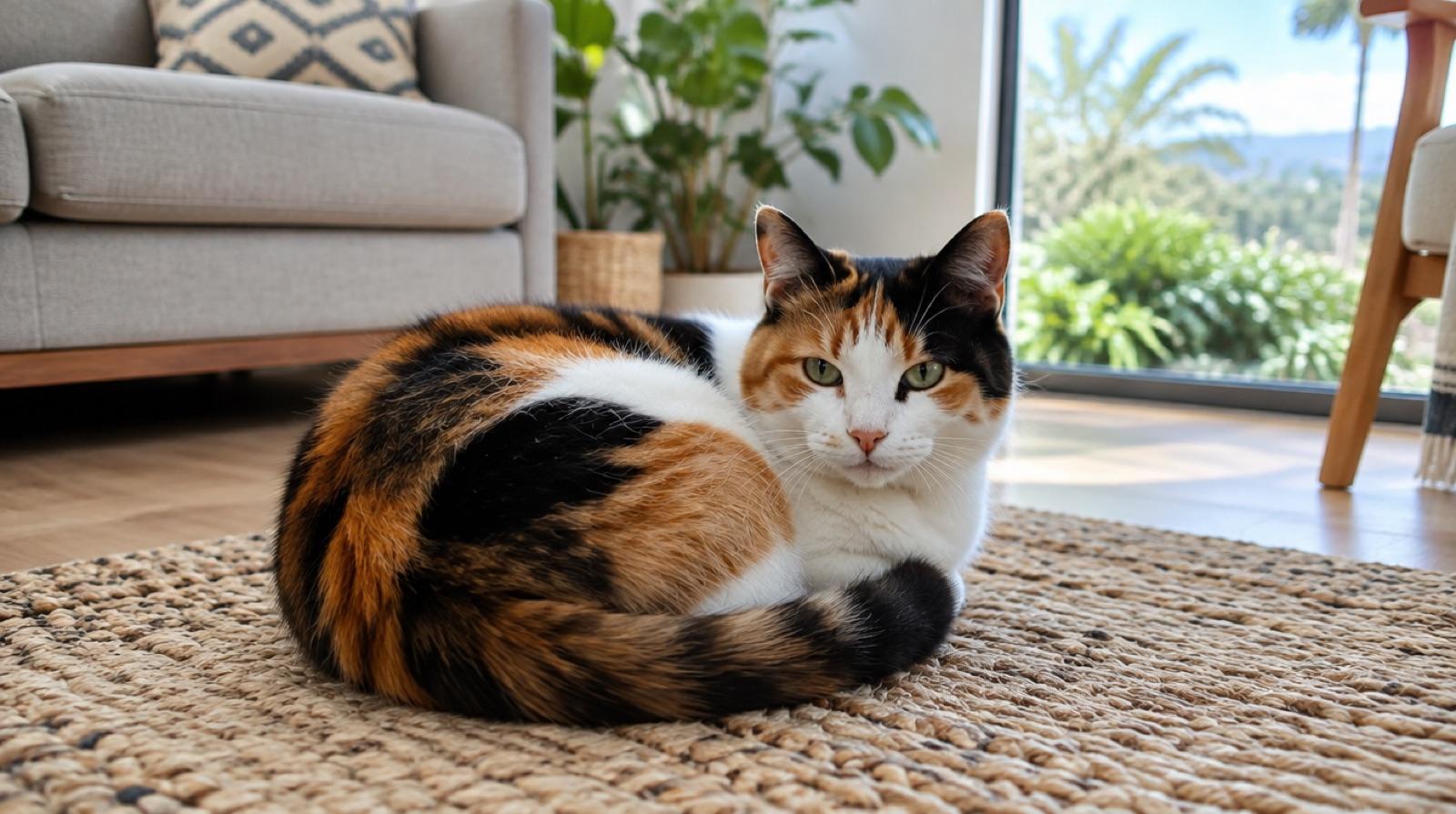
Is a calico cat a breed?
No. Calico describes a coat, the way “tabby” or “black” does. The International Cat Association (TICA) lists the official colour name as “black tortie and white” and calico as what most people call it. The Cat Fanciers' Association (CFA) colour standard defines calico as “white with unbrindled patches of black and red,” with the patches “clear and defined.”
Because it is a colour, many breeds can come in calico. The CFA notes that early Japanese Bobtails were most popular in bicolour or “mi-ke”, the Japanese word for tricolour or calico. In Australian rescue, though, almost every calico is a moggy: a Domestic Shorthair or Domestic Longhair with no known breed. Shelters often write the coat as “tortie and white” rather than calico, so search both terms. Our Domestic Shorthair guide explains what that shelter label means.
Why are calico cats almost always female?
Because the orange gene rides on the X chromosome. In May 2025 two teams, one at Kyushu University in Japan and one led from Stanford University, published papers in Current Biology identifying the orange gene: a small deletion in a gene called ARHGAP36 on the X chromosome. It confirmed what geneticists had suspected for over a century.
Here is how that plays out:
| Cat | Sex chromosomes | Orange possibilities | Can it be calico? |
|---|---|---|---|
| Female | XX | Two orange (ginger), two non-orange, or one of each | Yes, with one of each plus white spotting |
| Typical male | XY | One copy only: ginger or not ginger | No |
| Rare male | XXY, or a mix of XX and XY cells | Can carry one of each | Yes |
The patchwork comes from a process called X-inactivation. Early in development, each cell in a female embryo switches off one of its two X chromosomes at random, and every cell descended from it keeps the same choice. Kyushu University's release describes the result: areas where the orange version is active and areas where the black version is active, giving distinct patches. Professor Hiroyuki Sasaki, who led the Kyushu study, says the effect has become “the textbook example” of X-chromosome inactivation.
The same genetics explains why ginger cats lean male: a male needs only one orange copy, a female needs two. Our orange cats guide covers the ginger side of the story, and the male or female cat guide covers what sex does and does not change in a pet.
Where does the white on a calico come from?
From a different gene, called KIT, which has nothing to do with sex. A 2014 study in the journal G3 by David and colleagues found that white spotting in cats is caused by a retrovirus-derived stretch of DNA inserted into KIT, and that a shortened version of the same insertion causes all-white (dominant white) cats. The UC Davis Veterinary Genetics Laboratory now tests for both, and lists white spotting as an autosomal dominant trait: one copy is enough to show white.
White is not a pigment. It marks skin where pigment cells never settled. The amount varies a lot: the David study recorded different amounts of white in kittens that had inherited the identical white spotting variant from their mother. So the white on a calico is partly genetic and partly chance, laid over an orange-and-black patchwork that is itself chance.
Calico vs tortoiseshell vs dilute calico: what is the difference?
They are the same orange-and-black genetics with different extras. The definitions below follow the CFA colour standard, TICA's colour guide (for torbies) and the UC Davis dilute page.
| Name | Looks like | Genes involved |
|---|---|---|
| Tortoiseshell (tortie) | Black and orange “softly mingled, not patched”; no white | Orange on one X, black on the other |
| Calico (tortie and white) | Clear, defined patches of black and orange on white | As tortie, plus KIT white spotting |
| Dilute calico | Patches of blue-grey and cream on white | As calico, plus two copies of dilute |
| Blue-cream (dilute tortie) | Blue-grey and cream mingled; no white | As tortie, plus two copies of dilute |
| Torbie, or torbie and white | Tortie or calico with tabby stripes in the coloured areas | As above, plus a visible tabby pattern |
Dilute is recessive. UC Davis explains that a cat needs two copies to look dilute, so two ordinary-coloured parents that both carry it can have a dilute calico kitten. TICA notes that most torties are mainly black with varying amounts of red, and that a tortie with more red than black is rare. Every one of these coats follows the same rule: almost always female.
Want the tortie without the white? Browse tortoiseshell cats for adoption. For tabby patterns, blues, points and the rest, see moggy colours and patterns.
How rare is a male calico cat, really?
Rare enough that most people will never meet one, but the exact odds are not well measured. Here is what the published record actually holds.
- The 1 in 3,000 figure. It is everywhere, including the Morris Animal Foundation's 2016 cat genetics facts. We could not find the study that produced it. Treat it as a popular estimate, not a measured rate.
- The largest published survey. Leaman, Rowland and Long (Veterinary Record, 1999) collected the coat colour and sex of 9,816 cats from UK vet practices. Of 4,598 males, 20 were recorded as tortoiseshell (0.43 per cent). That is the share of males that were torties, which is a different question from the share of torties that are male, and colours were recorded by practice staff rather than geneticists.
- The chromosome studies. Centerwall and Benirschke (American Journal of Veterinary Research, 1975) reviewed 25 male tortoiseshell or calico cats; 16 had XXY in their chromosome make-up, and the review also found other changes including mosaicism and chimerism. In the Leaman study, 11 male torties were chromosome-tested: 6 had a mix of XX and XY cells, 2 were XXY, 2 showed only XX and 1 showed only XY in the cells tested.
So “a male calico is almost always XXY” is too strong. XXY is the best-known cause, and was the majority in the 1975 review, but mixed-cell cats were the larger group in the 1999 UK sample. What both studies agree on is that a male calico is a chromosome event, not a colour gene that can be bred for.
Are male calicos healthy, and can they breed?
Most live as ordinary pets, but they are usually sterile. Centerwall and Benirschke reported that almost all of the XXY cats in their review were sterile, and that testicular changes, where recorded, looked like those in human Klinefelter syndrome. The abstract makes a useful point: the coat is only a convenient sign of a chromosome change that happens independently of colour.
We found no good Australian or international data on long-term health in male calicos, so we will not guess. If you adopt one, tell your vet at the first check. Confirming the chromosome make-up needs a chromosome test (a karyotype), which is a specialist lab job and is not needed to care for a healthy cat. Your vet can advise whether anything else is worth checking. A rescue cat will already be desexed or booked in, so fertility is a curiosity rather than a decision.
See the calicos listed right now
Calico and tortie cats from the Australian rescues we aggregate, refreshed regularly. Most are female; a male is worth a closer look.
Browse calico cats →Do calico cats have a different personality?
There is no good evidence that coat colour sets personality. What exists is research on what owners report and what people expect.
- Owner reports. In a 2016 UC Davis online survey analysing 1,274 guardians (Stelow, Bain and Kass), guardians reported torties, calicos and torbies, plus black-and-white and grey-and-white cats, as more often aggressive toward people. The EveryCat Health Foundation summary notes the differences were relatively small and could partly reflect how guardians read the scoring.
- Expectations. In a 2012 survey of 189 people by Delgado, Munera and Reevy, reported by UC Berkeley, participants rated tricolour (tortoiseshell or calico) cats as more intolerant and aloof. That measured the people, not the cats. The lead author's point was that such beliefs can cost cats a home.
- A review. A 2020 review of cat temperament in Animals lists the same finding, orange-gene females reported as more aggressive based on owners' perceptions.
TICA's own colour page mentions “tortie-tude.” Enjoy it as folklore. The useful question is the one only a rescue can answer: how does this cat behave with people, other pets and handling? Foster carers usually know.
Does a calico need any special care in Australia?
One thing: sun on the white parts. The Cat Protection Society of NSW says cats with light-coloured fur on the nose or ears are more susceptible to sunburn, and that white cats are the most susceptible to skin cancer. Its advice for white cats and cats with light-coloured noses, ears or eyelids is to keep them inside all the time, or at least during the hottest part of the day (11am to 4pm), and never to use human sunscreen, which it says is toxic to cats. Ask your vet about a cat-safe product.
Signs the society lists include reddened or flaky skin, sores or hair loss on the ears, eyes or nose, and over-grooming those areas. Any of these is a vet visit. A calico with a white face and pink ear tips is the one to watch; a calico with dark ears and nose carries less of that risk. Everything else is ordinary cat care, which our adopting a cat guide covers.
How do you adopt a calico cat?
Through rescue, which is where most calicos are. Calico is a chance result of the genes above rather than a breed, so most calicos in rescue are moggies. Tortie and calico Domestic Shorthairs turn up in rescue all year, and RSPCA NSW says kittens arrive in big numbers from mid-October through spring, summer and most of autumn.
Fees are set by age and the rescue, not by coat. As reference points: RSPCA NSW lists $220 for a cat over six months and $270 for a kitten, and the Cat Protection Society of NSW lists $150 per cat or kitten, or $250 for two (both checked 10 November 2026). These are reference figures, not quotes; fees change and vary by rescue and state.
Be wary of “rare calico” sales. Scamwatch warns that scammers set up fake websites and social media profiles for pets that do not exist, and that a very cheap price is likely a scam. Its advice is to see the pet in person, or on a live video call if you cannot visit, and to check the seller. A male calico sold at a premium is a red flag twice over: the colour cannot be bred for, and the cat is almost certainly sterile. Our kittens for sale guide sets out each state's seller rules.
Not set on a calico? The what cat breed am I quiz and the cost of owning a cat guide help with the bigger decision.
Find a calico near you
These pages list calico and tortie cats from local rescues, refreshed regularly. Each listing links straight to the rescue.
- Sydney: calico cats, kittens
- Melbourne: calico cats, kittens
- Brisbane: calico cats, kittens
- Perth: calico cats, kittens
- Adelaide: calico cats, kittens
- Australia-wide: all calico cats and all tortoiseshell cats
If a calico you like is already taken, look at the bonded pairs too, such as bonded pairs in Sydney: two cats that already get along are often an easier start than one.
Frequently asked questions
Are all calico cats female?▼
Almost all of them. The orange colour gene sits on the X chromosome, and a calico needs orange on one X and black on the other. Females have two X chromosomes, so they can carry both; a normal male has one X, so he is either orange or not orange. A male calico only happens when something unusual has happened to his chromosomes, most often an extra X (XXY).
How rare is a male calico cat?▼
Very rare, but the popular figure is softer than it sounds. The line that 1 in 3,000 calicos is male is widely repeated (the Morris Animal Foundation, for example), but we could not trace it to a published count. The largest published survey, Leaman and colleagues in the Veterinary Record in 1999, found 20 cats recorded as tortoiseshell among 4,598 male cats seen at UK vet practices (0.43 per cent). That counts male torties among males, not males among torties, so the two numbers are not the same measure.
Why can a male cat be calico?▼
Because he has two different X chromosomes. In the classic study by Centerwall and Benirschke (1975), 16 of 25 male tortoiseshell or calico cats had an XXY chromosome make-up, the cat version of Klinefelter syndrome. Others showed mosaicism or chimerism, where the cat's body carries two cell lines. In the Leaman 1999 UK study, 6 of the 11 male torties that were chromosome-tested had a mix of XX and XY cells, and only 2 were XXY.
Can a male calico have kittens?▼
Usually not. Centerwall and Benirschke reported that almost all of the XXY male calicos and torties in their review were sterile, with testicular changes similar to human Klinefelter syndrome. Fertility in the rarer chimera cases is not something to assume either way. It rarely matters for a pet, because a rescue cat is desexed before or soon after adoption.
Is calico a breed?▼
No. Calico is a coat colour pattern. The International Cat Association's official name for it is black tortie and white, and calico is listed as the everyday name. It turns up in many breeds and in ordinary moggies; most calicos in Australian rescue are Domestic Shorthairs or Domestic Longhairs.
What is the difference between a calico and a tortoiseshell?▼
White. A tortoiseshell has black and orange with no white, and the Cat Fanciers' Association standard describes the colours as softly mingled. A calico has white too, and the same standard describes clear, defined patches of black and red on white. The orange and black come from the same X-linked gene in both; the white comes from a separate gene, KIT.
What is a dilute calico?▼
A calico that also carries two copies of the dilute gene. The UC Davis Veterinary Genetics Laboratory explains that dilution turns black to grey (called blue) and red to cream, so a dilute calico is white with patches of blue-grey and cream. The Cat Fanciers' Association standard calls it dilute calico.
What gene makes the white on a calico?▼
The KIT gene. A 2014 study in G3 by David and colleagues found that white spotting in cats is caused by a retrovirus-derived insertion in KIT, and that a shortened version of the same insertion causes all-white (dominant white) cats. UC Davis tests for both variants. Kittens that inherited the identical white spotting variant still showed different amounts of white in that study, which is why no two calicos match.
Do calico cats have more attitude?▼
Some owners report it, but the evidence is owner opinion, not observed behaviour. In a 2016 UC Davis survey of 1,274 cat guardians (Stelow and colleagues), guardians reported torties, calicos and torbies, along with black-and-white and grey-and-white cats, as more often aggressive toward people; a summary by the EveryCat Health Foundation notes the differences were small. Meet the individual cat and ask the rescue how it behaves.
Are calico cats rare?▼
No, female calicos are common. Across the rescues we aggregate, tortoiseshell and calico Domestic Shorthairs are a regular sight, especially during kitten season. Only the male calico is rare. Check the live calico listing pages for your city to see what is available today.
Do calico cats need any special care?▼
Mostly no; a calico is a normal cat. The one coat-related point in Australia is sun. The Cat Protection Society of NSW says cats with white or light-coloured ears, noses or eyelids are more prone to sunburn and skin cancer, and should be kept inside, at least during the hottest part of the day. Never use human sunscreen on a cat; ask your vet.
Should I pay more for a male calico?▼
No. Rescue fees are set by age and other factors, not coat colour; RSPCA NSW, for example, lists $220 for a cat over six months and $270 for a kitten (checked 10 November 2026, a reference, not a quote). Scamwatch warns that scammers advertise pets that do not exist, so be wary of any rare-colour kitten you cannot see in person or on a live video call before paying.
Why do calico kittens from one litter look different?▼
Because the patches are laid down by chance. Early in development each cell in a female embryo switches off one of its two X chromosomes at random, so some patches express orange and others black, as Kyushu University explains. White spotting then varies independently. Two calico sisters can look nothing alike.
Sources
- Kyushu University (2025): Scientists find the mutation that gives cats their orange fur (Current Biology)
- Centerwall and Benirschke (1975): An animal model for the XXY Klinefelter's syndrome in man: tortoiseshell and calico male cats, Am J Vet Res
- Leaman, Rowland and Long (1999): Male tortoiseshell cats in the United Kingdom, Veterinary Record
- David et al. (2014): Endogenous retrovirus insertion in the KIT oncogene determines White and White spotting in domestic cats, G3
- UC Davis Veterinary Genetics Laboratory: Dominant White and White Spotting
- UC Davis Veterinary Genetics Laboratory: Dilute
- The International Cat Association: What color is my cat?
- Cat Fanciers' Association: British Shorthair standard (tortoiseshell, calico and dilute calico colour definitions)
- Stelow, Bain and Kass (2016): The relationship between coat color and aggressive behaviors in the domestic cat, J Appl Anim Welf Sci
- UC Berkeley News (2012): Don't be so fast to judge a cat by its color (Delgado, Munera and Reevy, Anthrozoos)
- Cat Protection Society of NSW: Skin cancer in cats factsheet
- Scamwatch: Buying and selling scams
Keep reading
Calico and tortoiseshell cats for adoption
Calico and tortie cats listed by Australian rescues, refreshed regularly.
Moggy colours and patterns explained
Tabby, tortie, tuxedo, ginger, blue, point and white: every Domestic Shorthair coat in one place.
Tuxedo cats
The same white spotting gene on a black cat: what makes a tuxedo, and adopting one.
Male or female cat?
What the studies show once a cat is desexed, and why sex matters less than you think.