The short answer
Domestic Shorthair (DSH) is the shelter label for a short-coated cat of no known breed. In Australia that cat is a moggy. The colour and pattern on top are set by a handful of genes: the tabby gene chooses between classic, mackerel, spotted or ticked stripes; the orange gene is sex-linked, which is why tortoiseshells are almost always female and gingers are mostly male; the dilute gene turns black to blue and ginger to cream; and the KIT gene adds white patches or an all-white coat. None of these genes affects temperament. Across the rescues we aggregate, Domestic Shorthairs are the large majority of cats listed, and tabbies are the most common of those, so whichever colour you want, rescue will have it.
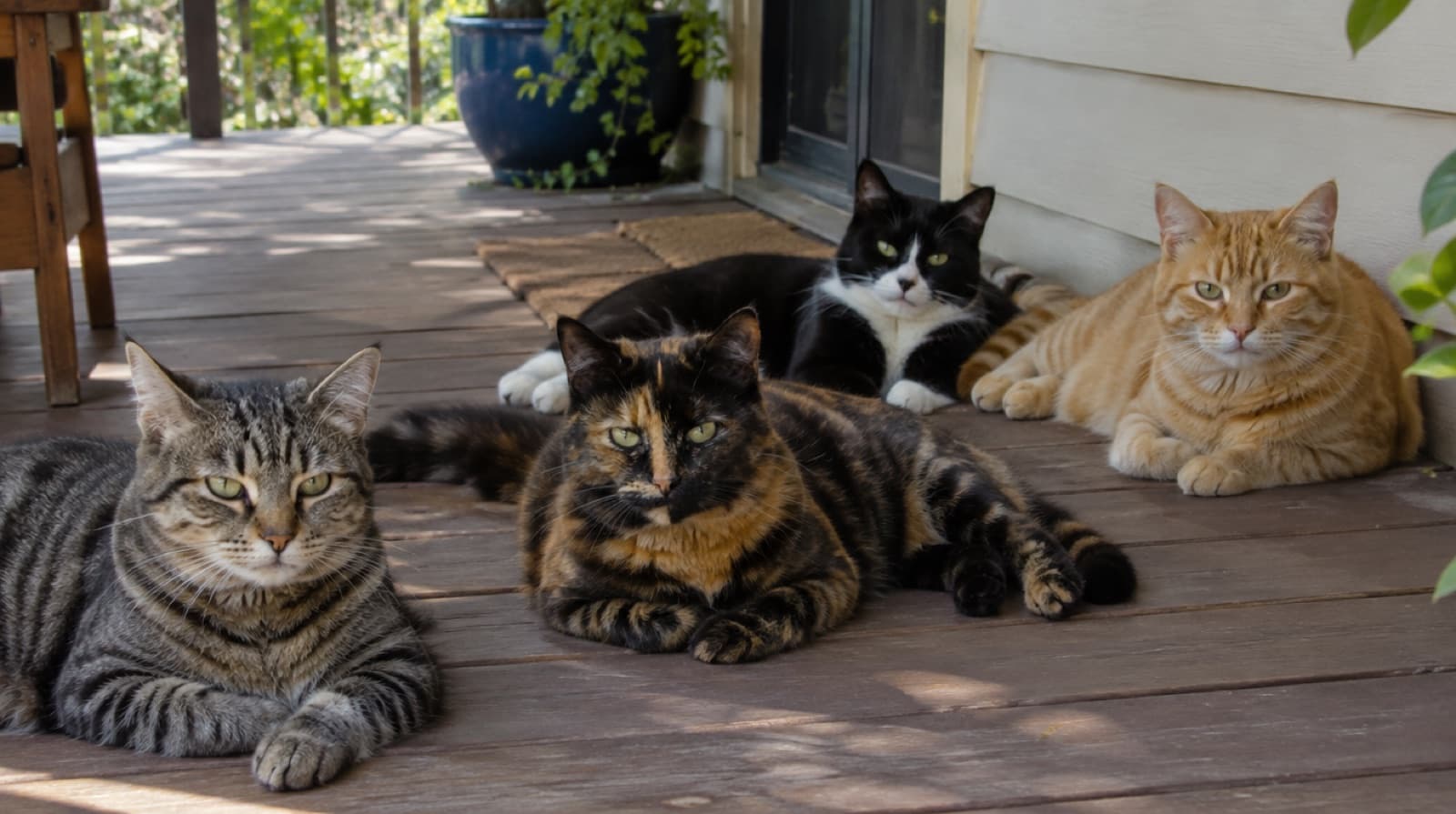
Is a Domestic Shorthair a breed?
No. Domestic Shorthair is a description, not a pedigree. It means a short-coated cat whose parents were not registered members of any breed. RSPCA Pet Insurance puts it plainly: the Domestic Shorthair is a type of cat rather than a recognised breed. Its long-coated cousin is the Domestic Longhair, and shelters use Domestic Medium Hair for the in-between coats.
In Australia we have a better word for the same cat: moggy. RSPCA South Australia uses it when it talks about the mixed-breed cats that fill its shelters. A moggy has no breed standard, no registry and no breeder. What it has is a coat, and that coat is where all the interesting variety lives.
Because a moggy is not a breed, its colour is the one thing a listing can describe with confidence, which is why listings read like a paint chart: “DSH, grey tabby and white,” “DMH, dilute tortie.” Learn a dozen terms and every listing makes sense.
Every moggy colour and pattern at a glance
Here is the whole list in one place. The genetics column uses the terms from the UC Davis Veterinary Genetics Laboratory, the lab most cat DNA tests are built on.
| Name | What it looks like | What is behind it |
|---|---|---|
| Classic (blotched) tabby | Wide swirling bands with a bullseye or butterfly shape on each flank. | One of the four CCCA tabby patterns; tabby gene with agouti switched on. |
| Mackerel tabby | Narrow, parallel stripes running down the sides like fish bones; the common “tiger” look. | CCCA tabby pattern; the most common tabby in moggies. |
| Spotted tabby | Mackerel or classic stripes broken into round or oval spots along the body. | CCCA tabby pattern; a modifier breaks the stripes up. |
| Ticked tabby | Each hair banded light and dark, so the body looks sandy or salt-and-pepper with few or no stripes; tabby marks stay on the face, legs and tail. | CCCA tabby pattern; the Abyssinian look. |
| Tortoiseshell (tortie) | Black and orange mixed in a brindled patchwork, usually with little or no white. | Sex-linked orange gene; almost always female. |
| Calico (tortie and white) | Clear black and orange patches on a white background. | Tortoiseshell plus white spotting from the KIT gene; almost always female. |
| Torbie | A tortoiseshell whose black patches show tabby stripes. | Tortoiseshell with the tabby pattern visible. |
| Tuxedo | Black with a white chest, belly and paws, often a white chin or blaze. | White spotting from the KIT gene over a black coat. |
| Bicolour and van | Any colour with large white areas; a “van” is white with colour only on the head and tail. | Higher grades of KIT white spotting. |
| Solid black | All black, sometimes with faint stripes visible in strong sun. | Non-agouti version of the agouti gene hides the tabby pattern. |
| Blue (grey) | Even slate grey all over. | Dilute gene lightens black pigment to blue. |
| Ginger (red, orange, marmalade) | Orange, nearly always with a tabby pattern showing. | Sex-linked orange gene; more often male. |
| Cream | Pale buff or apricot. | Dilute gene lightens red to cream. |
| Dilute tortie (blue-cream) | Grey and cream patchwork instead of black and orange. | Tortoiseshell plus dilute; almost always female. |
| Colourpoint | Pale body with darker face, ears, legs and tail; blue eyes. | Temperature-sensitive allele restricts colour to the cooler points. |
| Smoke | Looks solid until the coat parts and shows a white undercoat. | Inhibitor gene removes colour from the hair base on a solid cat. |
| Silver tabby | Black or grey stripes on a bright silver-white background. | Inhibitor gene on a tabby cat. |
| White | Pure white all over; eyes blue, gold, green or odd. | Dominant white on the KIT gene masks every other colour; raised deafness risk. |
Coat length is a separate question from colour. A tortie can be a Domestic Shorthair, Medium Hair or Longhair, and so can every other row in the table.
What are the four tabby patterns?
Tabby is not one pattern but four, and Australia's cat fancy sets them out in the Co-Ordinating Cat Council of Australia tabby patterns standard: classic, mackerel, spotted and ticked. All four share the tabby signature of an “M” on the forehead, pencil lines running back from the eyes and rings on the legs and tail. What changes is the body.
Classic, which breeders also call blotched, has broad bands that curl into a bullseye on each side and a butterfly shape across the shoulders. Mackerel is the striped one most people picture when they hear tabby: narrow lines running from a spine stripe down the ribs. Spotted is a mackerel or classic pattern whose stripes have been broken into spots. Ticked is the odd one out: each hair carries alternating light and dark bands, so the body looks like sand or peppered salt, with stripes only on the face, legs and tail.
Underneath all of this sits the agouti gene. The UC Davis VGL agouti test explains that agouti is what makes the banded hairs that let a tabby pattern show. Every cat carries a tabby pattern in its genes. If the cat has the agouti version, you see the stripes. If it carries two copies of the non-agouti version, the bands fill in with solid pigment and the cat looks black, blue or another solid colour, even though the pattern is still there underneath.
Tabby is what cats look like when nobody is choosing their colour, which is why it dominates rescue. Browse adoptable tabby cats across Australia and you will see all four patterns on the one page.
Why are torties female and gingers mostly male?
Both answers come from the same gene. The UC Davis VGL coat colour page describes the orange gene as sex-linked, meaning it sits on the X chromosome. The orange version switches every black or brown pigment in the coat to orange. A cat with orange on all its X chromosomes is ginger; a cat with none is not.
A female cat has two X chromosomes. If one carries orange and the other does not, each patch of skin uses one or the other, and the coat comes out as a patchwork of orange and black. That is a tortoiseshell. A male has one X chromosome, so he is normally either all orange or all not-orange and cannot be a patchwork. The result is that tortoiseshells and calicos are almost always female. A male tortie does appear now and then, usually because of an unusual chromosome arrangement, and shelters treat one as a curiosity rather than the norm.
Run the same logic the other way for ginger. A male needs a single orange gene to be ginger. A female needs two, one from each parent, which happens less often. So ginger cats are more often male, but ginger females are real and not rare enough to be remarkable. Ginger cats almost always show a tabby pattern because the orange gene does not hide stripes the way non-agouti does.
Add white to a tortie and you get a calico, which Australian shelters usually write as “tortie and white.” Add the dilute gene instead and the black turns blue and the orange turns cream, giving a soft grey-and-apricot cat called a dilute tortie or blue-cream. Add a visible tabby pattern in the black patches and you have a torbie. You can browse adoptable tortoiseshell cats and adoptable calico cats separately on this site, because that is how adopters search for them.
Tuxedo, bicolour and white: what the KIT gene does
White on a cat is not a colour. It is a gap where pigment cells never arrived. The UC Davis VGL dominant white test places both dominant white and white spotting on the KIT gene, which controls how pigment cells spread across the body of the developing kitten.
White spotting gives you a coloured cat with white patches. The amount varies from a white locket on the chest, through the classic tuxedo of white chest, belly and paws on a black coat, to a bicolour that is half white, and on to a “van” that is white everywhere except the head and tail. Tuxedo is simply the name for the low-to-medium white spotting pattern on a black cat; the same pattern on a grey cat is a blue and white, and on a ginger it is a ginger and white. See adoptable tuxedo cats for the black and white version.
Dominant white is the stronger switch. One copy covers the whole cat in white, hiding whatever colour its genes would otherwise paint. Underneath, a dominant white cat may be a tabby, a tortie or a black cat, which is why two white parents can produce coloured kittens. Dominant white also carries a raised risk of deafness, most often in white cats with blue eyes, because the same pigment cells are needed in the inner ear. Not every white cat is deaf, and the shelter will usually have noticed if one is. Deaf cats do well as indoor cats, which is how most Australian rescues want cats kept anyway.
Smoke and silver are different again. An inhibitor gene strips colour from the base of each hair: on a solid cat that gives a smoke, on a tabby a silver tabby. Both are uncommon in moggies.
How is cat colour inherited, in plain words?
Think of a moggy coat as a few switches stacked on top of each other, each set by a gene. Working from the bottom up, using the UC Davis VGL descriptions:
- Base colour. The pigment is black by default. Other versions of the same gene soften it to chocolate or cinnamon, which are rare in moggies.
- Orange. Sex-linked. Swaps black pigment for orange wherever it is active. Two X chromosomes with different settings give a tortoiseshell.
- Dilute. The VGL dilute page explains that two copies of the dilute version lighten black to blue and red to cream. A single copy does nothing visible, so two black parents can have blue kittens if both carry it.
- Agouti. Decides whether the tabby pattern shows. Agouti on, you see stripes; two copies of non-agouti, you see a solid cat.
- Tabby pattern. Chooses classic, mackerel, spotted or ticked, and only matters if agouti lets it show.
- Colourpoint. A temperature-sensitive version of a pigment gene. Colour develops only where the body is cooler, so the face, ears, legs and tail darken and the warm body stays pale. Colourpoint kittens are born almost white and darken over their first weeks. Most pointed moggies are Siamese or Ragdoll crosses a few generations back.
- Inhibitor. Removes pigment from the hair base, giving smoke on solids and silver on tabbies.
- KIT: white spotting and dominant white. Adds white patches, or paints the whole cat white and hides every switch below it.
Because most of these switches are recessive or hidden, one moggy litter can hold several colours. A black mum and a ginger tabby dad can produce black, tortie and ginger kittens, plus blue and cream ones if both carry dilute. A mixed litter is the normal state of a shelter nursery.
What does colour not tell you about a cat?
Colour tells you nothing about temperament. The genes above set pigment, nothing else. There is no personality gene riding along with orange or black. Yet every shelter volunteer has heard the folklore: gingers are laid-back, torties have “tortitude,” black cats are aloof or unlucky, white cats are shy. These stories travel because people remember the cat that fitted the pattern and forget the many that did not.
The folklore has a cost. Black cats and plain tabbies are the common coats in rescue, so they have the most competition for the same adopters and tend to wait longer, while a pointed or silver moggy is snapped up for its looks. A cat's history, age and how it behaves when you sit quietly with it at the shelter are the honest predictors of what it will be like at home. Ask the staff or foster carer what the cat is like day to day; they know, and the coat does not.
Colour also does not tell you breed. A grey moggy is not a Russian Blue, a pointed moggy is not a Siamese, and a fluffy brown tabby is not a Maine Coon. Blue, point and tabby are moggy colours first and breed colours second. If you suspect a pedigree somewhere in the line, the breed-standard checks in our Maine Coon guide show how to test the idea honestly, and the answer is usually still “a lovely moggy.”
What colour does tell you is short: a tortie or calico is almost certainly female, a ginger is more likely male, an all-white blue-eyed cat should be checked for deafness, and a pointed cat will darken with age and cooler weather. That is the whole list.
How do shelters name colours on a listing?
Most Australian rescues list through PetRescue, and the PetRescue help centre asks the lister to pick a breed from a set list. A cat with no known pedigree goes in as Domestic Short Hair, Domestic Medium Hair or Domestic Long Hair by coat length. Colour and pattern are not breeds, so they go into the cat's name or description, in whatever words the shelter uses.
That means the vocabulary varies. You will see “tortie,” “torti” and “tortoiseshell” for the same coat; “ginger,” “orange,” “red” and “marmalade” for the same colour; “grey” and “blue”; “tuxedo” and “black and white.” Some shelters write “DSH” and leave colour out altogether, trusting the photo. Our listings carry the shelter's own wording rather than rewriting it, so a search for one term can miss a cat described with another. Browse by photo as well as by word.
Across the rescues we aggregate, Domestic Shorthairs are the large majority of cats listed, and tabbies are the most common of those, followed by black, black and white, and tortie. Pointed, silver and pure white moggies are the exceptions. Whatever coat you have in mind, start with adoptable Domestic Shorthair cats and narrow from there using the pattern pages for tabby, tortoiseshell, calico and tuxedo. If you are not set on a look, consider the plain black cat or brown tabby that has been waiting longest. The coat is the least important thing about it.
Frequently asked questions
Is a Domestic Shorthair a breed?▼
No. Domestic Shorthair is a type, the catch-all for a short-coated cat of no particular breed. In Australia the everyday word is moggy. Shelters use Domestic Shorthair, Medium Hair or Long Hair as a coat-length label when a cat has no known pedigree, and the colour or pattern is described separately.
What are the four tabby patterns?▼
Classic (also called blotched), mackerel, spotted and ticked. These are the four patterns recognised in the Co-Ordinating Cat Council of Australia tabby standard. Classic has wide swirls and a bullseye on the flank, mackerel has narrow vertical stripes, spotted has the stripes broken into spots, and ticked has banded hairs with almost no body markings.
Why are tortoiseshell cats almost always female?▼
Because the orange colour gene sits on the X chromosome. A female has two X chromosomes and can carry black on one and orange on the other, which shows as a patchwork of both. A male has only one X, so he is normally either orange or not orange. A male tortoiseshell does turn up occasionally but it is a genuine rarity.
Are ginger cats always male?▼
No, but they are more often male than female. A male needs only one copy of the orange gene to be ginger because he has one X chromosome. A female needs two copies, one from each parent, so ginger females exist but are less common. Ginger is not a personality type; it is a colour.
What is the difference between a calico and a tortoiseshell?▼
A calico is a tortoiseshell with white. Both carry black and orange patches from the sex-linked orange gene. Add white spotting from the KIT gene and the coloured patches become bigger and more clearly separated on a white background, which is what most people call calico. Many Australian shelters simply write tortie and white.
What is a blue cat?▼
A blue cat is a grey cat. In cat colour terms, blue is black pigment lightened by the dilute gene. The same dilute gene turns ginger into cream, so a blue-cream tortie is just a dilute version of a black and orange tortie. Blue is common in moggies and is not a sign of Russian Blue or British Shorthair ancestry on its own.
Does a cat's colour tell you anything about its personality?▼
No. Colour and pattern are decided by a handful of coat genes that have nothing to do with temperament. Stories about laid-back gingers, feisty torties or aloof black cats are folklore, and they can cost a good cat a home. Judge a rescue cat on its own history and how it behaves when you meet it, not on its coat.
Are white cats deaf?▼
Not all of them, but all-white cats with the dominant white gene carry a raised risk of deafness, most often in cats with blue eyes. The dominant white gene sits on the KIT gene and affects the pigment cells, which are also involved in hearing in the inner ear. A shelter will usually know if a white cat is deaf, and deaf cats live full indoor lives.
Why are so many rescue cats tabbies?▼
Tabby is the default cat coat. Every cat carries a tabby pattern underneath, and it shows unless another gene masks it with solid colour or white. Across the rescues we aggregate, Domestic Shorthairs make up the large majority of cats listed, and tabbies are the most common of those. It is the pattern cats have when nobody is selecting for anything else.
Sources
- Co-Ordinating Cat Council of Australia, Tabby Patterns standard (March 2023)
- UC Davis Veterinary Genetics Laboratory, Cat Coat Color
- UC Davis Veterinary Genetics Laboratory, Dilute (cat)
- UC Davis Veterinary Genetics Laboratory, Agouti (cat)
- UC Davis Veterinary Genetics Laboratory, Dominant White (cat)
- RSPCA Pet Insurance, Popular cat breeds in Australia
- RSPCA South Australia, Misconceptions about rescue cats
- PetRescue Help Centre, Selecting a pet's breed
Keep reading
Domestic Shorthair cats for adoption
Every colour and pattern in this guide, listed by Australian rescues right now.
Tabby cats for adoption
Classic, mackerel, spotted and ticked tabbies across the rescues we aggregate.
Is my cat a Maine Coon?
The same honest test for the long-haired moggy everyone swears is a Maine Coon.
Cat adoption in Sydney
Cats and kittens listed by Sydney rescues, filterable by age and coat.