The short answer
Without papers from a recognised registry, nobody can say for certain that a cat is a Maine Coon, and most big fluffy cats are domestic longhairs. The traits that separate the breed from a lookalike come from the TICA, CCCA and CFA standards: large ears with lynx-like tipping, a visibly square muzzle, a frontal ruff, a heavy shaggy coat and a long bushy tail, on a cat that keeps growing for three to five years. TICA puts males at about 6 to 8 kg and females at about 4 to 6 kg. Across the rescues we aggregate, cats listed as Maine Coon are almost always crosses or lookalikes, and they make wonderful pets at a rescue fee.
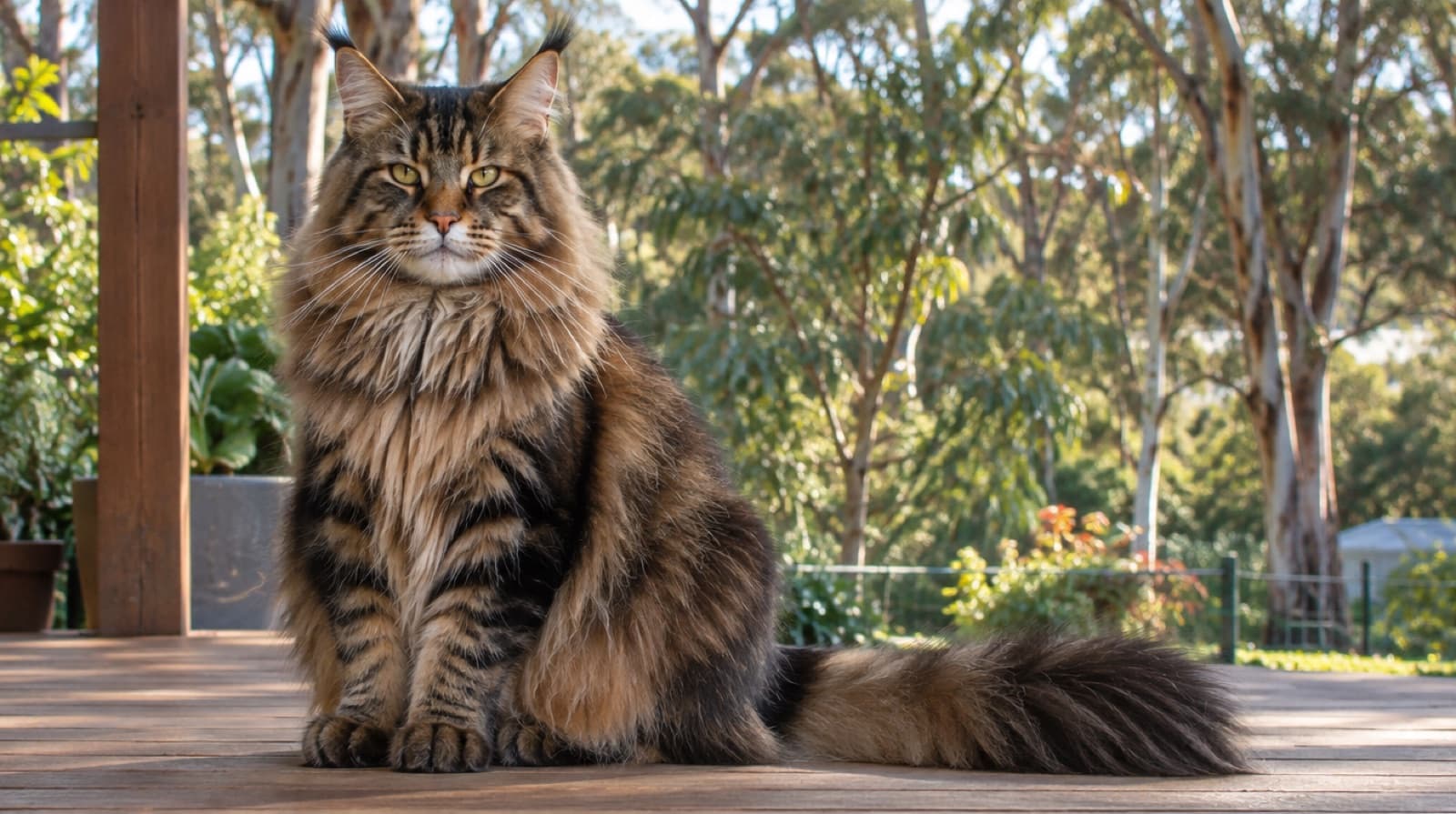
Is my cat a Maine Coon? The honest answer first
If your cat did not come with pedigree papers, the honest answer is almost certainly no. A Maine Coon is a registered breed with a written standard and a recorded family tree. A cat without that paperwork can look like a Maine Coon, act like one and even share some ancestry with one, but it cannot be shown to be one.
The confusion comes from the coat. Long hair is a single inherited trait that turns up in moggies everywhere, and a long-haired tabby with a bit of size is the classic “must be a Maine Coon” cat. Shelters know this. PetRescue asks rescues to list cats of unknown breed as Domestic Long Hair, Domestic Medium Hair or Domestic Short Hair rather than guessing a breed. A long fluffy coat does not make a cat a Maine Coon.
Across the rescues we aggregate, the cats that do carry a Maine Coon label are almost always crosses or lookalikes, usually tagged “Maine Coon x” or described as “Maine Coon type”. A purebred with papers is rare in rescue because breeders tend to take their own cats back. So if you adopted a big fluffy cat and want to know what it really is, the sensible frame is this: it is a domestic longhair until the traits below say otherwise, and even then the best you can claim is “possibly part Maine Coon”.
Maine Coon vs domestic longhair: the traits, one by one
The breed standards are the only authority worth using here, because they describe what registries actually judge. The three that matter for Australian readers are the CCCA standard (the Australian national council, February 2025), the TICA standard (2025) and the CFA standard. Run your cat down this table and count how many columns it really fits.
| Trait | Maine Coon (standard wording) | Typical domestic longhair |
|---|---|---|
| Size and weight | TICA: males 13 to 18 lb (about 6 to 8 kg), females 9 to 13 lb (about 4 to 6 kg). CCCA: the largest of all pedigreed cats. Long, rectangular body. | Ordinary house-cat size. A big moggy can reach the lower end of the Maine Coon range, so size alone proves little. |
| Ears | CCCA: large tufted ears with lynx-like tipping. TICA: tapering to appear pointed, with lynx tips. Set high and wide, with hair feathering out of the inside. | Medium ears in proportion to the head. Some fur inside, but rarely the tall lynx tips on the very top. |
| Muzzle | CCCA: square muzzle. CFA: muzzle visibly square. Seen from the front and the side, the chin, nose and upper lip form a box. | Rounded or tapered muzzle that blends into the cheeks. No obvious box shape. |
| Ruff | CCCA: frontal ruff. CFA: frontal ruff desirable. A bib of longer fur on the chest and neck, like a small lion's mane. | Fur is roughly even around the neck and chest. A slight thickening in winter is common but is not a ruff. |
| Coat | CCCA: shaggy coat. CFA: heavy and shaggy. Uneven in length, shorter over the shoulders and longer towards the belly and back legs, with a texture that falls smoothly. | Long hair that is fairly even all over, often soft and fine. It can be fluffier than a Maine Coon, which is not the same as shaggy. |
| Tail | Long and bushy, wide at the base and tapering, with flowing fur. Often described as a cat carrying its own blanket. | A long-haired tail that is plumed but usually in proportion to the body, not an oversized feature in its own right. |
| Maturity | TICA introduction: full size at three to five years. TICA standard: full maturity at four to five years. CCCA: ultimate type can take 3 or 4 years to develop. | Reaches adult size at around a year and fills out a little after that. A cat that stops growing early is not a Maine Coon. |
Scoring is simple. One or two matches, usually long hair and a plumed tail, describes most domestic longhairs. Four or five matches, with real size behind them, is a cat that may have Maine Coon ancestry. All seven, on a cat that is still growing at two or three years old, is as close to a yes as you can get without papers. Even then, the honest label is “Maine Coon type” or “possibly part Maine Coon”.
Why size is the trait people get wrong
Size is the first thing people quote and the least reliable thing to judge from. A long coat makes any cat look bigger than it is, and a well-fed moggy can tip the scales at the bottom of the Maine Coon range. The number that counts is the skeleton underneath: a long, rectangular body, big paws and a heavy bone structure, not a round cat under a lot of fur.
The other half of size is time. The TICA breed introduction says Maine Coons reach full size at three to five years, and the CCCA standard says the ultimate type can take 3 or 4 years to develop. Most domestic cats are adult-sized at around a year. If your two-year-old is still visibly growing, lengthening through the body and widening in the head, that is a stronger signal than any single weigh-in. If your cat finished growing at twelve months and weighs what a normal house cat weighs, the fluffy coat is doing the work.
Is my kitten a Maine Coon?
Kittens are the hardest case. Every long-haired kitten is a ball of fluff, the ruff has not come in, and the coat has not settled into its adult texture. If you bought a “Maine Coon kitten” without papers from a registered breeder, you should assume it is a domestic longhair until it proves otherwise.
There are early hints. Maine Coon kittens tend to have oversized ears that look too big for the head, with the lynx tips already showing as wisps on the top edge. The paws look large and the muzzle starts to square off rather than stay rounded. But the real test is the one above: a kitten that keeps growing well past its first birthday. If you want a real answer, the only path is pedigree papers at the time of purchase. Our Maine Coon price guide explains what those papers should look like and why the cheap kitten ads are usually scams.
What a DNA test can and cannot tell you
Consumer cat DNA tests have made “is my cat a Maine Coon” feel answerable with a cheek swab. It is worth being clear about what they do. A breed-ancestry test compares your cat's genetic markers with reference groups of cats from known breeds and reports how similar they are. If your cat carries a lot of markers common in Maine Coons, the report will say so. That can be a genuine, interesting hint about ancestry.
What it cannot do is make your cat a Maine Coon. Breed membership is a registry decision based on a recorded pedigree, not a genetics result. No Australian registry, and no international one, accepts a consumer DNA report as proof of breed. The reference groups also vary between companies, random-bred cats can share markers with several breeds by chance, and the same cat can get different percentages from different tests. Treat a result as “shares ancestry with”, never as “is”.
Where a DNA test can earn its cost is health, not identity. Some tests screen for genetic variants linked to conditions seen in certain breeds. If you run one, take the health section to your vet and let them interpret it rather than reading it as a diagnosis.
Why it matters for care, even without papers
For most of daily life the label does not change much, but a big long-haired cat does have needs that a standard moggy setup misses. These apply whether your cat is a registered Maine Coon, a cross or a large domestic longhair that happens to look the part.
- A litter tray sized for the cat. A standard tray is too short for a long-bodied cat to turn around in. Many owners switch to a large storage tub with a low entry cut into one side. A cat that hangs over the edge or starts going next to the tray is often telling you the tray is too small.
- Grooming that reaches the undercoat. A shaggy, uneven coat mats behind the ears, under the armpits and in the britches at the back legs. A short brush most days beats a long session once a week, and a wide-tooth comb finds mats a slicker brush skates over. Never shave a long coat to save brushing time; ask a groomer about trimming problem spots instead.
- Furniture that takes the weight. Cheap cat trees wobble under a six to eight kilogram cat. Look for a wide base, thick posts and shelves big enough for a cat to lie flat on.
- Heart screening. Maine Coons are one of the breeds where vets pay close attention to the heart. If your cat is large and looks like the breed, ask your vet about heart screening at the next check-up and whether it makes sense for your cat. This is a question for your vet, not something to decide from an article.
- Weight checks. A big frame hides extra weight under a thick coat. Feel for the ribs and a waist rather than trusting your eyes, and have your vet confirm a healthy weight for the cat in front of them rather than for a breed average.
If you want a real Maine Coon
If what you want is a registered Maine Coon with papers, the path is a breeder registered with a recognised Australian body, and the price reflects that. Registered breeders typically list pet-quality, desexed Maine Coon kittens at about $2,000 to $3,500 when we checked in October 2026, with show-quality cats and rare colours higher. Our Maine Coon price guide covers how to check a breeder is registered, what the paperwork should include and how to spot the scam ads that undercut that range.
If what you want is the look and the personality, rescue is the route most people skip. Purebred Maine Coons with papers are rare in rescue, but big fluffy domestic longhairs and cats listed as Maine Coon crosses do turn up, and they come desexed, vaccinated and microchipped for a rescue fee. As a comparison, RSPCA NSW charges $270 for a kitten and $220 for an adult cat. Browse adoptable Maine Coons and crosses across the rescues we aggregate, or widen the search to Domestic Longhair cats for adoption, which is where most of the lookalikes live. Set an alert if nothing suits today; the right cat is usually a matter of timing.
And if you already have a big fluffy cat on your lap while you read this, the kindest answer may be the simplest. It is a domestic longhair with a Maine Coon look, it needs a bigger litter tray and a good comb, and it does not need papers to be exactly the cat you wanted.
Frequently asked questions
How can I tell if my cat is a Maine Coon?▼
Without pedigree papers you cannot be certain, but you can compare your cat with the breed standards. A Maine Coon has large ears with lynx-like tipping, a square muzzle, a frontal ruff, a shaggy coat and a long bushy tail, and it keeps growing for three to five years. A cat that has most of these traits, and is noticeably bigger than an ordinary house cat, may be a Maine Coon or a cross. A cat that is simply long-haired is a domestic longhair.
Is a long fluffy coat enough to call a cat a Maine Coon?▼
No. A long fluffy coat is a coat type, not a breed. Many cats carry the gene for long hair, and shelters list unknown long-haired cats as Domestic Long Hair or Domestic Medium Hair rather than as a breed. The Maine Coon look comes from the whole package: size, ear tips, square muzzle, ruff, shaggy uneven coat and a bushy tail, not fur length alone.
How big is a real Maine Coon?▼
The TICA breed introduction gives males at 13 to 18 lb (about 6 to 8 kg) and females at 9 to 13 lb (about 4 to 6 kg). The CCCA standard calls the Maine Coon the largest of all pedigreed cats. A large domestic longhair can reach the lower end of that range, so size on its own does not settle the question.
Can a DNA test prove my cat is a Maine Coon?▼
A consumer cat DNA test reports how similar your cat's genetic markers are to reference groups of breeds. It can suggest Maine Coon ancestry, but it is not a pedigree and no registry accepts it as proof of breed. Only pedigree papers from a recognised registry such as the CCCA, the ACF, ANCATS or TICA show that a cat is a registered Maine Coon.
How do I know if my kitten is a Maine Coon?▼
Kittens are the hardest to judge because every long-haired kitten is fluffy and the breed matures slowly. Look for oversized ears with lynx tips, big paws and a square muzzle starting to form, then wait. The TICA introduction says Maine Coons reach full size at three to five years, so a kitten that stops growing at a normal house-cat size by its first birthday is almost certainly a domestic longhair.
What does part Maine Coon or Maine Coon cross mean on a rescue listing?▼
It usually means a rescue volunteer has guessed from the cat's look. Across the rescues we aggregate, cats listed as Maine Coon or Maine Coon cross are almost always lookalikes or crosses with no paperwork. Treat the label as a description of size and coat, not as a breed claim, and judge the cat on its own personality and care needs.
Does it matter whether my cat is a Maine Coon?▼
For day-to-day life, not much. A big long-haired cat needs a larger litter tray, regular brushing and a solid cat tree whether or not it has papers. Where it can matter is health: Maine Coons are one of the breeds where vets watch the heart, so ask your vet about heart screening if your cat is large and looks like the breed.
Where can I adopt a Maine Coon or a Maine Coon lookalike in Australia?▼
Purebred Maine Coons with papers are rare in rescue, but large fluffy domestic longhairs and Maine Coon crosses do turn up. Our national Maine Coon page pulls together the cats listed as Maine Coon or cross across the rescues we aggregate, and the Domestic Longhair page lists the big fluffy moggies that give the same look for a rescue adoption fee.
Sources
- Co-Ordinating Cat Council of Australia, Maine Coon breed standard (February 2025)
- The International Cat Association, Maine Coon breed standard (2025)
- The International Cat Association, Maine Coon breed introduction
- Cat Fanciers’ Association, Maine Coon breed standard
- PetRescue, Selecting a pet’s breed (how unknown cats are listed)
Keep reading
Maine Coon Price in Australia: Breeder vs Rescue
What a registered breeder charges, why the cheap ads are scams, and the rescue route most people miss.
Maine Coons and crosses in Australian rescue
Cats listed as Maine Coon or Maine Coon cross across the rescues we aggregate, refreshed regularly.
Domestic Longhair cats for adoption
The big fluffy moggies that give the Maine Coon look for a rescue adoption fee.
Domestic Shorthair Colours and Patterns Explained
Tabby, tortie, calico, tuxedo and colourpoint: what each moggy colour is called and how it is inherited.