The short answer
For a desexed pet cat, sex makes little reliable difference. Cats Protection says that as long as a cat is desexed there is not much difference between males and females, and we found no well-designed study showing that either sex is more affectionate. The real differences are smaller than the myths: males are usually a little bigger, and in UK veterinary data females lived about 1.3 years longer on average. Desexing matters far more than sex: it curbs spraying, roaming, fighting and calling, and the RSPCA advises doing it before four months of age. Most rescue cats are already desexed, so choose on the individual cat's personality and history, which a foster carer or shelter staff can describe.
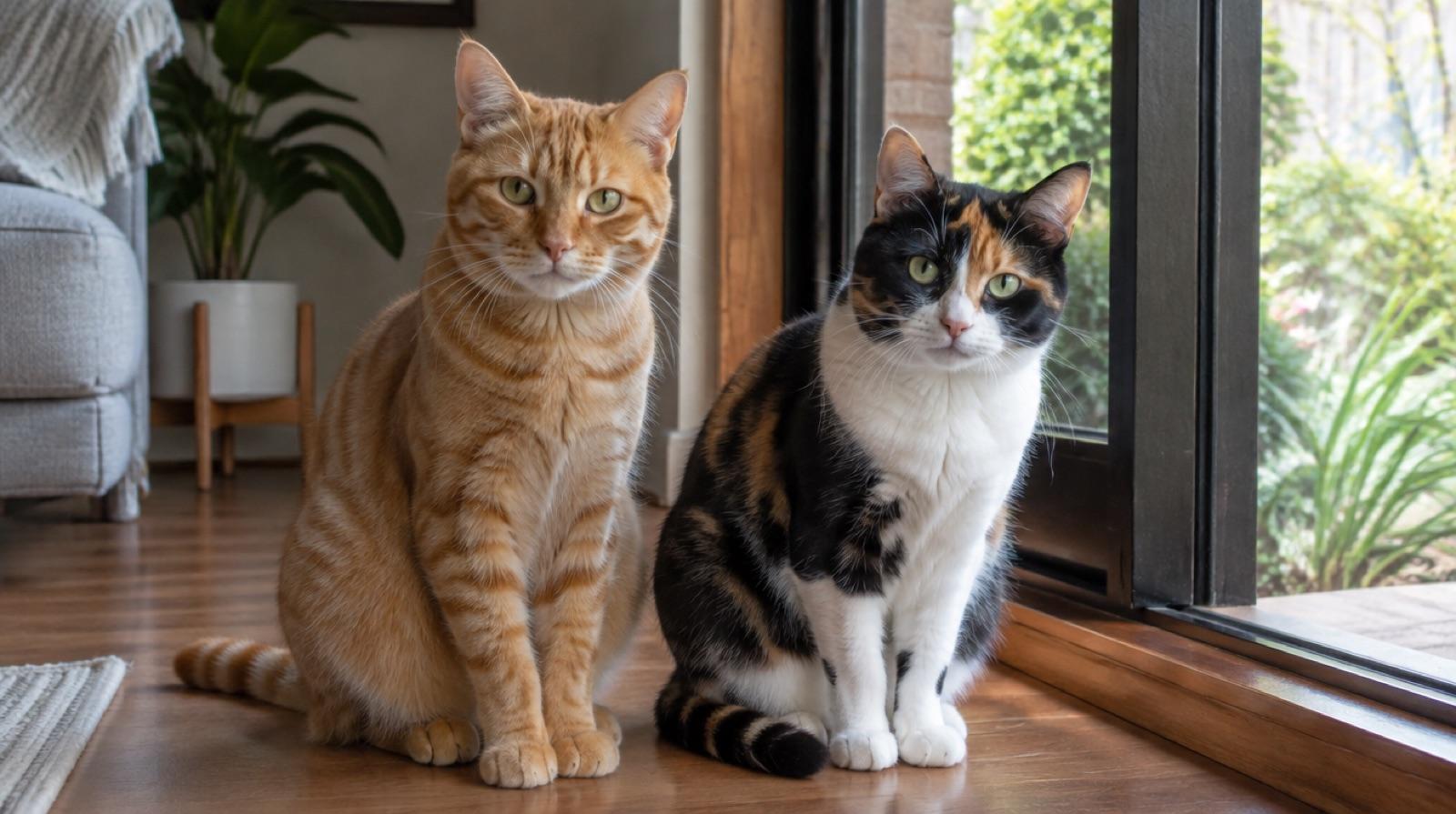
Is a male or female cat better?
Neither, for most homes. Cats Protection, a UK cat charity, puts it plainly: as long as a cat is desexed there really isn't much difference between getting a male or a female, and it is much better to think about the personality you want. Australian guidance points the same way. When the RSPCA Knowledgebase lists what shapes how a cat gets on in a home, sex is one item among many, alongside genetics, age, desexing, personality, previous living situation and individual sociability.
The big behavioural differences people associate with toms and queens (spraying, roaming, fighting, yowling) are mostly differences between entire cats and desexed cats. Most cats adopted from Australian rescues go home already desexed, so for an adopter the question usually shrinks to size, a small lifespan gap and personal preference.
What does the research actually say about male and female cats?
Less than the internet suggests. Most published work on cat personality relies on owner questionnaires, and sex effects, where they appear, are small and do not always repeat from one study to the next. The table sets out the common claims and how well each is supported.
| Claim | What the evidence shows | Strength |
|---|---|---|
| Males are more affectionate | No good study shows this for desexed cats. Cats Protection says both sexes can be as affectionate, calm and easy to care for as each other. | Weak (a popular belief) |
| Females are more aggressive | A 2024 owner survey using the Fe-BARQ questionnaire reported higher aggression in females toward strangers, owners and other cats. A 2026 review says sex and desexing status appear to play a part, but findings are not entirely consistent across studies. | Mixed |
| Males start more cat fights | In cats referred to a behaviour service for fighting with a housemate, males were more often the initiators, but the target was as likely to be the same sex as the opposite sex (cited in a 2020 JFMS study). | Moderate, but from a referral population |
| Entire males spray, roam and fight | Yes. International Cat Care and the RSPCA both describe this, and both say desexing reduces it. | Strong |
| Entire females are loud and restless in season | Yes. International Cat Care says an entire female will “call” about every three weeks in the breeding season if she does not get pregnant. | Strong |
| Males are bigger | Usually slightly, and more so if desexed late. Breed registries list larger weights for males. | Strong, but the gap is small |
| Females live longer | In UK VetCompass data, female life expectancy at birth was 12.51 years against 11.18 for males. | Good (one large UK dataset) |
| Torties have “tortitude” | One owner survey found owners rated tortoiseshell and calico females as more aggressive toward people, but a 2020 review notes this was based on owners' perceptions. | Weak (perception, not behaviour) |
Sources: Cats Protection; the 2026 aggression review in Veterinary Sciences, which summarises the 2024 Fe-BARQ survey; Elzerman et al. (2020); International Cat Care; RSPCA Knowledgebase; Teng et al. (2024); the 2020 temperament review in Animals. All read 10 November 2026.
The honest summary: if someone tells you a girl cat will be aloof or a boy cat will be cuddly, they are passing on folklore. The evidence for a personality difference between desexed males and females is thin, and where studies find one, others do not. A cat's own genes, how it was handled as a kitten and its age carry far more weight.
Why does desexing matter more than sex?
Because most of the behaviour people blame on a cat's sex is really driven by its hormones. The RSPCA lists less wandering and roaming, and less mounting and urine spraying, among the commonly accepted benefits of desexing, and International Cat Care describes what entire cats of each sex do:
| Entire male (tom) | Entire female (queen) | Desexed, either sex | |
|---|---|---|---|
| Behaviour | Roams widely and may not come home; marks territory with pungent urine spray; much more likely to fight | Calls loudly, about every three weeks in the breeding season, until she is pregnant | Spraying, roaming and calling much reduced |
| Health | Fight injuries such as bite abscesses; higher risk of catching and spreading FIV | Risk of pyometra (womb infection) and more likely to develop mammary tumours | Lower disease risks; watch weight, especially in males |
| Breeding | One entire male can father many litters | Can have up to three litters a year; first season usually around six months but can be earlier | No unplanned litters |
From International Cat Care, Neutering your cat, and the RSPCA Knowledgebase, both read 10 November 2026.
The FIV point matters for anyone planning a multi-cat home. The RSPCA Knowledgebase says FIV is mainly shed in saliva and that fights involving a deep bite are the most common way it spreads, and its guidance on cat aggression says territorial aggression is more likely in entire males during the breeding season.
When to desex: the RSPCA advises before four months of age, because cats can breed as early as 16 weeks, and International Cat Care also recommends around four months. One side effect to manage: the RSPCA notes a documented increase in obesity risk in desexed cats, particularly males, so portion control and play matter.
The law: several states and territories make cat desexing compulsory by a set age, with limited exemptions, and NSW charges an annual permit for a cat not desexed by four months. The RSPCA Knowledgebase summarises the rules, and our cat desexing cost guide sets out each state's law, the right age and published male and female prices. For help with the cost, see free and low-cost desexing in Australia.
How much bigger are male cats?
Usually a little. Cats Protection says males are usually slightly larger than females, particularly if they were not desexed before they reached sexual maturity at around four months, and that entire or late-desexed males typically have rounder faces with bigger cheeks because of testosterone. The pedigree registries show how wide the gap can be within a breed:
| Breed | Males | Females | Source |
|---|---|---|---|
| Maine Coon | Not unusual to reach or exceed 20 lb (about 9 kg) | Usually smaller | CFA |
| British Shorthair | May grow as large as 17 lb (about 7.7 kg) | Somewhat smaller | CFA |
| Burmese | May reach or exceed 12 lb (about 5.4 kg) | Usually smaller | CFA |
| Russian Blue | Rarely exceed 10 lb (about 4.5 kg) | 5 to 8 lb (about 2.3 to 3.6 kg) | CFA |
Weights are the Cat Fanciers' Association's published figures in pounds, converted to kilograms, read 10 November 2026. Individual cats vary, and most rescue cats are domestic shorthairs, which have no breed standard.
For an adopter, size mostly matters for gear (a bigger litter tray and carrier) and for food and parasite product weight bands. If you want a big cat, see our guide to the largest cat breeds; for a petite one, small cat breeds.
Do female cats live longer?
A little, on average. Life tables for pet cats from the UK VetCompass programme (Teng et al., 2024), used 7,936 confirmed deaths among cats under UK primary veterinary care in 2019. Female cats had a life expectancy at birth of 12.51 years and males 11.18 years, a gap of 1.33 years. The same study linked being entire, being purebred and a non-ideal body weight to a shorter life.
Read that carefully. It is a UK population average, not a forecast for any one cat, and the factors you control (desexing, weight, vet care) are linked to lifespan in the same study. A desexed male kept at a healthy weight is not a short-lived choice.
Why are ginger cats mostly male and calicos female?
Because the orange colour gene sits on the X chromosome. In 2025, researchers at Kyushu University in Japan, publishing in Current Biology, identified the mutation behind orange fur, and a separate Stanford-led team confirmed it. Their explanation of the pattern:
- Males have one X chromosome, so a single copy of the orange gene makes a male ginger. That is why most ginger cats are male.
- Females have two X chromosomes and need two copies to be fully orange, so ginger females are less common.
- Calico and tortoiseshell coats appear when a female carries orange on one X and black on the other, giving the patchwork. That is why these cats are nearly always female; a male tortie or calico is a genetic rarity.
None of this is about personality. Our guide to moggy colours and patterns covers the rest of the coat genetics, and why coat colour stories should not cost a good cat a home. To browse by colour, see the orange cat, calico and tortoiseshell pages.
Two cats are often easier than one
Bonded pairs listed by Sydney and NSW rescues, refreshed regularly. Each pair already gets along, which is the hardest part of a two-cat home.
See bonded pairs in Sydney →If you want two cats, which sexes go best together?
There is no reliable best combination. What predicts success is whether the two cats already get along, not whether they are two boys, two girls or one of each. The RSPCA's cat buyer's guide suggests adopting two kittens who are littermates, or two cats who are already bonded, because they are more likely to live happily together than cats who are strangers.
The sex evidence is thin. A 2020 study of multi-cat households in the Journal of Feline Medicine and Surgery cites earlier work on cats referred to a behaviour service for fighting with a housemate: males were more likely to start the aggression, but it was as likely to be aimed at a same-sex housemate as an opposite-sex one. The RSPCA Knowledgebase lists sex as one of many factors in how well cats adapt to sharing a home, alongside personality, age, genetics and desexing.
Practical rules that do hold:
- Desex both cats. International Cat Care warns that brothers and sisters from the same litter can and will breed once they mature.
- Match energy, not sex. The RSPCA says a high-play newcomer with a low-play resident is more likely to cause tension.
- Introduce slowly. The RSPCA's step-by-step introduction starts with swapping scents, and its multi-cat guidance says the process should be gradual (weeks to months) and that a harmonious multi-cat home is not guaranteed.
- Double the resources. Separate food, water, litter trays, resting and hiding spots for each cat.
A bonded pair from a rescue skips the riskiest step. The Cat Protection Society of NSW charges $150 per cat or $250 for two, and RSPCA NSW lists $220 for an adult cat (both checked 10 November 2026; reference figures, not quotes).
What should you ask the rescue instead?
Ask about the cat, not its sex. Shelter staff and foster carers spend every day with the animals, and many rescue cats live in foster homes, so someone can tell you how this cat actually behaves. Useful questions:
- Is it a lap cat, a sit-beside-you cat, or an independent one?
- How does it react to strangers, children, dogs and other cats?
- How much play does it need, and how vocal is it?
- Has it ever sprayed or had litter tray problems, and was it checked by a vet?
- When was it desexed, and does it have any health conditions?
- Does it have a bonded friend it should go home with?
The RSPCA says a kitten's experiences between roughly 2 and 9 weeks of age can shape its behaviour for life, which is one reason an adult cat with a known history is often a surer bet than a kitten of either sex. For more on matching personality to your home, see the best cat breeds guide and the what cat breed am I quiz.
Find a cat near you
Every listing shows the cat's sex and desexing status and links straight to the rescue. Pages are refreshed regularly.
- Sydney: all cats, kittens, bonded pairs
- Melbourne: all cats, kittens, bonded pairs
- Brisbane: all cats, kittens, bonded pairs
- Perth: all cats, kittens, bonded pairs
- Adelaide: all cats, kittens, bonded pairs
Still deciding whether a cat is right for you? Try the dog or cat quiz and the adoption readiness check, read how cat adoption works in Australia, and budget with what a cat costs. If a kitten is on your list, kitten blues covers the first hard weeks honestly.
Frequently asked questions
Is it better to get a male or female cat?▼
Neither sex is better once the cat is desexed. Cats Protection, the UK cat charity, says that as long as a cat is desexed there really is not much difference between a male and a female, and that the personality you want matters far more than the sex. Desexing removes most of the behaviour people dislike in entire cats, such as spraying, roaming, fighting and calling. Choose the individual cat.
Are male cats more affectionate than female cats?▼
There is no good evidence that they are. The idea is popular, but Cats Protection says male and female cats can be as affectionate, calm and easy to care for as each other, and we found no well-designed study showing a reliable difference in affection between desexed males and females. How a kitten was handled early in life, its genes and its age matter more. Ask the rescue how the individual cat behaves.
Are female cats more aggressive than male cats?▼
The evidence is mixed. A 2024 owner survey using the Fe-BARQ behaviour questionnaire reported female cats as more aggressive than males toward strangers, owners and other cats, but a 2026 review of cat aggression research in Veterinary Sciences says that, while sex and desexing status appear to influence aggression, the findings are not entirely consistent across studies. Owner surveys measure what owners report, not observed behaviour. Any one cat's history tells you more than its sex.
Do male cats spray more than females?▼
Spraying is mostly a habit of entire (undesexed) cats. International Cat Care says entire males mark their territory with a very pungent urine spray, sometimes in the house; Cats Protection says undesexed cats of both sexes may spray to attract a mate; and the RSPCA lists less urine spraying as a benefit of desexing. Desexed cats of either sex can still spray, but Cats Protection says it is usually a sign that something is wrong, so see your vet to check for a medical cause.
Are male cats bigger than female cats?▼
Usually, by a little. Cats Protection says males are usually slightly larger than females, especially if they were not desexed before about four months of age. Breed registries show the gap: the Cat Fanciers' Association says Maine Coon males often reach or exceed 20 pounds (about 9 kg) with females usually smaller, and Russian Blue males rarely exceed 10 pounds (about 4.5 kg) while females range from 5 to 8 pounds (about 2.3 to 3.6 kg).
Do female cats live longer than male cats?▼
On average, yes, by a little over a year in the best data available. The UK VetCompass life tables published in 2024, built from 7,936 confirmed deaths among cats under UK primary veterinary care in 2019, gave female cats a life expectancy at birth of 12.51 years against 11.18 years for males. The same study linked being entire (not desexed) to a shorter life. These are UK averages, not a promise for any one cat.
Are ginger cats always male?▼
No, but most are. Kyushu University researchers, publishing in Current Biology in 2025, identified the gene behind orange fur, which sits on the X chromosome. A male has one X, so one copy of the gene makes him orange. A female has two X chromosomes and needs two copies to be fully orange, which is why ginger females are less common. Ginger is a coat colour, not a personality.
Are calico and tortoiseshell cats always female?▼
Almost always. A calico or tortoiseshell coat needs an orange gene on one X chromosome and a black one on the other, according to Kyushu University's 2025 research, and normal males have only one X. A male tortoiseshell or calico does occur but it is a genetic rarity. Stories about tortie temperament come from owner perception, not from anything the colour genes are known to do.
Should I get two male cats, two females, or one of each?▼
No pairing is reliably best, so focus on whether the two cats get on. The RSPCA suggests adopting littermates or a pair that is already bonded, because they are more likely to live happily together. One study of cats seen by a behaviour service found males more often started fights, but the aggression was as likely to target a same-sex housemate as an opposite-sex one. Desex both cats, whatever the mix.
When should I desex my cat?▼
Before four months of age, the RSPCA advises, because cats can breed as early as 16 weeks. International Cat Care also recommends desexing at around four months, before sexual maturity. Rescue cats and kittens are usually desexed before adoption. If you buy a kitten, ask your vet when to book it in, and remember that brother and sister kittens will mate with each other once they mature.
Is it cheaper to desex a male or female cat?▼
A male. Desexing a female is abdominal surgery, so vets price it higher than castrating a male. Our cat desexing cost guide lists the published prices from Australian charity and community vet clinics, dated, for both sexes. If you adopt from a rescue, desexing is normally already done and included in the adoption fee.
Does a desexed male cat put on weight?▼
He is more likely to. The RSPCA notes a documented increase in the risk of obesity in desexed cats, particularly males, and says to keep an eye on diet and exercise. That is a reason to manage portions and play, not a reason to skip desexing: the UK VetCompass study linked both being entire and a non-ideal body weight to a shorter life.
Sources
- RSPCA Knowledgebase: Why should I have my cat desexed?
- RSPCA Knowledgebase: Is desexing mandatory for cats and dogs?
- RSPCA Knowledgebase: My cat is being aggressive towards my other cat
- RSPCA Knowledgebase: Should I get another cat to provide company for my cat?
- RSPCA Knowledgebase: What do I need to know about multi-cat households?
- RSPCA Knowledgebase: FIV and FeLV
- RSPCA Australia: Smart Kitten and Cat Buyer's Guide (2024)
- International Cat Care: Neutering your cat
- Cats Protection: Should I get a male or female cat?
- Teng et al. (2024): Life tables of annual life expectancy in UK cats, VetCompass
- Veterinary Sciences (2026): Genetic and environmental causes of aggression in the domestic cat (review)
- Elzerman et al. (2020): Conflict and affiliative behaviour in multi-cat households, JFMS
- Kyushu University (2025): The gene behind orange fur
- Cat Fanciers' Association: Maine Coon, British Shorthair, Russian Blue and Burmese breed profiles
Keep reading
Best cat breeds: friendliest and most affectionate
What the registries and research say about breed temperament, matched to your home.
Cat desexing cost in Australia
Published male and female desexing prices, the right age, and the law in every state.
Adopting a cat in Australia
The steps, the fees in every state and the cat laws to know before you bring one home.
What cat breed am I?
Match your home and routine to the cat types that suit them, before you start meeting cats.