The short answer
The Maine Coon is the largest domestic cat breed: the Australian CCCA standard calls it the largest of all pedigreed cats, and the Cat Fanciers' Association (CFA) says mature males often reach or exceed about 9 kg. Ragdoll males can be as heavy. Norwegian Forest Cats (males about 5.4 to 7.3 kg), Siberians (males about 5.4 to 8.2 kg) and British Shorthairs (males up to about 7.7 kg) follow, per the CFA. All of these breeds grow slowly, for three to five years. A big cat needs a longer litter tray, a bigger carrier and sturdier furniture. Purebreds are uncommon in rescue, but large domestic longhairs are listed often, for a rescue fee of a few hundred dollars (for example $220 for an adult cat at RSPCA NSW on 10 November 2026, a reference, not a quote).
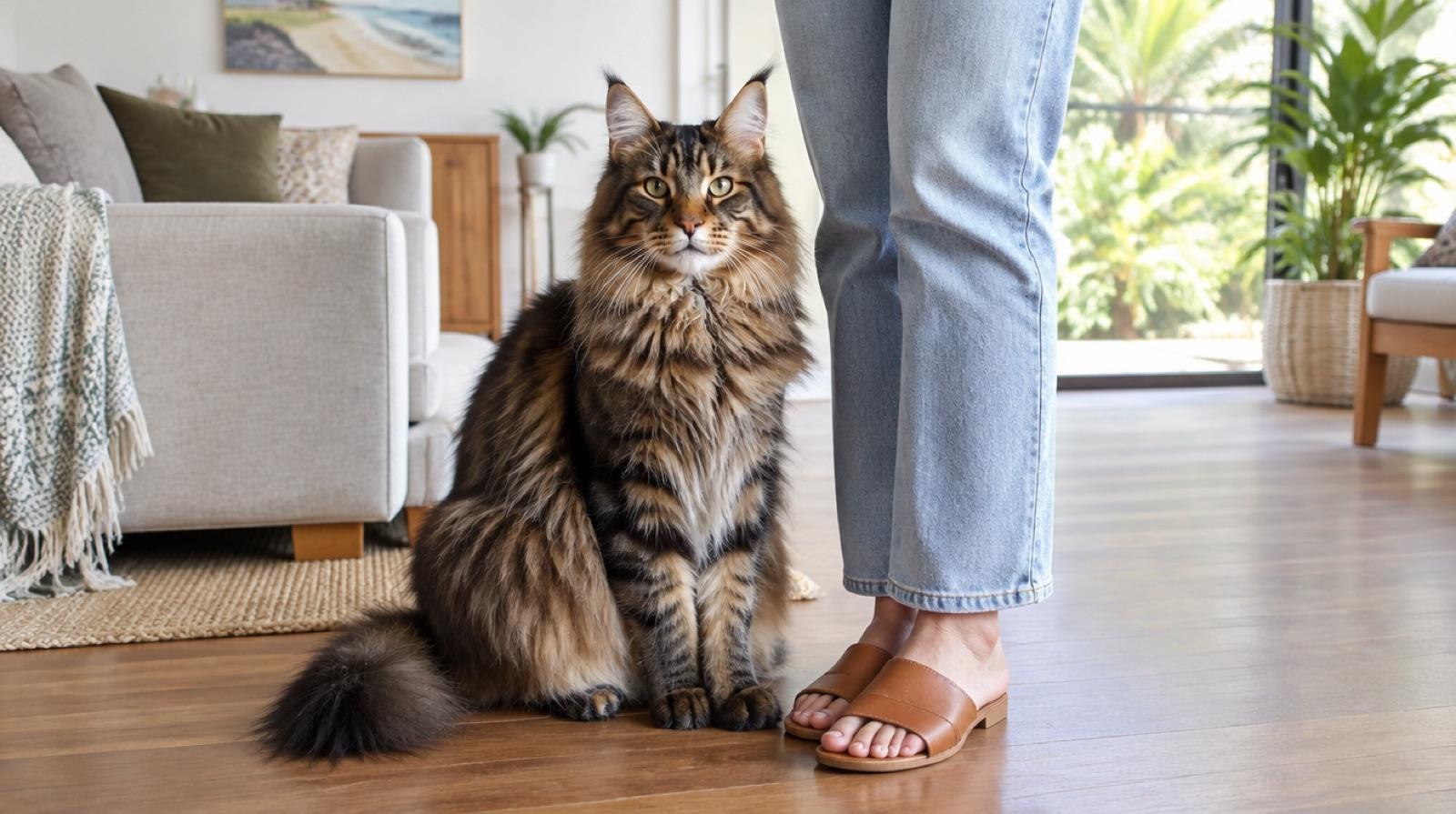
What are the largest cat breeds?
The Maine Coon, then the Ragdoll, then a group of heavy-coated or heavy-boned breeds: the Norwegian Forest Cat, Siberian, RagaMuffin and British Shorthair. The table uses the weights the Cat Fanciers' Association (CFA), a pedigree cat registry, publishes for each breed, converted to kilograms. Where Australia's Coordinating Cat Council of Australia (CCCA) standard describes the size, its wording is in the last column.
| Breed | Adult male (CFA) | Adult female (CFA) | Full size by (CFA) | Australian standard (CCCA) |
|---|---|---|---|---|
| Maine Coon | Often reaches or exceeds 20 lb (about 9 kg) | “Usually smaller” | Up to 3 years | “The largest of all pedigreed cats”; type can take 3 or 4 years |
| Ragdoll | Often reaches or exceeds 20 lb (about 9 kg) | “Usually smaller” | 4 years | “Medium to large”; males much larger than females |
| RagaMuffin | Up to 20 lb (about 9 kg) | Closer to 15 lb (about 6.8 kg) | About 4 years | Not quoted here |
| Siberian | 12 to 18 lb (about 5.4 to 8.2 kg) | 8 to 12 lb (about 3.6 to 5.4 kg) | Most by 3 years; up to 5 to mature | “Large and impressive” |
| Norwegian Forest Cat | 12 to 16 lb (about 5.4 to 7.3 kg) | 9 to 12 lb (about 4.1 to 5.4 kg) | Up to 5 years | Males “large and imposing”; maturity up to 5 years |
| British Shorthair | Up to 17 lb (about 7.7 kg) | “Somewhat smaller” | About 3 years | CFA body: “medium to large” |
Weights are the CFA's published figures for mature cats, converted from pounds and rounded. Registries do not all agree, and even one registry can differ with itself: the TICA Maine Coon page says males usually weigh around 18 to 22 lb (about 8 to 10 kg) and females 12 to 15 lb (about 5.5 to 7 kg) in its at-a-glance panel, but its breed description says males average 13 to 18 lb (about 6 to 8 kg) and females 9 to 13 lb (about 4 to 6 kg). Individual cats sit above and below every range, and none of these figures is a promise about a particular kitten.
Why do big cat breeds take so long to grow?
Because they are bred to mature slowly. The CFA says the Ragdoll reaches full size and weight at four, the Norwegian Forest Cat can take up to five years, and the British Shorthair takes three to five years to reach full maturity. The CCCA Maine Coon standard says the ultimate type can take 3 or 4 years to develop.
That matters for two reasons. First, a kitten or a one-year-old tells you little about the adult it will become, so be wary of anyone promising an exact adult weight. Second, an adult rescue cat is already finished growing. If size is the thing you care about, an adult lets you see exactly what you are getting.
What is each large breed like to live with?
Size is only part of the decision. Coat care and temperament matter more day to day. In brief, from the registry breed pages:
- Maine Coon. The CFA describes it as getting on well with children and other animals, and notes both may be startled at first by its size: “Maines are larger than many small dogs.” Breeders recommend regular combing to control shedding and matting. Our Maine Coon identification guide covers the breed traits in detail.
- Ragdoll. A blue-eyed pointed cat with a silky coat and little undercoat, so the CFA says grooming is less work than the coat suggests. It also notes Ragdolls are known for their love of food and may be at risk of obesity, so watch portions.
- Norwegian Forest Cat. A thick, water-repellent double coat and a frontal ruff, per the CFA. Much of the bulk you see is coat.
- Siberian. A dense triple coat on a strong, heavy-boned body; the CFA says it has “surprising heft for its size”. Siberians are often sold as hypoallergenic, which our hypoallergenic cats guide explains is not something any breed can promise.
- British Shorthair. Short, dense coat and a round, solid build; heavy rather than long. Our British Shorthair guide covers buying or adopting one.
Not sure which coat and temperament suit your household? The what cat breed am I quiz matches your home and routine to cat types before you start meeting cats.
Can a rescue cat be just as big?
Yes. Most of the big, fluffy cats in Australian rescue are domestic longhairs and medium hairs, cats of mixed or unknown ancestry. Across the rescues we aggregate, cats listed as Maine Coon or Ragdoll are more often crosses or lookalikes than papered purebreds. Some of them are large, long-bodied cats in their own right.
Two honest points about a big rescue cat:
- A heavy cat is not always a big-framed cat. RSPCA Pet Insurance says there is no single healthy weight for all cats and that vets look at body condition rather than the scale alone. You should be able to feel the ribs with light pressure and see a waist from above. A fluffy coat can hide extra weight, so ask the rescue whether a big cat is big-boned or carrying extra kilos.
- The label does not change the cat. Whether a rescue cat is a purebred, a cross or a domestic longhair, it needs the same space and gear if it is big. If you want to know what you might have, read Is my cat a Maine Coon? and what is a domestic shorthair.
Big, fluffy cats listed right now
Long-haired rescue cats from Australian rescues, refreshed regularly. Each listing links straight to the rescue, where you apply.
What does a big cat need at home?
Mostly bigger versions of ordinary gear, bought for the adult cat rather than the kitten.
| Item | What changes for a big cat |
|---|---|
| Litter tray | International Cat Care says the ideal tray is one and a half times the cat's length from nose to the base of the tail, and that many standard trays are too small. For a long cat, a large storage tub with a cut-down entry often works better than a pet-shop tray. |
| Carrier | Check the inside measurements against your cat, not the label. A carrier that opens from the top as well as the front makes it easier to lift a heavy cat in and out at the vet. |
| Cat tree and shelves | A wide, heavy base and thick posts, with platforms big enough for the cat to lie flat. Light trees can tip under a heavy cat jumping on or off. |
| Scratching post | Tall enough for a full stretch and heavy enough not to move when the cat leans on it. |
| Grooming | Long, thick coats (Maine Coon, Norwegian Forest Cat, Siberian, domestic longhairs) need regular combing to prevent mats, especially in a moult. |
| Indoor space | If your cat lives indoors or in a cat run, a big cat needs room to climb and run. Our indoor cats listings show rescue cats suited to indoor life. |
Does a bigger cat cost more?
A little, in a few places. A larger cat eats more food over a year, and the bigger gear above costs more up front. Parasite prevention can cost more too: a vet-written comparison of cat flea, tick and worm products sold in Australia shows they come in weight bands, and several labels tell owners of cats above the top band to combine doses as the label directs. That is a reason to weigh your cat and ask your vet which product and size suits it, not to guess from the packet.
The adoption fee is not one of those costs. A big rescue cat costs the same as any other rescue cat:
| Where from | Published fee | Includes | Source |
|---|---|---|---|
| RSPCA NSW | $220 adult cat, $270 kitten under 6 months | Desexing, microchipping, vaccinations, health checks | Fee page, checked 10 November 2026 |
| Cat Protection Society of NSW | $150 per cat or kitten | Vet check, desexing, microchip, first vaccination, flea and worm treatment | Adoption page, checked 10 November 2026 |
Reference figures from the organisations named, not quotes. Fees vary by cat, age and promotion; check the fee on the cat's own listing. For pedigree kitten prices, see our Maine Coon price guide and Ragdoll price guide, and for running costs, how much a cat costs in Australia.
What about Savannah cats and other “giant” breeds?
Lists of big cats from overseas often include the Savannah, a cross between a domestic cat and a wild African serval. In Australia it is off the table. The Department of Agriculture, Fisheries and Forestry says domestic and wild cat hybrids cannot be imported under the Environment Protection and Biodiversity Conservation Act 1999, and lists Savannah, Safari, Chausie and Bengal cats as examples. Anyone advertising a Savannah kitten for sale in Australia is a reason to stop and check, not to pay a deposit.
Should you buy a big breed from a breeder?
Rescue is not the right fit for everyone. If you want a papered Maine Coon, Ragdoll, Norwegian Forest Cat or Siberian with a known health history, a breeder registered with an Australian cat council is a reasonable choice. Ask which council they are registered with, ask to meet the kitten's mother, and ask what health testing the parents have had. Our Maine Coon and Ragdoll guides list the specific tests for those breeds.
Big, popular breeds attract scams. Scamwatch warns against prices that look too good to be true, unusual payment methods, and paying before you have seen the animal in person. Never send money for a kitten you have only seen in photos.
Find a big cat near you
Each link shows long-haired rescue cats listed in that city right now, with every listing linking through to the rescue:
- Long-haired cats in Sydney
- Long-haired cats in Melbourne
- Long-haired cats in Brisbane
- Long-haired cats in Perth
- Long-haired cats in Adelaide
For a specific breed, watch the Maine Coon, Ragdoll and Norwegian Forest Cat pages for Sydney and set an alert, since a rare breed can be adopted quickly. Still deciding whether a cat is right for you? Try the dog or cat quiz and the adoption readiness check, and read how to adopt a cat in Australia.
Frequently asked questions
What is the largest cat breed?▼
The Maine Coon is usually named the largest domestic cat breed. The Coordinating Cat Council of Australia standard calls it the largest of all pedigreed cats, and the Cat Fanciers' Association says it is not unusual for a mature male to reach or exceed 20 pounds (about 9 kg), with females usually smaller. The Ragdoll is close behind: the CFA uses the same wording for Ragdoll males.
How big does a Maine Coon get?▼
Big, and slowly. The Cat Fanciers' Association says a mature male can reach or exceed about 9 kg, females are usually smaller, and the breed can take up to three years to reach full growth. TICA, another registry, gives two sets of figures on its breed page: at a glance, males usually around 18 to 22 pounds (about 8 to 10 kg) and females 12 to 15 pounds (about 5.5 to 7 kg), while its breed description says males average 13 to 18 pounds (about 6 to 8 kg) and females 9 to 13 pounds (about 4 to 6 kg). Individual cats vary, so treat these as guides, not promises.
Is a Ragdoll bigger than a Maine Coon?▼
Usually not, but they overlap. The Cat Fanciers' Association uses the same wording for both breeds: it is not unusual for a mature male to reach or exceed 20 pounds (about 9 kg). The Australian CCCA standard describes the Ragdoll as medium to large and the Maine Coon as the largest of all pedigreed cats. A big Ragdoll can outweigh a small Maine Coon.
How big do Norwegian Forest Cats get?▼
The Cat Fanciers' Association says a mature male weighs from 12 to 16 pounds (about 5.4 to 7.3 kg) and a female from 9 to 12 pounds (about 4.1 to 5.4 kg). It is a slow-maturing breed that can take up to five years to reach full growth, and the thick double coat makes it look bigger than the scales say.
How big is a Siberian cat?▼
The Cat Fanciers' Association gives 12 to 18 pounds (about 5.4 to 8.2 kg) for a mature male and 8 to 12 pounds (about 3.6 to 5.4 kg) for a female, with most reaching full size by three years. The CFA notes the breed can take as long as five years to fully mature and has surprising heft for its size.
Are British Shorthairs a large breed?▼
Medium to large. The Cat Fanciers' Association says males may grow as large as 17 pounds (about 7.7 kg) while females are somewhat smaller, and that the breed does not reach full size until about three years old. It is a heavy, compact cat rather than a long one.
What about Savannah cats?▼
You cannot bring one into Australia. The Department of Agriculture, Fisheries and Forestry says domestic cat hybrids with wild cats cannot be imported under the Environment Protection and Biodiversity Conservation Act 1999, and it names the Savannah cat (domestic cat crossed with a serval) first. So they do not belong on an Australian adoption shortlist.
Can I adopt a Maine Coon or Ragdoll from a rescue?▼
Sometimes, but purebreds are uncommon. Across the rescues we aggregate, cats listed as Maine Coon or Ragdoll are more often crosses or lookalikes, usually big domestic longhairs. Watch the breed pages for your city and set an alert, and look at the long-haired cats pages too, where most big fluffy rescue cats are listed.
Can a domestic cat be as big as a Maine Coon?▼
A big domestic cat can overlap with the lighter end of the large breeds. Size varies a lot between individual cats, and a heavy coat hides a lot. What usually separates a Maine Coon is the shape (square muzzle, big tufted ears, long body) and slow growth over three years or more, not the number on the scale.
What size litter tray does a big cat need?▼
Longer than most standard trays. International Cat Care says the ideal tray is one and a half times the length of your cat from nose to the base of the tail, and warns that many standard-sized trays are too small. For a long cat like a Maine Coon, that often means a large storage tub with a low entry.
Do big cats cost more to keep?▼
Often a little more. A bigger cat eats more, needs bigger gear, and many cat parasite products are sold in weight bands, so a heavy cat may need the larger size or, above the top band, more than one dose as the label directs. Ask your vet which product and size is right for your cat rather than guessing from the box.
How much does a large cat cost to adopt?▼
The same as any other rescue cat. On 10 November 2026 RSPCA NSW listed $220 for an adult cat and $270 for a kitten, and Cat Protection Society of NSW $150 per cat, with desexing, microchip and vaccination included. Breeder prices for big breeds are covered in our Maine Coon and Ragdoll price guides. These are reference figures, not quotes.
Sources
- Cat Fanciers’ Association: Maine Coon
- Cat Fanciers’ Association: Ragdoll
- Cat Fanciers’ Association: Norwegian Forest Cat
- Cat Fanciers’ Association: Siberian
- Cat Fanciers’ Association: British Shorthair
- Cat Fanciers’ Association: RagaMuffin
- TICA: Maine Coon
- Coordinating Cat Council of Australia: Breed standards
- International Cat Care: Choosing a litter tray
- RSPCA Pet Insurance: Average cat weight (September 2026)
- Petbarn (vet-written): Flea, tick and worm products for cats
- Department of Agriculture, Fisheries and Forestry: Cats and dogs FAQ
- RSPCA NSW: Adoption fees
- Cat Protection Society of NSW: Cats for adoption
- Scamwatch: Buying and selling scams
Keep reading
Is my cat a Maine Coon?
The traits that separate a Maine Coon from a large domestic longhair, from the registry standards.
Maine Coon price in Australia
What member breeders publish, the health tests to ask for, and the rescue route.
Ragdoll price in Australia
The other big, gentle pedigree: breeder prices, the HCM test and rescue Ragdolls.
Small cat breeds
Singapura, Devon Rex, Cornish Rex and Burmese sizes, and the truth about teacup cats.