The short answer
Registered breeders typically list Ragdoll kittens at about $1,500 to $3,000 in Australia. That is the editorial range we read across registered-breeder listings and pet price guides in October 2026. The price usually covers desexing, vaccinations, a microchip, DNA testing of the parents and a kitten raised indoors with its mother. Anything well under that range in a classified ad is a warning sign, not a bargain. Purebred Ragdolls are uncommon in rescue, but Ragdoll crosses and lookalike pointed longhairs are not, and rescue fees across the NSW groups we aggregate run about $150 to $270 with the same vet work included. Start with adoptable Ragdolls and crosses before you call a breeder.
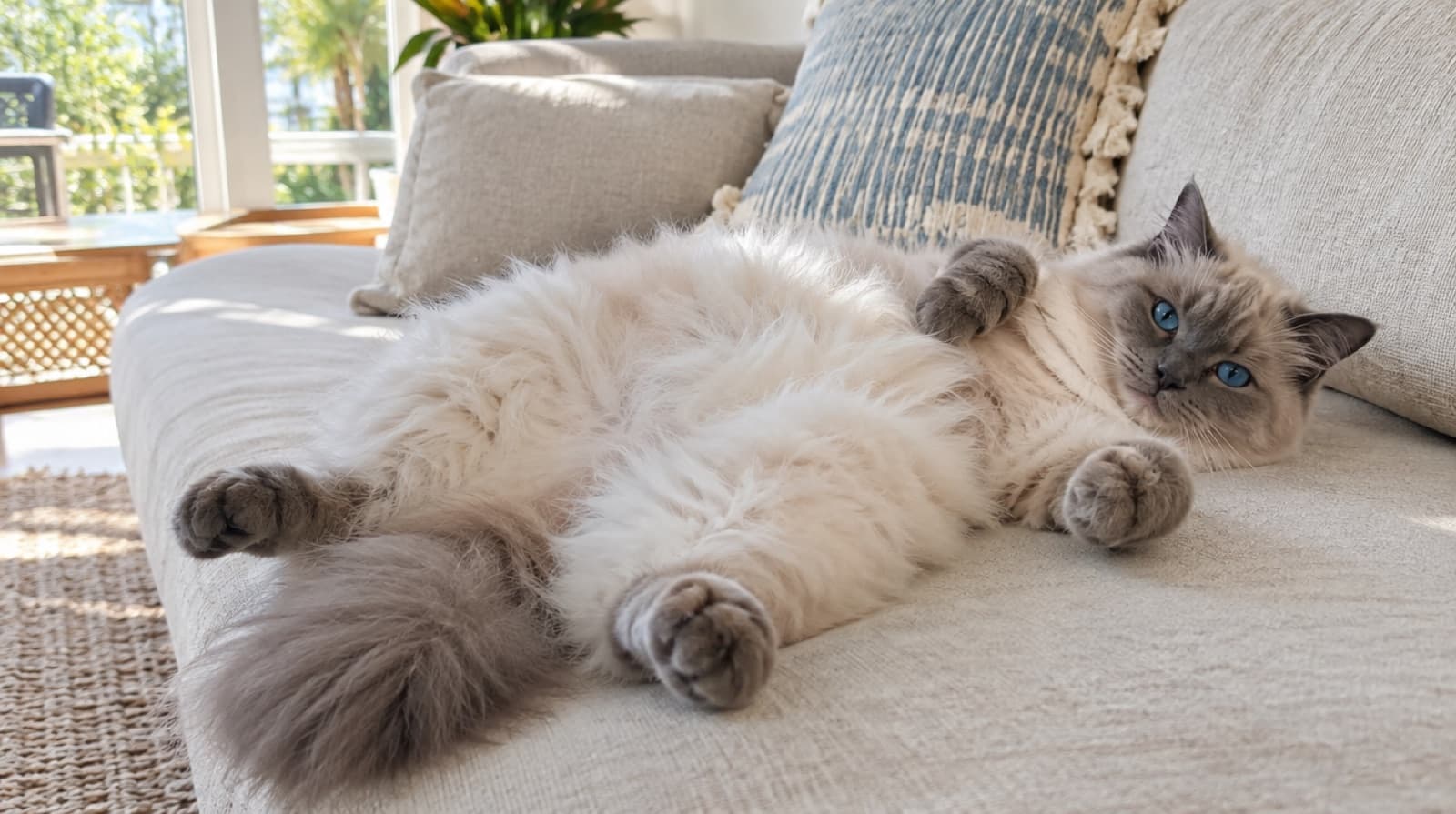
How much does a Ragdoll cat cost in Australia?
Registered breeders typically list a pet-quality, desexed Ragdoll kitten at about $1,500 to $3,000. That figure is an editorial range. We read it across registered-breeder listings and pet price guides in October 2026, and no registry, insurer or government body publishes an official Ragdoll price. Treat it as the band a legitimate kitten should sit inside, not a fixed rate.
Within that band, breeders price by pattern, colour and purpose. Ragdolls are pointed cats: a pale body with darker colour on the face, ears, legs and tail, and blue eyes. The three main patterns are colourpoint, mitted and bicolour, and the common colours are seal and blue, with chocolate, lilac, red and cream less often seen. Show-quality kittens, the less common colours and kittens sold with breeding rights sit at the top of the range. A straightforward seal or blue pet kitten usually sits lower.
There are three ways to bring a Ragdoll home in Australia: a registered breeder, a classified ad, or a rescue. They cost very different amounts and carry very different risks. The rest of this guide takes them in turn, then puts breeder and rescue side by side in one table.
Path one: what a registered breeder's price covers
A registered breeder's price is high because most of the vet work is already done before the kitten leaves. When you ask what the price includes, a registered breeder should be able to list all of this without hesitating:
- Desexing. Pet kittens from registered breeders are normally desexed before they go home, so the cat cannot be bred from. That matters in NSW, where an undesexed cat needs an annual council permit from four months of age.
- Vaccinations and a vet check. At least the first course, with a vaccination card signed by a vet.
- A microchip registered in your name, which is a legal requirement before a kitten is sold or given away in NSW.
- DNA testing of the parents. Ragdolls carry a known gene mutation for hypertrophic cardiomyopathy (HCM), a heart disease, and can carry polycystic kidney disease (PKD). A registered breeder runs both tests through a genetics laboratory and shows you the results. A clear test lowers the risk but does not remove it.
- Indoor raising. Kittens raised inside the breeder's home with their mother, handled daily and not released before they are old enough to leave her.
- Pedigree papers from the registry the breeder belongs to, and a written sales agreement with return terms.
Breeders sometimes also rehome retired breeding adults for less than a kitten. Those cats are desexed, settled and already past the kitten stage. If you want a Ragdoll but not a kitten, it is worth asking.
How to check the breeder is registered
“Registered” only means something if you can check it. Ask the breeder which body they belong to and for their membership number or cattery prefix, then look it up yourself rather than taking a screenshot on trust.
- Australian National Cats Inc (ANCATS) is a national registry with a public Check a Member lookup on its website. Type the breeder's name or number and see whether they appear.
- The Australian Cat Federation (ACF) is a federation of state cat bodies. Its members page lists each state body, which is where many breeders hold their registration.
- The Co-Ordinating Cat Council of Australia (CCCA) is the other national council and publishes breed standards.
- Cats Australia is the Australian charter club of The International Cat Association (TICA), so a TICA-registered breeder should appear there.
A breeder who is registered with none of these, or who will not give you a number to check, is a backyard breeder whatever the website says. The kittens may be lovely, but you are paying a pedigree price without the testing, papers or recourse that justify it.
The NSW refund rule
NSW gives buyers one specific protection. Under the NSW Breeding Code, a buyer who returns a kitten to the breeder within 3 days receives a 50% refund, as set out on the NSW Department of Primary Industries buying a dog or cat page. Three days is short, so book a vet check for the first or second day. Other states have their own codes, and a registered breeder in any state should put return terms in writing before you pay.
Path two: the classified ad and the scam
Search “Ragdoll kittens” and the first results below the breeders are classified ads and standalone websites offering kittens for a fraction of the registered price. Some are unregistered litters. Many are not kittens at all.
The pet scam follows a pattern that has barely changed in years. The photos are copied from a real breeder. The price is well below the range above. The kitten is always interstate, so you cannot visit. You are asked to pay a deposit, then a transport fee, then a new fee appears: a climate-controlled crate, pet travel insurance, a vet certificate, a customs charge. Each one is “refundable on delivery”. The kitten never arrives.
The scale is real. In March 2018 the ACCC reported more than $310,000 lost to puppy scams across 584 reports in the previous 12 months, and noted that scammers ask for transport or medical costs before delivery (ACCC media release). Kittens follow exactly the same script, and Ragdolls are a favourite because the breed is expensive and photogenic.
Scamwatch, the ACCC's scam reporting service, gives four plain rules for buying a pet: view the animal in person, ask for a video call if you cannot, compare the price with other sellers, and treat a very cheap pet as a likely scam. We would add one more. Never pay a deposit for a kitten you have not watched move on a live video call, and never pay a transport fee to anyone other than a transport company you found and contacted yourself.
The unregistered litter is a different problem. The kitten exists, but there is usually no DNA testing for HCM or PKD, no desexing, no papers and no refund terms. You may still pay close to a registered price. If the seller cannot be found on any of the registries above, you are not buying a pedigree Ragdoll, whatever the ad says.
Path three: adopting a Ragdoll or Ragdoll cross
Purebred Ragdolls are uncommon in Australian rescue, because almost all of them are bought from breeders and kept. When one does appear it is usually an adult, surrendered because someone in the home developed allergies, the family moved interstate or overseas, or a rental changed hands and the new lease said no pets. These are often lovely, settled cats whose only fault was their owner's circumstances.
We will be honest about our own listings. Across the rescues we aggregate, most cats tagged “Ragdoll” are crosses, or blue-eyed pointed longhairs that a shelter has described as Ragdoll-type because that is what they look like. Rescues cannot prove a pedigree without papers, so the careful ones list these cats as a Ragdoll cross or as a Domestic Longhair. If you want the Ragdoll look and a calm, people-focused cat, these are exactly the cats to meet. If you need a papered purebred, rescue is the slower path.
There is one NSW rescue that works with purebred cats directly. DCH Animal Adoptions, a NSW rehoming organisation, runs a wait list for purebred cats including Ragdolls, Burmese and Persians, and for Siamese and Oriental cats. It is foster-based, with carers across Sydney and the Central and South Coast, so there is no shelter to walk into; you register and wait.
The fee is the same as for any other cat at that rescue, and it covers the same vet work a breeder's price does. Read directly from their own fee pages in October 2026:
- RSPCA NSW: $270 for a kitten under 6 months, $220 for a cat over 6 months, covering desexing, microchipping, vaccinations and health checks.
- Cat Protection Society of NSW: $150 per cat or kitten, $250 for two, including vet check, desexing, microchip, first vaccination, flea and worm treatment.
- Animal Welfare League NSW: $270 for kittens 6 months and under, $230 for adult cats, $170 for senior cats 8 years and over, including desexing, microchipping, vaccination and free lifetime registration.
Rescues outside NSW set their own fees, and they move. Check the live listing and the rescue's own page before you plan around a number. Start with the Ragdolls and Ragdoll crosses listed now, or browse every cat for adoption in Sydney and filter for longhairs with blue eyes. If you are on the other side of this, with a Ragdoll you can no longer keep, our Ragdoll rehoming guide explains how to do it without a free-to-good-home ad.
Breeder vs rescue: the comparison
The two legitimate paths side by side. The breeder column is the editorial range for a registered breeder; the rescue column uses the three NSW fee pages above.
| What you compare | Registered breeder | Rescue (NSW examples) |
|---|---|---|
| Up-front cost | About $1,500 to $3,000 for a pet kitten | $150 (Cat Protection Society of NSW) to $270 (RSPCA NSW and AWL NSW kittens); $170 for an AWL NSW senior |
| What the cat is | Papered purebred kitten, pattern and colour of your choosing | Usually an adult Ragdoll cross or a Ragdoll-type pointed longhair; a papered purebred now and then |
| Included vet work | Desexing, vaccinations, microchip, vet check | Desexing, vaccinations, microchip, vet check; AWL NSW adds free lifetime registration |
| Health screening | DNA tests on the parents for HCM and PKD through a genetics laboratory | A vet check and any known history; no parental DNA results |
| Waiting time | Often a wait list for a litter, then until the kitten is old enough to leave | Crosses appear often; a purebred may mean months on a wait list |
| If it does not work out | In NSW, return within 3 days for a 50% refund under the Breeding Code; otherwise the written sales terms | Ask the rescue what happens if it does not work out; most will take the cat back and talk first |
| Scam risk | Low once you have checked the registry yourself and seen the kitten live | Low; you deal with a known organisation and usually meet the cat first |
The honest summary: a breeder sells you certainty about pedigree and parentage, and charges for it. A rescue sells you a cat that already exists and needs a home, with the same core vet work, for a fraction of the price. Which matters more is your call, not ours.
Ragdolls are indoor cats
Whichever path you take, plan for an indoor cat. The breed is named for the way many Ragdolls go limp and floppy when picked up, and that same trusting, placid nature is a liability outside. A Ragdoll does not read cars, dogs or strangers as threats. Breeders and rescues alike will usually ask you to keep the cat indoors or give it a secure catio, and some Australian councils now have cat containment rules of their own.
Indoor life suits the breed. Ragdolls are people-focused, low-key and happy to follow you from room to room, then sleep on the nearest soft thing. Give them a tall cat tree, a window perch and some daily play and they are content in an apartment. They are a poor match for a home that wants a cat to come and go through the back door.
The coat is semi-long and silky with less undercoat than many longhaired breeds, so it mats less than it looks like it should. A brush a few times a week keeps it tidy; daily during the spring shed. Budget for ongoing costs the same as any cat: food, litter, annual vaccination and check-up, parasite prevention on your vet's advice, and pet insurance if you want it. Because HCM runs in the breed, ask your vet about heart checks as the cat ages, and act on any change in breathing or energy rather than waiting.
Which path is right for you?
If you want a papered kitten of a particular pattern and colour, and you are comfortable paying about $1,500 to $3,000 for it, go to a registered breeder and check the registration yourself before you pay a deposit. If you want the Ragdoll temperament and look, are open to an adult or a cross, and would rather spend a few hundred dollars than a few thousand, start with rescue and keep checking the listings. If you want a papered purebred but not at breeder prices, join a purebred wait list and be patient.
The one path we would steer anyone away from is the cheap classified ad. It is either a scam or a kitten without the testing that makes a Ragdoll worth the name. If you are not sure you are ready for a cat at all, our adoption readiness check takes a few minutes and asks the questions a good rescue will ask you anyway.
Frequently asked questions
How much does a Ragdoll kitten cost in Australia?▼
Registered breeders typically list pet-quality, desexed Ragdoll kittens at about $1,500 to $3,000. That is the range we read across registered-breeder listings and pet price guides in October 2026. No registry or insurer publishes an official price, so treat it as a guide, not a fixed rate. Show-quality kittens and less common colours sit at the top of the range.
Why are some Ragdolls advertised for far less than that?▼
A Ragdoll priced well below the registered-breeder range is usually one of two things: a scam listing using copied photos, or an unregistered litter with no DNA testing, no papers and often no desexing. Scamwatch says a very cheap pet is likely a scam. Ask to see the kitten move on a live video call, or visit in person, before any money changes hands.
How do I check a Ragdoll breeder is registered?▼
Ask for the breeder's registry and membership number, then look it up yourself. Australian National Cats (ANCATS) has a public Check a Member lookup on its website. The Australian Cat Federation lists its state member bodies, the Co-Ordinating Cat Council of Australia lists its affiliates, and Cats Australia is the TICA charter club. A breeder who will not give you a number to check is not registered.
Can I return a Ragdoll kitten if something is wrong?▼
In NSW, yes, within a tight window. Under the NSW Breeding Code, a buyer who returns a kitten to the breeder within 3 days receives a 50% refund. Other states have their own rules, so ask the breeder for the return terms in writing before you pay. Rescues handle returns differently; ask the rescue what happens if the adoption does not work out.
Are purebred Ragdolls ever available for adoption?▼
Yes, but not often. Purebred Ragdolls usually reach rescue as adults, surrendered because of allergies, a move or a change in rental rules. Across the rescues we aggregate, most cats listed as Ragdoll are crosses or blue-eyed pointed longhairs with a Ragdoll look. DCH Animal Adoptions in NSW runs a wait list for purebred cats including Ragdolls.
What does a rescue Ragdoll or Ragdoll cross cost?▼
The same as any other cat at that rescue. RSPCA NSW charges $270 for a kitten under 6 months and $220 for a cat over 6 months. Cat Protection Society of NSW charges $150 per cat or kitten. Animal Welfare League NSW charges $270 for kittens, $230 for adult cats and $170 for senior cats. Each fee includes desexing, microchipping and vaccination.
Do Ragdolls need to stay indoors?▼
Yes. Ragdolls are trusting, placid cats with little street sense, which makes them easy prey for cars, dogs and thieves. They do well as indoor cats or with access to a secure catio. Most Australian rescues and breeders now ask for an indoor or contained home, and some councils have cat containment rules.
Is a Ragdoll cross the same as a Ragdoll?▼
No. A Ragdoll cross has one Ragdoll parent or Ragdoll ancestry and may or may not share the breed's floppy, placid nature. Many will look the part, with blue eyes, a pointed coat and a semi-long coat. Without papers, a rescue cannot prove a cat is a Ragdoll, which is why most are listed honestly as a cross or as a Domestic Longhair.
What health tests should a Ragdoll breeder show me?▼
Ask to see DNA results for the parents for the Ragdoll form of hypertrophic cardiomyopathy (HCM) and for polycystic kidney disease (PKD), run through a genetics laboratory. A clear DNA test lowers the risk but does not rule out heart disease entirely, so a vet check before sale and a vaccination record matter too. A breeder who cannot produce the paperwork has not done the testing.
Sources
- Australian National Cats Inc (ANCATS), Check a Member
- Australian Cat Federation, member bodies
- Co-Ordinating Cat Council of Australia
- Cats Australia (TICA charter club)
- Scamwatch, buying and selling scams
- ACCC media release, Don’t fall for a scammer’s puppy dog eyes (26 March 2018)
- NSW Department of Primary Industries, buying a dog or cat
- RSPCA NSW adoption fees
- Cat Protection Society of NSW, cats for adoption
- Animal Welfare League NSW, adopt
Keep reading
Ragdolls and Ragdoll crosses for adoption
Every Ragdoll and Ragdoll-type cat listed across the Australian rescues we aggregate, refreshed regularly.
Rehoming a Ragdoll
How to rehome a Ragdoll safely, from vetting enquiries to the hand-over, without a free-to-good-home ad.
Maine Coon price in Australia
The other big, gentle pedigree cat: what a Maine Coon kitten costs and how the rescue route compares.
Cats for adoption in Sydney
Browse every cat and kitten listed by Sydney rescues, including the pointed longhairs that look like Ragdolls.