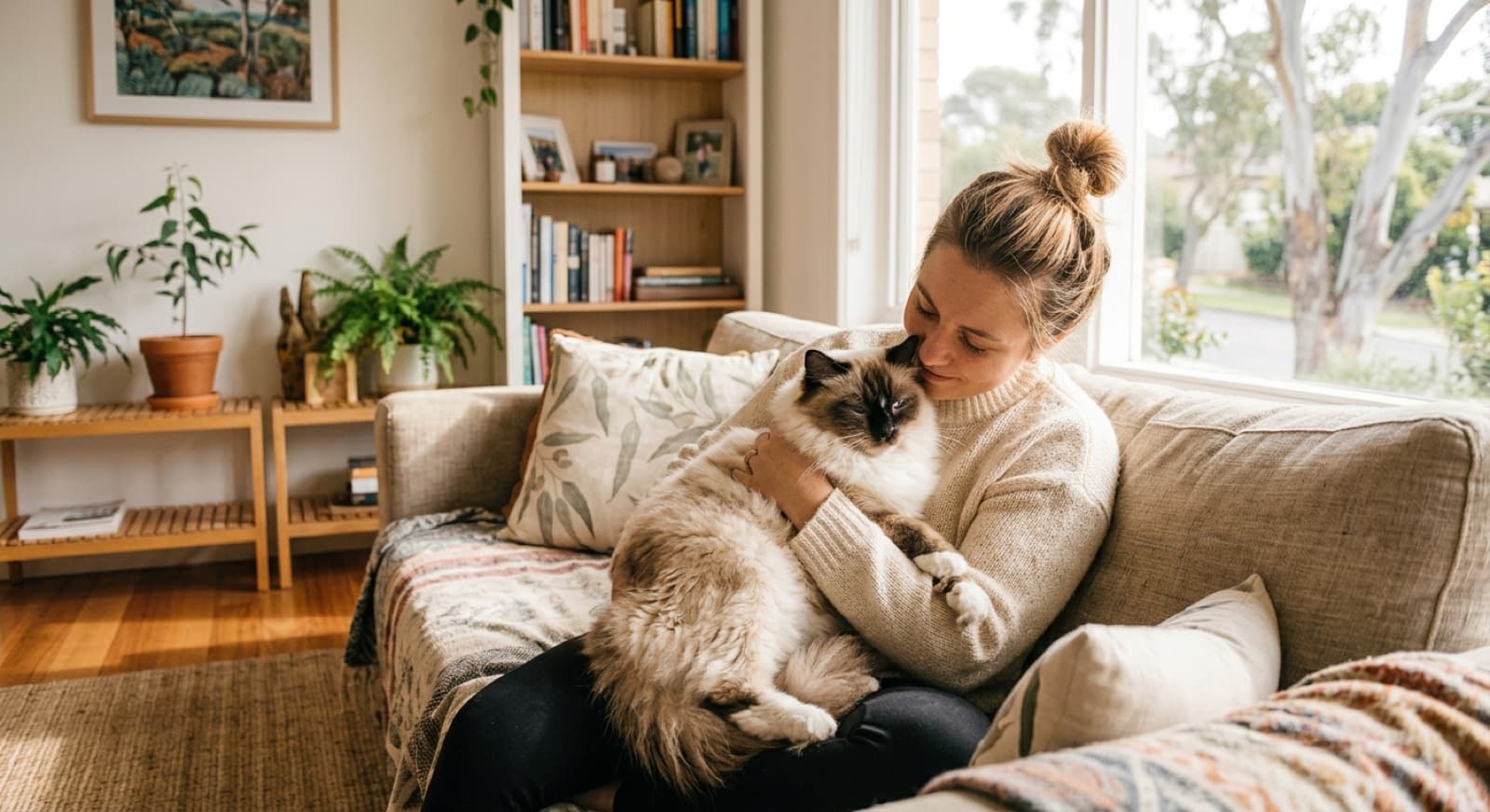
The short answer
List your Ragdoll free on LocalPetFinder, keep it with you, and choose the home yourself. Screen for three things: the cat will be kept indoors or safely contained, someone is home a fair amount, and the adopter can afford a big cat's vet bills. Desex the cat before handover if it is not already (in WA it is the law), hand over the full vet file including any heart screening, and charge a modest fee so the listing does not attract resellers.
Rehome your Ragdoll on LocalPetFinder
List free, keep your cat at home until adopted, and choose the new family yourself. Your email stays private.
List your cat free →Why Ragdolls end up needing a new home
The Cat Fanciers' Association (CFA) sums up the Ragdoll's personality as "docile, placid and affectionate", and describes them as loving without being demanding. That is why so few are rehomed for behaviour. When a Ragdoll needs a new home, the reason is usually the owner's life: a move into a rental or a smaller place, a new partner or baby with a cat allergy, a tighter budget, or an owner who has become ill, moved into care or died.
Size and cost play a part too. The CFA notes that a mature male can reach or exceed 20 pounds (about 9 kg) and that the breed reaches full size and weight at around four years, so a fluffy kitten can grow into a big cat with big-cat food and vet bills. None of that says anything bad about your cat. It means circumstances changed, and a careful rehoming fixes exactly that.
When we checked the rescue cat listings we gather from shelters around Australia in November 2026, pedigree cats made up only a small share and most cats were domestic shorthairs. A Ragdoll listed by its owner, with honest details and a full vet history, stands out in that crowd.
The right home for a Ragdoll
A Ragdoll suits a calm household where people are around for a good part of the day. They are generally gentle with respectful children and calm pets when introductions are slow, but every cat is an individual, so describe how yours actually behaves rather than the breed reputation.
Contained living matters for this breed. RSPCA Australia says roaming cats are at risk of injury and death from road accidents, fighting and disease, and that two in three cat owners have lost a pet to a roaming-related incident. A trusting cat that approaches strangers may be more exposed to those risks. Indoors, a secure catio or cat-proof fencing, or supervised harness walks are all reasonable answers. An open back door is not.
Grooming is lighter than many people expect. The CFA says regular combing at least once or twice a week with a steel comb is enough to remove loose hair and tangles, with more shedding as the seasons change. The right adopter is happy to comb, and to keep an eye on weight, because a placid cat can gain it easily.
Questions to ask every applicant
Ask them plainly: will this cat ever go outside unsupervised? If the answer is yes, or vague, keep looking. Then ask how many hours the house is empty on a normal day, who else lives there (children, dogs, other cats), whether they rent and have the landlord's consent, and what they would do if the cat needed a $1,000 vet visit next month. A genuine adopter answers these easily and asks you questions back.
Watch for the reseller pattern. Ragdoll kittens from registered Australian breeders commonly cost about $1,500 to $3,000, so a free or cheap adult attracts people who flip cats or want an entire (undesexed) cat to breed from. The signs are pressure to collect today, no interest in the cat's personality, refusal of a video call or home visit, no vet they can name, and questions about whether the cat is desexed or has papers before anything else. Desexing before handover and a modest fee remove most of that interest.
If your cat came from a registered breeder, read your purchase contract before you list. Some contracts ask owners to offer the cat back to the breeder first, and even without a clause, the breeder may know a waiting home. ANCATS, the national cat registry, runs a public Check a Member lookup if you need to find or confirm a breeder.
What to disclose honestly
Heart history comes first. Hypertrophic cardiomyopathy (HCM), a thickening of the heart muscle, is a known concern in the breed: the 2020 American College of Veterinary Internal Medicine (ACVIM) consensus lists the Ragdoll among pedigree breeds believed to be at increased risk, and one of only two HCM mutations identified in cats was found in Ragdolls. The UC Davis Veterinary Genetics Laboratory offers a test for it, and the ACVIM calls echocardiography (heart ultrasound) the gold standard for diagnosis. Hand over any DNA result, echo report, murmur note or breeder paperwork you have. You are not diagnosing anything; you are giving the next vet the full file.
Then the everyday details: current weight and what your vet considers healthy, diet and any prescription food, dental work, litter habits, how the cat handles grooming, and how it is with children, dogs and other cats. Say whether the cat is desexed, microchipped and vaccinated, and when it last saw a vet.
Be honest about any bond with another cat. Two cats that sleep together and groom each other are best rehomed as a pair, and a listing that says so up front finds the people who want two.
Cat rules that change the handover
The state rules for advertising and microchip transfer are listed further down this page. A few rules are specific to cats. In Western Australia a cat must be sterilised and microchipped before it is sold or given away. In South Australia, cats born after 1 July 2018 must be desexed, and a new owner of an undesexed cat has 28 days from taking possession to have it done (cats of Feline Association of SA or Cat Fancy of SA members and of registered breeders are exempt). In Tasmania, the Department of Natural Resources and Environment says a cat sold, given away or rehomed must be desexed and microchipped (exceptions apply) and have had the prescribed health checks.
If the adopter lives in the ACT, cats born on or after 1 July 2022 must be contained to the owner's premises 24 hours a day, and all cats must be contained in the declared cat containment suburbs. Elsewhere, many councils set their own curfews or containment rules, so ask the adopter to check theirs. Transfer the microchip through your state or territory's pet registry at the handover.
Where to rehome, and the fee
We could not verify any Ragdoll-only rescue in Australia that says on its own site that it takes owner surrenders, so we do not name one. DCH Animal Adoptions, an all-breed rescue in the Sydney, Wollongong and Central Coast areas of NSW, says it has affiliates in the pedigree cat world, offers advice and assistance with purebred cats needing new homes (it names Burmese, Ragdolls and Persians), and keeps a wait list of adopters looking for a particular breed. Beyond that, your state RSPCA or animal welfare league takes cats by appointment when it has space; see the state guides. Animal Welfare League SA has paused new rehoming requests. Your cat's breeder is often the best first call.
As a reference, not a quote: RSPCA NSW lists $220 to adopt a cat over six months, RSPCA Victoria $145 to $400 for an adult cat, and Cat Haven in WA $195 for a cat aged one to five (all read on their own pages on 20 November 2026). Geelong Animal Welfare Society listed a $300 special-breed adult cat fee that names the Ragdoll (read 13 November 2026). Those fees cover the shelter's desexing, vaccination and microchipping. For a private rehoming, a modest fee filters out resellers better than a free listing; the screening matters more than the figure.
New to rehoming? Start with our step-by-step guide to rehoming a cat for free, our guide to screening adopters, and the reasons a modest fee beats free to good home.
How rehoming your Ragdoll on LocalPetFinder works
- List for free. Add up to five photos, with the first as the cover, and describe your cat honestly: age, health, how they are with children, dogs and cats, and what kind of home suits them. There is no listing fee.
- We review it. Every listing is checked before it goes live, usually within 24 to 48 hours.
- Adopters contact you privately. Your email address is never shown on the listing. Enquiries reach you through the site, and you choose who to reply to.
- You choose the family. Your cat stays with you while you screen applicants, meet them and decide. When your cat has gone to their new home, mark the listing adopted using the link in the email we send when your listing goes live.
What the law asks of you, by state
Rehoming a Ragdoll is legal everywhere in Australia, but each state and territory sets its own rules for advertising a pet and passing it on, even for free. In every state, transfer the microchip registration to the new owner at the handover.
New South Wales
Since 1 July 2019, every ad to sell or give away a cat or dog must include an identification number: the microchip number, a breeder identification number or a rehoming organisation number. Transfer the microchip through the NSW Pet Registry.
Victoria
An ad to sell or give away a dog or cat must show the animal’s microchip number and a Pet Exchange Register source number. It is an offence to advertise without both.
Australian Capital Territory
Anyone rehoming a cat or dog, even for free, must include the microchip number plus an identifier for the advertiser (such as their name) in the ad, or a breeding licence number.
Queensland
Giving away, selling or advertising a dog born on or after 26 May 2017 needs a supply number. This applies to dogs only, not cats.
Western Australia
A cat must be microchipped and sterilised before it is sold or given away (or come with a prepaid sterilisation voucher if it is too young), and a dog must be microchipped before it is transferred.
South Australia
Giving a pet away free needs no breeder registration. Anyone breeding dogs or cats to sell, including after an accidental litter, must register with Dogs and Cats Online and show the number in ads.
Tasmania
Under the Cat Management Act 2009, giving a cat away counts as selling it. The cat must be at least 8 weeks old, microchipped, desexed (unless it goes to a registered breeder or permit holder) and have passed the prescribed health checks.
The Northern Territory has no territory-wide rule we could confirm; check with your council. Each state guide linked above has the detail and the official sources.
Scam rules to follow
- Meet anyone interested in person, or at least on a video call, before you agree to anything.
- Never send your cat anywhere before you have met the new owner, and never pay for transport, crates or “insurance” on a stranger's behalf.
- Never accept an overpayment or refund the difference. That is a common scam pattern.
- Keep the conversation on the site until you have decided someone is genuine.
Our rehoming safety guide covers the warning signs in more detail.
Looking to adopt a Ragdoll instead?
Browse Ragdolls available for adoption from rescues and owners across Australia.
See adoptable Ragdolls →Frequently asked questions
Is it hard to rehome a Ragdoll?+
It depends on the cat, but a Ragdoll starts with advantages: pedigree cats are a small share of the rescue cats listed in Australia, and the breed's calm, affectionate nature suits many households. Expect most of the work to be screening, confirming a contained home and filtering out people who want a cheap pedigree to resell or breed from.
Should I give my Ragdoll away for free?+
No. A free pedigree cat attracts resellers and backyard breeders. Charge a modest fee, desex the cat before handover if it is not already, and meet the adopter at least once. If keeping the money feels wrong, donate it to a cat rescue afterwards.
Do Ragdolls have to be indoor cats?+
They should be kept indoors or safely contained. RSPCA Australia says roaming cats risk injury and death from cars, fights and disease, and a trusting Ragdoll has little street sense. In the ACT, cats born on or after 1 July 2022 must be contained by law; elsewhere, check the adopter's council rules.
What health issues should I tell the adopter about?+
Start with the heart. Hypertrophic cardiomyopathy (HCM) is a recognised concern in Ragdolls and a DNA test exists for one Ragdoll mutation, so hand over any test result, echocardiogram or murmur note. Then share the full vet records, weight, diet, dental history and anything your vet is monitoring.
Do Ragdolls really go limp when you pick them up?+
Not usually. The CFA says the founding cat was said to go limp when held, but that this is not typical of most of today's Ragdolls. Describe how your own cat likes to be handled so the adopter knows what to expect.
Can I rehome an older Ragdoll?+
Yes. A settled adult or senior Ragdoll suits quieter homes that want a calm cat with a known personality. Be clear about age, health and any ongoing medication, and give the search more time than you would for a young cat.
How do I rehome my Ragdoll for free?+
List your Ragdoll on LocalPetFinder at no cost. Keep the cat with you, screen applicants for a contained home, meet them, and transfer the microchip through your state or territory's pet registry at the handover, along with the vet records and any pedigree papers.
Related guides
Rehoming a Maine Coon anywhere in Australia? Screen for a home ready for a big cat, disclose heart history, avoid resellers, and list free.
Rehoming a Siamese anywhere in Australia? Be honest about the voice, keep bonded pairs together, screen for company at home, and list free.
Rehoming a domestic shorthair or moggy anywhere in Australia? Write a listing that stands out, screen well, know the cat rules, and list free.
Every guide on rehoming a dog or cat in Australia, plus how to list for free.
Sources
- Cat Fanciers' Association: Ragdoll
- ACVIM consensus statement on cardiomyopathies in cats (2020)
- UC Davis Veterinary Genetics Laboratory: Ragdoll HCM test
- RSPCA Australia: Keeping cats safe at home
- DCH Animal Adoptions: breed rescue
- Dog and Cat Management Board (SA): cat desexing
- NRE Tasmania: breeding, selling and buying cats
- ACT Government: cats
- RSPCA NSW: adoption fees
- RSPCA Victoria: the adoption process
- Cat Haven: adopt
- ANCATS
Rehoming guides for your state
Surrender options, the local law and the help that lets you keep your pet are different in every state, territory and in New Zealand. Each guide covers the shelters, the rules and the owner-to-owner route where you live.