The short answer
List your Maine Coon free on LocalPetFinder, keep it with you, and choose the home yourself. Screen for a contained home, a real grooming routine, and a budget for big-cat vet bills. Desex the cat before handover if it is not already (in WA it is the law), hand over the full vet file including any heart screening or DNA results, say honestly whether the cat has papers, and charge a modest fee so the listing does not draw resellers.
Rehome your Maine Coon on LocalPetFinder
List free, keep your cat at home until adopted, and choose the new family yourself. Your email stays private.
List your cat free →Why Maine Coons end up needing a new home
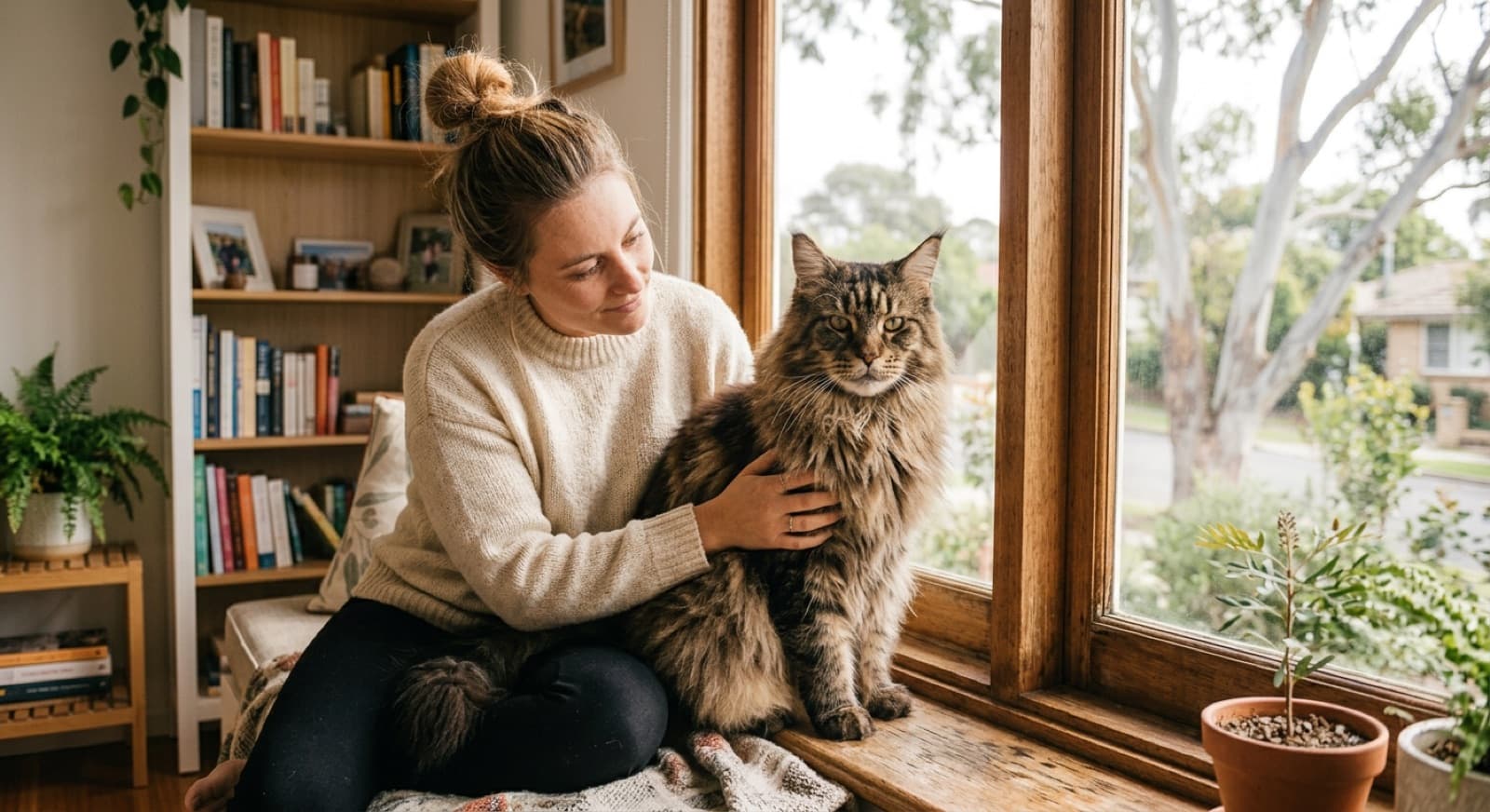
The Cat Fanciers' Association (CFA) describes the Maine Coon as "gentle, easy going yet active", a cat that tends to go from one family member's lap to another. Temperament is rarely the reason one needs a new home. More often it is an allergy in the household, the work of keeping a long, shaggy coat free of mats, the cost of feeding and treating a large cat, a move to a rental or a smaller place, or an owner whose health or circumstances have changed.
Size takes people by surprise. The CFA says a mature male can reach or exceed 20 pounds (about 9 kg) and that the breed can take up to three years to reach full growth, so a kitten bought for a small flat can become a very large adult. Everything scales up with the cat: food, litter, carrier size, boarding, and medication dosed by weight.
None of this means your cat has a problem. It means a good cat met changed circumstances. A careful owner-to-owner rehoming lets the next family meet the cat in its own home and hear its routine from you.
Is your cat a Maine Coon? Say what you know
Many big, fluffy cats get called Maine Coons. Australian shelters list long-haired cats of unknown breeding as domestic longhairs or medium hairs rather than as a breed, because a long coat on its own does not make a cat a Maine Coon. If your cat came from a registered breeder with papers, say so and hand the papers over. If it did not, describe it as a Maine Coon type or a domestic longhair and let the photos speak.
Honest labelling protects you. An adopter who thinks they are getting a pedigree and later finds out otherwise may feel misled, and a correct description draws the people who want this cat for itself. ANCATS, the national cat registry, runs a public Check a Member lookup if you want to confirm a breeder's registration.
Questions to ask every applicant
Ask how they will keep the coat in order. The CFA says breeders recommend combing a Maine Coon two or three times a week, in sessions of five or ten minutes, to control shedding, hairballs and matting. An adopter who has owned a long-haired cat usually answers this without being prompted. Then ask whether the cat will be kept indoors or contained, how long the house is empty each day, who else lives there, whether they rent with the landlord's consent, and how they would cover a large vet bill.
Watch for resellers. Maine Coon kittens from registered Australian breeders commonly cost about $2,000 to $3,500, so a free or cheap adult attracts people who flip cats or want an entire (undesexed) cat for breeding. Pressure to collect immediately, no questions about the cat's personality, no vet they can name, and refusing a video call or home visit are the warning signs. Desex before handover, charge a modest fee, and let the process take a week or two.
If your cat came from a breeder, read the purchase contract first. Some ask owners to offer the cat back before rehoming, and the breeder may already know a suitable home.
What to disclose honestly
The heart is the big one. Hypertrophic cardiomyopathy (HCM), a thickening of the heart muscle, is the Maine Coon's best-known health concern. The 2020 American College of Veterinary Internal Medicine (ACVIM) consensus lists the breed among those believed to be at increased risk, and the UC Davis Veterinary Genetics Laboratory reports that cats with one copy of the Maine Coon HCM mutation are about 1.8 times, and cats with two copies about 18 times, more likely to develop HCM than cats without it. The test detects only that one mutation, and the ACVIM calls echocardiography (heart ultrasound) the gold standard for diagnosis. Hand over any DNA result, echo report, murmur note and breeder paperwork you have.
UC Davis also tests for spinal muscular atrophy (SMA) in the breed, an inherited condition that shows at about three to four months and that the laboratory says is not painful or fatal. If your breeder gave you SMA or other test results, pass them on.
Then the everyday details: current weight and your vet's healthy target, diet, dental work, coat condition and any mat-prone areas, how the cat tolerates combing, litter habits, and how it is with children, dogs and other cats. If the coat has got away from you, have the mats dealt with before you list and say so.
Cat rules that change the handover
The state rules for advertising and microchip transfer are listed further down this page. Some rules apply to cats only. In Western Australia a cat must be sterilised and microchipped before it is sold or given away. In South Australia, cats born after 1 July 2018 must be desexed, and a new owner of an undesexed cat has 28 days from taking possession to have it done (with exemptions for cats of Feline Association of SA or Cat Fancy of SA members and of registered breeders). In Tasmania, the Department of Natural Resources and Environment says a cat sold, given away or rehomed must be desexed and microchipped (exceptions apply) and have had the prescribed health checks.
In the ACT, cats born on or after 1 July 2022 must be kept on the owner's premises 24 hours a day, and all cats must be contained in the declared cat containment suburbs. In other states, many councils set their own cat curfews or containment rules, so ask the adopter to check theirs. Transfer the microchip through your state or territory's pet registry at the handover.
Where to rehome, and the fee
We could not verify any Maine Coon-only rescue in Australia that says on its own site that it takes owner surrenders, so we do not name one. DCH Animal Adoptions, an all-breed rescue in the Sydney, Wollongong and Central Coast areas of NSW, says it offers advice and assistance with purebred cats needing new homes and keeps a wait list of adopters looking for a particular breed. Your state RSPCA or animal welfare league takes cats by appointment when it has space; see the state guides. Animal Welfare League SA has paused new rehoming requests. If your cat came from a breeder, call them first.
As a reference, not a quote: RSPCA NSW lists $220 to adopt a cat over six months, RSPCA Victoria $145 to $400 for an adult cat, and Cat Haven in WA $195 for a cat aged one to five (all read on their own pages on 20 November 2026). Those fees cover the shelter's desexing, vaccination and microchipping. For a private rehoming, a modest fee is safer than free because a free pedigree draws resellers. The screening matters more than the amount.
New to rehoming? Start with our step-by-step guide to rehoming a cat for free, our guide to screening adopters, and the reasons a modest fee beats free to good home.
How rehoming your Maine Coon on LocalPetFinder works
- List for free. Add up to five photos, with the first as the cover, and describe your cat honestly: age, health, how they are with children, dogs and cats, and what kind of home suits them. There is no listing fee.
- We review it. Every listing is checked before it goes live, usually within 24 to 48 hours.
- Adopters contact you privately. Your email address is never shown on the listing. Enquiries reach you through the site, and you choose who to reply to.
- You choose the family. Your cat stays with you while you screen applicants, meet them and decide. When your cat has gone to their new home, mark the listing adopted using the link in the email we send when your listing goes live.
What the law asks of you, by state
Rehoming a Maine Coon is legal everywhere in Australia, but each state and territory sets its own rules for advertising a pet and passing it on, even for free. In every state, transfer the microchip registration to the new owner at the handover.
New South Wales
Since 1 July 2019, every ad to sell or give away a cat or dog must include an identification number: the microchip number, a breeder identification number or a rehoming organisation number. Transfer the microchip through the NSW Pet Registry.
Victoria
An ad to sell or give away a dog or cat must show the animal’s microchip number and a Pet Exchange Register source number. It is an offence to advertise without both.
Australian Capital Territory
Anyone rehoming a cat or dog, even for free, must include the microchip number plus an identifier for the advertiser (such as their name) in the ad, or a breeding licence number.
Queensland
Giving away, selling or advertising a dog born on or after 26 May 2017 needs a supply number. This applies to dogs only, not cats.
Western Australia
A cat must be microchipped and sterilised before it is sold or given away (or come with a prepaid sterilisation voucher if it is too young), and a dog must be microchipped before it is transferred.
South Australia
Giving a pet away free needs no breeder registration. Anyone breeding dogs or cats to sell, including after an accidental litter, must register with Dogs and Cats Online and show the number in ads.
Tasmania
Under the Cat Management Act 2009, giving a cat away counts as selling it. The cat must be at least 8 weeks old, microchipped, desexed (unless it goes to a registered breeder or permit holder) and have passed the prescribed health checks.
The Northern Territory has no territory-wide rule we could confirm; check with your council. Each state guide linked above has the detail and the official sources.
Scam rules to follow
- Meet anyone interested in person, or at least on a video call, before you agree to anything.
- Never send your cat anywhere before you have met the new owner, and never pay for transport, crates or “insurance” on a stranger's behalf.
- Never accept an overpayment or refund the difference. That is a common scam pattern.
- Keep the conversation on the site until you have decided someone is genuine.
Our rehoming safety guide covers the warning signs in more detail.
Looking to adopt a Maine Coon instead?
Browse Maine Coons available for adoption from rescues and owners across Australia.
See adoptable Maine Coons →Frequently asked questions
Is it hard to rehome a Maine Coon?+
It depends on the cat, but a healthy, friendly Maine Coon has a lot going for it, and pedigree cats are a small share of the rescue cats listed in Australia. Most of the effort goes into screening: finding a home ready for the size, the coat and the vet bills, and turning away resellers.
My cat looks like a Maine Coon but has no papers. What do I call it?+
Call it a Maine Coon type or a domestic longhair. Shelters list long-haired cats of unknown breeding that way, because a long coat alone does not make a cat a Maine Coon. Honest labelling avoids a disappointed adopter and still draws people who love the look.
What health issues should I tell the adopter about?+
Start with the heart. Hypertrophic cardiomyopathy (HCM) is the breed's best-known concern and a DNA test exists for one Maine Coon mutation, so hand over any test results, echocardiograms or murmur notes. Add the full vet records, weight, diet, dental history, and any SMA test result from the breeder.
How much grooming does a Maine Coon need?+
The CFA says breeders recommend combing two or three times a week for five to ten minutes to prevent matting and hairballs. Tell adopters how your cat tolerates combing and where it tends to mat, so they can keep the routine going.
Should I give my Maine Coon away for free?+
No. A free pedigree cat attracts resellers and people looking for breeding stock. Charge a modest fee, desex before handover if the cat is not already desexed, and meet the adopter in person or by video before you agree.
Can I rehome an older Maine Coon?+
Yes. An adult or senior Maine Coon with a known personality suits households that want a calm, settled cat. Be upfront about age, weight, joint stiffness and any medication, and give the search more time than you would for a young cat.
How do I rehome my Maine Coon for free?+
List it on LocalPetFinder at no cost. Keep the cat at home, screen applicants, meet them, and transfer the microchip through your state or territory's pet registry at the handover, along with the vet records and any pedigree papers.
Related guides
Rehoming a Ragdoll anywhere in Australia? Screen for a contained home, disclose heart history, avoid resellers, and list free with LocalPetFinder.
Rehoming a Siamese anywhere in Australia? Be honest about the voice, keep bonded pairs together, screen for company at home, and list free.
Rehoming a domestic shorthair or moggy anywhere in Australia? Write a listing that stands out, screen well, know the cat rules, and list free.
Every guide on rehoming a dog or cat in Australia, plus how to list for free.
Sources
- Cat Fanciers' Association: Maine Coon Cat
- ACVIM consensus statement on cardiomyopathies in cats (2020)
- UC Davis Veterinary Genetics Laboratory: Maine Coon HCM test
- UC Davis Veterinary Genetics Laboratory: Maine Coon SMA test
- RSPCA Australia: Keeping cats safe at home
- DCH Animal Adoptions: breed rescue
- Dog and Cat Management Board (SA): cat desexing
- NRE Tasmania: breeding, selling and buying cats
- ACT Government: cats
- RSPCA NSW: adoption fees
- RSPCA Victoria: the adoption process
- Cat Haven: adopt
- ANCATS
Rehoming guides for your state
Surrender options, the local law and the help that lets you keep your pet are different in every state, territory and in New Zealand. Each guide covers the shelters, the rules and the owner-to-owner route where you live.