The short answer
A tuxedo cat is a solid black cat that also carries a white spotting variant of the KIT gene, which leaves the chest, belly, paws and often the face white. The International Cat Association says “Tux” is a nickname, not a breed or an official colour name; registries call it black and white or bicolour. Because KIT is not on a sex chromosome, tuxedos can be male or female. Studies of tuxedo “personality” measured what people believe or report, not how the cats behave, and found small or contradictory effects. Black and white is a common rescue coat, and fees go by age, not colour (RSPCA NSW lists $220 for an adult cat, checked 10 November 2026; a reference, not a quote).
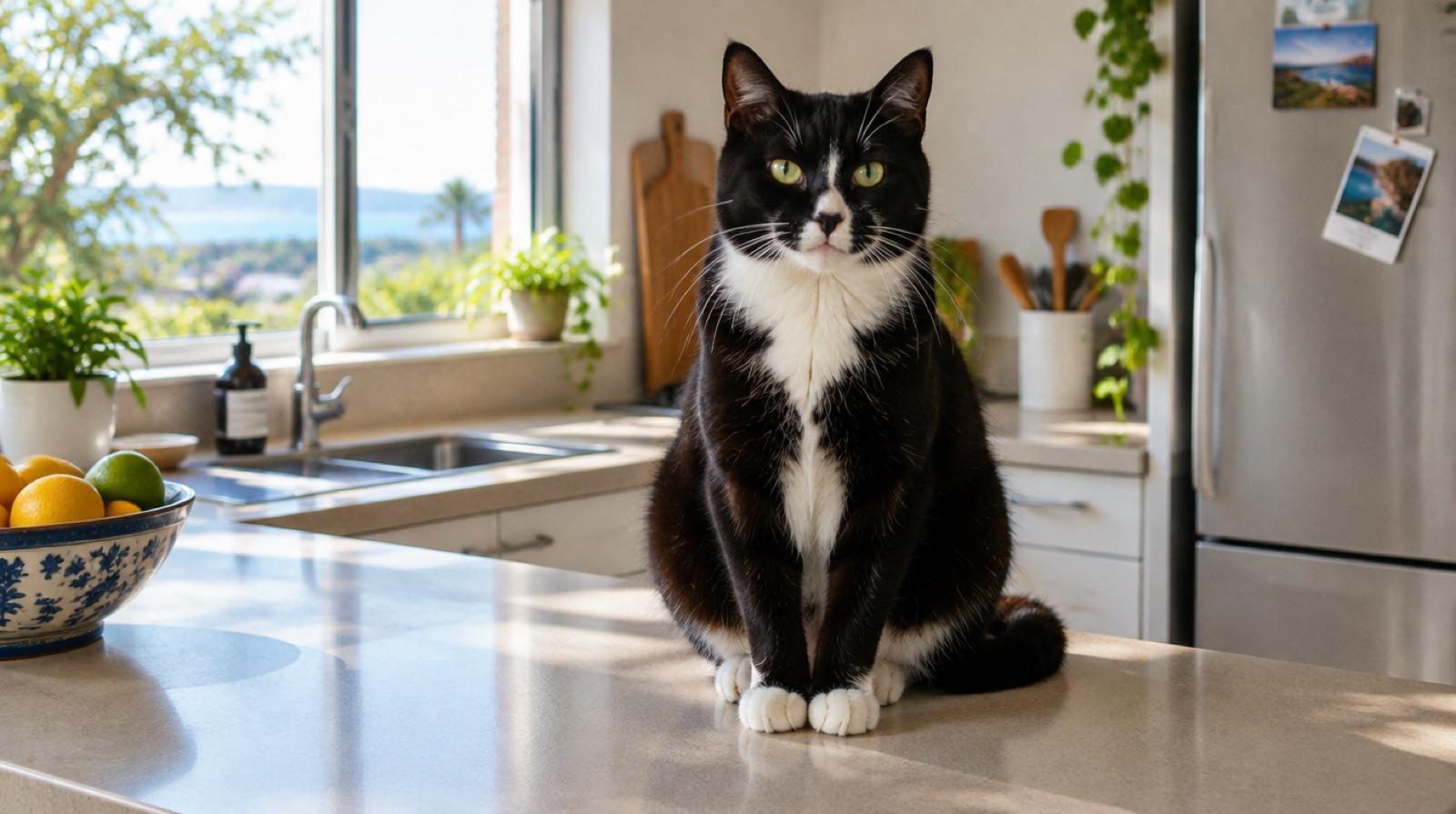
What is a tuxedo cat?
A tuxedo cat is black with white in the places a dinner suit would show a shirt: chest, belly and paws, and often the chin, muzzle or a stripe (a “blaze”) up the face. Some have white socks, some only white toes, some a white locket on the chest. Owners use the name loosely, and a grey and white cat is often called a grey tuxedo.
The International Cat Association (TICA) puts it plainly: solid black and white cats are often called “Tux,” and that is “not a breed or an official color name,” just a nickname for a cat that looks like it is wearing a tuxedo. In registry language a tuxedo is a black and white cat, part of what TICA calls the particolours: any colour or pattern with white added.
Is a tuxedo cat a breed?
No. Because it is a colour pattern, it can turn up in many breeds; the Cat Fanciers' Association (CFA) British Shorthair standard, for example, lists black and white among its bicolours. In Australian rescue, though, almost every tuxedo is a moggy, a Domestic Shorthair or Domestic Longhair whose parents were not registered to any breed. Our Domestic Shorthair guide explains what that shelter label means.
Tuxedo cats can be male or female. Unlike the orange colour behind calicos and gingers, which sits on the X chromosome, the genes that make a tuxedo are not sex-linked. If a listing says “tuxedo,” it tells you nothing about the cat's sex; check the listing itself.
What genes make the tuxedo pattern?
Two switches. First, the black. The UC Davis Veterinary Genetics Laboratory explains that cats with two copies of the non-agouti variant are solid (self) in colour, and tabby patterns become hard to see. Add black pigment and no orange, and you have a black cat; our black cats guide covers that coat on its own.
Second, the white. A 2014 study in the journal G3 by David and colleagues found that white spotting in cats comes from a retrovirus-derived stretch of DNA inserted into a gene called KIT, which guides pigment cells as they spread through the developing skin. A shortened version of the same insertion produces all-white cats instead. The UC Davis white spotting test lists the trait as autosomal dominant: one copy is enough to show white, and a cat with one copy passes it to about half its kittens.
Here is why no two tuxedos match. White is not a pigment; it marks skin where pigment cells never settled. In the David study, kittens that inherited the identical white spotting variant from the same mother still showed different amounts of white. Genes set the possibility; chance during development sets the exact pattern.
- Black and white (classic tuxedo): solid black plus white spotting.
- Grey and white: the same, plus two copies of the dilute gene, which UC Davis says turns black to grey (called blue).
- Tabby and white: white spotting on a cat that shows tabby stripes. Not a tuxedo in the strict sense, though some shelters use the word anyway.
- Calico: white spotting on a tortoiseshell. See our calico cats guide.
Tuxedo vs bicolour vs cow cat vs van: what is the difference?
They sit on one scale: how much of the cat is white. Registries name points on that scale; “tuxedo” and “cow cat” are everyday nicknames.
| Name | Where the white is | Whose term |
|---|---|---|
| Locket | A small white spot on the neck or chest of an otherwise coloured cat | TICA (not counted as a “with white” cat) |
| Mitted | White only on paws, belly, chest and chin | TICA |
| Tuxedo | Black with white chest, belly and paws, often chin or face | Nickname (TICA: “Tux”) |
| Bicolour | White further up the legs and on the face; WCF sets one third to one half white | TICA, CFA, WCF |
| Harlequin | Mostly white (WCF: about five sixths) with a few coloured patches, coloured head and tail | WCF |
| Cow cat | Mostly white with black patches, like a dairy cow | Nickname only |
| Van | White with colour mainly on the head and tail | TICA, CFA, WCF |
Sources: TICA's colour guide for locket, mitted, bicolour and van; the World Cat Federation (WCF) for the bicolour and harlequin proportions; and the CFA Turkish Van standard, which allows colour on no more than 15 per cent of the body outside the head and tail, and notes that “van” is now used across many breeds for white cats with coloured head and tail markings.
Shelters are not judging at a cat show, so expect the words to blur. One rescue's “tuxedo” is another's “black and white” or “bicolour.” Search all three, and look at the photos.
See the tuxedo cats listed right now
Black and white cats from the Australian rescues we aggregate, refreshed regularly. Kittens, adults and seniors.
Browse tuxedo cats →Do tuxedo cats have a special personality?
There is no good evidence that they do. Online, tuxedos are often described as clever, chatty or extra friendly. The research that exists measured people, not cats, and it does not agree with itself:
- What people expect. Delgado, Munera and Reevy (Anthrozoos, 2012) asked 189 people to rate the personality of orange, tricolour, white, black and bicoloured cats. In the UC Berkeley summary, orange and bicoloured cats were characterised as friendly. Participants were rating colours, not real cats they knew.
- What owners report. In a 2016 UC Davis online survey analysing 1,274 guardians (Stelow, Bain and Kass), black-and-white cats, along with grey-and-white cats and torties, calicos and torbies, were reported as more often aggressive toward people. The EveryCat Health Foundation summary notes the differences were relatively small and might reflect how guardians read the scoring.
So one study found people expect bicolour cats to be friendly, and another found owners of black-and-white cats reported slightly more swatting. Neither watched the cats. The lead author of the 2012 study warned that colour beliefs can affect which cats get adopted. The way to learn a tuxedo's personality is to ask the shelter or foster carer how this cat behaves, and to meet it.
Do tuxedo cats have any health issues linked to their coat?
Hearing. Deafness in white cats is tied to the dominant white variant of KIT, the one that makes a cat white all over. The UC Davis test page notes possible hearing impairment for cats carrying dominant white, and lists no such note for white spotting, the variant that makes tuxedos. The 2014 KIT study likewise linked deafness to the dominant white form.
Sun. This is the Australian point. The Cat Protection Society of NSW says cats with light-coloured fur on the nose or ears are more susceptible to sunburn, and that white cats are the most susceptible to skin cancer. It advises keeping white cats and cats with light-coloured noses, ears or eyelids inside, or at least inside during the hottest part of the day (11am to 4pm), and warns never to use human sunscreen, which it says is toxic to cats. Ask your vet about a cat-safe product. A tuxedo with black ears and a white nose needs that nose watched; one with black ears and a black nose has less exposed skin.
Watch for reddened or flaky skin, sores, scabs or hair loss on the ears, eyelids or nose, and see a vet if they appear. Beyond that, a tuxedo is an ordinary cat, and its health depends on age, history and care, not colour.
How do you adopt a tuxedo cat?
Through rescue, where black and white Domestic Shorthairs are a common sight, and RSPCA NSW says kittens arrive in big numbers from mid-October through spring, summer and most of autumn. If you want a tuxedo kitten, this is the time; if you want a calm adult, there are tuxedos of every age.
Fees go by age and rescue, not coat. RSPCA NSW lists $220 for a cat over six months and $270 for a kitten, and the Cat Protection Society of NSW lists $150 per cat or kitten, or $250 for two (both checked 10 November 2026). These are reference figures, not quotes; check the rescue's own page.
Skip the “designer” pitch. A tuxedo is a common coat, so nobody needs to charge extra for one. Scamwatch warns that scammers advertise pets that do not exist and advises seeing the pet in person, or on a live video call, before paying. Our kittens for sale guide covers each state's seller rules.
Questions worth asking the rescue: Is this cat a lap cat or independent? How does it handle strangers, children, dogs and other cats? Is it used to being indoors? Does it have a bonded friend? For more, see male or female cat, the cost of owning a cat, and the what cat breed am I quiz.
Find a tuxedo cat near you
These pages list black and white cats from local rescues, refreshed regularly. Each listing links straight to the rescue.
- Sydney: tuxedo cats, kittens
- Melbourne: tuxedo cats, kittens
- Brisbane: tuxedo cats, kittens
- Perth: tuxedo cats, kittens
- Adelaide: tuxedo cats, kittens
- Australia-wide: all tuxedo cats and all black cats
Indoor living suits a white-nosed tuxedo in the Australian sun; see the indoor cats in Sydney page. For the rest of the moggy colour range, see moggy colours and patterns.
Frequently asked questions
What is a tuxedo cat?▼
A tuxedo cat is a black cat with white on the chest, belly and paws, and often the chin or a stripe up the face, so it looks dressed for dinner. The International Cat Association says solid black and white cats are often called Tux, and that this is a nickname, not a breed or an official colour name.
Is a tuxedo cat a breed?▼
No. Tuxedo is a coat pattern. Registries call it black and white, or a black bicolour, and it can appear in many breeds. Almost every tuxedo cat in Australian rescue is a Domestic Shorthair or Domestic Longhair, an ordinary moggy with no known breed.
What gene makes a tuxedo cat?▼
Two genes together. The black comes from a solid (non-agouti) coat, which UC Davis describes as cats that are solid in colour rather than tabby. The white comes from a white spotting variant of the KIT gene, which a 2014 study in G3 by David and colleagues traced to a retrovirus-derived insertion. UC Davis lists white spotting as dominant, so one copy is enough to show white.
Are tuxedo cats always male?▼
No. Tuxedo cats can be male or female. The white spotting gene is not on a sex chromosome, and black can appear in either sex, so there is no genetic reason for tuxedos to lean one way. That is different from calicos and gingers, whose orange gene is on the X chromosome.
What is the difference between a tuxedo and a cow cat?▼
The amount of white. A tuxedo is mostly black with white underneath and on the paws. A cow cat is a nickname for a mostly white cat with black patches, like a dairy cow. Neither is a registry term; registries describe the same range as mitted, bicolour, harlequin and van, from least white to most.
What is a van pattern cat?▼
A van is a white cat with colour mainly on the head and tail. The International Cat Association describes the van pattern as a predominantly white cat with coloured patches usually on the face and tail. The Cat Fanciers' Association Turkish Van standard allows colour on no more than 15 per cent of the body, excluding the head and tail.
Are tuxedo cats friendlier?▼
There is no good evidence that they are. In a 2012 survey of 189 people by Delgado and colleagues, reported by UC Berkeley, participants tended to rate bicoloured cats as friendly; that measured people's expectations, not the cats. A 2016 UC Davis survey of 1,274 guardians found black-and-white cats were reported slightly more often aggressive toward people, and the differences were small. Judge the individual cat.
Are tuxedo cats deaf?▼
No more than other cats, as far as the published genetics shows. UC Davis links possible hearing impairment to the dominant white variant that makes all-white cats, and does not list it for the white spotting variant that makes tuxedos. If you are worried about any cat's hearing, ask the rescue and your vet.
Do tuxedo cats get sunburnt?▼
They can, on white or pink-skinned areas. The Cat Protection Society of NSW says cats with light-coloured noses, ears or eyelids are more prone to sunburn and skin cancer, and advises keeping them inside all the time, or at least during the hottest part of the day (11am to 4pm). Never use human sunscreen on a cat; it says that is toxic to cats. A tuxedo with a white nose is the one to watch.
Can a tuxedo cat be grey and white?▼
Yes, people often call a grey and white cat a grey tuxedo. In cat genetics grey is called blue: UC Davis explains that two copies of the dilute gene turn black to grey. The Cat Fanciers' Association lists blue and white among its bicolours, next to black and white.
Are tuxedo cats common in rescue?▼
Yes. Black and white is a common Domestic Shorthair coat in rescue. Shelters may list them as tuxedo, black and white, or bicolour. Check the live tuxedo listing page for your city to see who is available now.
How much does it cost to adopt a tuxedo cat?▼
The same as any other cat at that rescue; fees go by age and the rescue, not coat colour. As reference points, RSPCA NSW lists $220 for a cat over six months and $270 for a kitten, and the Cat Protection Society of NSW lists $150 per cat or $250 for two (checked 10 November 2026). These are references, not quotes, and fees vary by rescue and state.
Sources
- The International Cat Association: What color is my cat?
- David et al. (2014): Endogenous retrovirus insertion in the KIT oncogene determines White and White spotting in domestic cats, G3
- UC Davis Veterinary Genetics Laboratory: Dominant White and White Spotting
- UC Davis Veterinary Genetics Laboratory: Feline Coat Color
- UC Davis Veterinary Genetics Laboratory: Dilute
- Cat Fanciers' Association: British Shorthair standard (bicolour definitions)
- Cat Fanciers' Association: Turkish Van breed profile and standard
- World Cat Federation: Distribution of white (bicolour, harlequin, van)
- Delgado, Munera and Reevy (2012): Human perceptions of coat color as an indicator of domestic cat personality, Anthrozoos
- Stelow, Bain and Kass (2016): The relationship between coat color and aggressive behaviors in the domestic cat, J Appl Anim Welf Sci
- Cat Protection Society of NSW: Skin cancer in cats factsheet
- Scamwatch: Buying and selling scams
Keep reading
Tuxedo cats for adoption
Black and white cats listed by Australian rescues, refreshed regularly.
Calico cats
The same white spotting gene on a tortoiseshell: why calicos are female and how rare males are.
Moggy colours and patterns explained
Every Domestic Shorthair coat, from tabby to colourpoint, with the genes behind each.
Adopting a cat in Australia
Fees, what is included, and how the rescue process works in each state.