The short answer
A cat is black when it inherits two copies of the recessive non-agouti gene, which hides the tabby pattern every cat carries underneath; researchers pinned it to a small deletion in the ASIP gene in 2003. A black coat can turn rusty brown, and diets low in tyrosine are the best-documented cause. A black smoke has a white undercoat; a solid black is black to the roots. The Bombay is the only breed that is always black, but almost every black cat in Australian rescue is a moggy. Whether black cats wait longer in shelters depends on the shelter: studies in Colorado, New York State and Kentucky found a penalty, while a University of Sydney study found black cats left sooner than white cats. Colour tells you nothing reliable about personality.
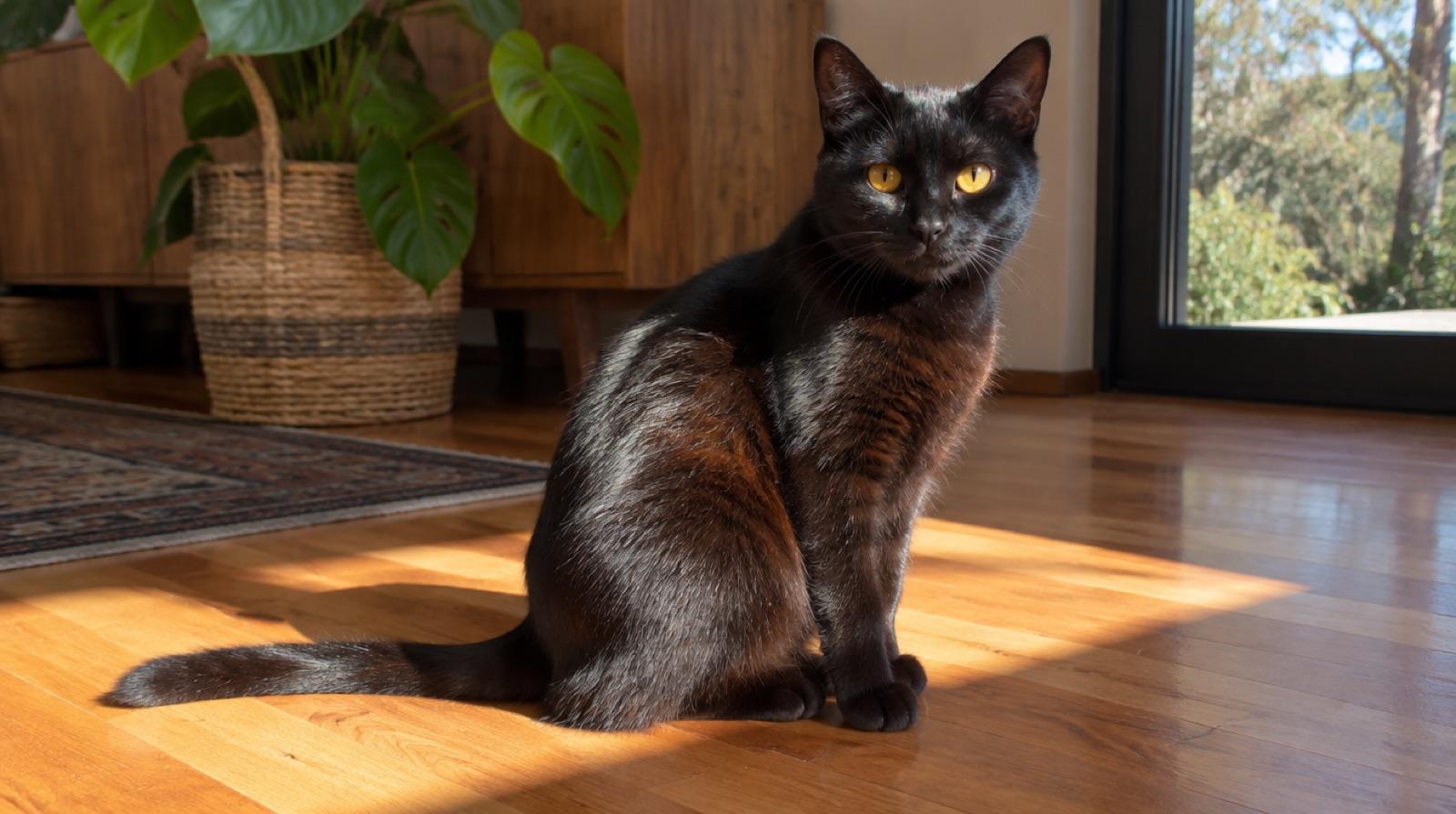
What makes a cat black?
Two copies of a recessive gene variant called non-agouti. In 2003 a team publishing in Current Biology traced it to a tiny deletion, just two DNA letters long, in the ASIP gene (agouti signalling protein). All 57 unrelated black domestic cats they tested from around the world carried two copies, and in a family of 89 cats the deletion and black coat were inherited together every time.
What the gene does is simple once you see a single hair. The UC Davis Veterinary Genetics Laboratory explains that the agouti protein switches pigment production between black and a lighter yellow-red, which gives a normal hair its bands. The non-agouti variant stops the switch, so each hair is one even colour. On a tabby, the banded background hairs are what make the stripes stand out; take the bands away and the whole cat fills in black.
Because the variant is recessive, a black cat needs one copy from each parent. That has three handy consequences:
- Two black parents cannot have tabby kittens, since both can only pass on non-agouti. They can still have blue (grey) kittens if both carry dilute.
- A tabby can carry black without showing it, so two tabbies can produce a black kitten.
- Black and ginger work differently. The orange gene overrides non-agouti, which is why a black mother and a ginger father can have ginger and tortoiseshell kittens alongside black ones. Our ginger cat guide explains that gene.
Blue (grey) is black lightened by the separate dilute gene. The rest of the colour switches, from dilute to white spotting, are set out in our guide to every moggy colour and pattern.
Why can you see faint stripes on a black cat?
Because the tabby pattern is still there under the black. Non-agouti hides the pattern; it does not delete it. A 2009 genetics study in the journal Genetics described non-agouti, non-orange cats as showing no pattern “other than occasional faint ghost patterns.” Owners often say they notice them in kittens or in strong sunlight, but we found no study measuring when they show.
Ghost stripes are harmless. They do not mean a black cat is “part tabby” in any useful sense, because every cat is a tabby underneath.
Why do some black cats turn rusty brown?
The clearest evidence points to diet. In a 2001 study in the Journal of Small Animal Practice, researchers at the University of California, Davis fed black cats diets low in the amino acid tyrosine. Their coats turned reddish-brown, the hair held less melanin under the microscope, and blood tyrosine was low. Black kittens born to mothers fed a tyrosine-deficient diet were reddish too. Diets high in tyrosine or phenylalanine kept or restored the black.
A follow-up in the Journal of Nutrition in 2002 measured the threshold. Cats fed less than about 16 g of phenylalanine plus tyrosine per kilogram of diet developed “red hair,” and the authors recommended at least 18 g/kg to keep a black coat black, well above what was then considered enough for growth. In plain words: the amount of these amino acids that keeps a kitten growing is not enough to keep a black coat fully black.
Two other explanations are often given: sun-bleaching in cats that bask a lot, and a browner tinge with age. Both are widely reported, but we found no study measuring either, so treat them as likely rather than proven. Show standards treat rust as a fault: the Cat Fanciers' Association British Shorthair standard asks for black with “no rusty tinge,” and the Oriental standard for ebony asks for a coat “free from any tinge of rust.”
What to do: if the change is sudden or patchy, the coat is dull or thin, or the cat is on a home-made or restricted diet, talk to your vet rather than adding supplements yourself.
Smoke or solid: what is the difference?
A smoke has a white undercoat; a solid does not. The Cat Fanciers' Association Persian standard describes a solid black as “dense coal black, sound from roots to tip of fur,” and a black smoke as “undercoat white, deeply tipped with black.” The Maine Coon standard uses almost the same words.
| Coat | What you see | How to tell |
|---|---|---|
| Solid black | Black from root to tip | Part the fur: black right down to the skin |
| Black smoke | Looks black at rest, shimmers silver when the cat moves | Part the fur: white or silvery near the skin |
| Rusty black | Black with a brown or reddish sheen, often worst on the flanks | Roots usually darker than tips |
| Black and white (tuxedo) | Black with white chest, paws or face | White patches from a separate white-spotting gene |
| Blue (grey) | Even slate grey | Black lightened by the dilute gene |
On a short coat, smoke can be hard to spot until you part the fur. If a rescue listing says “black smoke,” it is describing the undercoat, not a different personality or breed.
Which cat breeds come in black?
Only one breed is always black: the Bombay. The Cat Fanciers' Association says it was developed in Kentucky from 1966 by crossing a black American Shorthair with a Burmese, to look like a small black panther with gold to copper eyes. CFA calls it one of its rarer breeds, and it rarely appears in Australian rescue.
Many other breeds accept black as one colour among several. These are the ones we checked in the CFA standards:
| Breed | Black in the CFA standard |
|---|---|
| Bombay | The only colour; “black to the roots” with gold to copper eyes |
| British Shorthair | Solid black, “jet black to roots, no rusty tinge”; gold or copper eyes |
| Persian | Solid black and black smoke |
| Maine Coon | Solid black and black smoke |
| Oriental | Called ebony, “free from any tinge of rust” |
In rescue, breed matters far less than you might expect. Almost every black cat Australian rescues list is a Domestic Shorthair, Medium Hair or Longhair, the shelter label for a moggy. A sleek black shorthair with copper eyes is usually not a Bombay, and a fluffy black cat is usually not a Persian or Maine Coon. Our guide to what a Domestic Shorthair is explains the label.
Where do the black cat superstitions come from?
Mostly from medieval Europe. The US National Library of Medicine's history blog traces the bad-luck idea to the Middle Ages, when black cats became tied to witches and the devil, and says the fear travelled to North America with the Puritans. It also notes the opposite traditions: English sailors thought a black cat that came aboard and stayed brought luck, and in Japan black cats are said to bring prosperity and bless a marriage.
In other words, the same black cat is lucky or unlucky depending on where you grew up. None of these beliefs says anything about the cat in front of you.
Do black cats really wait longer in shelters?
Sometimes. Shelter staff call it black cat syndrome, and researchers call it black cat bias. The published studies do not all agree, and the only Australian one we found points the other way. Here is what each study measured and found:
| Study | Where and what | What it found about black cats |
|---|---|---|
| Kogan et al. 2013 | Two Colorado shelters, days to adoption | Black cats took longest. Adult all-black cats averaged 26.55 days against 20.64 for cats that were not mainly black. |
| Brown and Morgan 2015 | A no-kill shelter in New York State, length of stay | Darker adult cats generally stayed longer than lighter ones, but cats recorded as yellow (most likely gingers) had the longest stay. Coat colour made no difference for kittens. |
| Carini et al. 2020 | 7,983 cats at a public shelter in Kentucky, 2010 to 2011 | Black cats had the lowest adoption rate (10.0%) and white the highest (18.8%), but the authors said this gave only “weak support” for black cat bias. Black cats did no better in October. |
| Miller, Ward and Beatty 2019 | 2,584 cats adopted from a Sydney shelter, 2016 to 2019 (University of Sydney) | White cats stayed significantly longer than black cats. No other colour differed significantly from black. |
| Jones and Hart 2020 | People rating photos of cats, not shelter records | Found evidence of bias against black cats. It was stronger in more superstitious people and in people who found black cats' expressions hard to read. |
So the honest answer is that a black-cat penalty has been measured in some American shelters, it is not universal, and the size of the gap varies. In the Sydney study, black was the second most common colour after tabby, at about a quarter of the cats, and the stays of ginger, tabby, grey and tortoiseshell cats did not differ significantly from black cats'. The authors' own advice was that shelters should look at their own data.
The Jones and Hart finding is the most useful one for an adopter. If black cats lose out, a likely reason is that people find them harder to read, in a photo or across a room. That is a problem with the photo, not the cat. Ask the rescue for a video, or meet the cat in person.
Do black cats have a different personality?
No good evidence says so. The studies on colour and personality mostly measure what people believe:
- A 2012 online survey of 189 people, reported by UC Berkeley, found people rated orange cats friendliest and white and tortoiseshell cats least friendly. Black cats were given less extreme traits than other colours. The lead author said there was little evidence that the perceived differences actually exist.
- A 2016 UC Davis survey of 1,274 owners linked more reported aggression toward people to torties, calicos, black-and-white and grey-and-white cats. Solid black cats were not among the colours singled out. These were owner reports, not observed behaviour.
For a desexed rescue cat, its history and how it behaves with a foster carer are far better guides than colour, or sex: see male or female cat for what the research says there.
Tips for choosing a black cat from a listing
Black cats are hard to photograph, so the listing photo is a weaker guide than usual. A few things help:
- Read the description, not just the photo. Notes from a foster carer about how the cat behaves at home are worth more than any picture.
- Ask for a video or a second photo taken in daylight. It is a normal request.
- Meet more than one. Black cats often look alike on a page and are very different in person.
- Ask how long the cat has been listed. A cat that has waited a while may already have a well-known personality.
Rescue cats normally come desexed, vaccinated and microchipped, whatever their colour. For the steps, fees and state laws, read adopting a cat in Australia, and budget with what a cat costs. If you live in Sydney, our Sydney black cat adoption guide lists the local rescues.
Find a black cat near you
These pages show black cats listed by Australian rescues right now, with age, sex and desexing status, and a link straight to the rescue. They are refreshed regularly.
- Sydney: black cats in Sydney
- Melbourne: black cats in Melbourne
- Brisbane: black cats in Brisbane
- Perth: black cats in Perth
- Adelaide: black cats in Adelaide
- Anywhere in Australia: all black cats for adoption
Not sure a cat suits you yet? Try the dog or cat quiz, the what cat breed am I quiz and the adoption readiness check. If a kitten is on your list, kittens in Sydney and kittens in Melbourne include black kittens alongside every other colour.
Frequently asked questions
What makes a cat black?▼
Two copies of a recessive gene variant called non-agouti. Researchers publishing in Current Biology in 2003 found that a 2 base-pair deletion in the ASIP (agouti) gene makes domestic cats black, and that every one of the 57 unrelated black cats they tested carried two copies. With two copies, the hairs lose their light bands and the tabby pattern underneath is hidden, so the cat looks solid black.
Can two black cats have kittens that are not black?▼
Not with tabby kittens, but other colours are possible. Because black (non-agouti) is recessive, two black parents can only pass on non-agouti, so their kittens will not be tabbies, according to the UC Davis Veterinary Genetics Laboratory. They can still have blue (grey) kittens if both carry the dilute gene, and a black mother can have ginger or tortoiseshell kittens with a ginger father.
Why can I see faint stripes on my black cat?▼
Because every black cat still has a tabby pattern underneath. The non-agouti gene hides it, but researchers describe occasional faint ghost patterns in non-agouti cats. The stripes are harmless and do not mean the cat is part tabby in any meaningful way; the pattern was always there under the black.
Why is my black cat turning brown or rusty?▼
Diet is the best-documented cause. Studies at the University of California, Davis in 2001 and 2002 turned black cats reddish-brown by feeding diets low in the amino acids tyrosine and phenylalanine, and turned them black again by adding them back. Sun-bleaching and age are also commonly blamed, but we found no study measuring them. If the change is sudden or patchy, or the coat is dull, see your vet.
What is the difference between a black smoke and a solid black cat?▼
A smoke has a white undercoat. The Cat Fanciers' Association describes a black smoke as having a white undercoat deeply tipped with black, so the cat looks solid black until it moves or you part the fur. A solid black is black from the root to the tip of every hair. Parting the fur is the easiest way to tell them apart.
Which cat breeds come in black?▼
Many, but only one is always black. The Bombay is bred to be black only, with gold to copper eyes, according to the Cat Fanciers' Association. Black is also an accepted colour in the CFA standards for the British Shorthair, Persian and Maine Coon, and the Oriental's black is called ebony. In Australian rescue, almost every black cat is a Domestic Shorthair or Longhair, not a pedigree.
Are black cats adopted less often?▼
Some studies say yes and one Australian study says no. Studies of shelters in Colorado, New York State and Kentucky found black or darker cats waited longer or had worse outcomes, though the Kentucky effect was weak. A University of Sydney study of 2,584 cats adopted from a Sydney shelter between 2016 and 2019 found the opposite: white cats stayed significantly longer than black cats. The effect seems to depend on the shelter.
What is black cat syndrome?▼
It is the shelter belief that black cats wait longer for homes than other colours. Researchers call it black cat bias. The evidence is mixed: some US shelter studies support it, a Sydney study did not, and a 2020 photo-rating study found people rated black cats more negatively, especially people who were more superstitious or found black cats' expressions hard to read.
Do black cats have a different personality?▼
There is no good evidence that they do. In a 2012 survey of 189 people led by a UC Berkeley researcher, black cats were rated as having less extreme traits than other colours, and that study measured people's perceptions, not the cats. A 2016 UC Davis owner survey linked more reported aggression to torties, calicos, black-and-white and grey-and-white cats, not solid blacks. Ask the rescue about the individual cat.
Are black cats bad luck?▼
No. The idea comes from medieval European folklore that tied black cats to witchcraft, and it travelled to North America, according to the US National Library of Medicine. Other traditions say the opposite: sailors kept black cats on ships for luck, and in Japan a black cat is said to bring prosperity. None of it reflects anything about the cat.
Are black cats more likely to have health problems?▼
We found no health condition linked to black coat colour in the veterinary sources we checked. A black cat's health depends on its breed or mix, age and care, like any other cat. The one colour-linked change worth knowing is the rusty brown coat that low-tyrosine diets can cause, which is a diet issue, not a disease of black cats.
Where can I adopt a black cat in Australia?▼
From almost any cat rescue; in the University of Sydney shelter study, about a quarter of the cats were black. Our black cat listing pages for Sydney, Melbourne, Brisbane, Perth and Adelaide show the black cats Australian rescues have listed right now, with each cat's age, sex and desexing status and a link straight to the rescue.
Sources
- Eizirik et al. (2003): Molecular genetics and evolution of melanism in the cat family, Current Biology
- UC Davis Veterinary Genetics Laboratory: Agouti (cat)
- Schmidt-Küntzel et al. (2009): Domestic cat X chromosome linkage map and the sex-linked orange locus, Genetics
- Yu, Rogers and Morris (2001): Effect of low levels of dietary tyrosine on the hair colour of cats, Journal of Small Animal Practice
- Anderson, Rogers and Morris (2002): Cats require more dietary phenylalanine or tyrosine for melanin deposition in hair, Journal of Nutrition
- Cat Fanciers' Association: Bombay, British Shorthair, Persian, Maine Coon and Oriental breed standards
- US National Library of Medicine, Circulating Now: The truth about black cats
- Kogan, Schoenfeld-Tacher and Hellyer (2013): Cats in animal shelters, Open Veterinary Science Journal
- Brown and Morgan (2015): Age, breed designation, coat color and coat pattern influenced the length of stay of cats at a no-kill shelter, JAAWS
- Carini, Sinski and Weber (2020): Coat color and cat outcomes in an urban U.S. shelter, Animals
- Miller, Ward and Beatty (2019): Cats adopted from an urban cat shelter and length of stay, Animals (University of Sydney)
- Jones and Hart (2020): Black cat bias, prevalence and predictors, Psychological Reports
- UC Berkeley News (2012): Don't be so fast to judge a cat by its color (Delgado et al., Anthrozoös)
- Stelow, Bain and Kass (2016): Coat color and aggressive behaviors in the domestic cat, JAAWS
Keep reading
Black cats for adoption
Black cats listed by Australian rescues right now, refreshed regularly.
Ginger cats: why most are male
The orange gene found in 2025, why every ginger is a tabby, and the personality myth.
Every moggy colour and pattern
Tabby, tortie, calico, tuxedo, blue, cream and point, and the genes behind each.
Adopting a cat in Australia
The steps, the fees in every state and the cat laws to know before you bring one home.