The short answer
Applehead and modern Siamese share the same origin, the same pointed coat and the same blue eyes; the difference is head and body type. By the 1950s show Siamese had much longer heads and finer boning than the original cats, and the rounder old style became its own breeding line. TICA calls that old style the Thai and granted it championship status in 2010; FIFe recognises it too. In Australia the ACF and CCCA standards list Siamese but no Thai, ANCATS lists the Thai, and Cats Australia is the TICA club. Across the rescues we aggregate, most cats listed as Siamese are pointed moggies or old-style types, not extreme show cats.
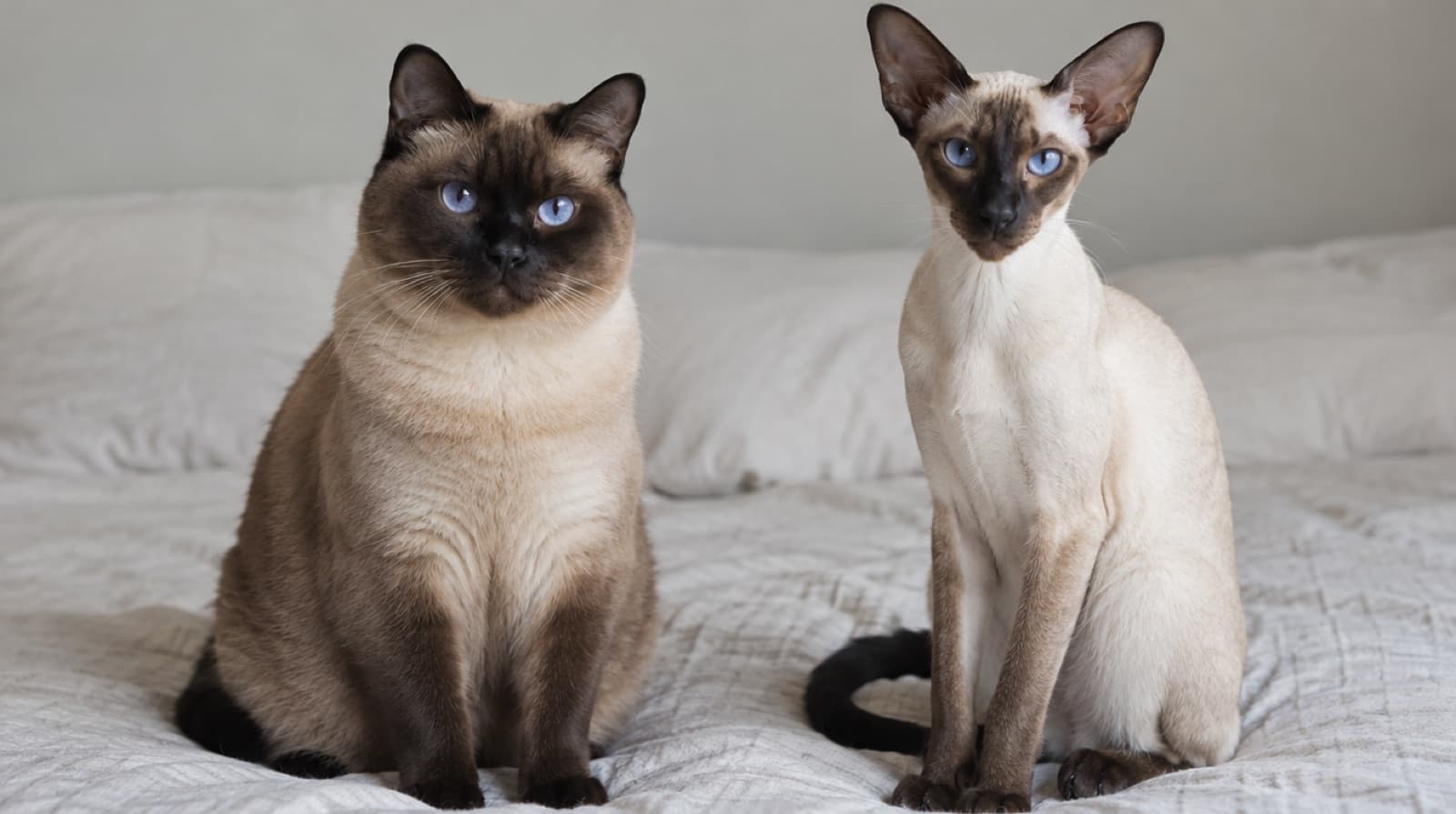
Are applehead and modern Siamese the same breed?
Yes. Both descend from the same pointed cats brought out of Thailand in the 19th century, and both carry the breed's signature: a pale body, darker points on the face, ears, legs and tail, and blue eyes. What changed over the 20th century was the shape of the cat around that coat. Show breeders selected for a longer head and a finer frame, and the cats that kept the older, rounder look were bred on separately.
The names cause most of the confusion. “Applehead” is a colloquial American term, not an official breed name; it describes the rounder skull of the old-style cat. In TICA and FIFe the old style is registered as the Thai, which TICA says is “also called the Old-Style Siamese”. Traditional, classic and old-style Siamese all mean the same cat. The modern wedge-head is simply the Siamese in the CFA, ACF and GCCF standards.
In Australia the picture is split. When we read the standards lists on 18 October 2026, the Australian Cat Federation (ACF) and the Co-Ordinating Cat Council of Australia (CCCA) each carried a Siamese standard but no Thai. Australian National Cats Inc (ANCATS) lists the Thai among its breeds, and Cats Australia is the TICA charter club here. So a Thai can be registered and shown in Australia, but only through some registries.
Applehead vs modern Siamese at a glance
The table below puts the two looks side by side. Head and body rows follow the TICA Thai standard and the CFA and ACF Siamese standards in plain words; the temperament row is a tendency, not a promise.
| Feature | Traditional (applehead, old style, Thai) | Modern (show Siamese) |
|---|---|---|
| Head shape | Rounded, apple-like skull with a moderately wedge-shaped face and a gentle, full muzzle | Long, straight wedge from nose to ear tips, flat planes, fine muzzle |
| Ears | Medium size, set more upright on the head | Strikingly large, wide at the base, flared to continue the lines of the wedge |
| Eyes | Blue, rounder, set slightly less on the slant | Blue, almond shaped, slanted toward the nose |
| Body and boning | Medium, moderate build with some substance; sits between a moggy and a show cat | Long, tubular and slim, with fine boning, long legs and a whip-like tail |
| Coat and points | Short, close coat; pale body with darker points in seal, blue, chocolate, lilac and other colours by registry | Same short coat and pointed pattern; accepted point colours vary by registry |
| Typical temperament (tendency only) | Vocal and people-focused; often described as a touch more laid-back | Vocal, busy and people-focused; often described as more intense |
| Registries that recognise it | TICA (championship 2010) and FIFe as the Thai; WCF since 1990; ANCATS lists Thai; Cats Australia as the TICA club | CFA, GCCF, FIFe, TICA, ACF and CCCA as the Siamese |
How did one breed end up with two looks?
The Siamese arrived in Britain and then North America as a medium-sized cat with a moderately wedge-shaped head. The GCCF breed history describes the original cats that way, and notes that a more slender version was favoured from the middle of the 20th century. Judges rewarded length and fineness, breeders followed the judges, and the look moved in one direction for decades.
TICA puts a date on the shift: by the 1950s show Siamese had much longer heads and finer boning than the cats of fifty years earlier. Owners and some breeders who preferred the older shape kept breeding it, but their cats no longer matched the written standard, so they could not compete. That is where the applehead nickname comes from, as a way of describing a cat the show ring had left behind.
Recognition came slowly. The World Cat Federation (WCF) recognised the Thai as a breed in 1990. TICA followed, granting the Thai championship status in 2010, and FIFe recognises it as well. The CFA keeps a single Siamese standard that describes the modern type, as does the ACF in Australia with its Siamese standard dated October 2023. Neither of those documents is wrong; each describes the cat its registry chose to keep.
How do I tell which type a cat is?
Look at the cat in profile and from the front, and judge the whole animal rather than one feature. The checks below are the ones that separate the two looks most reliably in an adult cat.
- Profile. A modern Siamese shows a long, nearly straight line from the top of the head to the tip of the nose. An old-style cat has a rounder forehead and a visible curve where the forehead meets the nose.
- Ears. On a modern cat the outer edges of the ears carry on the lines of the face, so the head reads as one big triangle. On an old-style cat the ears sit more upright and the head reads as a rounded wedge.
- Body. Pick the cat up. A modern Siamese feels long and light, with fine legs and a thin tail. An old-style cat feels more solid for its size, closer to a well-built moggy.
- Age. Kittens of both types have round faces. The long wedge develops as a modern Siamese matures, so do not label a young kitten from its head alone.
One more caution. The pointed coat and blue eyes that make a cat look Siamese come from a single colourpoint gene that restricts colour to the cooler parts of the body, and that gene turns up in moggies too. A rounder-headed pointed cat with no papers is just as likely to be a Siamese cross or a pointed Domestic Shorthair as a Thai. Our guide to moggy colours and patterns explains how colourpoint is inherited. Without a pedigree, type is a description, not a breed.
Which Siamese turns up in Australian rescue?
Mostly the old-style look, or something close to it. Across the rescues we aggregate, most cats listed as Siamese are pointed moggies or moderate, round-headed types rather than extreme show cats. Pedigree cats bred to the modern standard are a small share of Australian cats, and the ones that do need rehoming are often placed by their breeder or breed network before they reach a shelter listing. The Siamese that reach rescue are usually crosses, owner surrenders of unknown background, or cats a shelter has labelled by looks.
Shelters generally describe a cat by what they can see. A pointed cat with no history is often listed as a Siamese cross, a Siamese mix, or a Domestic Shorthair with a note about the colouring. If you want the applehead look specifically, that works in your favour: the cat you are picturing is the one most likely to be sitting in a listing right now. Browse adoptable Siamese and crosses nationally, or the Sydney cat listings if you are in NSW.
Breed-specific cat rescue barely exists in Australia; we could not verify a single Siamese-only rescue when we checked in October 2026. The one verified option is a wait list: DCH Animal Adoptions, a NSW foster-based rescue, keeps a wait list for Siamese and Oriental cats and matches adopters when one comes in. Elsewhere, set an alert on the breed page and check the general rescues, because that is where pointed cats are listed. If you are the one rehoming a Siamese, our Siamese rehoming guide covers how to do it without handing the cat to a stranger.
Searching “applehead Siamese for sale” or “applehead Siamese cattery”?
Start with the registries, not the classifieds. In Australia a “cattery” in this sense means a registered breeding prefix, and the breeder behind it should be a current member of a recognised cat body. ANCATS runs a public Check a Member lookup on its site, the ACF publishes the list of its member bodies, and Cats Australia is the club to ask if you want a TICA-registered Thai with papers that say Thai. A breeder who cannot tell you which body they register with, or whose prefix does not appear when you check, is not a registered breeder whatever the ad says.
Be clear about what you are buying. If the papers say Siamese from an ACF or CCCA affiliate, the breeder is working to a modern standard, even if some kittens finish rounder than others. If you want the old style on paper, you are looking for a Thai, and in Australia that means the ANCATS or TICA route. Ask to see both parents, in person or on a video call, because the parents are the best guide to how a kitten will look as an adult.
The scam pattern is the same as for any sought-after pet. Scamwatch advises viewing the pet in person, asking for a video call if you cannot, and comparing pricing, and it warns that a very cheap pet is likely a scam. Watch for a seller who is always interstate, who wants a deposit before you have seen the kitten move, or who adds transport, crate or vet fees after you have paid. We do not quote a Siamese price because no registry publishes one; compare several registered breeders yourself.
And weigh the rescue route honestly before you buy. A rescue cat arrives desexed, microchipped and vaccinated, with a vet check behind it, and the applehead look you are searching for is the one rescue has. If you are not sure you are ready for a vocal, people-focused cat, the adoption readiness check takes a few minutes.
Do the two types differ in health or temperament?
Less than the internet suggests. Both types share the same breed background, and the conditions a Siamese owner watches for, dental disease among them, apply to both. Some owners believe the moderate type is hardier because it is closer to the original cat, but we have not found evidence that one head shape is healthier as a group. The individual cat, its parents and its vet history tell you far more than the shape of its skull.
Heart health is the question worth asking directly. Ask the breeder or your vet about heart screening, what it involves and whether the parents have been checked, and ask a rescue what its vet check covered. Keep up with dental checks, since Siamese-type cats are prone to gum and tooth trouble, and talk to your vet about anything that seems off. None of that changes between an applehead and a wedge-head.
On temperament, the honest answer is a tendency. Old-style cats are often described as a little calmer, and modern cats as more intense, but both are talkative, clever and want to be where you are. Neither suits a home where no one is around for long stretches. Meet the cat, ask the rescue or breeder how it behaves day to day, and choose the individual rather than the label.
Frequently asked questions
Is an applehead Siamese a different breed from a Siamese?▼
No. The applehead is the older, rounder-headed look of the same breed, and the modern wedge-head is the look favoured in show rings since the middle of the 20th century. TICA and FIFe register the old style under its own name, the Thai, so in those registries it is a separate breed on paper. In Australia the ACF and CCCA standards list Siamese but no Thai.
What is a Thai cat?▼
The Thai is the registered name for the old-style Siamese in TICA and FIFe. TICA describes it as also called the Old-Style Siamese, with the rounder head and more moderate body of the cats imported from Thailand before show breeding changed the look. WCF recognised the Thai in 1990 and TICA granted it championship status in 2010.
Is the applehead Siamese a recognised breed in Australia?▼
Not under that name. Applehead is a colloquial American term, not an official breed name anywhere. When we read the Australian standards lists in October 2026, the ACF and CCCA carried Siamese but no Thai. ANCATS lists the Thai among its breeds, and Cats Australia is the TICA charter club in Australia, so TICA-registered Thai cats can be shown here through that route.
How can I tell if my cat is an applehead Siamese or a Siamese cross?▼
Without papers you cannot tell for certain, because a pointed coat and blue eyes are not unique to the breed. The colourpoint pattern is a temperature-sensitive gene that restricts colour to the face, ears, legs and tail, and it turns up in moggies as well as pedigree cats. A rounder head, medium ears and a moderate body with points suggests old-style type, but a pedigree is the only proof of breed.
Are applehead Siamese healthier than modern Siamese?▼
There is no evidence we can point to that one type is healthier as a group. Both share the same breed background and the same list of conditions worth watching, so the individual cat and its line matter more than the head shape. Ask the breeder or your vet about heart screening and dental care, and ask a rescue what its vet check covered.
Are applehead Siamese calmer or quieter than modern Siamese?▼
Sometimes, but it is a tendency rather than a rule. Old-style cats are often described as a little more laid-back, while both types are vocal, people-focused and want company. Temperament comes from the individual cat, its parents and its early handling far more than from head shape, so meet the cat before you decide.
Where can I find an applehead Siamese for sale in Australia?▼
Look for a breeder registered with an Australian cat body rather than a classified ad. ANCATS has a public Check a Member lookup, the ACF publishes its member bodies, and Cats Australia is the TICA club if you want a TICA-registered Thai. Scamwatch advises viewing the pet in person or by video call before paying anything, and warns that a very cheap pet is likely a scam.
Do applehead Siamese turn up in rescue?▼
Yes, more often than the extreme show type. Across the rescues we aggregate, most cats listed as Siamese are pointed moggies or old-style types rather than long wedge-headed show cats, and many are listed as a Siamese cross or a pointed Domestic Shorthair. One NSW rescue, DCH Animal Adoptions, runs a wait list for Siamese and Oriental cats.
Can a Siamese kitten's head shape change as it grows?▼
Yes. Kittens of both types start with rounded faces, and the long wedge of a modern Siamese develops as the cat matures. A breeder can tell you what the parents look like, which is the best guide to how a kitten will finish. In a rescue kitten with no history, wait until the cat is grown before you label the type.
Sources
- TICA: Thai breed page
- GCCF: Siamese breed history
- CFA: Siamese breed standard
- Australian Cat Federation: Siamese standard (October 2023)
- Australian Cat Federation: breed standards list
- Co-Ordinating Cat Council of Australia: breed standards list
- FIFe: recognised breeds
- Scamwatch (ACCC): buying and selling scams
Keep reading
Siamese cats for adoption across Australia
Live listings of Siamese, Siamese crosses and pointed cats from the rescues we aggregate.
Rehoming a Siamese
If you need to find your Siamese a new home, how to do it safely and what adopters will ask.
Oriental Shorthair
The Siamese cousin bred in solid colours and patterns, sharing the same wedge head and voice.
Cats for adoption in Sydney
Every cat listed by the Sydney rescues we aggregate, updated regularly.