The short answer
If you want a papered Birman kitten, buy from a breeder registered with a cat council and expect to pay around the club guide: the Birman Cat Club of Australia says from $1,600 for a kitten that is desexed, vaccinated and microchipped. Two member breeders who publish a price listed $1,800 and $2,500 plus GST in November 2026, too few for a range. Ask for both parents' DNA results for congenital hypotrichosis. Purebred Birmans are uncommon in rescue, but adults, crosses and Birman-look colourpoint longhairs do appear, for a rescue fee of a few hundred dollars with desexing and vaccination included. All figures were read on 9 November 2026 and are a reference, not a quote.
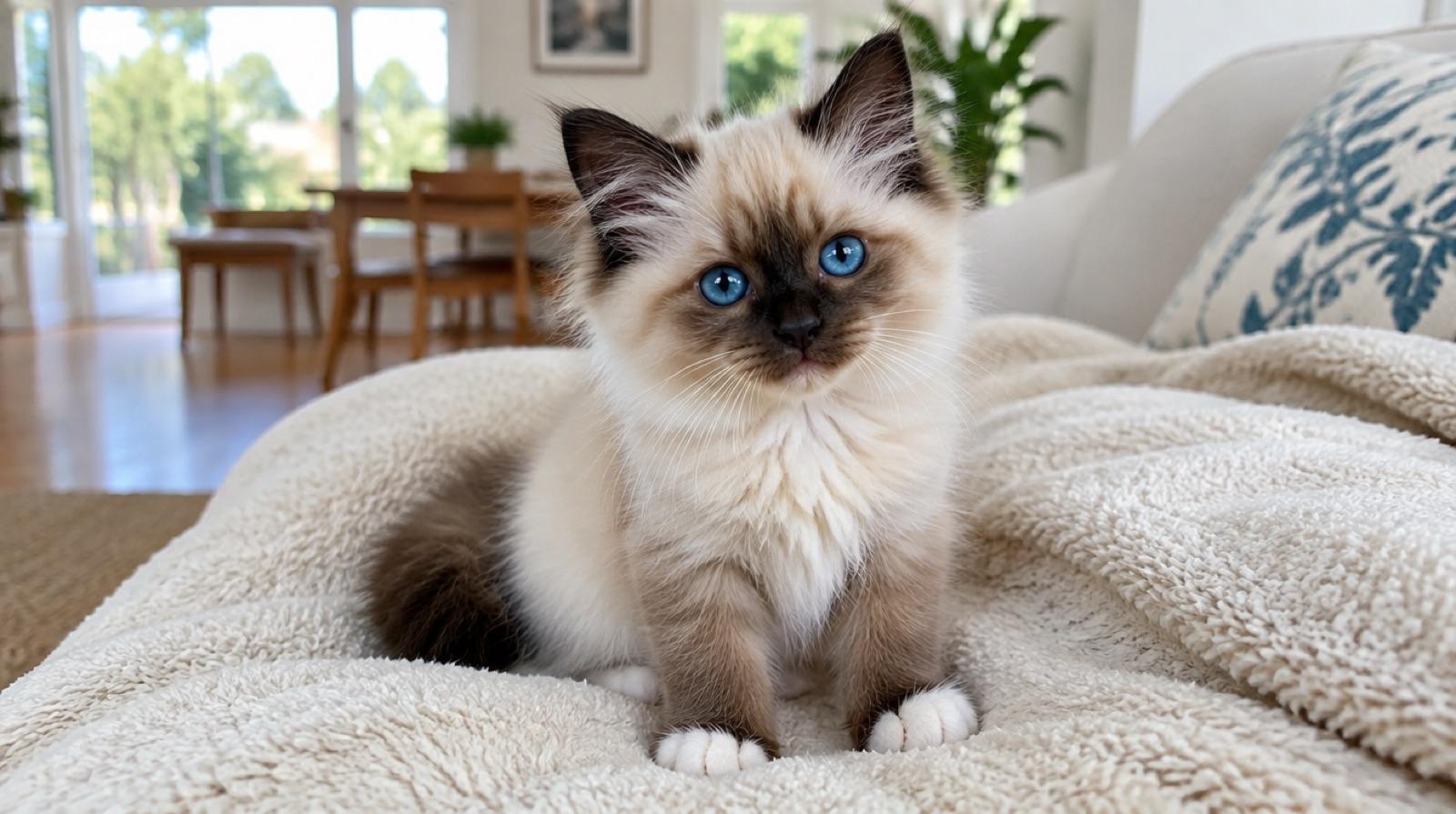
Should you adopt or buy a Birman?
It depends on whether the papers matter to you. If you want a purebred Birman kitten with known parents, a breeder registered with a cat council is the realistic route, because purebred Birman kittens rarely reach rescue. If what you want is a calm, affectionate longhaired cat with blue eyes, rescues list adults, Birman crosses and colourpoint longhairs that give you much of the look for a fraction of the price.
| Route | Reference cost | What you usually get | Main risk |
|---|---|---|---|
| Registered breeder | Club guide from $1,600; two member breeders listed $1,800 and $2,500 plus GST | A papered kitten, usually desexed, vaccinated and microchipped, a chance to meet the mother | A wait for a kitten; health testing still needs asking about |
| Rescue | A rescue fee, often a few hundred dollars | Mostly adults, crosses and Birman-look longhairs, desexed, microchipped and vaccinated | Few purebreds; unknown parents |
| Online ad or social media | Anything, often well under the club guide | Anything from a real litter to a kitten that does not exist | Scams, unregistered breeding, crosses sold as purebreds |
Club guide, breeder prices and rescue fees read 9 November 2026 on the pages linked below. A reference, not a quote: breeders and rescues set and change their own prices.
What does a Birman kitten cost from a registered breeder?
Birmans are unusual: a breed club publishes a guide price, so you have a benchmark that does not depend on any one seller.
| Source | Published guide | Includes |
|---|---|---|
| Birman Cat Club of Australia, Code of Ethics | “From $1,600” | Desexed, vaccinated and microchipped |
| Member breeders' own websites | Two published a pet price: $1,800, and $2,500 plus GST | Vaccinated and microchipped on both sites; desexing included on one |
Read 9 November 2026. We looked for Birman breeders who show cat council membership on their own website and publish a pet kitten price there, leaving out listing sites and “price on application”. Only two of the sites we checked qualified, both in Queensland, which is too small a sample to quote a range; most breeders ask you to contact them. A reference, not a quote.
The club code also sets out what the price should cover. The Birman Cat Club of Australia's code says kittens may not be sold younger than 10 weeks, must be vaccinated, microchipped, vet certified and house trained, and that a kitten not desexed before it leaves must be desexed by 5 months under a signed contract. Its listings page notes that prices vary with what is included, such as how many vaccinations and whether the kitten is already desexed. Compare those inclusions, not just the number.
For the first year's food, vet care and insurance on top, see our cat desexing cost guide and the kittens for sale guide.
What does the Australian Birman standard ask for?
The Coordinating Cat Council of Australia Birman standard (November 2024) is the clearest description of what a purebred should look like:
- Coat: semi-longhaired and silken, short about the face but longer at the cheeks, with a full ruff around the neck, slightly curled on the stomach, and “of such texture that it will not mat”.
- Eyes: almost round and blue in every colour: deep blue for seal and red, bright blue for blue and cream, bright blue preferably with violet undertones for chocolate and lilac. Green eyes rule a cat out of show awards.
- Gloves: “The white feet are characteristic of the Birman.” Front paws are gloved evenly across the paw; back paws are white over the whole paw, tapering up the back of the leg. Gloves and gauntlets carry 20 of the standard's 100 points.
- Colours: seal, blue, chocolate, lilac, red and cream points, with tortie, tabby, tortie tabby, smoke and silver tabby versions.
The standard does not describe temperament, so we do not quote one. Every cat is an individual, and a breeder or rescue that knows the cat is the best guide to its personality. A kitten without white gloves or blue eyes may be a lovely pet; it is just unlikely to be a purebred Birman.
Which health questions should you ask a Birman breeder?
Three conditions come up in the veterinary literature for Birmans. Only one has a DNA test that breeders can use to avoid it.
| Condition | What the evidence says | What to ask |
|---|---|---|
| Congenital hypotrichosis | Kittens born hairless with a short life expectancy; recessive, so two healthy carriers can produce it; a DNA test is available (PLOS One, 2015) | Have both parents been DNA tested, and how are carriers paired? |
| Feline infectious peritonitis (FIP) | A 2006 single-hospital study reported a significantly higher risk in Birmans and several other breeds | Have any kittens from this cattery or these parents developed FIP? |
| Neutrophil granulation anomaly | A rare inherited trait; neutrophil function is unaffected and no treatment is required (Vetlexicon) | Nothing to avoid; just tell your vet the cat is a Birman before blood tests |
From Abitbol et al. (2015), Pesteanu-Somogyi et al. (2006) and Vetlexicon, read 9 November 2026. A buying checklist, not veterinary advice.
The hypotrichosis study found none of the reported hairless kittens survived beyond eight months, which is why a breeder's answer on testing matters. The FIP study is one hospital's records, so it is a reason to ask about earlier litters, not a forecast for any kitten. Also ask to see the kitten's vet check, and book your own vet visit in the first week.
See Birmans listed by rescues right now
Purebred Birmans are uncommon in rescue, so they go quickly. The breed page shows Birmans and Birman crosses listed today, and an alert tells you when a new one arrives.
See Birmans →What do Birmans in rescue look like?
Mostly adults and look-alikes. Across the rescues we aggregate, purebred Birmans appear only now and then, usually as adults whose owners could no longer keep them. More often you will see Birman crosses and colourpoint longhaired cats with blue eyes, listed as Birman on looks. Without papers, the white gloves are the strongest visual clue, but the personality a foster carer describes matters more than the label.
A rescue cat arrives desexed, microchipped and vaccinated, for a fee well below a breeder kitten:
| Rescue | Published fee | Checked |
|---|---|---|
| RSPCA NSW | $270 kitten under 6 months; $220 cat over 6 months | 9 Nov 2026 |
| Cat Protection Society of NSW | $150 per cat or kitten | 9 Nov 2026 |
Fees as published on the date shown. A reference, not a quote: fees change, and some cats are priced individually.
If you are open to an adult, an older Birman or Birman cross can suit a quiet home well, and the rescue can tell you how it lives with people and other pets.
How do you check a Birman breeder?
- The cat council. Ask which body the breeder is registered with and check with that body yourself. Australian registering bodies include ANCATS, the Australian Cat Federation and its member bodies, and the Coordinating Cat Council of Australia and its members.
- The breed club. The Birman Cat Club of Australia lists member breeders. A breeder who follows a club code has agreed to its rules on age, desexing and paperwork.
- The state number. NSW requires a breeder identification number in ads, Victoria a Pet Exchange Register source number, and Queensland and South Australia have their own rules. Our kittens for sale guide sets out each state's scheme.
- The parents and the paperwork. Meet the mother, ask for both parents' hypotrichosis DNA results, and read the contract, including any take-back clause.
What do Birman scams look like?
Never pay a deposit for a Birman you have not seen with its mother, in person or on a live video call. A request for more money for transport or insurance after a deposit is the classic scam script.
Scamwatch says scammers set up fake websites, social media profiles and marketplace listings for popular breeds and pets that do not exist, and that if a pet is very cheap, it is likely a scam. Because Birmans have a published club guide, a price well under it is an easy warning sign to spot. So is a “Birman” kitten without blue eyes or white gloves, with no council registration, or one offered with no desexing contract when the club code expects one.
Is a Birman the right cat for you?
A Birman suits a household that wants a longhaired cat kept indoors or in a contained run, can manage regular brushing, and has someone home for company. If allergies are a concern, no cat is hypoallergenic; read our hypoallergenic cats guide first. Still choosing between breeds? Try the what cat breed am I quiz, the dog or cat quiz or the adoption readiness check, and compare the Ragdoll, Siamese and Persian guides.
Find a Birman near you
Each page shows Birmans and Birman crosses listed right now by rescues in that city, and each listing links to the rescue where you apply directly.
- Birmans for adoption in Sydney
- Birmans for adoption in Melbourne
- Birmans for adoption in Brisbane
- Birmans for adoption in Perth
- Birmans for adoption in Adelaide
Long-haired cats of every type, listed by city: Sydney, Melbourne, Brisbane, Perth, Adelaide.
Rescue kittens by city: Sydney, Melbourne, Brisbane, Perth, Adelaide.
Frequently asked questions
How much is a Birman kitten in Australia?▼
The Birman Cat Club of Australia's code says a buyer should expect to pay from $1,600 for a desexed, vaccinated and microchipped kitten. Two member breeders who publish a price on their own websites listed $1,800 and $2,500 plus GST in November 2026, too small a sample for a range. These are reference figures, not quotes.
Why are Birman kittens expensive?▼
Because a registered breeder carries real costs before a kitten leaves: vet checks, vaccinations, microchipping, usually desexing, registration with a cat council and the care of the breeding cats. The club guide assumes those are included. A Birman priced far below the club guide usually means something is missing, or that the kitten or the ad is not what it claims.
What does a Birman look like?▼
The Coordinating Cat Council of Australia standard describes a semi-longhaired, silken coat with a full ruff, blue eyes, a pale body with coloured points, and white feet, which it calls characteristic of the Birman. The front paws are gloved in white across the paw and the back paws have white gloves that taper up the back of the leg. Under the show standard, green eyes rule a cat out of awards.
What colours do Birmans come in?▼
The Coordinating Cat Council of Australia standard recognises seal, blue, chocolate, lilac, red and cream points, plus tortie, tabby, tortie tabby, smoke and silver tabby versions. Every colour has blue eyes and white gloves. Seal and red points have deep blue eyes, blue and cream bright blue, and chocolate and lilac bright blue, preferably with violet undertones.
What health tests should a Birman breeder do?▼
Ask about a DNA test for congenital hypotrichosis, an inherited condition in which kittens are born hairless and have a short life expectancy. A 2015 study in PLOS One found it is recessive, so two healthy carrier parents can produce affected kittens, and says a DNA test is available. Ask for both parents' results, the health of earlier litters, and whether the kitten has been vet checked. Any treatment questions are for your vet.
Are Birmans prone to FIP?▼
One study reported a higher risk. A 2006 study in the Journal of Feline Medicine and Surgery, based on cats at one hospital, found Birmans among the breeds with a significantly higher risk of feline infectious peritonitis (FIP), along with Abyssinians, Bengals, Himalayans, Ragdolls and Rexes. It was a single-hospital study, so treat it as a reason to ask a breeder about earlier kittens, and to talk to your vet, not as a prediction for any one cat.
What is Birman neutrophil granulation anomaly?▼
A harmless inherited quirk of the white blood cells. Vetlexicon describes it as a rare hereditary trait in Birman cats in which neutrophil function is unaffected, with no treatment required and a good prognosis. It matters mainly so your vet knows that unusual-looking granules on a blood test can be normal for a Birman.
Can you adopt a Birman in Australia?▼
Sometimes, but purebred Birmans are uncommon in rescue. Across the rescues we aggregate they appear only now and then, often as adults, Birman crosses or colourpoint longhaired cats listed as Birman on looks. Watch the Birman breed page for your city, set an alert, and include long-haired cats in your search.
How much does it cost to adopt a cat instead?▼
A few hundred dollars at most rescues. RSPCA NSW charges $270 for a kitten under 6 months and $220 for an adult cat, and the Cat Protection Society of NSW charges $150 per cat or kitten, with desexing, microchipping and vaccination included (read 9 November 2026). These are reference figures, not quotes.
How do I check a Birman breeder is registered?▼
Ask which cat council the breeder belongs to and check with that council directly, not through a link the seller sends. Australian registering bodies include ANCATS, the Australian Cat Federation and its member bodies, and the Coordinating Cat Council of Australia and its members. The Birman Cat Club of Australia lists member breeders on its website. Then check your state's own rules, such as a breeder number in NSW or a Pet Exchange Register source number in Victoria.
Does a Birman need much grooming?▼
Less than its long coat suggests. The Australian standard describes a silken coat of such texture that it will not mat, with a full ruff around the neck. Regular brushing keeps loose hair down, especially when the coat sheds seasonally. A Birman is not hypoallergenic; no cat is.
Sources
- Birman Cat Club of Australia: Code of Ethics (price guide)
- Birman Cat Club of Australia: Breeder listings
- Coordinating Cat Council of Australia: Birman standard (Nov 2024)
- Abitbol et al. (2015), PLOS One: FOXN1 and congenital hypotrichosis in the Birman cat
- Vetlexicon: Birman neutrophil granulation anomaly
- Pesteanu-Somogyi et al. (2006), Journal of Feline Medicine and Surgery: Prevalence of feline infectious peritonitis in specific cat breeds
- Scamwatch: Buying and selling scams (pet scams)
- RSPCA NSW: Adoption fees
- Cat Protection Society of NSW: Cats for adoption
Keep reading
Birmans listed by rescues
Birmans and Birman crosses listed right now by the rescues and shelters we aggregate.
Ragdoll price in Australia
The other blue-eyed colourpoint longhair: breeder prices, health testing and the rescue route.
Kittens for sale: adopt or buy?
State breeder rules, how to check a seller, and what rescue kittens cost.
What cat breed am I?
A short quiz that matches your home and routine to a cat type before you choose.