The short answer
If you want a papered Siamese kitten, buy from a breeder registered with a cat council who shows you DNA reports for PRA and gangliosidosis: the Siamese Cat Society of NSW lists $2,500 to $3,500 for a kitten. If what you want is the talkative, people-focused cat with blue eyes and dark points, rescue lists pointed cats and Siamese crosses through the year for a few hundred dollars with desexing and vaccination included. A “purebred” kitten far below breeder prices, with no visit allowed, is a scam pattern. All figures are reference points checked 9 November 2026, not quotes.
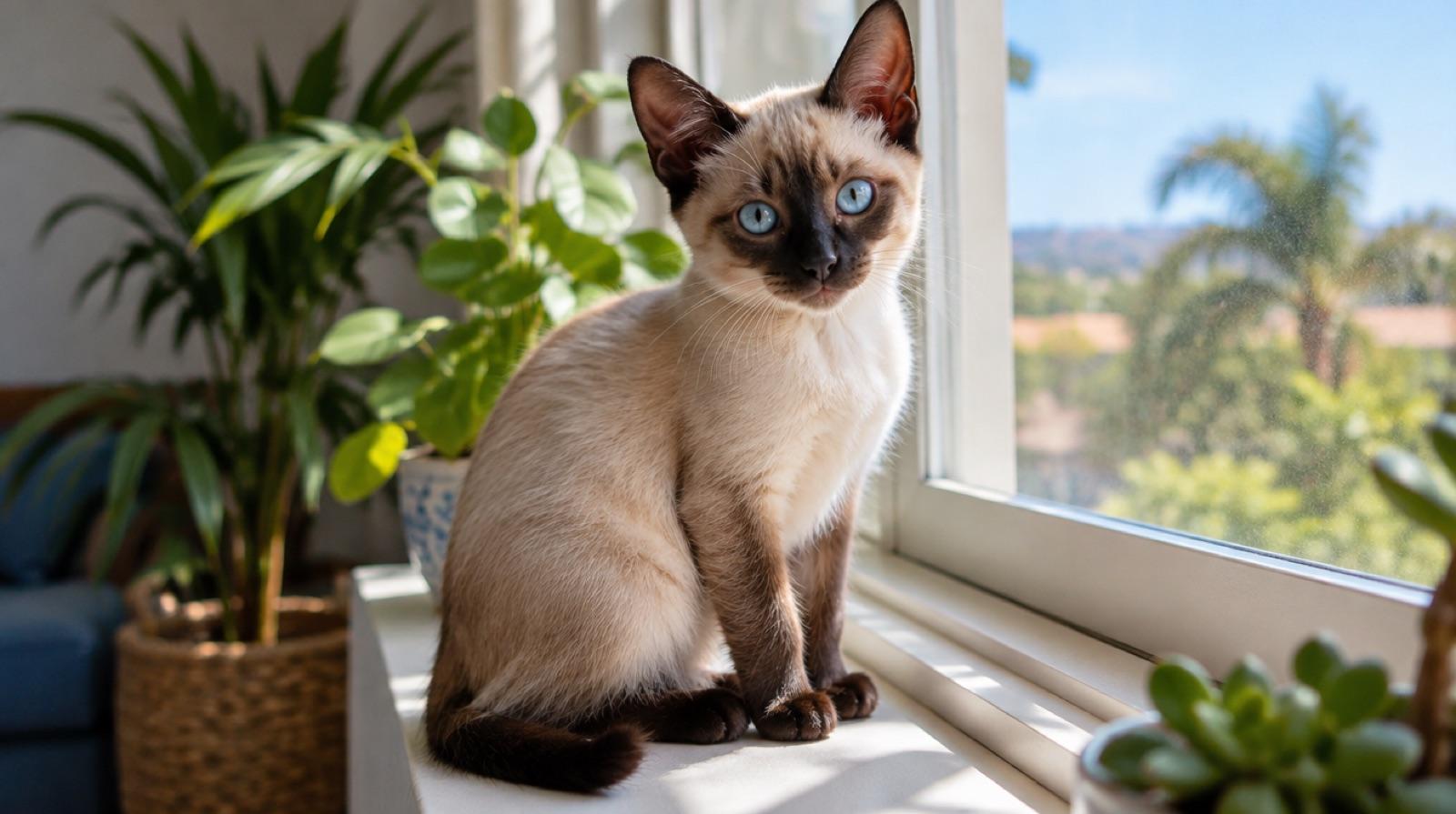
Should you adopt or buy a Siamese?
It depends on whether you want the papers or the personality. If you want a registered Siamese kitten, for showing or because the pedigree matters to you, a registered breeder is the honest answer. If you want a chatty, affectionate cat with blue eyes and dark points, Siamese-type cats and Siamese crosses do come through Australian rescue, and the fee includes desexing, microchipping and vaccination.
There are three routes, and each has its own trap:
- A registered breeder. About $2,500 to $3,500, according to the Siamese Cat Society of NSW, often with a wait for a particular colour. The trap is a seller who says “purebred” without registration papers or DNA reports.
- A rescue, shelter or council pound. A few hundred dollars, all vet work done. The trap is a label: a pointed moggy listed as “Siamese” is still a moggy, which is fine as long as you know it.
- An online ad. The highest risk. Scamwatch says a very cheap pet is likely a scam.
What does a Siamese kitten cost in Australia?
The Siamese Cat Society of New South Wales lists $2,500 to $3,500 on its kitten availability page, above its list of what to expect from a registered breeder (page updated 19 October 2026). It does not say whether that is a recommended price or what each end of the range covers, so treat it as a guide, not a fixed fee. We also read the websites of Siamese breeders elsewhere in Australia that show membership of a cat council on their own site or in the council's own breeder list. Only two published a price for a pet kitten there, one in WA and one in Tasmania, at $2,000 and $2,100. Two breeders is too few to call a range, so treat these as examples; both sit below the bottom of the society's figure.
| Route | Reference cost | What is included | Source |
|---|---|---|---|
| Siamese Cat Society of NSW breeders | $2,500 to $3,500 | The society's must-have list: desexing certificate, two F3 vaccinations, microchip, Cats NSW registration, PRA and gangliosidosis DNA reports | Siamese Cat Society of NSW, read 9 Nov 2026 |
| Other member breeders that publish a price (2 only) | $2,000 and $2,100 | Desexing, vaccination, microchip, pedigree registration and pet insurance in both cases | Breeders' own websites, read 9 Nov 2026 |
| RSPCA NSW | $270 kitten (under 6 months); $220 adult cat | Desexing, microchipping, vaccinations and health checks | RSPCA NSW fees, read 9 Nov 2026 |
| Cat Protection Society of NSW | $150 per cat or kitten, $250 for two | Vet check, desexing, microchip, first vaccination, flea and worm treatment | Cat Protection Society, read 9 Nov 2026 |
Reference figures, not quotes. Breeders set their own prices for each litter and rescues change their fees; follow the link or ask before you rely on a number. Fees in other states are in our guide to kittens for sale in Australia.
The society's page also lists optional extras some breeders include, such as a starter pack and a short period of free pet insurance. Whatever the price, the paperwork is what you are paying for: proof of registration, the DNA reports and the vet records.
Which health tests should a Siamese breeder show you?
The Cat Fanciers' Association says most Siamese are healthy and that breeders are working on two key issues: progressive retinal atrophy, which can cause blindness and has a DNA test, and amyloidosis, which causes liver problems and has no test yet. Australian breeders add more. The Siamese Cat Society of NSW puts DNA test reports for PRA and gangliosidosis on its must-have list for a kitten from a registered breeder, and the Australian Cat Federation's minimum testing list for the breed reads like this:
| Check | What it screens for | What to ask to see |
|---|---|---|
| PRA DNA test (rdAc) | Progressive retinal atrophy, an inherited eye disease. The CFA says it is recessive, so carriers can be bred only to non-carriers | Laboratory reports for both parents |
| Gangliosidosis (GM1) DNA test | An inherited disease of the nervous system; on both the society's and the ACF's lists | Laboratory reports for both parents |
| MPS VI DNA test | Mucopolysaccharidosis type VI, an inherited storage disease | Ask whether it was tested |
| Amyloidosis (no DNA test) | Abnormal protein in organs; the CFA says in Siamese it causes liver problems | Any history of it in the kitten's lines, as the CFA advises |
| Tests some laboratories add | Niemann-Pick disease, PKD and two forms of acute intermittent porphyria, each listed by one laboratory | Ask what the breeder tests for and why |
Sources: Australian Cat Federation, DNA health testing by breed (Oct 2025); Siamese Cat Society of NSW; Cat Fanciers' Association. This is a checklist for talking to a breeder, not veterinary advice.
International Cat Care lists further conditions seen in Siamese and related cats, including asthma, a crossed-eye squint (strabismus), and some forms of lymphoma and intestinal cancer. None has a breeder test, which is one more reason to ask about the health of the parents and earlier litters, and to keep up regular vet checks for life.
Is it a Siamese or a pointed domestic cat?
The Siamese look is the pointed pattern: a pale body with darker face, ears, legs and tail, and blue eyes. That pattern comes from a temperature-sensitive gene, and it turns up in domestic cats with no Siamese papers at all. So Australian shelters see a steady stream of pointed cats, and many are listed as “Siamese” or “Siamese cross” because of the look.
| Feature | Registered Siamese | Pointed moggy or Siamese cross |
|---|---|---|
| Eyes | Blue; the CFA calls for deep, vivid blue | Often blue, sometimes paler or another colour |
| Point colours | The CFA recognises seal, chocolate, blue and lilac points | Any, including tabby points, red points and white feet |
| Head and body | Modern type: long wedge head, large ears, svelte body. Old-style type: rounder and sturdier | Anything in between |
| Proof | Registration and pedigree papers from a cat council | None needed: it is a moggy |
Sources: Cat Fanciers' Association Siamese standard; Australian Cat Federation Siamese standard. The moggy column is general guidance, because a moggy has no standard.
Only papers prove a pedigree. For most people that does not matter: you are choosing a personality, and pointed rescue cats are often just as chatty and affectionate. If you are curious about head shape, our guide to applehead versus modern Siamese explains the two types, and our guide to domestic shorthair colours and patterns explains the pointed gene in moggies.
See Siamese and pointed cats listed near you
Siamese, Siamese crosses and pointed domestic cats from the rescues we aggregate. Each listing links to the rescue, where you apply directly.
How do you check a Siamese breeder?
Australian cat registration runs through several councils: ANCATS (Australian National Cats), the Australian Cat Federation and its state member bodies, and the Co-Ordinating Cat Council of Australia and its members. The Siamese Cat Society of NSW publishes its breeders with a council registration number beside each name, which is a useful model of what to ask for.
- Confirm the registration yourself. Ask which council the breeder belongs to and for the registration number, then check with that council directly. ANCATS has a public “Check a Member” lookup.
- Check your state's number. NSW, Victoria, South Australia and the ACT set rules for kitten ads (a breeder or microchip number in NSW, a Pet Exchange Register source number in Victoria, a DACO number in SA, a licence number in the ACT). The state-by-state table is in our kittens for sale guide.
- See the DNA reports. PRA and gangliosidosis at minimum, for both parents, and ask about amyloidosis in the line.
- Meet the kitten with its mother, in person or on a live video call.
- Expect a wait if you want a particular colour or sex. The CFA says you may have to wait for one, but that finding a Siamese is generally not hard.
What do Siamese kitten scams look like?
Scamwatch describes the pet-scam playbook: fake websites, social media profiles and marketplace listings for popular breeds and pets that do not exist. Its advice is to view the pet in person, or on a video call with the breeder, verify the breeder is legitimate, and compare prices, because a very cheap pet is likely a scam.
- The price. A “purebred” or “registered” Siamese far below the $2,000 to $3,500 that registered breeders and the society quote.
- No visit. The seller cannot meet you or do a live video call with the kitten and its mother.
- Extra fees after the deposit. Transport, a crate, insurance or a vet certificate, each one urgent.
- No paperwork. No council registration number, no DNA reports, no microchip number, no state number where one is required.
- “Purebred, no papers.” Often an honest pointed moggy sold at a pedigree price. It may be a lovely cat; it is not worth a breeder's price.
If you have already paid, contact your bank straight away and report it to Scamwatch. More checks are in our kittens for sale guide.
Is a Siamese the right cat for you?
The Cat Fanciers' Association describes the Siamese as vocal, affectionate and active, and says they can be insistent, making their wishes known through body language and a large repertoire of sounds. It says they give a new meaning to the word clingy, gravitate to the warmest spot in the house (usually your lap) and have a need for closeness and human attention. Grooming is easy: the CFA says you can groom a Siamese with just your hands.
- Good fit: someone home a lot, people who enjoy a cat that talks back, and households happy with a cat that follows them around.
- Think twice: long days with the cat alone, light sleepers who want a quiet cat, or a home that wants an independent pet.
- A rescue advantage: a foster carer can tell you how loud and how needy a particular cat is.
Not sure what kind of cat suits you? Try the what cat breed am I quiz, or dog or cat? if you are still deciding on the species.
Where to find a Siamese to adopt
Siamese-type cats do come up in Australian rescue, usually as pointed moggies, Siamese crosses or adult cats. DCH Animal Adoptions in NSW offers advice on Siamese and Oriental cats needing homes, and a wait list for them. Rescue kittens come in waves in the warm months, which is when a pointed kitten is easiest to find.
Siamese listings in the big cities
- Siamese cats for adoption in Sydney
- Siamese cats for adoption in Melbourne
- Siamese cats for adoption in Brisbane
- Siamese cats for adoption in Perth
- Siamese cats for adoption in Adelaide
- Australia-wide: the Siamese breed page.
City guides to adopting a Siamese
Each city guide names the local rescues, fees and council rules:
- Siamese adoption in Sydney
- Siamese adoption in Melbourne
- Siamese adoption in Brisbane
- Siamese adoption in Gold Coast
- Siamese adoption in Perth
- Siamese adoption in Adelaide
- Siamese health issues (Sydney)
- Siamese health issues (Brisbane)
- Siamese temperament and companionship (Sydney)
- Siamese temperament and companionship (Gold Coast)
If a kitten is what you want, see the kittens in Sydney or kittens in Melbourne. Before you apply, the adoption readiness check takes five minutes.
Frequently asked questions
How much is a Siamese kitten in Australia?▼
The Siamese Cat Society of NSW lists $2,500 to $3,500 on its kitten availability page (updated 19 October 2026, read 9 November 2026). Only two other member breeders, in WA and Tasmania, published a pet kitten price on their own websites in November 2026, at $2,000 and $2,100, too few to call a range. A rescue cat costs the normal rescue fee, for example $220 for an adult cat at RSPCA NSW. These are reference figures, not quotes.
What health tests should a Siamese breeder do?▼
DNA tests for progressive retinal atrophy (PRA), an inherited eye disease, and gangliosidosis, an inherited nervous-system disease. The Siamese Cat Society of NSW lists DNA test reports for both on its must-have list for a kitten from a registered breeder, and the Australian Cat Federation's minimum testing list for the breed includes them. Also ask about amyloidosis in the line, which has no DNA test yet.
What is amyloidosis in Siamese cats?▼
A disease in which an abnormal protein builds up in organs. The Cat Fanciers' Association says in Siamese it causes liver problems, that research is still working out which genes are responsible, and that buyers should ask whether there is any history of it in a kitten's lines. The Australian Cat Federation lists it as a non-DNA check for the breed.
Is my pointed cat a Siamese?▼
Not unless it has pedigree papers. The pointed pattern, with darker face, ears, legs and tail and a paler body, is a temperature-sensitive gene that also appears in domestic cats. Many rescue cats listed as Siamese or Siamese cross are pointed moggies. That makes no difference to how good a pet they are; it only matters if you want a registered Siamese.
Can you adopt a Siamese from a rescue in Australia?▼
Yes, sometimes. Siamese and Siamese-type cats do turn up in Australian rescue, often as adults or as pointed crosses. DCH Animal Adoptions in NSW offers advice on Siamese and Oriental cats and a wait list for them. Watch the Siamese breed page for your city and set an alert.
Are Siamese cats very vocal?▼
Yes, as a rule. The Cat Fanciers' Association describes the breed as vocal, affectionate and active, and says Siamese can be insistent, making their wishes known through body language and a large repertoire of sounds. If you want a quiet cat, meet the individual first or look at a calmer breed.
Do Siamese cats need a lot of attention?▼
Yes. The Cat Fanciers' Association says Siamese give a new meaning to the word clingy and have a need for closeness and human attention. A Siamese left alone for long days may be unhappy, so some owners keep two cats. A rescue can tell you whether a particular cat would cope with a quiet weekday.
What is the difference between an applehead and a modern Siamese?▼
Head and body shape. The modern Siamese has a long wedge head, large ears and a slender body, while the applehead or old-style type is rounder and sturdier. They are the same breed background; TICA and FIFe register the old style as the Thai. Our applehead versus modern Siamese guide covers the detail.
What colours do Siamese cats come in?▼
The Cat Fanciers' Association recognises four point colours for the Siamese: seal, chocolate, blue and lilac, always with blue eyes. Other point colours, such as red or tabby points, are registered under different names by some bodies, so ask a breeder which council registers the kitten and as what.
Are Siamese kitten ads on social media scams?▼
Some are. Scamwatch warns that scammers set up fake websites and marketplace profiles for popular breeds and pets that do not exist, and that a very cheap pet is likely a scam. A registered Siamese advertised far below $2,000, with no visit, no video call and no DNA reports, should be treated as a scam until proven otherwise.
How much grooming does a Siamese need?▼
Very little. The Cat Fanciers' Association says Siamese do shed, but no special equipment is needed and you can groom one with just your hands, and that a pet Siamese should not need bathing. Dental checks and a healthy weight matter more than coat care.
Where can I see Siamese cats for adoption right now?▼
LocalPetFinder lists cats from the rescues, shelters and council pounds we aggregate, refreshed regularly. Open the Siamese page for Sydney, Melbourne, Brisbane, Perth or Adelaide to see current matches and set an alert so you hear about new arrivals early. Each listing links to the rescue, where you apply directly.
Sources
- Siamese Cat Society of New South Wales: Kitten availability
- Cat Fanciers' Association: Siamese breed profile and standard
- Australian Cat Federation: DNA health testing by breed (2025)
- Australian Cat Federation: Siamese standard (October 2023)
- International Cat Care: Inherited disorders in cats
- Scamwatch: Buying and selling scams (pet scams)
- DCH Animal Adoptions: Breed rescue
- RSPCA NSW: Adoption fees
- Cat Protection Society of NSW: Cats for adoption
Keep reading
Applehead vs modern Siamese
The old-style and show-style Siamese, the Thai, and how to tell the types apart.
Siamese cats for adoption in Sydney
Siamese and Siamese crosses listed by the Sydney rescues we aggregate, with each rescue's details on the profile.
Burmese kittens: adopt or buy?
Another people-focused Asian breed: breeder checks, inherited conditions and the rescue route.
Kittens for sale in Australia: adopt or buy?
Breeder rules state by state, the scam pattern to avoid, and what rescue kittens cost.