The short answer
A tabby cat is any cat with a striped, swirled, spotted or ticked coat and an M on its forehead. Tabby is a pattern, not a breed. The Coordinating Cat Council of Australia recognises four tabby patterns: classic (blotched swirls), mackerel (narrow stripes), spotted and ticked (banded hairs, few stripes). Mackerel is the ancestral pattern; a gene called Taqpep turns it into classic, and a gene called Dkk4 produces ticked. Tabbies come in brown, grey (blue), silver, orange, cream and more, and nearly every orange cat is a tabby. Coat pattern says nothing reliable about personality, and tabbies are a common sight in rescue, so finding one to adopt is easy.
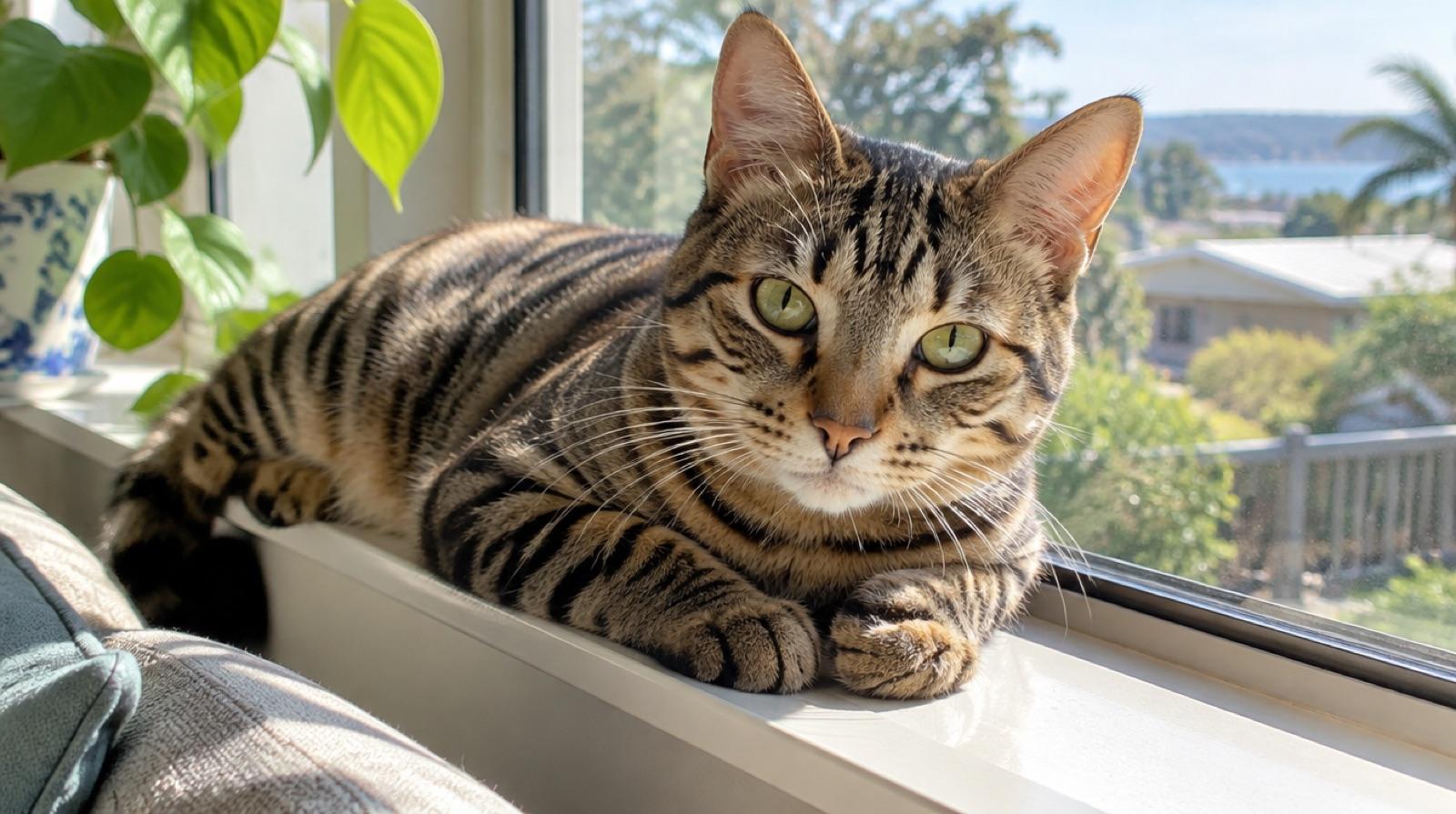
Is a tabby cat a breed?
No. Tabby describes a coat, the way “brindle” describes a dog. A tabby can be a moggy, a Persian, a British Shorthair or a Maine Coon. What makes a breed is registered parents; what makes a tabby is a set of coat genes that almost every cat carries.
That matters when you read rescue listings. Australian shelters list most cats through PetRescue, and the PetRescue help centre asks them to pick a breed from a set list. A cat with no known pedigree goes in as Domestic Short Hair, Medium Hair or Long Hair. Tabby is not on the breed list, so it appears in the cat's name or description instead: “Tiger, DSH brown tabby.” If you search only for the word tabby you can miss cats whose shelter just wrote “striped” or nothing at all, so browse the photos too.
If you want the full list of moggy colours, including tortoiseshell, tuxedo, blue and pointed, our Domestic Shorthair colours guide covers them all in one table. This page goes deeper on tabby alone.
What are the four tabby patterns?
The CCCA Tabby Patterns standard (issue date March 2023) is the Australian cat fancy's definition, and it recognises four: classic (blotched), mackerel, spotted and ticked. The table below sets out how to tell them apart, using the standard's own descriptions.
| Pattern | What the body looks like | Gene involved | Breeds known for it |
|---|---|---|---|
| Mackerel | Narrow, parallel stripes running down from a line along the spine | Taqpep, ancestral version | Toyger (a modified mackerel); common in moggies |
| Classic (blotched) | Butterfly on the shoulders, oyster-shaped patch ringed on each flank | Taqpep, changed version (two copies needed) | Common in moggies and many longhair and shorthair breeds |
| Spotted | Spots of any size or shape over the body and legs | Not yet known | Egyptian Mau, Ocicat, Bengal, Australian Mist |
| Ticked | Banded hairs, no noticeable body stripes or spots | Dkk4 | Abyssinian, Singapura |
Pattern descriptions: CCCA Tabby Patterns standard. Genes: Kaelin et al. 2012 (Science) and Kaelin, McGowan and Barsh 2021 (Nature Communications). Breeds: CCCA breed standards and the 2021 study.
Mackerel tabby
This is the striped cat most people picture. The CCCA standard asks for three narrow lines from the back of the head to the base of the tail, with the rest of the body covered in narrow parallel lines running down from the spine, “as narrow and as numerous as possible.” It is named after the fish because the stripes look like a fish skeleton. The 2021 Nature Communications study describes the mackerel stripe pattern as the ancestral state, the wild-type coat that the other patterns are variations on.
Classic (blotched) tabby
Instead of thin stripes, a classic tabby wears bold swirls. The standard describes a butterfly shape across the shoulders when seen from above, three stripes down the spine, and on each flank “a large oyster-shaped patch” surrounded by one or more unbroken rings. That ringed patch is the giveaway: if you can see a bullseye on the cat's side, it is a classic tabby.
Spotted tabby
A spotted tabby has its body markings broken into spots, which the CCCA standard says may vary in size and shape but should not run together into stripes. The face, with its M and eye lines, is marked like any other tabby. Spotted coats range from scattered round spots on a moggy to the bold, contrasting spots that define the Egyptian Mau and Ocicat. Nobody yet knows exactly which gene breaks the stripes into spots: the 2021 study states that the genetic basis of mackerel versus spotting is not known.
Ticked tabby
The ticked tabby is the odd one out. Each hair carries alternating bands of light and dark colour, and the body has no noticeable stripes, blotches or spots, only darker shading along the back. The M, face markings and often a necklace or leg bars remain, though the CCCA standard allows ticked cats to show few or none of the leg and tail markings. From a distance a ticked cat looks evenly coloured, like sand or wild rabbit fur. The CCCA Abyssinian standard calls for a coat that is “distinctly ticked,” and the Abyssinian is the breed most people know it from.
Patched tabby (torbie)
Some guides list a fifth type. A patched tabby is a tortoiseshell whose black and orange patches both show tabby markings. The CCCA Persian standard notes that tortoiseshell tabbies “are sometimes known as Torbies,” and the American Shorthair standard uses the name patched tabby. It is not a separate pattern so much as tabby and tortoiseshell on the same cat, and like all tortoiseshells it is almost always female. Our tortoiseshell cats guide explains why.
What do all tabbies have in common?
Whatever the body pattern, the CCCA standard lists markings that every tabby shares:
- A scarab or M on the forehead.
- Unbroken stripes running back from the outer corner of each eye, and fine pencilling on the cheeks and around the eyes and nose.
- Darker-spotted whisker pads.
- One or more necklaces across the chest.
- Spots on the belly, which the standard calls vest buttons.
- Barred legs, with solid colour up the back of the hind legs from paw to hock.
- A ringed tail with a solid tip the colour of the markings.
- Solid-coloured ears, which must show a “thumbprint” mark.
A show cat is judged on how clearly these appear. A rescue moggy is not, and many have smudged or partial markings. The standard itself notes that markings can be less distinct in young kittens and in dilute colours. If you are trying to work out whether a cat is a tabby, the M and the ringed tail are the quickest checks.
What does the M on a tabby's forehead mean?
Biologically, the M is just part of the tabby pattern on the head, the same way the necklace is part of it on the chest. Every tabby has one because the head markings are the same in all four patterns; only the body changes.
Culturally, the M has collected stories. Popular folk tales credit it to the Virgin Mary, to the Prophet Muhammad or to the cats of ancient Egypt. They are charming, and none of them is history. Treat them as folklore that travels with the pattern.
Kittens can also show tabby traces that later fade. The CCCA Persian standard says cream kittens sometimes show faint ghost barring or tabby markings that should disappear as the kitten grows.
How does the tabby pattern work genetically?
Three groups of genes decide whether, and how, a tabby pattern shows. In plain words:
- Agouti decides whether you see the pattern at all. The UC Davis Veterinary Genetics Laboratory explains that the agouti gene switches each growing hair between black and red pigment, which creates the banded hairs that let a tabby pattern show. A cat with two copies of the non-agouti version has hairs of one uniform colour, so it looks solid black, grey or brown. The non-agouti version is recessive: a cat needs two copies to be solid. The CCCA's article Reds, Creams and Inbetweens by Dr Kerry Fowler puts the key point simply: the tabby pattern gene is present in all cats, including solid ones. It is just hidden.
- Taqpep decides stripes or swirls. In 2012, Kaelin and colleagues reported in Science that the gene behind tabby pattern variation in domestic cats is Transmembrane aminopeptidase Q, or Taqpep. Cats with working Taqpep are mackerel; cats with two changed copies are classic (blotched). Because classic needs two copies, two mackerel parents that each carry one hidden copy can have classic kittens. The same team found that a change in the same gene causes the rare king cheetah, whose spots merge into blotches and stripes.
- Dkk4 produces the ticked coat. In 2021, Kaelin, McGowan and Barsh studied fetal cat skin and reported in Nature Communications that the pattern is laid down as a “pre-pattern” in the skin long before any hair is coloured. A gene called Dickkopf 4 (Dkk4) plays a central role, and changes in Dkk4 were found in cats with the ticked pattern. The paper explains that one copy of the ticked variant obscures tabby markings except on the legs and tail, and two copies remove them. As Stanford Medicine summarised it, without working DKK4 the dark areas do not vanish but become smaller and packed together.
The 2021 study adds two details adopters may find interesting. First, ticked overrides the other patterns: you can only see whether a cat is mackerel or classic if it is not ticked, which is why an Abyssinian may carry either and look the same. Second, the ticked variant was rare among the Californian feral cats the researchers sampled, which fits with ticked moggies being uncommon in rescue. Of the cats tested, every Abyssinian and Singapura carried a ticked Dkk4 variant, and so did most Burmese, a breed that uses it to suppress tabby markings, while none of the Egyptian Maus, Ocicats or Bengals did.
What science still does not know is the spotted pattern. The 2021 paper is explicit that the genetic basis of mackerel versus spotting is not known. Anyone who tells you exactly which gene makes a spotted tabby is ahead of the published research.
What colours do tabby cats come in?
Pattern and colour are separate. The pattern decides where the dark markings go; colour genes decide what colour they are. Shelters usually describe a tabby by both, such as “brown mackerel tabby” or “silver classic tabby.” The CCCA Persian standard recognises brown, blue, chocolate, lilac, red and cream tabbies, and silver tabbies are recognised in breeds such as the American Shorthair.
| Tabby colour | What it looks like | What causes it |
|---|---|---|
| Brown | Black markings on a warm brown ground | Black pigment, agouti |
| Blue (grey) | Deep blue-grey markings on a pale bluish ivory ground | Black pigment diluted by two copies of the dilute gene |
| Silver | Black markings on a pale silver ground | Silver variety: white undercoat under black-based markings |
| Red (orange, ginger) | Deep orange markings on a lighter orange ground | X-linked orange gene |
| Cream | Darker buff cream markings on a very pale cream ground | Orange plus dilute |
| Torbie (patched) | Tortoiseshell patches with tabby stripes in them | Orange on one X chromosome, black on the other, plus agouti |
Colour names and descriptions: CCCA Persian and American Shorthair standards. Genetics: UC Davis VGL and Kyushu University (2025).
Why are orange cats always tabby? Because the non-agouti gene that makes a black cat solid does not work on orange pigment. Dr Fowler's CCCA article explains that the non-agouti protein “does not work on the dominant ‘O’ gene pigment colour,” so a genetically solid red or cream cat often still shows clear tabby markings, which makes it very hard to breed a red or cream cat with no stripes. In practice, nearly every ginger cat you meet in rescue is a ginger tabby. The orange gene itself was identified in 2025: Kyushu University researchers found it is a deletion near a gene called ARHGAP36 on the X chromosome, a result confirmed by a separate Stanford-led study. That X-chromosome location is why orange tabbies are more often male. Our orange cats guide covers the rest.
Can a black cat be a tabby? Genetically, yes: Dr Fowler's article notes that the tabby pattern gene is present in all cats, including solid ones, so a black cat carries a tabby pattern that two copies of non-agouti have filled in.
Which cat breeds come in tabby?
Plenty. For some breeds a tabby pattern is optional; for a few it is the whole point of the breed. The examples below come from the CCCA breed standards and the 2021 Dkk4 study.
| Breed | Tabby pattern | Source |
|---|---|---|
| Abyssinian | Ticked only; coat “distinctly ticked” | CCCA standard |
| Singapura | Ticked; all tested cats carried a ticked Dkk4 variant | Kaelin et al. 2021 |
| Egyptian Mau | Spotted; described as the only natural domesticated breed of spotted cat | CCCA standard |
| Ocicat | Spotted only for showing; marbled or classic kittens registered for breeding only | CCCA standard |
| Australian Mist | Spotted or marbled, under a soft “agouti misting” | CCCA standard |
| Toyger | Modified mackerel tabby with high contrast | CCCA standard |
| Bengal | Tabby markings required; none tested carried the ticked variant | Kaelin et al. 2021 |
| Persian | Classic, mackerel and spotted tabby in six colours, plus torbies | CCCA standard |
| American Shorthair | Classic or mackerel tabbies, silver tabbies and patched tabbies | CCCA standard |
| Burmese | Not tabby to look at; most tested Burmese carried ticked Dkk4, which suppresses tabby markings | Kaelin et al. 2021 |
The Australian Mist is worth a special mention for Australian readers: it carries the country's name, and its standard calls for a spotted or marbled pattern seen “despite the diffusing effect of the characteristic agouti misting.” If you like the look of a tabby but want a known breed, the standards above are where to start. Our best cat breeds guide covers temperament, and the cat breed quiz can help you narrow the field.
The honest catch: a pedigree tabby from a registered breeder costs far more than a rescue tabby, and pedigree breeds are rare in rescue. If what you love is the pattern rather than the paperwork, a moggy tabby gives you the same coat.
Which tabby myths should you ignore?
- “Tabby is a breed.” It is a pattern. A cat without registered parents is a Domestic Shorthair, Medium Hair or Longhair, whatever its stripes.
- “Tabbies are always male” or “always friendly.” Tabby is not linked to sex; only the orange colour is. And we found no study showing that tabbies behave differently from other cats. Kyushu University's lead orange-gene researcher, Professor Hiroyuki Sasaki, said in 2025 that there is no scientific evidence yet linking coat colour to personality.
- “Spots mean Bengal.” Spotted tabby is a moggy pattern too. Only papers prove a Bengal.
- “A ticked moggy must be half Abyssinian.” Ticked moggies exist without any known Abyssinian parent; the 2021 study found the ticked variant in a few non-breed cats. It is uncommon, not proof of ancestry.
- “You can DNA test for the tabby pattern.” Partly. The UC Davis VGL coat colour page lists tests for agouti, dilute, brown and colourpoint among others, but not for the tabby pattern genes themselves. For a pet, the pattern you can see is the answer.
Do tabby cats have any health issues?
None that come from the pattern. The genes that make a tabby are about pigment and pattern, and we found no published link between tabby markings and disease. A tabby's health depends on its breed (if it has one), its age, weight, desexing and vet care.
For a sense of lifespan, the best general data come from UK veterinary records. A 2024 VetCompass study built life tables from 7,936 confirmed deaths among cats under UK primary veterinary care and gave a life expectancy at birth of 11.74 years, with being entire (not desexed) and a non-ideal body weight both linked to a shorter life. Those are averages, not a promise for any one cat.
The one colour with a known health flag is white, not tabby: all-white cats with the dominant white gene have a raised risk of deafness, as our colours guide explains.
How do you adopt a tabby cat?
Tabby is one of the easiest coats to find in rescue, in many colours and patterns, as kittens and adults. See the tabbies listed right now on the pages below.
To adopt one:
- Browse the tabby cats listed across Australia, or the city pages below, and look at photos as well as the words.
- Decide what else matters: kitten or adult, indoor temperament, coat length, getting on with other pets. Our guide to adopting a cat in Australia walks through fees, desexing and what rescues ask.
- Ask the shelter or foster carer how the cat behaves at home. That tells you far more than the stripes do.
- Check you are ready with the adoption readiness check, and if you are torn between a cat and a dog, try the dog or cat quiz.
Find a tabby cat near you
These pages show the tabby cats listed by rescues in each city right now, refreshed regularly:
Want a kitten? Try the kitten pages for Sydney, Melbourne and Brisbane. Looking for a fluffy tabby? See long-haired cats in Sydney and Melbourne. Related coat guides: tortoiseshell cats, calico cats, orange cats and black cats.
Frequently asked questions
What are the types of tabby cats?▼
There are four tabby patterns: classic (also called blotched), mackerel, spotted and ticked. The Coordinating Cat Council of Australia tabby standard recognises exactly these four. Classic has swirls and a bullseye on each flank, mackerel has narrow vertical stripes, spotted has the stripes broken into spots, and ticked has banded hairs with few or no body markings. A fifth label, patched tabby or torbie, means a tortoiseshell cat whose patches also show tabby stripes.
Is a tabby cat a breed?▼
No. Tabby is a coat pattern that turns up in moggies and in many pedigree breeds. Most tabby cats in Australian rescue are Domestic Shorthairs, Medium Hairs or Longhairs, which are coat-length labels for cats with no known pedigree. A breed needs registered parents; a pattern only needs the right genes.
What does the M on a tabby cat's forehead mean?▼
It is part of the tabby pattern itself. The CCCA tabby standard lists a scarab or M on the forehead as one of the markings every tabby shares, along with lines running back from the eyes, a ringed tail and barred legs. Folk tales link the M to religious figures, but those are stories, not history. If a cat has the M, it is a tabby of some kind.
What is the difference between a mackerel and a classic tabby?▼
Mackerel tabbies have narrow stripes running down from a line along the spine, like a fish skeleton. Classic tabbies have broad swirls, a butterfly shape across the shoulders and an oyster-shaped patch circled by rings on each flank. A 2012 study in Science found the switch is the Taqpep gene: two changed copies of Taqpep produce the classic pattern, and a 2021 follow-up study describes mackerel as the ancestral pattern. The same gene causes the rare king cheetah coat.
What is a ticked tabby?▼
A ticked tabby has bands of light and dark colour on each hair and few or no stripes on the body, so the coat looks evenly flecked, like sand. The Abyssinian is the best-known ticked breed. A 2021 study in Nature Communications linked the ticked pattern to changes in a gene called Dkk4. The same study found ticked is rare among the feral cats it sampled in California, so a ticked moggy is uncommon.
Are all orange cats tabbies?▼
Nearly all orange cats show tabby markings, and the reason is genetic. The gene that makes a cat solid instead of striped works on black pigment but not on orange pigment, as a Coordinating Cat Council of Australia article on red and cream cats explains. So an orange cat with the solid-coat genes still shows stripes. Breeders find it very hard to breed a red or cream cat with no tabby markings at all.
Are tabby cats mostly male?▼
No. Tabby is not linked to sex, so males and females are equally likely to be tabbies. The exception is orange: the orange gene sits on the X chromosome, so orange tabbies are more often male, as Kyushu University's 2025 research on the orange gene explains. Brown, grey and silver tabbies show no sex bias.
What is a torbie?▼
A torbie is a tortoiseshell tabby: a cat with the black and orange patches of a tortoiseshell where the patches also show tabby stripes. The CCCA Persian standard notes that tortoiseshell tabbies are sometimes known as torbies, and the American Shorthair standard calls the same look a patched tabby. Because torbies carry the X-linked orange gene alongside black, almost all of them are female.
Is my spotted tabby a Bengal?▼
Probably not. Plenty of moggies have a spotted tabby pattern with no Bengal ancestry. A Bengal is a registered breed with papers, and pattern alone cannot prove breed. Researchers also do not yet know which gene breaks mackerel stripes into spots, according to the 2021 Nature Communications study on cat patterns, so there is no simple test for it. A spotted rescue cat is a spotted Domestic Shorthair unless papers say otherwise.
Do tabby cats have a different personality?▼
There is no good evidence that they do. The coat genes that make a tabby have no known link to temperament, and we found no study showing that tabbies behave differently from other cats. A rescue cat's history, age and early handling tell you far more. Ask the shelter or foster carer how the cat behaves day to day.
How long do tabby cats live?▼
As long as any other cat, because tabby is a pattern, not a breed. The best general figure is from UK veterinary records: a 2024 VetCompass study gave cats a life expectancy at birth of 11.74 years. Diet, weight, desexing and vet care matter far more than coat pattern. These are UK averages, not a promise for any one cat.
Where can I adopt a tabby cat in Australia?▼
Tabbies are a common sight in rescue, so most shelters will have some. You can browse tabby cats from rescues in Sydney, Melbourne, Brisbane, Perth and Adelaide on our tabby listing pages, and set an alert so you hear about new cats. Shelters often write the pattern in the cat's description, so look at the photos as well as the words.
Sources
- Coordinating Cat Council of Australia: Tabby Patterns standard (March 2023)
- Coordinating Cat Council of Australia: Reds, Creams and Inbetweens (Dr Kerry Fowler)
- CCCA breed standards: Persian, American Shorthair, Abyssinian, Egyptian Mau, Ocicat, Toyger, Australian Mist
- Kaelin et al. (2012), Science: Specifying and sustaining pigmentation patterns in domestic and wild cats
- Kaelin, McGowan and Barsh (2021), Nature Communications: Developmental genetics of color pattern establishment in cats
- Stanford Medicine (2021): Color patterns of cat fur tracked to a key gene
- UC Davis Veterinary Genetics Laboratory: Agouti (cat)
- UC Davis Veterinary Genetics Laboratory: Feline Coat Color
- Kyushu University (2025): The gene behind orange fur
- Teng et al. (2024): Life tables of annual life expectancy in UK cats, VetCompass
Keep reading
Tabby cats for adoption
Classic, mackerel, spotted and ticked tabbies listed by Australian rescues right now.
Domestic Shorthair colours and patterns
Every moggy coat in one table: tortie, tuxedo, blue, point, smoke and white as well as tabby.
Tortoiseshell cats
The X-linked genetics, why torties are female, and what the tortitude research really measured.
Orange cats
Why ginger cats are mostly male and nearly always tabby.