The short answer
A tortoiseshell (tortie) is a cat with a black and orange coat and little or no white. It is a colour pattern, not a breed. The orange gene sits on the X chromosome, so a tortie needs one X carrying orange and one carrying black; Kyushu University, which identified the gene in 2025, explains that one X is switched off at random in each cell, which creates the patches. That is why torties are almost always female. Male torties do occur, usually with an extra X chromosome, and are rarely fertile. Add white and you have a calico; add tabby stripes and you have a torbie. “Tortitude” comes from owner surveys: owners report torties as more often aggressive, but the differences were small and measure perception, not tested behaviour. Judge the individual cat. Adoption fees quoted here are references only, not quotes.
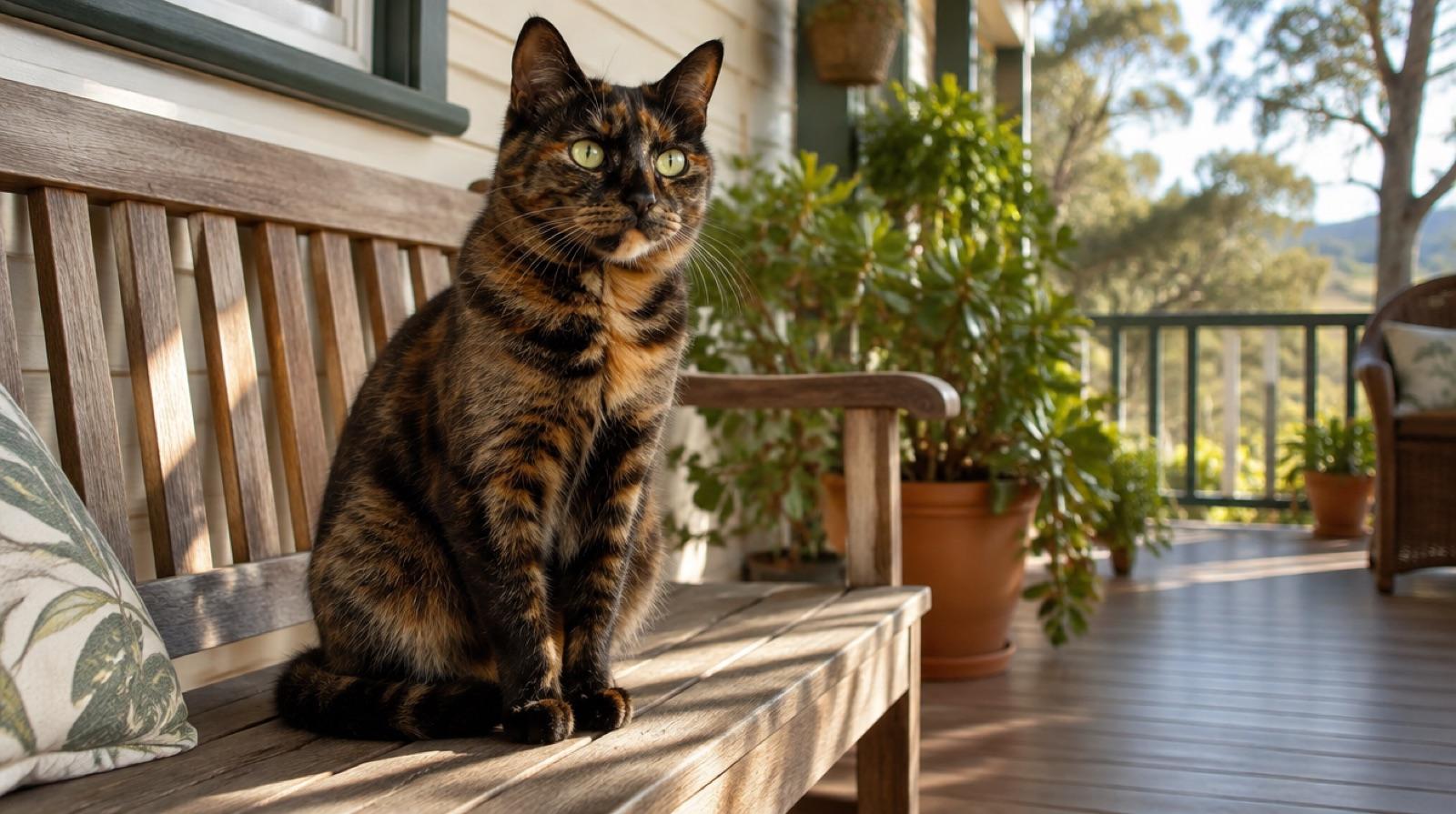
What is a tortoiseshell cat?
A tortoiseshell is a cat whose coat combines two pigment types: black (eumelanin) and orange (phaeomelanin). The name comes from the mottled look of polished tortoiseshell. There is no tortoiseshell breed. Most torties in rescue are moggies, listed by shelters as Domestic Shorthair, Medium Hair or Longhair, with “tortie” or “torti” in the description.
The pattern varies a lot from cat to cat. The CCCA Persian standard recognises two styles. Patched tortoiseshells have well-defined patches of each colour. Intermingled tortoiseshells have the colours softly blended, which the standard describes in the blue cream as “the appearance of pale shot silk.” Moggies show every version in between, from a cat that looks mostly black with a few orange flecks to one split down the face like a harlequin.
Colour varies too. A standard tortie is black and orange. With two copies of the dilute gene, the same cat becomes a blue-cream (blue-grey and cream), often called a dilute tortie. Pedigree cats add chocolate and lilac tortoiseshell; the CCCA lists black, blue, chocolate and lilac tortoiseshells for the Persian, and brown, blue, chocolate and lilac tortoiseshell for the Burmese.
For every other moggy colour, from tabby to tuxedo, see our Domestic Shorthair colours guide.
Tortoiseshell, calico or torbie: what is the difference?
The three are close cousins built on the same black-and-orange base. What changes is whether white or tabby stripes are added on top.
| Pattern | Colours | Extra gene | Other names on listings |
|---|---|---|---|
| Tortoiseshell | Black and orange, little or no white | None | Tortie, torti, tortoiseshell |
| Calico | Black, orange and clear white patches | White spotting | Tortie and white, tricolour |
| Torbie | Black and orange patches with tabby stripes | Agouti (tabby shows) | Tortoiseshell tabby, patched tabby |
| Blue-cream | Blue-grey and cream | Two copies of dilute | Dilute tortie |
Definitions: CCCA Persian standard (tortoiseshell, blue cream, tortoiseshell tabbies “sometimes known as Torbies,” and the bicolour section accepting tortoiseshell with white).
The white in a calico usually changes the look as well as the colour list: the black and orange tend to sit in bigger, cleaner blocks on a white background. Our calico cats guide covers that pattern and the rare male calico in detail, and the tabby patterns guide explains the stripes in a torbie. One detail worth knowing: in a tortie, the orange patches often show faint stripes even when the black patches look solid, because the gene that makes a cat solid works on black pigment but not on orange, as Dr Kerry Fowler's article for the CCCA explains.
Why are tortoiseshell cats almost always female?
It comes down to where the orange gene lives. Scientists suspected for over a century that it sat on the X chromosome, and in May 2025 two teams confirmed it. Kyushu University researchers, led by Professor Hiroyuki Sasaki, published in Current Biology that orange fur comes from a small deletion at a gene called ARHGAP36 on the X chromosome. A separate Stanford-led study published at the same time reached the same answer.
Here is how that produces a tortie, step by step:
- A female cat has two X chromosomes. If one carries the orange version and the other the black version, she has both colours available.
- Early in development, one X chromosome in each cell is switched off at random. Kyushu's Professor Sasaki describes this as the “textbook example” of X-chromosome inactivation.
- As those cells divide, each patch of skin keeps whichever X was left on. Patches with the orange X grow orange fur; patches with the black X grow black fur.
- The result is a coat of orange and black patches that is different on every cat, even littermates.
A normal male has one X and one Y. With only one X, every cell has the same colour setting, so he is either orange or not orange. He cannot be both, which is why a normal male cannot be a tortoiseshell. The same rule explains why ginger cats are mostly male: a male needs one orange X to be fully orange, while a female needs two. Our orange cats guide covers that side of the story.
The Kyushu team also found ARHGAP36 was much more active in pigment cells from orange patches, and thinks this may shift them from black pigment toward orange. The gene is active in other parts of the body too, including areas of the brain and hormonal glands, and Professor Sasaki said it is possible the orange variant influences more than coat colour. He was equally clear that there is no scientific evidence yet linking coat colour to personality. That is a question for future research, not a fact.
How rare is a male tortoiseshell cat?
Rare, but the numbers you see online are often not traceable to any study. The best population figure we found is a UK survey published in the Veterinary Record in 1999. Researchers from the University of Bristol asked veterinary practices to record the coat colour and sex of cats coming in for vaccination or desexing. Of 4,598 male cats recorded, 20 were tortoiseshell, about 0.43 per cent. A figure of one in 3,000 is widely repeated, but we could not find the study it came from. Either way, a male tortie is unusual.
How does a male end up with two colours? The same 1999 study checked the chromosomes of 11 male torties. Six were XX/XY chimeras (a single cat made from two different cell lines, one female and one male), two were XXY, two were XX and one was XY. A 2022 veterinary review in the Journal of Feline Medicine and Surgery says any male cat with three colours must have at least two X chromosomes, and that most have an XXY set or are mosaics or chimeras.
| Study | What it looked at | Main finding |
|---|---|---|
| Centerwall and Benirschke, 1975 | Chromosome findings in 25 male tortoiseshell or calico cats | XXY in 16 of 25; almost all sterile |
| Leaman, Rowland and Long, 1999 (UK) | Coat and sex of 9,816 cats at vet practices; chromosomes of 11 male torties | 20 of 4,598 males tortoiseshell; mostly XX/XY chimeras and XXY |
| Kuiper et al., 2003 | Four tortoiseshell tomcats | Two XXY, one XX/XY, one XY; sperm production seen only in some tubules of the XX/XY cat |
| Foster, 2022 review (JFMS) | Disorders of sexual development in cats | Tricoloured males: gonads usually underdeveloped, undescended testicles common; rarely fertile |
Are male torties sterile? Almost always in practice. Centerwall and Benirschke found that almost all of the XXY males they reviewed were sterile, with testicular changes like those in human Klinefelter syndrome. They also made a point worth repeating: the coat colour does not cause the problem; it is simply a visible sign of a chromosome difference that happened anyway. A small study by Kuiper and colleagues found sperm production in some testicular tubules of one chimera, which is why “rarely fertile” is more accurate than “never.”
For an adopter, none of this changes much. A male tortie should be desexed like any other cat, and the vet will see the testicles during surgery. If one is undescended, which the 2022 review says is common in these cats, the vet will need to find it, so mention his colour when you book.
What is tortitude, and is it real?
“Tortitude” is the popular idea that tortoiseshell cats are sassy, strong-willed, quick to hiss or swat, and fussier about handling than other cats. Ask a room of cat owners and many will agree. The question is whether research backs it, and the honest answer is: weakly, and only as owner perception.
The UC Davis owner survey (Stelow, Bain and Kass, 2016)
This is the study most articles cite. Veterinary behaviourists at the University of California, Davis ran an online survey of cat owners, published in the Journal of Applied Animal Welfare Science. Of 1,432 owners who completed it, 1,274 surveys were analysed. Owners reported their cat's coat colour and how often it showed aggressive behaviour toward people.
According to the abstract, owners reported sex-linked orange females (tortoiseshells, calicos and torbies), along with black-and-white and grey-and-white cats, as more frequently aggressive toward humans during everyday interactions, during handling and at the vet. The same abstract also states that the separate analyses of aggression during handling and at vet visits showed little difference among coat colours, so the paper's own summary is mixed.
The size of the effect matters most. The EveryCat Health Foundation's summary of the paper notes that, despite statistical significance, the median scores suggest the differences between colours are relatively small and could be explained by owners interpreting the scoring differently. Cats in the survey showed low levels of aggression overall. The lead author, Dr Elizabeth Stelow, told reporters the team was not suggesting anyone avoid these cats and that most of them make lovely pets.
The perception study (Delgado, Munera and Reevy, 2012)
An earlier study asked a different question: what do people believe about colour? In an online survey of 189 people published in Anthrozoös, participants assigned personality words to five colours of cat. They were more likely to call tricoloured cats (calicos and tortoiseshells) intolerant and aloof, and orange cats friendly. No colour differed on stubbornness. The cats were imaginary: this measured people's expectations, not any real cat's behaviour. The authors suggested the findings matter for how shelters present cats of different colours.
Why that matters
Put the two together and a problem appears. If people already expect torties to be prickly, owners filling in a survey may notice and report a hiss from a tortie more readily than the same hiss from a grey cat. A 2020 review of cat temperament research in Animals notes that the finding of more aggression in orange-gene females was based on owners' perceptions. No study we found has put torties and other cats through the same standardised behaviour test.
| What the evidence says | What it does not say |
|---|---|
| Owners in one survey reported torties as slightly more often aggressive toward people | That torties behave differently when tested the same way as other cats |
| People expect tricoloured cats to be more intolerant and aloof | That those expectations match real cats |
| The orange gene is active outside the skin too | That it affects temperament: no evidence yet, per the Kyushu team |
| The same survey also flagged black-and-white and grey-and-white cats | That tortitude is unique to torties |
Our position: tortitude is a fun nickname and a real belief, but it is not a reason to pass over a tortie, or to adopt one expecting fireworks. This fits the line taken in our colours guide: coat colour is not a reliable guide to temperament.
What actually shapes a tortie's personality?
The same things that shape any cat's:
- Early handling. The RSPCA's Smart Kitten and Cat Buyer's Guide puts the critical socialisation period at roughly 2 to 9 weeks. A kitten gently handled by people in that window is far more likely to grow into a confident, friendly cat, whatever its colour.
- The individual. Personality research treats cats as individuals that differ along several dimensions. The Feline Five study, based on 2,802 pet cats in South Australia and New Zealand, described five: neuroticism, extraversion, dominance, impulsiveness and agreeableness. Coat colour was not one of them.
- History. A cat that has been through several homes, a hoarding case or life as a stray may need weeks to settle. Shelter and foster notes tell you what you are dealing with.
- Pain and health. A cat that suddenly becomes grumpy or swats when touched should see a vet first. The RSPCA Knowledgebase says aggressive behaviour may indicate pain or physical health problems, which a vet can investigate.
- Your home. A calm routine, hiding spots and patient handling help any cat relax.
If you are choosing between two cats, the shelter's notes on how each one behaves with people, other cats and handling are worth far more than the colour of its coat. Our male or female cat guide covers the other question adopters often ask, and since torties are almost always girls, it is worth a read.
Which breeds come in tortoiseshell?
Because tortoiseshell is a colour, it turns up wherever a breed allows both black-based colours and red or cream. Examples from the Australian standards:
- Persian: black, blue, chocolate and lilac tortoiseshell, blue cream and lilac cream, torbies, and tortoiseshell with white in the bicolour group (CCCA standard).
- Burmese: brown, blue, chocolate and lilac tortoiseshell alongside six solid colours (CCCA standard).
- Birman: tortie and tortie tabby points among its recognised colours (CCCA standard).
If a particular breed in tortie is what you want, our adopt-or-buy guides for the Persian, Burmese and Birman explain what to check before buying from a registered breeder. If it is the coat you love, a moggy tortie from rescue gives you the same patchwork.
How do you adopt a tortoiseshell cat?
Torties are a regular sight in Australian rescue. Because almost all are female, you will mostly be choosing between girls, and a male tortie is a genuine rarity.
- Browse the tortoiseshell cats listed across Australia or the city pages below. Shelters write tortie, torti, tortoiseshell, tortie and white or blue-cream, so look at the photos as well as the words.
- Ask how the cat behaves with handling, visitors and other pets. That answer matters more than any reputation.
- Budget for the adoption fee. As a reference only, RSPCA NSW listed $220 for a cat over six months and $270 for a kitten, and the Cat Protection Society of NSW listed $150 per cat or kitten, when checked on 10 November 2026. Fees change and differ by rescue and state; this is not a quote. Rescue cats are normally desexed, microchipped and vaccinated before they go home.
- Read our guide to adopting a cat in Australia, check you are ready with the adoption readiness check, and if you are unsure about a cat at all, try the dog or cat quiz.
Find a tortoiseshell cat near you
These pages show the torties listed by rescues in each city right now, refreshed regularly:
Prefer the version with white? See calico cats in Sydney, Melbourne and Brisbane. Looking for a kitten? Try kittens in Sydney, Melbourne and Perth. More coat guides: tabby cats, calico cats, orange cats and black cats.
Frequently asked questions
What is a tortoiseshell cat?▼
A tortoiseshell, or tortie, is a cat whose coat mixes black (or a black-based colour) with orange, in patches or finely blended, with little or no white. It is a colour pattern, not a breed. Most torties in Australian rescue are Domestic Shorthairs or Longhairs, and the pattern also appears in pedigree breeds such as the Persian and Burmese.
Why are tortoiseshell cats almost always female?▼
Because the orange colour gene sits on the X chromosome. Kyushu University researchers, who identified the gene in 2025, explain that a female with one orange and one black X develops the patchy coat of a tortoiseshell, because one X is randomly switched off in each cell early in development. A normal male has only one X chromosome, so he is either orange or not orange, never both.
How rare is a male tortoiseshell cat?▼
Rare, but less rare than the internet suggests. In a 1999 UK survey of cats brought to vets for vaccination or desexing, 20 of 4,598 males were recorded as tortoiseshell, about 0.43 per cent. A figure of one in 3,000 is often repeated online, but we could not trace it to a published study. Most male torties have an extra X chromosome or are a genetic mix of two cell lines.
Are male tortoiseshell cats sterile?▼
Usually. A 1975 review of 25 male tortoiseshell and calico cats found an XXY chromosome set in 16, and almost all were sterile. A 2022 veterinary review says tricoloured males are rarely fertile, their testicles are usually underdeveloped and undescended testicles are common. A few, usually cats made of a mix of XX and XY cells, have shown some sperm production, so rarely fertile is more accurate than never. A pet male tortie should be desexed like any other cat.
What is the difference between a tortoiseshell and a calico?▼
White. A tortoiseshell is black and orange with little or no white. A calico has the same black and orange plus clear patches of white, which come from a separate white-spotting gene. The CCCA Persian standard groups the white version as tortoiseshell and white in its bicolour section, and many Australian shelters simply write tortie and white. The genetics behind the black and orange is identical, so both are almost always female.
What is a torbie cat?▼
A torbie is a tortoiseshell tabby: a tortie whose patches also show tabby stripes. The CCCA Persian standard notes that tortoiseshell tabbies are sometimes known as torbies. Torbies are almost always female for the same X chromosome reason as torties.
What is a dilute tortoiseshell or blue-cream cat?▼
It is a tortoiseshell with two copies of the dilute gene, which softens black to blue-grey and orange to cream. The CCCA Persian standard describes the blue cream as blue and cream softly intermingled, like pale shot silk. Pedigree breeds also come in chocolate and lilac tortoiseshell. They are all the same pattern in a different shade.
What is tortitude?▼
Tortitude is a nickname for the belief that tortoiseshell cats are feisty, strong-willed or quick to swat. The best-known study, a 2016 UC Davis survey of 1,274 cat owners, found owners reported torties, calicos and torbies, along with black-and-white and grey-and-white cats, as more often aggressive toward people. It measured what owners reported, not how the cats behaved in a test, and the differences were small.
Is tortitude real?▼
Not in any way that should decide which cat you adopt. Owner surveys find people perceive and report torties as more intolerant or more aggressive, but those surveys measure belief and owner reports, not standardised behaviour. A 2020 review notes the tortie finding rests on owners' perceptions, and Kyushu University's orange-gene researcher said in 2025 there is no scientific evidence yet linking coat colour to personality.
What is a tortie cat's personality like?▼
Like any other cat's: it depends on the individual. Early handling during the socialisation period of about 2 to 9 weeks, genetics, age and the cat's history shape temperament far more than coat colour. Plenty of torties are calm lap cats and some are not. Ask the shelter or foster carer how the specific cat behaves at home.
Do tortoiseshell cats have health problems?▼
Female torties have no known health problems caused by their colour. The orange and black genes affect pigment, and a female tortie's health depends on her breed (if any), age, weight and care. Male torties are different because most have abnormal sex chromosomes, which commonly affects their testicles and fertility. Your vet can check a male tortie when he is desexed.
Where can I adopt a tortoiseshell cat in Australia?▼
Torties are a common sight in rescue, and you can browse them on our tortoiseshell cat pages for Sydney, Melbourne, Brisbane, Perth and Adelaide. As a reference, RSPCA NSW listed adoption fees of $220 for a cat over six months and $270 for a kitten when checked on 10 November 2026; fees change, so this is not a quote. Shelters also write torti, tortie and white or calico, so check the photos.
Sources
- Kyushu University (2025): The gene behind orange fur (Toh et al., Current Biology)
- Coordinating Cat Council of Australia: Persian standard (Nov 2024), tortoiseshell, blue cream, torbie and bicolour definitions
- Coordinating Cat Council of Australia: Burmese standard (May 2025)
- Coordinating Cat Council of Australia: Reds, Creams and Inbetweens (Dr Kerry Fowler)
- Leaman, Rowland and Long (1999), Veterinary Record: Male tortoiseshell cats in the United Kingdom
- Centerwall and Benirschke (1975), American Journal of Veterinary Research: tortoiseshell and calico male cats
- Foster (2022), Journal of Feline Medicine and Surgery: Disorders of sexual development in the cat
- Kuiper, Hewicker-Trautwein and Distl (2003): Cytogenetic and histologic examination of four tortoiseshell cats
- Stelow, Bain and Kass (2016), Journal of Applied Animal Welfare Science: Coat color and aggressive behaviors in the domestic cat
- EveryCat Health Foundation: summary of Stelow et al. (2016)
- Delgado, Munera and Reevy (2012), Anthrozoös: Human perceptions of coat color as an indicator of domestic cat personality
- Animals (2020): review of cat temperament research
- Litchfield et al. (2017), PLOS ONE: The Feline Five
- RSPCA Australia: Smart Kitten and Cat Buyer's Guide (2024)
Keep reading
Tortoiseshell cats for adoption
Torties listed by Australian rescues right now, kittens and adults.
Calico cats
The tortie with white: how the white-spotting gene changes the look, and male calicos.
Tabby cat patterns
Mackerel, classic, spotted and ticked, and the torbie that mixes tabby with tortie.
Male or female cat?
What the research shows on sex differences once a cat is desexed.