The short answer
This is an emergency: call or go to your nearest vet now if your dog in the heat has constant panting, fast breathing, pale or red gums, drooling, vomiting or diarrhoea, or is weak, wobbly, confused, trembling, having a seizure or collapsing. The RSPCA's first aid is to cool your dog with room-temperature or cool water on its fur and skin, keep the air cool with a fan or air-conditioning, and seek veterinary attention immediately. To prevent it: never leave a dog in a car, even with the windows down; walk early or late; use the five-second hand test on the ground; and give shade, airflow and water at all times. Flat-faced, overweight, very young and old dogs are at higher risk.
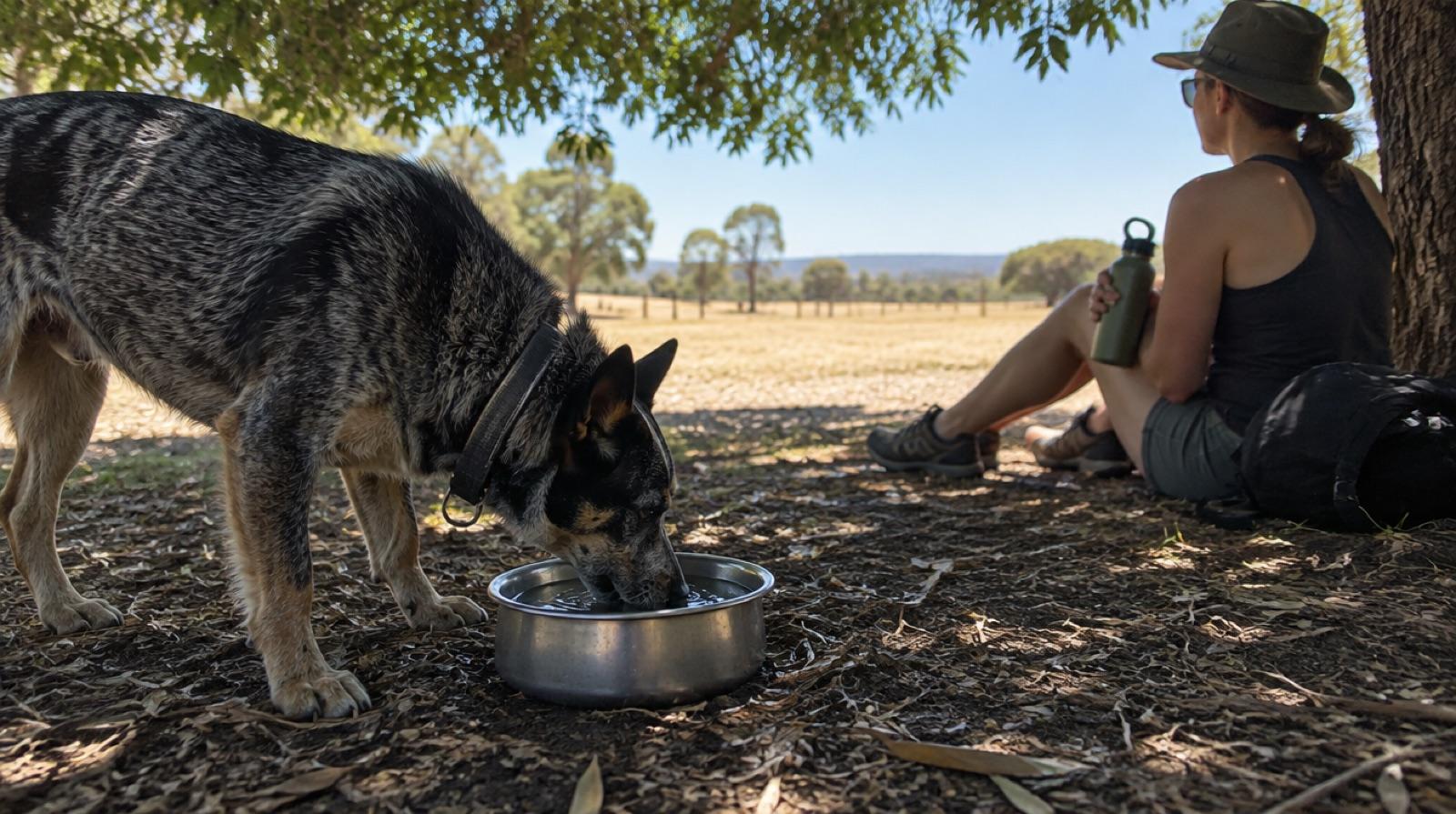
Heatstroke: what to do right now
“If you suspect your dog is suffering from heatstroke, start emergency first aid. Try to cool your dog down by applying room-temperature or cool water to their fur/skin. To maximise heat loss, keep the environment cool (e.g. fan, air-conditioning). Seek veterinary attention immediately.”
First aid quoted in full from the RSPCA Knowledgebase. Find a 24-hour hospital: Sydney, Melbourne, Brisbane, Perth, Adelaide, Gold Coast, Canberra, Hobart, Darwin.
What is heatstroke in dogs?
Heatstroke is a dangerous rise in body temperature that happens when a dog cannot shed heat as fast as it gains it. The RSPCA Knowledgebase calls it a life-threatening emergency and says that in dogs it can lead to rapid multi-organ failure and has a high mortality rate. Dogs cool down by panting; the RSPCA says flat-faced breeds have a reduced capacity to cool down this way, and that heatstroke is a greater risk in warm or hot, humid environments.
Most affected dogs in UK general practice survived, but not all. A study of 905,543 dogs under veterinary care in the UK in 2016 found 395 confirmed heat-related illness events, and 14.18% of them ended in the dog's death (Hall, Carter and O'Neill, 2020). A follow-up study notes earlier research in which survival fell from over 90% to 43% once dogs progressed from mild or moderate to severe disease (Hall et al, 2022). The RSPCA's advice is to start first aid and seek veterinary attention immediately.
LocalPetFinder is an adoption listings site, not a vet. This page brings together the RSPCA, government pages and published veterinary research, read in November 2026. It is general information, not a substitute for your vet.
What are the signs of heatstroke?
The RSPCA lists these signs. A dog may show a few or many, and they can move quickly from the first column to the second:
| Breathing and body | Brain and collapse |
|---|---|
| Constant panting | Dizziness |
| Rapid breathing and heart rate | Weakness, lethargy |
| Pale or red gums | Confusion |
| Drooling | Muscle tremors |
| Vomiting, diarrhoea | Seizures |
| Little to no urination | Collapse |
Source: RSPCA Knowledgebase, updated 8 May 2023, read 11 November 2026. The grouping into two columns is ours, to make the list easier to scan; the RSPCA lists them together.
Panting after a run is normal. Panting that does not ease when your dog rests in the shade, or comes with any of the signs above, is not. RSPCA South Australia's vet puts it simply: a dog panting excessively should be moved somewhere cool straight away, and any wobbliness, collapse or distress means contacting an emergency vet straight away (RSPCA SA).
What is the first aid for heatstroke?
This is the RSPCA Knowledgebase first aid, quoted in full (updated 8 May 2023, read 11 November 2026):
“If you suspect your dog is suffering from heatstroke, start emergency first aid. Try to cool your dog down by applying room-temperature or cool water to their fur/skin. To maximise heat loss, keep the environment cool (e.g. fan, air-conditioning). Seek veterinary attention immediately.”
That is the whole of it. The RSPCA's steps use room-temperature or cool water and do not mention ice, and we do not add steps the RSPCA does not publish. The first aid does not replace the vet: the last step is to seek veterinary attention immediately.
Which dogs are most at risk?
The RSPCA names these risk factors: body weight (overweight dogs overheat faster), breed (flat-faced breeds have a reduced capacity to cool down by panting), sex (male dogs are more likely to develop heatstroke after exercise), age (very young and very old dogs), a hot or humid environment without shade, water or airflow, too much exercise, and transport. It also notes that the risk is increasing as heatwaves become more frequent.
The biggest study of the question looked at UK dogs in general vet practice. It is not Australian, but it is the clearest breed-level evidence published, and the RSPCA cites it:
| Group | Odds of heat-related illness | Compared with |
|---|---|---|
| Chow Chow | 16.61 times | Labrador Retriever |
| Bulldog | 13.95 times | Labrador Retriever |
| French Bulldog | 6.49 times | Labrador Retriever |
| Dogue de Bordeaux | 5.31 times | Labrador Retriever |
| Greyhound | 4.26 times | Labrador Retriever |
| Cavalier King Charles Spaniel | 3.45 times | Labrador Retriever |
| Pug | 3.24 times | Labrador Retriever |
| English Springer Spaniel | 2.74 times | Labrador Retriever |
| Golden Retriever | 2.65 times | Labrador Retriever |
| Flat-faced (brachycephalic) dogs | 2.10 times | Medium-faced dogs |
| Dogs over 50 kg | 3.42 times | Dogs under 10 kg |
| Dogs 12 years and older | 1.75 times | Dogs under 2 years |
| At or above the average weight for breed and sex | 1.42 times | Below the average |
Source: Hall, Carter and O'Neill, Scientific Reports, 2020: VetCompass records of 905,543 dogs under primary veterinary care in the UK in 2016, 395 heat-related illness events. Non-designer crossbred dogs were not at significantly different odds from Labradors.
Odds ratios are about relative risk, and heat-related illness was uncommon overall in this UK population (0.04% of dogs in a year). An Australian summer is hotter and longer, so the absolute risk here will differ, but the pattern is consistent with the RSPCA's warning about flat faces, weight and age. A follow-up VetCompass study also found that the majority of cases were triggered by exertion, and that the median air temperature on the days dogs fell ill was 16.9 degrees (Hall et al, 2022). In that UK data, a mild day and a hard run were the everyday pattern.
Why are flat-faced dogs at higher risk?
Because they cannot pant as well. The RSPCA Knowledgebase says brachycephalic dogs, such as pugs, British and French bulldogs and Boston terriers, can have brachycephalic obstructive airway syndrome (BOAS), a lifelong and often progressive breathing problem, and lists exercise and heat intolerance among their health problems. Its heatstroke page adds that flat-faced breeds have a reduced capacity to cool down by panting, and its prevention list includes avoiding high-risk breeds with exaggerated features. The RSPCA also says the snuffling, snoring and snorting these dogs make are signs that breathing is very difficult and distressing for the dog.
RSPCA South Australia's vet advises that more at-risk dogs, such as brachycephalic breeds, should not be walked when it is over 25 degrees (RSPCA SA). Our breed guides go deeper:
- Pug breathing and heat care (Sydney), also for Brisbane and the Gold Coast
- British Bulldog heat and breathing (Sydney), also for Perth and Brisbane
- French Bulldog heat and breathing care (Brisbane), also for Perth
- Boston Terrier breathing and heat care (Sydney)
- Boxer exercise and heat and German Shepherd heat management
- Thick coats: Alaskan Malamute, Bernese Mountain Dog, Saint Bernard and Golden Retriever
Is it illegal to leave a dog in a hot car?
Never leave a dog in a parked car on a warm day, legal or not. The RSPCA says even on an overcast day with the windows down, dogs can overheat and die in a short time. RSPCA Australia says the temperature inside a car can climb to double the outside temperature in a short time, and RSPCA WA says that on a mild 22-degree day the inside of a parked car can rise to over 47 degrees in a matter of minutes, and that tinting, shade and open windows give little or no relief. The VetCompass researchers found that dogs overheated in vehicles were more likely to develop severe disease, because they could not escape the heat (Hall et al, 2022).
The law differs across Australia. Here is what the official page or legislation says in each place, as read on 11 November 2026:
| State or territory | What the official source says | Source |
|---|---|---|
| Victoria | Illegal to leave an animal unattended inside a car for more than 10 minutes when outside temperatures are at or above 28°C; also rules for dogs on hot metal ute trays | Agriculture Victoria |
| New South Wales | No dog-specific hot-car offence yet. A government bill introduced on 7 May 2026 would make it an offence to leave a dog unattended in a vehicle for more than 10 minutes when it is over 28°C outside, unless the vehicle is adequately cooled (the government says fines of up to $44,000). On 11 November 2026 the Parliament page still listed it as “In Legislative Council, 2R, Debate adjourned” (second reading), so it is not law. The existing cruelty laws still apply | Parliament of NSW, NSW Government |
| Queensland | Leaving an animal in a hot car is listed as an example of cruelty under the Animal Care and Protection Act 2001; the page gives a maximum penalty for an individual of $345,400 or 3 years' imprisonment | Business Queensland |
| ACT | Offence for a person in charge of an animal to confine it in or on a vehicle where that causes, or is likely to cause, injury, pain, stress or death (example given: locking an animal in a hot car). ACT Policing says police and inspectors may enter a vehicle, including by breaking a window, and does not advise the public to break in | Animal Welfare Act 1992 s 9, ACT Policing |
| Northern Territory | You must not leave animals in a parked car, even with the windows open; if an animal is injured or dies you can be charged; welfare inspectors can enter the vehicle | NT Government |
| Western Australia | The WA government (DPIRD) lists an animal locked in a hot car as an example of an animal in immediate danger to report to RSPCA WA, and says to call WA Police if an animal's life is in immediate danger. Its dog welfare standards say a dog must not be left unattended in a vehicle where it is at risk of heat stress, but DPIRD says these standards become mandatory only once regulations are made, and the regulations are still being drafted. RSPCA WA (not a government page) says owners can be prosecuted under the Animal Welfare Act 2002, with a maximum penalty of $50,000 or five years' imprisonment, and that it is illegal for the public to break into a vehicle | DPIRD reporting, DPIRD dog standards, DPIRD legislation, RSPCA WA |
| South Australia | We found no SA government page on hot cars. The SA environment department says anyone who ill-treats an animal is guilty of an offence under section 13 of the Animal Welfare Act 1985, enforced by the RSPCA, police and others. RSPCA South Australia (not a government page) says to call SA Police on 000 if you find an animal left in a hot car | SA Department for Environment and Water, RSPCA SA |
| Tasmania | A person with care or charge of a dog must not leave it unattended in, or on, a vehicle where there is a reasonable likelihood of the dog suffering from heat stress or cold stress (fine not exceeding 20 penalty units), under the Animal Welfare (Dogs) Regulations 2026, in force from 19 August 2026. RSPCA Tasmania says to call Tasmania Police on 131 444 and the animal cruelty helpline on 1300 139 947 if a companion animal is suffering in a hot vehicle | Regulations, reg 18(4), NRE Tasmania, RSPCA Tasmania |
This is general information from the pages linked, not legal advice. For South Australia we found no government hot-car page (searched 11 November 2026), so the reporting advice in that row comes from RSPCA SA; the WA penalty figure is from RSPCA WA, not a government page. Penalties change; check the current legislation in your state. A time or temperature in a law is not a safe allowance: the NSW bill itself says (proposed section 7A(5)) that compliance with the new section is not a defence for an offence against another provision of the Act or the regulations.
If you see a dog in a hot car, call police or the RSPCA in your state straight away and do not break in yourself. RSPCA WA suggests noting the registration and location, asking shopping centre management to page the owner, and watching the dog from a distance until help arrives (RSPCA WA).
How hot is too hot to walk a dog?
No authority publishes one cut-off temperature for every dog, so test the ground and watch your dog. These are the tests the RSPCA publishes:
- The five-second rule. RSPCA Australia: place the back of your hand on the ground for five seconds; if it is too hot for you, it is too hot for your dog. RSPCA WA uses the same five seconds.
- A longer test. RSPCA South Australia's vet suggests bare hands or feet on a sun-exposed surface for 10 seconds (RSPCA SA). The stricter of the two is the safer habit.
- Walk early or late. RSPCA Australia advises early mornings and evenings on hot days. If it stays warm overnight, RSPCA SA's vet suggests a shorter walk than usual.
- It is not just bitumen. The RSPCA Knowledgebase says the ground can be unsafe in warm weather on bare earth and grass too, especially brown grass in sunny, dry spots, and that hot ground adds to the heat a dog is already carrying.
- Higher-risk dogs: flat-faced breeds should not be walked when it is over 25 degrees, according to RSPCA SA's vet.
Shaded bush tracks are cooler underfoot, but RSPCA SA points out they bring snakes and grass seeds. Keep your dog on a lead in scrub and check its paws afterwards: see grass seeds and dogs and snake bite in dogs.
How do I keep my dog cool at home?
- Shade and airflow at all times. The RSPCA says dogs need access to a cool, shaded area with good ventilation at all times.
- More water than you think. RSPCA Australia suggests several water sources in sturdy bowls that are hard to knock over.
- Bring them in. On really hot or humid days, RSPCA Australia suggests bringing pets inside with air-conditioning, fans or open windows. Shade in the yard is not always enough.
- Keep the weight down. Overweight dogs overheat faster and cool less well, says the RSPCA.
- Skip the midday game of fetch. In the UK research most heat illness was triggered by exercise, so play in the cool of the morning or evening.
Adopting a dog that copes with Australian heat
If you live somewhere hot and humid, the honest advice from the RSPCA's own risk list is that a flat-faced breed needs more planning, and some households will be better suited to a longer-nosed dog. That is not a reason to pass over a pug or bulldog in rescue, many of whom need homes; it is a reason to go in prepared with air-conditioning, a walking routine and a vet nearby. Our pug, French Bulldog and British Bulldog guides cover what to ask a rescue or breeder.
Older dogs are also at higher risk in the heat. If you are thinking about adopting a senior dog, plan its summer the same way. For everything else in the first months, see a rescue dog's first weeks and adopting a dog in Australia.
Find a rescue dog near you
Dogs listed right now by the rescues and shelters we aggregate.
More guides for dog owners
- Flying with a pet in Australia: airline and interstate rules for travelling with a dog or cat.
- Barking dogs and bark collars: the law and the RSPCA position.
- Cat enclosures and catios: for the cat in a dog household.
- Cheap vet care: charity clinics and help with an emergency bill.
Frequently asked questions
What are the signs of heatstroke in a dog?▼
The RSPCA lists constant panting, rapid breathing and heart rate, pale or red gums, drooling, vomiting, diarrhoea, dizziness, weakness, lethargy, confusion, muscle tremors, seizures, little or no urination and collapse. Heatstroke is a life-threatening emergency: start cooling your dog and get to a vet immediately.
What should I do if my dog has heatstroke?▼
The RSPCA Knowledgebase first aid, in full: 'If you suspect your dog is suffering from heatstroke, start emergency first aid. Try to cool your dog down by applying room-temperature or cool water to their fur/skin. To maximise heat loss, keep the environment cool (e.g. fan, air-conditioning). Seek veterinary attention immediately.'
Should I use ice or iced water to cool my dog?▼
The RSPCA Knowledgebase first aid says room-temperature or cool water on the fur and skin, and it does not mention ice. Follow those steps, keep the environment cool with a fan or air-conditioning, and seek veterinary attention immediately.
Can a dog get heatstroke on a mild day?▼
Yes. The RSPCA says heatstroke can develop even in cooler weather if other risk factors are present, such as a flat face, too much exercise, no shade or water, or being shut in a car. In a UK study of heat-related illness in dogs, the median air temperature on the days dogs fell ill was 16.9 degrees, and the majority of cases were triggered by exertion.
Which dogs are most at risk of heatstroke?▼
Flat-faced breeds, overweight dogs, very young and very old dogs, and dogs exercising in the heat, according to the RSPCA. In a VetCompass study of 905,543 UK dogs, Chow Chows had 16.6 times, Bulldogs 14.0 times and French Bulldogs 6.5 times the odds of heat-related illness of Labradors, and flat-faced dogs overall had 2.1 times the odds of medium-faced dogs.
Is it illegal to leave a dog in a hot car in Australia?▼
It depends on where you are. Victoria makes it illegal to leave an animal unattended in a car for more than 10 minutes when it is 28 degrees or hotter outside; the ACT has a vehicle-confinement offence; and Tasmania's dog welfare regulations say a dog must not be left unattended in or on a vehicle where heat stress or cold stress is reasonably likely. Queensland's government lists leaving an animal in a hot car as cruelty, and the Northern Territory government says you must not leave animals in a parked car. The WA government lists a dog locked in a hot car as an animal in immediate danger to report. New South Wales has a dog-specific hot-car bill that the NSW Parliament website still showed at second reading in the Legislative Council on 11 November 2026, so it is not law yet.
Can I leave my dog in the car with the windows down?▼
No. The RSPCA says never leave your dog in a vehicle, and that even on an overcast day with the windows down, dogs can overheat and die in a short time. RSPCA Western Australia says window tinting, parking in the shade and leaving the windows down give little or no relief.
What should I do if I see a dog in a hot car?▼
Call for help straight away rather than breaking in yourself. In South Australia RSPCA SA says to call SA Police on 000; in Western Australia RSPCA WA says to call its cruelty hotline or police; in Tasmania RSPCA Tasmania says to call police and its cruelty helpline; in the ACT, ACT Policing says to contact RSPCA ACT or police. Note the car's registration and location, and ask centre management to page the owner if you are at a shopping centre.
How hot is too hot to walk a dog?▼
There is no single official temperature, so test the ground. RSPCA Australia's five-second rule: put the back of your hand on the ground for five seconds, and if it is too hot for you, it is too hot for your dog. Walk in the early morning or evening on hot days. An RSPCA South Australia vet advises that higher-risk dogs such as flat-faced breeds should not be walked when it is over 25 degrees.
Can hot pavement burn a dog's paws?▼
Yes. RSPCA Australia says walking at the coolest times helps stop dogs burning their sensitive paw pads on hot pavement, and the RSPCA Knowledgebase notes that even bare ground and brown grass in sunny, dry spots can be too hot. Walk at cooler times, stay on shaded grass and use the five-second hand test.
How do I keep my dog cool at home in summer?▼
Give access to a cool, shaded, well-ventilated area at all times and plenty of water, as the RSPCA advises. RSPCA Australia suggests extra water bowls that are hard to knock over, and on really hot or humid days bringing pets inside with air-conditioning, fans or open windows. Skip exercise in the hottest part of the day.
I want to adopt a flat-faced dog. Can it cope with an Australian summer?▼
Go in with your eyes open. The RSPCA says flat-faced breeds have a reduced capacity to cool down by panting and lists exercise and heat intolerance among their problems, and it asks potential owners to think carefully about their capacity to care for one, including access to a specialist emergency vet. Plan for air-conditioning, early or late walks, and a vet you can reach quickly. Rescues sometimes list pugs, bulldogs and their crosses, and our breed heat guides cover each in detail.
Sources
- RSPCA Knowledgebase: How can I protect my dog from heatstroke? (updated 8 May 2023)
- RSPCA Knowledgebase: What do I need to know about brachycephalic dogs? (updated 6 November 2025)
- RSPCA Australia: Caring for animals over summer (12 December 2023)
- Hall, Carter and O’Neill (2020): Incidence and risk factors for heat-related illness (heatstroke) in UK dogs under primary veterinary care in 2016, Scientific Reports
- Hall et al (2022): Risk factors for severe and fatal heat-related illness in UK dogs, a VetCompass study, Veterinary Sciences
- Agriculture Victoria: Travelling with dogs
- Business Queensland: Cruelty, duty of care and abandoning animals
- Parliament of NSW: Prevention of Cruelty to Animals Amendment (Enforcement and Operational Powers) Bill 2026
- Animal Welfare Act 1992 (ACT), section 9 (republication 36)
- NT Government: Animals in cars
- Animal Welfare (Dogs) Regulations 2026 (Tas), regulation 18
- WA DPIRD: Reporting animal cruelty
- WA DPIRD: Standards and Guidelines for the Health and Welfare of Dogs in WA (February 2020)
- SA Department for Environment and Water: Animal welfare legislation
- RSPCA WA: The dangers of dogs in hot cars
- RSPCA South Australia: Paws on the pavement (9 November 2021)
Keep reading
Boxer exercise and heat
How much exercise a Boxer needs and the summer routine for a short-muzzled dog.
German Shepherd heat management
Keeping a big double-coated dog cool through an Australian summer.
Grass seeds and dogs
The signs in the paw, ear, eye and nose, and why grooming beats clipping.
Snake bite in dogs
The warning signs and the RSPCA first-aid steps.