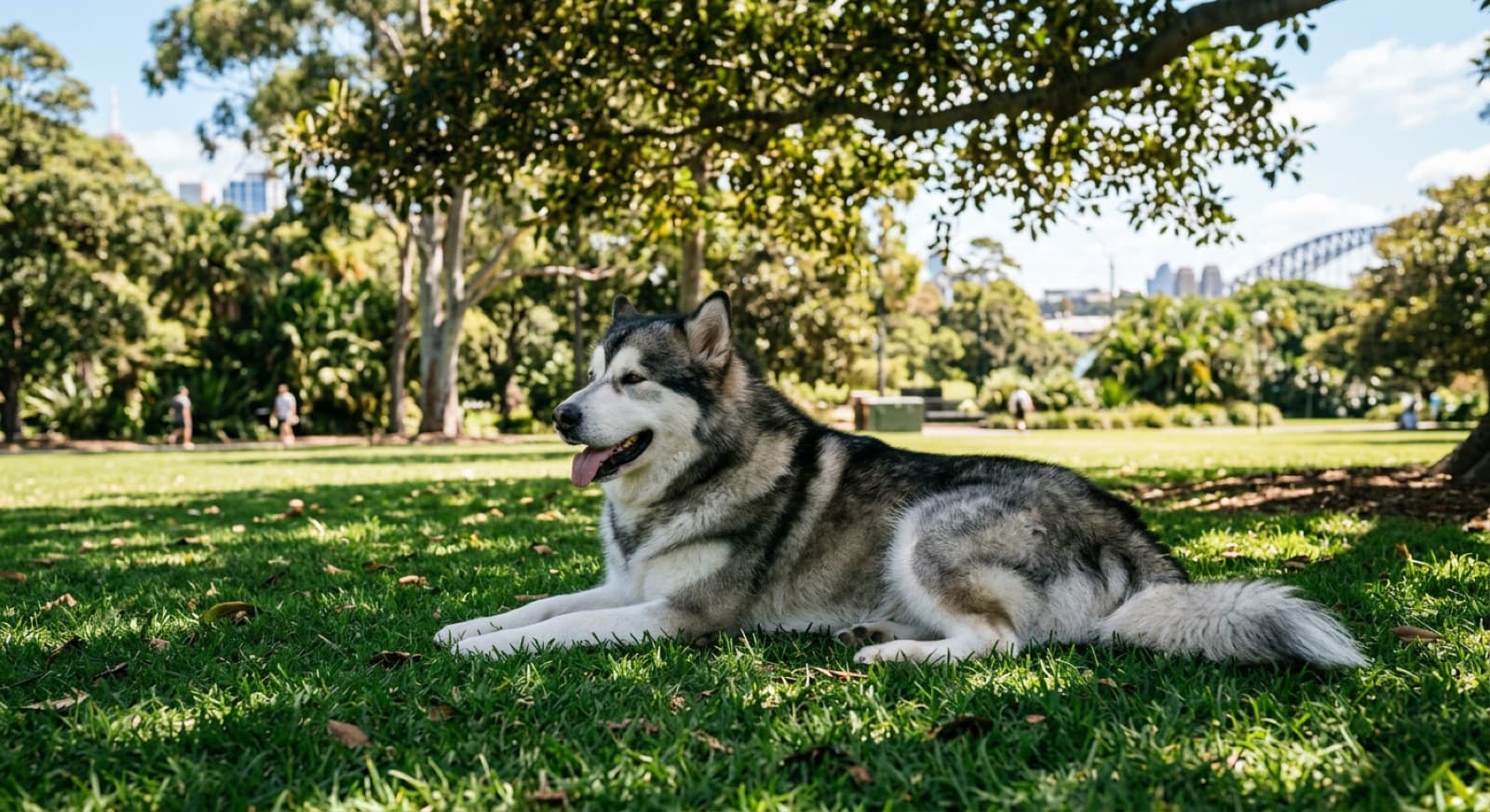
The short answer
An Alaskan Malamute is a big, strong Arctic working dog, and three things dominate its care in Sydney. First, the thick double coat: brush it several times a week, expect a huge undercoat blow once or twice a year, and never shave it, because the coat insulates against heat and protects the skin. Second, the heat: a sled dog overheats fast, so exercise in the cool hours and provide shade, water, cooling mats and air-conditioning on hot days. Third, the exercise and strength: a Malamute needs plenty of daily activity, loves to pull, is powerful on the lead, and needs secure high fencing because it digs and escapes. Take one on only if you can meet all three.
Pillar one: the thick Arctic double coat
Start with what the coat actually is, because it changes how you care for it. An Alaskan Malamute has a true double coat built for brutal Arctic cold. On top sits a coarse, weather-resistant outer coat of guard hairs. Underneath is a dense, woolly undercoat that does the insulating. The two layers work as a system, and that system is why the breed could survive hauling sleds in freezing conditions. In Sydney it is doing a very different job, but it is still the same coat.
The key point: a Malamute coat is brushed and de-shedded, not clipped into a shape. You do not scissor it down the way you would a doodle. The job is to keep both layers clean, brushed to the skin, and free of the packed-in undercoat that causes mats. When the coat is looked after it looks after the dog. When it is neglected the soft undercoat felts into tight mats against the skin, which traps moisture and dirt and can lead to sore skin underneath. That is a welfare problem, not just a scruffy look.
A workable brushing routine for a Malamute looks like this:
- Line-comb several times a week, right to the skin. Work in sections, lifting the outer coat with one hand and combing the undercoat underneath in a line. A slicker brush plus an undercoat rake or comb is the usual pair of tools.
- Check the mat hot-spots every time. Behind and under the ears, the armpits, the chest, the trousers on the back legs, and anywhere a harness or collar rubs. These tangle first.
- De-shed daily when the coat is blowing. Pull the loose undercoat out with a rake before it drifts around the house.
- Comb through after walks and swims. Grass seeds, sand and burrs catch in the coat, and a wet coat left to dry unbrushed mats fast.
The seasonal undercoat blow
On top of the year-round shedding, a Malamute blows its undercoat once or twice a year. This is not ordinary shedding. Over a few weeks the dog releases its dense undercoat in enormous clumps, and the amount genuinely startles owners the first time. You can pull out handfuls at a time. On a dog this size, that is a lot of fur, and it ends up on your clothes, your floors, your furniture and drifting across the room no matter how often you vacuum.
The way to stay ahead of it is daily de-shedding with an undercoat rake, ideally outside, to pull the loose undercoat out before it spreads through the house. Get it out at the source and both your home and the dog's coat stay in far better shape. Skipping the de-shed during a blow is how the loose undercoat felts into mats. This is also the time many owners book a professional groom, where a high-velocity blow-dry drives an enormous amount of loose undercoat out in one session. Either way, plan for these heavy shedding periods. A Malamute is a wonderful dog, but it is not the breed for a spotless, fur-free home.
Never shave a Malamute
This is the most important message on the page, and in a warm climate like Sydney it is the one owners most often get wrong. Never shave an Alaskan Malamute. It feels logical: the coat is thick, the summer is hot, so surely taking the coat off will keep the dog cooler. It does the opposite, and it can genuinely harm the dog.
The double coat does not just trap warmth. It insulates in both directions. It slows how fast heat gets in as well as how fast it gets out, so a well-maintained coat actually helps a Malamute stay cooler in summer. The coat also shields the skin underneath from the sun. Shave it off and you strip away both the natural cooling and the sun protection at once. The results of shaving a double coat can include:
- Sunburn. The skin under a Malamute coat rarely sees direct sun. Exposed by a shave, it can burn, and repeated sun damage carries longer-term skin risks.
- A higher heatstroke risk, not lower. With the insulating layer gone, the dog loses a real part of how it regulates temperature.
- Coat damage. A shaved double coat often grows back wrong: patchy, coarse, a different texture, or slow to return. It can be permanent.
The right approach in the heat is to keep the coat, not remove it. Brush and de-shed regularly so the coat is clean and airy and the loose undercoat is not packing in and trapping heat. Then manage the environment. If a groomer offers to shave your Malamute for summer, find a different groomer who understands double-coated breeds. The RSPCA Australia Knowledgebase is a good general reference on coat care and keeping dogs cool in hot weather.
Pillar two: keeping a sled dog cool in Sydney
Heat is the real welfare risk with an Arctic breed in this climate, and it deserves to be taken seriously rather than glossed over. A Malamute evolved to work in the snow. It carries a heavy insulating coat and it overheats far faster than a heat-adapted breed. Sydney summers average around 26°C in January with occasional days above 35°C, and they are humid, which makes it harder for a dog to cool itself by panting. This is a co-lead challenge alongside the coat, not an afterthought.
The rules for a Malamute through a Sydney summer are straightforward:
- Exercise only in the cool hours. Early morning or evening, never the middle of a hot, humid day. Test the footpath with your hand first, since hot pavement burns paw pads.
- Shade, water and a cool spot always. Fresh water everywhere, deep shade in the yard, and a cool indoor spot. Air-conditioning matters on the worst days for this breed.
- Cooling aids help. A cooling mat, and a shell pool or paddling pool the dog can lie in, take real heat off a Malamute.
- Never leave the dog in a car. A parked car heats to lethal temperatures within minutes, and a Malamute is at the front of the queue for heatstroke.
Be honest with yourself about your home before you adopt. A Malamute living in an un-airconditioned place through a Sydney heatwave is a genuine welfare risk. Watch for signs of overheating: heavy panting, drooling, bright red gums, weakness or a dog that lags and wants to stop. If you see them, move the dog to shade, offer water, wet the coat and belly with cool water and get to a vet, because heatstroke is an emergency. We go into the medical warning signs in more depth in the Alaskan Malamute health issues guide.
Pillar three: exercise, strength and secure fencing
The third challenge is the one that separates a Malamute from a fluffy Samoyed: this is a serious working dog. The Alaskan Malamute was bred to haul heavy freight over long distances, and that history shapes everything about its exercise needs, its strength and its behaviour. A Malamute is not a low-effort pet, and pretending otherwise sets both dog and owner up to fail.
Exercise comes first. A Malamute needs plenty of daily activity: long walks, plus mental work to keep a smart, independent mind occupied. Because the breed genuinely loves to pull, activities that channel that instinct suit it well. Harness work, canicross and scootering are a good fit in cool weather, giving the dog a real job rather than a token stroll. A bored, under-exercised Malamute is a destructive one, so the exercise is not negotiable. One important caution: giant-breed puppies must not be over-exercised while their joints are still growing, so build the load up gradually and ask your vet what suits the age.
Strength on the lead is the next reality. A Malamute is immensely powerful and it pulls, because leaning into a harness is what it was built to do. An adult can drag an unprepared person off their feet, which is a safety issue near a road. Invest in a well-fitted harness and steady lead training from the start, and consider a force-free trainer experienced with strong working breeds. Their prey drive and independent nature also make recall unreliable, so a Malamute should not be off-lead in an unfenced area. The Australian Veterinary Association has useful general guidance on exercise and behaviour for active breeds.
Then there is the digging and escaping. Malamutes are notorious diggers and determined escape artists. A bored one will dig craters in the lawn and can dig under a fence, and a strong prey drive means an escaped Malamute may chase cats, small dogs or wildlife. You need high, sturdy fencing with the base secured against digging, and it pays to check the perimeter regularly. The good news is that most of the digging and destruction comes from boredom and pent-up energy, so meeting the exercise need cuts it down a lot. If your yard cannot be made genuinely secure, this is not the breed for the space.
Bathing, ears, nails, teeth and ticks
A few smaller jobs round out Malamute care. Bathe only when the dog needs it, rinse until the water runs clear, and dry the dense coat thoroughly right down to the skin, because a coat left damp underneath will mat and can start to smell. Check the ears at least weekly, keep them clean and dry, and watch for redness, a bad smell or head-shaking that points to an infection and a vet visit. Trim the nails every few weeks, since overgrown nails change how a big dog stands and moves. Brush the teeth regularly with a dog toothpaste or use vet-approved dental chews.
Paralysis ticks deserve their own mention because a thick double coat makes them harder to find, and they are a serious, year-round danger across the whole Sydney region. A paralysis tick can be fatal without treatment, so keep your Malamute on a vet-recommended tick prevention product all year, and do a hands-on physical check after any bushwalk. Part the coat and feel right down to the skin, working over the head, ears, neck, chest, armpits and legs, because a quick pat over a dense coat will miss a tick. If you find a tick, or notice weakness, wobbliness or a change in your dog's bark or breathing, get to a vet straight away. Talk to your vet about the right prevention product for your dog.
Browse adoptable Alaskan Malamutes in Sydney
A Malamute rewards an owner who keeps up the coat, manages the heat and meets the exercise need. Browse live NSW listings and set an alert so you hear the moment one comes in.
See Available Alaskan Malamutes →Is an Alaskan Malamute right for your Sydney home?
Put the three pillars together and the picture is clear. A Malamute needs the coat brushed several times a week and de-shedded daily when it blows, and it must never be shaved. It needs active heat management through a Sydney summer, including shade, water, cooling aids and air-conditioning on hot days. And it needs plenty of exercise, firm lead training, and a securely fenced, dig-proof yard, because this is a strong, smart, independent working breed that pulls, digs and escapes when its needs are not met. None of this is a weekend project. It is a way of life for as long as you have the dog.
For the household that is genuinely up for all three, a Malamute is a magnificent, affectionate and characterful companion. If the coat, the heat or the exercise sound like too much, that is worth being honest about before you adopt rather than after. Malamutes are not common in rescue, so set an alert and be patient. Rescues like RSPCA NSW, AWL NSW, Sydney Dogs and Cats Home, Monika's Doggie Rescue and Maggie's Rescue take in dogs of all breeds and crosses and can tell you honestly what a particular dog's coat, energy and temperament are really like. For where to adopt one and what to expect, our Alaskan Malamute adoption guide goes into detail. Register your dog with your council as required under the Companion Animals Act, which you can do through the NSW Pet Registry.
Frequently Asked Questions
Should I shave my Alaskan Malamute in summer?
No, do not shave an Alaskan Malamute, even through a Sydney summer. It feels like the kind thing to do with such a thick coat, but the double coat is not only for warmth. It insulates against heat as well as cold, slowing how fast the dog warms up, and it shields the skin from the sun. Shave it off and you strip away the Malamute's own cooling system and its sun protection at once, which raises the risk of sunburn and heatstroke. On top of that, a shaved double coat often grows back patchy, coarse or a different texture, and it can be permanent. The right way to keep a Malamute cool is to keep the coat well brushed and de-shedded so air moves through it, then manage the heat around the dog with shade, water and cool-hour walks.
Can an Alaskan Malamute cope with the Sydney heat?
An Alaskan Malamute can live in Sydney, but heat is the serious welfare issue with an Arctic breed and you have to manage it actively. This is a dog built to haul freight across snow, and it overheats far faster than a heat-adapted breed. A well-maintained coat actually helps, because it insulates against heat, which is exactly why you never shave it. The care that matters is exercising only in the cool of early morning or evening rather than the middle of a hot day, and always giving shade, fresh water, a cool indoor spot and access to air-conditioning on the worst days. Cooling mats and a shell pool or paddling pool help a lot. A Malamute left in an un-airconditioned home through a Sydney heatwave is a real risk, so plan for the hot months before you adopt.
How much do Alaskan Malamutes shed?
Alaskan Malamutes shed heavily. They drop hair year-round, and then once or twice a year they blow their undercoat, releasing it in enormous quantities over a few weeks. During a blow you can pull out handfuls at a time, and you will find fur on your clothes, your floors and your furniture no matter how often you clean. The way to manage it is daily de-shedding during the blow with an undercoat rake or comb to pull the loose undercoat out before it drifts around the house, plus brushing several times a week the rest of the year. There is no low-shed version of this breed, so a Malamute is not the dog for anyone who wants a fur-free home. Given how big the dog is, expect a lot of coat.
How much exercise does an Alaskan Malamute need?
An Alaskan Malamute needs plenty of daily exercise, well beyond a short stroll around the block. This is a powerful working breed bred to pull heavy loads over long distances, so it wants long walks, and it genuinely loves to pull. Activities that channel that, like harness work, canicross or scootering in cool weather, suit the breed well, alongside daily walks and mental work to keep the mind busy. A bored, under-exercised Malamute digs craters in the yard, howls and becomes destructive, so the exercise is not optional. One caution: giant-breed puppies should not be over-exercised while their joints are still growing, so build up slowly and ask your vet what is appropriate for the age. In the Sydney heat, do the harder work in the cool hours.
How often do I need to brush an Alaskan Malamute?
Brush an Alaskan Malamute several times a week at a minimum, and daily during a seasonal shed. The double coat is a coarse weather-resistant outer coat over a dense woolly undercoat, and if you do not brush right down to the skin the undercoat packs into mats. Line-comb in sections, lifting the outer coat and working the comb through the undercoat underneath, rather than skating a brush over the top. The mat hot-spots are behind the ears, the armpits and the trousers on the back legs, so check those every time. On top of home brushing, many owners have a groomer do a full wash, de-shed and blow-dry periodically through the year. Skip the brushing and you end up with tight mats that often have to be clipped out.
Do Alaskan Malamutes pull on the lead?
Yes, Alaskan Malamutes pull, and they are immensely strong, so lead training and the right gear matter a great deal. This is a freight dog whose whole history is leaning into a harness and hauling, so pulling is in the wiring, not a training failure. An adult Malamute can drag an unprepared person off their feet, which is a genuine safety issue on a footpath or near a road. Invest in a well-fitted harness and steady lead training from the start, and consider working with a force-free trainer experienced with strong working breeds. Their prey drive and independent nature also mean recall is unreliable, so a Malamute should not be off-lead in an unfenced area. Channel the urge to pull into structured activities like canicross in cool weather instead of fighting it on every walk.
Do Alaskan Malamutes dig and escape?
Yes, Alaskan Malamutes are notorious diggers and determined escape artists, so secure fencing is essential. A bored or under-exercised Malamute will dig craters in a lawn and can dig under a fence, and a motivated one will try to get over or through weak points too. You need high, sturdy fencing with the base secured against digging, and it pays to check the perimeter regularly. Their strong prey drive means an escaped Malamute may chase cats, small dogs or wildlife, which is dangerous for the dog and for other animals. Plenty of exercise and mental stimulation cuts the digging a lot, because most of it comes from boredom and pent-up energy. If your yard cannot be made genuinely secure, this is not the right breed for the space.
What else does Alaskan Malamute grooming and care involve?
Beyond the coat, a Malamute needs regular nail trims, ear checks, dental care and year-round paralysis tick prevention. Trim the nails every few weeks, since long nails change how a big dog stands and moves. Check the ears weekly and keep them clean and dry, watching for redness, smell or head-shaking that points to an infection and a vet visit. Bathe only when needed and dry the dense coat thoroughly right down to the skin, because a coat left damp underneath will mat and can smell. Paralysis ticks are a year-round danger across Sydney and they hide easily in a thick coat, so keep your dog on a vet-recommended tick prevention product all year and hand-check the skin after any bushwalk. Brush the teeth regularly or use vet-approved dental chews.
Keep reading
Adoptable Alaskan Malamutes in Sydney
Live listings of Malamutes and Malamute crosses across Sydney and NSW rescues.
Alaskan Malamute Adoption in Sydney
Where to adopt, why Malamutes end up in rescue, and what adoption costs against a breeder.
Alaskan Malamute Health Issues in Sydney
The health areas to know, plus Sydney heat safety and year-round paralysis tick prevention.
All Sydney Adoption Guides
Browse every breed and how-to guide for adopting a rescue dog in Sydney.