The short answer
Give a healthy adult Boxer about 90 minutes of activity a day, split into a morning walk, an evening walk and a short block of mental work. Puppies need short, frequent sessions, not distance, and seniors need the same two walks at a slower pace. In summer the biggest change is timing, not length: walk at dawn and after dark, test the footpath with your hand, use swimming and indoor enrichment to fill the gap, and skip the walk entirely on heatwave days. Learn the early heat stroke signs, because a short-muzzled dog moves from tired to emergency faster than owners expect. If in doubt, cool the dog and go to a vet.
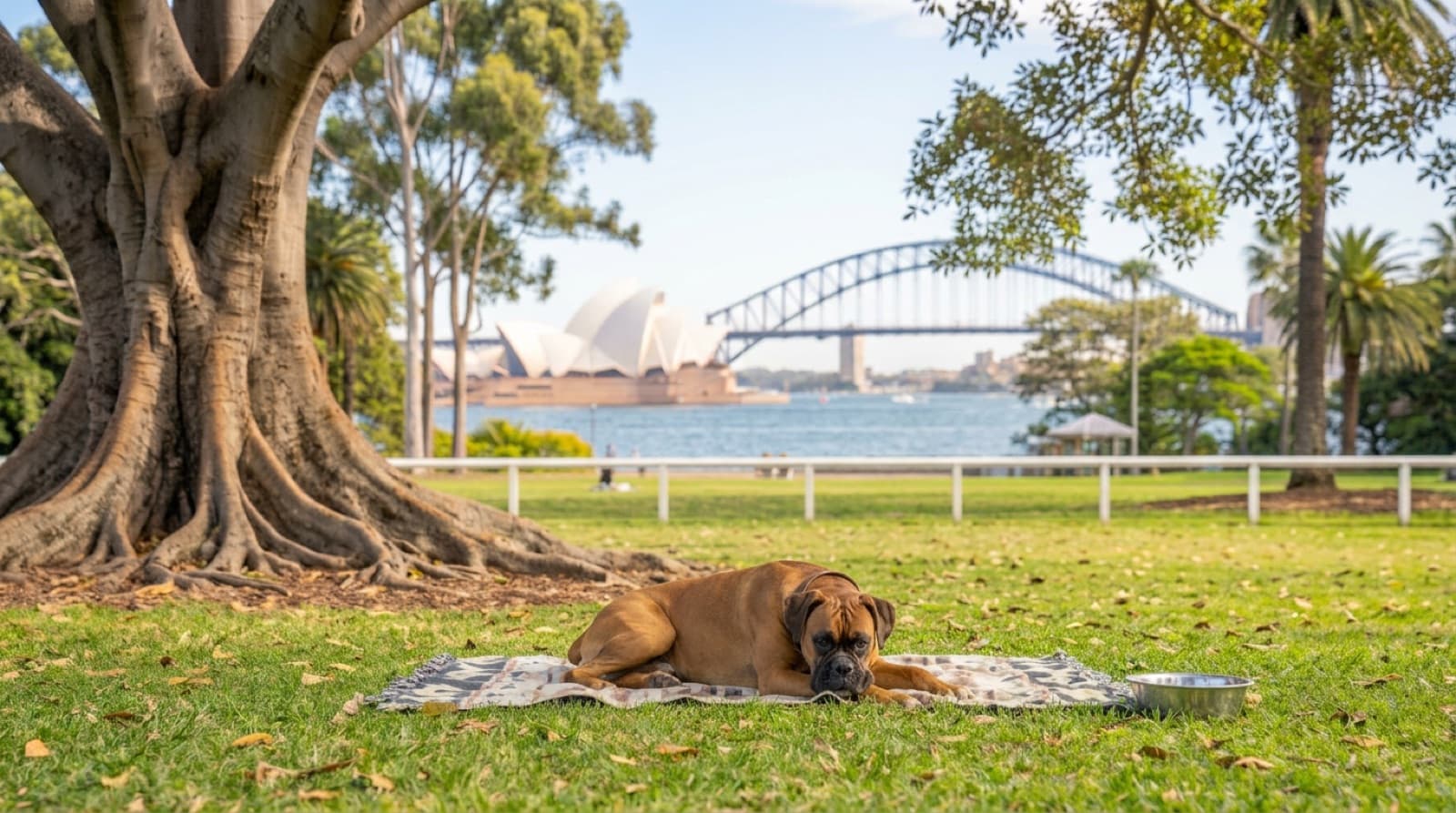
Why Boxer exercise needs a plan
Most active breeds have one of two problems: a big exercise need, or a body that struggles in heat. The Boxer has both. It was developed in Germany as a working dog with real daily output, and later breeding shortened the muzzle. The modern dog keeps the working ancestor's energy and carries a face that cools less efficiently than a longer one.
That is the whole tension in one paragraph. An under-exercised Boxer becomes destructive, anxious and overweight. An over-exercised Boxer on a hot day can tip into heat stroke, which is life-threatening and moves fast in a short-muzzled dog. The routine that works shifts exercise to the cool ends of the day, uses water and mental work to fill the middle, and accepts that on some days the right call is no walk at all.
Across the rescues we aggregate, Boxers surrendered for “behavioural issues” are often dogs that never got the outlet the breed needs.
How the short muzzle affects cooling
Dogs cool mainly by panting. Air moves over the moist surfaces of the tongue, nose and airways, water evaporates and heat leaves the body. A longer muzzle gives more surface to cool across, so a Labrador or a Greyhound sheds heat faster than a dog with a compressed face.
A brachycephalic, or short-faced, dog has a shorter nasal passage, often a longer soft palate and narrower airways. Each breath moves less air, so the dog has to pant harder to get the same cooling, and the effort of panting adds heat of its own. Boxers sit at the mild end of this group. Most breathe and exercise well, but they still cool less efficiently than a long-nosed dog of the same size. The RSPCA Australia Knowledgebase and the Australian Veterinary Association both cover the welfare problems of short-faced breeds and the extra care they need in hot weather.
- Boxers tire sooner on hot days than long-nosed dogs of the same size.
- A fit Boxer is not heat-proof. Watch the forecast as well as the dog.
- A Boxer with Brachycephalic Obstructive Airway Syndrome (BOAS) is far more limited and needs a veterinary airway assessment.
- Older Boxers often breathe less efficiently than they did when young, even without a BOAS diagnosis.
If your Boxer snores loudly, breathes noisily on easy walks or overheats on mild days, ask your vet about BOAS. The condition can be managed, and in selected dogs improved with surgery to widen the nostrils or shorten the soft palate. Left alone, a narrowed airway caps how much exercise a dog can safely do. Our Boxer health guide covers the airway and heart conditions in more depth.
How much exercise a Boxer needs, by age
Puppies (under 12 months). A Boxer puppy is a bundle of energy with joints that are still forming. Long walks, repeated jumping and hard running on bitumen can damage growing bones. What a puppy needs is several short walks and play sessions a day, lots of sleep, and short training games that tire the brain. Ask your vet how far to walk at each stage and build up gradually through the first year.
Adolescents and young adults (roughly one to seven years). This is the 90-minute dog. Split the time rather than doing it in one block: a morning walk of 30 to 45 minutes, a short block of mental work in the middle of the day, and an evening walk of 30 to 45 minutes with some off-lead play at a fenced dog park where your council allows it. Add a longer walk, a swim and a few training sessions across the week.
Seniors (from about eight years). Older Boxers need less distance and a slower pace, not fewer sessions. Two shorter walks a day keep joints moving and weight down. Cutting exercise altogether stiffens an older dog up. Any Boxer with a diagnosed heart condition needs its exercise plan set with the vet, because the heart limits tolerance regardless of the weather.
Mental work counts. A short session of scent games, puzzle feeding or training tires a Boxer in a way a lap of the block does not, and it keeps going on days when the weather closes the outdoors.
Australian heat is not one kind of heat
Summers are hot everywhere in Australia, but the heat comes in two flavours and they stress a Boxer differently.
Humid heat in the north-east. Along the tropical and subtropical coast the air is already full of moisture through summer. Panting relies on evaporation, so humid air takes less moisture off the tongue with every breath and the dog cools less. A sticky morning in the high 20s can be more dangerous for a Boxer than a hotter dry afternoon, because the cooling system has nowhere to send the heat. Here the safe windows are early and late, and even then a Boxer may need a shorter walk than the calendar says.
Dry heat in the south and west. In the southern and western capitals the air is drier, which helps evaporation, so a Boxer cools better per pant. What these regions throw at the dog instead is raw temperature. Hot northerly winds can push a southern city to 40 degrees or beyond for two or three days before a cool change, and the west runs long stretches of high 30s under relentless sun. A 40-degree day with full sun overwhelms the cooling system no matter how dry the air is, and hot nights before a change can stay warm after dark, so the evening walk is not automatically safe.
The ground underfoot. Bitumen, concrete and dry beach sand heat well above the air temperature on a sunny day and can burn paw pads in under a minute. This is true in every state. Check the Bureau of Meteorology forecast and heatwave warnings the night before and plan the next day around them, rather than judging by the view from the window.
Ticks and other outdoor hazards. The paralysis tick is a year-round risk along the east coast, from north Queensland down the coast of New South Wales, and is rare in Victoria and Western Australia. If you live or walk in tick country, keep prevention current with a product your vet recommends and check the dog by hand after every bush walk. A short Boxer coat makes that quick. Wobbly back legs, a changed bark, gagging or laboured breathing after a bush walk is an emergency. Snakes are active in long grass in the warmer months in most of the country, and some states lay poison baits for pest animals in reserves, so keep a fast, curious Boxer on lead in bushland and obey the signage.
The daily plan, season by season
Cooler months. This is the Boxer's best time of year. Keep the full split routine going and use mild days for the weekly longer walk of 60 to 90 minutes on a shaded trail or foreshore. Cold is far easier to manage than heat, but it is not nothing. A Boxer has a short single coat and little body fat, so older or lean dogs feel a cold, wet, windy morning more than you might expect. In the cooler parts of the country a well-fitted waterproof coat helps, older dogs should start walks slowly to warm stiff joints, and every Boxer should sleep inside in a padded bed off the floor.
Warm days. The single biggest change is when you walk, not how long. Walk shortly after sunrise while the air and footpaths are cool. Through the middle of the day keep the dog in the coolest room with water, a fan or air-conditioning and a tiled floor to lie on. Walk again after the evening has cooled, and only after testing the footpath. Carry water on every walk.
The seven-second surface test. Before any daytime walk in summer, press the back of your hand flat on the footpath, road or sand for seven seconds. If you cannot hold it there comfortably, the surface is too hot for your dog's paws. Go early so that even the walk across the sand to the water is not a burn risk.
Heatwave days. Skip the walk. A missed walk costs nothing and heat stroke can cost the dog's life. Use a quick toilet break in the shade, keep the dog inside, and fill the day with indoor enrichment. A backyard in full sun is not a safe place for a Boxer on a 40-degree day, and a parked car is never safe, not even for a few minutes.
Swimming as the summer substitute. Water exercise sidesteps most of the heat problem. Boxers are not strong natural swimmers because of the deep chest and short muzzle, so keep swims short and shallow, stay close and consider a canine flotation vest for deeper water. Twenty to thirty minutes of supervised swimming works a dog hard with no heat load and no impact on the joints. Check with your council or state parks body for where dogs are allowed in the water.
Heat stress: the signs and the first response
Heat stroke is a life-threatening emergency, and the Boxer's short muzzle puts the breed among the more at-risk dogs. The progression from tired to critical is faster than owners expect, and survival depends on how quickly you cool the dog and how quickly you reach a vet. The RSPCA Australia heatstroke guide is the reference to read before summer, not during an emergency.
Early signs, when you can still turn it around:
- Heavy, fast panting that does not slow when the dog rests
- Seeking shade hard, or stopping repeatedly on a walk
- Pulling towards water or trying to drink from puddles
- Lying down on cool surfaces without being asked
- Ears or belly that feel noticeably hotter than usual
Progressing signs, which are a veterinary emergency:
- Thick, rope-like or stringy saliva
- Bright red or purple gums (lift the lip and look)
- Glazed or unfocused eyes
- Vomiting or diarrhoea
- Stumbling, weakness or dragging the back legs
- Collapse
What to do, all at once:
- Stop and get out of the sun. Move the dog into shade, indoors or into an air-conditioned car.
- Wet the dog with cool, not icy, water. Focus on the belly, groin, armpits and paws, where blood runs close to the skin. Do not use ice or ice-cold water, which can shut down blood flow at the surface and slow cooling.
- Get air moving over the wet coat. A fan, the car's air-conditioning or a breeze speeds evaporation.
- Offer small sips of water if the dog can drink. Never pour water into its mouth.
- Call a vet while you cool, and go straight there, even if the dog seems to recover. Heat stroke can damage organs hours after the dog looks fine, and only a vet can check for that.
Save two numbers in your phone before summer: your regular vet's after-hours line and the nearest 24-hour emergency hospital. Finding them during the emergency wastes the minutes that matter.
Why under-exercised Boxers struggle
The other side of the equation is just as real. A Boxer that does not get its outlet is genuinely hard to live with. The energy has to go somewhere, and without a routine it turns into destructive chewing, counter-surfing, excessive barking, obsessive jumping, an inability to settle indoors and weight gain. Many owners read this as a difficult dog when it is an under-exercised one. That is why the summer plan moves exercise rather than cutting it. A Boxer that loses its walks for three months of heat without a substitute will find its own entertainment.
Indoor enrichment for heatwave and storm days
On the days when the outdoors is closed, mental work fills the gap. Done well, it tires a Boxer almost as much as a walk.
- Food puzzles. A frozen stuffed food toy, a lick mat or a snuffle mat with the dog's normal food scattered in it gives focused work for a good stretch.
- Short training sessions. Five to ten minutes of reward-based training, repeated through the day. Teach a new cue, sharpen recall, work on a trick.
- Scent games. Hide food around the house and let the dog find it, or put treats inside a cardboard box and let the Boxer demolish it.
- Brain games. Which cup hides the treat, find a named toy, settle on a mat for a count.
- Long-lasting chews. Something safe for the dog's size that takes a while to work through. Ask your vet what suits your dog.
Forty-five minutes of varied indoor work is roughly a walk's worth of tiredness for most Boxers. The day is salvageable even when the forecast is not.
Boxers that need extra care in the heat
- Dogs with BOAS. Far more limited in both exercise and heat. A specialist airway assessment and a vet-set plan are essential.
- Seniors from about eight years. Reduced heart and airway capacity. Shorter, slower walks, and watch for the early signs more closely.
- Overweight Boxers. Body fat is insulation. A heavy dog heat-stresses much faster. Getting the weight down, with your vet, is the first job.
- Boxers with heart conditions. The cardiomyopathy and aortic stenosis the breed is known for reduce exercise tolerance on their own. The vet sets the limits here, not the thermometer.
- White and lightly marked Boxers. Thin-coated pale skin burns in the sun. Limit midday exposure and ask your vet about sun protection.
The summer routine, summarised
The short version to pin to the fridge:
- Walk after sunrise and after dark, never in the middle of the day
- Seven-second surface test before any daytime outing
- Skip the walk on heatwave days and use indoor enrichment instead
- A supervised swim as the low-impact summer substitute
- Fresh water always available, and water carried on every walk
- A cool indoor space through the middle of the day
- Never leave the dog in a parked car, even for a few minutes
- Know the early heat stroke signs and your nearest 24-hour vet
- If in doubt, cool the dog first and drive to the vet second
Adopting a Boxer with the right routine in mind
Rescue Boxers usually arrive with foster carer notes on energy level and how the dog handled the last summer, which is exactly the information this guide is about. Our national Boxer page pulls together the Boxers and Boxer crosses listed across the rescues we aggregate, and the city pages for Sydney, Melbourne, Brisbane, Perth and the Gold Coast narrow that to dogs near you. Before you apply, run through our adoption readiness check with 90 minutes a day and a hot summer in mind. The right dog plus the right routine is the whole game.
Frequently asked questions
How much exercise does a Boxer need each day?▼
A healthy young adult Boxer needs about 90 minutes of activity a day, split into two walks plus play or training. Two sessions of 30 to 45 minutes with a short block of mental work in between suits the breed better than one long outing. Senior Boxers, from about eight years, need less distance and a slower pace, but they still do best with two shorter walks rather than none.
How much exercise does a Boxer puppy need?▼
Less than you think, and in short bursts. A Boxer puppy's joints and growth plates are still forming, so long walks, repeated jumping and hard running on bitumen are the wrong kind of exercise. Several short walks and play sessions a day, plenty of sleep and basic training give a puppy what it needs. Ask your vet how far to walk at each age, and build up slowly through the first year.
Are Boxers brachycephalic and what does that mean for exercise?▼
Boxers are mildly brachycephalic, meaning the muzzle is shorter than a typical dog's. Most Boxers breathe and exercise well, but a shorter face gives less surface for panting to cool across. The dog cools more slowly than a long-nosed breed of the same size, so it overheats faster on a hot walk. A Boxer that tires sooner than expected on a warm day is usually heat-stressed, not unfit.
What temperature is too hot to walk a Boxer?▼
There is no single safe number because humidity, sun and the surface underfoot matter as much as the air temperature. As a rule, once the day is in the high 20s in full sun the risk is rising, and in the 30s the safer choice is a dawn or after-dark walk with indoor enrichment in between. On heatwave days skip the walk altogether. Test the footpath with the back of your hand for seven seconds before any daytime walk in summer.
Why does humidity matter so much for a Boxer?▼
Dogs cool themselves by evaporating moisture from the tongue and airways as they pant. Humid air is already carrying a lot of moisture, so less evaporates and the dog cools less with each breath. A short-muzzled Boxer has less cooling surface to begin with, so humidity hits it harder than most dogs. A warm, sticky morning in the humid north-east can be more dangerous for a Boxer than a hotter, drier day in the south or west.
What are the signs of heat stroke in a Boxer?▼
Early signs are heavy panting that does not settle when the dog rests, seeking shade or stopping repeatedly, and ears or belly that feel hotter than usual. Progressing signs are thick or stringy saliva, bright red or purple gums, glazed eyes, vomiting or diarrhoea, stumbling and collapse. Start cooling the dog with cool, not icy, water and moving air, and get to a vet immediately, even if it seems to recover. Heat stroke can damage organs hours later.
Can Boxers swim?▼
Most Boxers enjoy water, but the breed's deep chest and short muzzle make them tire faster than a Labrador and they are not natural swimmers. Keep sessions short and shallow, stay close, and consider a canine flotation vest for deeper water. Swimming is one of the best summer substitutes for a walk because it works the dog hard with no heat load and no impact on the joints. Check where dogs are allowed in the water in your area.
My Boxer snores and pants loudly. Is that normal?▼
Some snoring and noisier breathing is normal for a short-muzzled breed. Loud snoring you can hear across the room, open-mouth breathing at rest, laboured breathing on an easy walk, or overheating on a mild day can point to Brachycephalic Obstructive Airway Syndrome, known as BOAS. Ask your vet for an airway assessment. BOAS can be managed and in some dogs improved with surgery, and an untreated airway limits how much exercise a dog can safely do.
Do Boxers need a coat in winter?▼
In the cooler parts of Australia, often yes. A Boxer has a short single coat and very little body fat, so it feels a cold, wet, windy morning more than many dogs its size. A well-fitted waterproof coat keeps older or lean dogs comfortable, and every Boxer should sleep indoors in winter. Cold is far easier to manage than heat, so keep the full exercise routine going through the cooler months.
Sources
Keep reading
Boxers for adoption across Australia
Boxers and Boxer crosses listed across the rescues we aggregate, with foster notes on energy and heat tolerance where the rescue gives them.
Boxer Health Issues to Plan For
The heart conditions, cancers and breathing limits that decide how much exercise a particular Boxer can safely do.
German Shepherds and Australian Heat
The same summer problem from the other direction: a double-coated breed, and why shaving is the wrong answer.
Are you ready to adopt a high-energy dog?
A quick check of time, space and routine before you commit to a breed that needs 90 minutes a day.