The short answer
A German Shepherd's double coat insulates against heat as well as cold, so you never shave it. Brush the dead undercoat out instead, a few times a week and daily during a coat blow. Walk before the day heats up and after sunset, and skip the walk entirely on a hot and humid day or a heatwave day. Press the back of your hand on the footpath for seven seconds before any daytime outing. Give constant shade, water and a cool room, and never leave the dog in a parked car. If your Shepherd pants heavily and will not settle, drools thickly, stumbles or collapses, cool it with cool water and moving air and go straight to a vet.
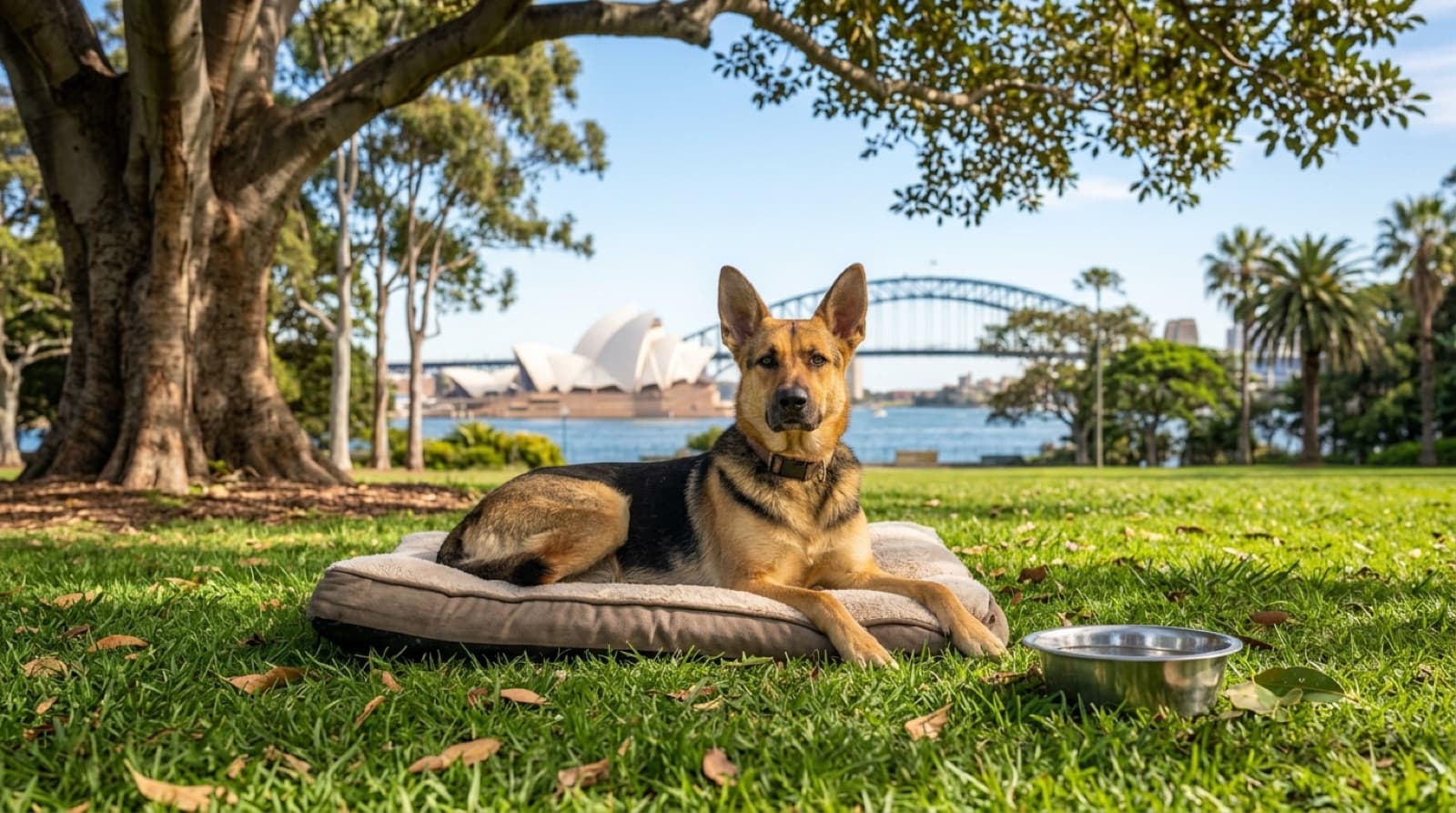
Why you never shave a double coat
Shaving a Shepherd for summer is the most common mistake first-time owners make. The thinking seems sound: a thick coat must be hot, so taking it off must help. The biology disagrees, and the dog ends up worse off, not better.
A German Shepherd has two coat layers doing different jobs. The outer coat is the longer, coarser layer of guard hairs you see and pat. It shields the skin from direct sun, sheds rain and creates an air gap between the sun-warmed surface and the dog's body. The undercoat is the soft, dense layer underneath. It traps a thin layer of air close to the skin that insulates in both directions, slowing heat moving in on a hot day and out on a cold night.
Shaving that coat does four things, none of them good:
- Removes the sun barrier. The skin underneath is pale and never normally sees direct sun. It burns on the back, ears, nose bridge and belly within hours under an Australian sky.
- Removes the air-gap insulation. The dog now takes direct radiant heat from any sun-warmed surface, with nothing buffering it.
- Does nothing for cooling. Dogs cool by panting, with a little through the paw pads. Coat thickness barely affects either system.
- Can damage the coat for good. A shaved double coat often grows back patchy, with the undercoat returning faster than the guard hairs and the texture changed.
What helps instead is removing the dead coat, not the coat. Shed undercoat left in place mats, traps heat against the skin and stops air circulating. Brush it out a few times a week, and daily during the two big seasonal coat blows. A slicker brush lifts loose hair from the outer coat and an undercoat rake reaches the dead layer underneath. Bath only occasionally and dry thoroughly, because a damp double coat in humid weather is a recipe for skin trouble. If a coat is badly matted close to the skin, a professional groomer can work it out without shaving.
The one legitimate exception is medical. If your vet directs a clip for a hot spot, a skin infection or surgery, follow that advice. Otherwise the answer is no, every summer.
What an Australian summer asks of a Shepherd
German Shepherds were developed in Germany at the end of the 1800s for cool, wet herding and protection work. Nowhere in Australia matches that. The catch is that the heat arrives differently depending on where you live, and the right routine depends on which version you get.
- The humid north-east. Subtropical coastal summers are warm and sticky from late spring into autumn. The air temperature often looks manageable, but humidity undercuts a panting dog, so a Shepherd can overheat on a day that does not feel extreme to you.
- The temperate east coast. Warm and humid summers with a sea breeze on the coast and hotter, drier conditions a short drive inland. Heatwave weeks are the danger, and the coast gets humidity on top.
- The cooler south. Milder summers on average, which is part of why the breed does well there. The risk is the spike: a mild week broken by a single very hot northerly day that a dog has not acclimatised to, often followed by a cool change that does not undo the morning's heat load.
- The dry south-west and inland. Long runs of hot, dry days under a fierce sun. Lower humidity helps a panting dog, but the extremes run higher, the ground gets hotter and the ultraviolet is harsher on skin and eyes.
The mechanism behind the humidity warning is simple. Dogs cool mainly by panting, which relies on moisture evaporating from the tongue and airways. In muggy air there is less room for that moisture, so less heat leaves the dog. The RSPCA Australia Knowledgebase lists warm, humid environments, hot surfaces such as sand and concrete, and a lack of shade and airflow among the main risk factors for heatstroke. A humid day in the high 20s can be harder on a Shepherd than a hotter, drier one.
Whatever your region, the Bureau of Meteorology forecast is the tool that tells you which kind of day is coming. Check it each morning through summer rather than assuming today will match yesterday, and treat a heatwave warning as a signal to change the dog's day before you leave the house.
Walk timing by season and region
The single biggest shift from the cool season to the hot season is when you walk. Across the country the pattern is the same, dawn and after sunset, but how long that pattern needs to run depends on where you are.
| Where you live | When the heat bites | Walk windows | What to watch |
|---|---|---|---|
| Humid north-east coast | Late spring through to autumn, with the muggiest stretch in high summer | Early morning and after dark for most of the warm season; shade and water play through the middle of the day | Humidity. Shorten walks on sticky days even when the temperature looks fine |
| Temperate east coast | Peak summer, with heatwave weeks the main risk | Dawn and dusk from early summer to late summer; longer if autumn stays warm | Hot bitumen and dry sand; humid afternoons on the coast |
| Cooler south | A handful of extreme days each summer rather than a steady season | Normal walks on mild days; dawn only, or no walk at all, on a forecast spike | The forecast. A dog that has not acclimatised feels the spike hardest |
| Dry south-west and inland | Long runs of hot days from late spring to early autumn | Early morning as the main window; after sunset once the ground has cooled | Ground temperature and sun. Dry heat is honest but the extremes run higher |
A workable hot-season day looks the same everywhere. The morning walk is the main exercise window, taken as early as you can manage. The middle of the day is spent in the coolest room. The evening walk happens after sunset, once the footpath has cooled even if the air has not. On a heatwave day or a hot and humid day, the dog does not get a walk. Scent games, a frozen food toy and a short training session replace it, because mental work tires a Shepherd too.
Off-lead beach and reserve sessions are the best hot-weather exercise where your council allows them. The dog can swim, the surfaces are sand or grass rather than bitumen, and the dog sets its own pace. Shepherds are strong but not natural swimmers, so keep swims short and rinse salt water out of the undercoat afterwards.
Hot ground: the seven-second test
The most useful habit you can build is checking the ground. Before any daytime walk in summer, press the back of your hand flat onto the footpath where you would walk and hold it for seven seconds. If you cannot keep it there comfortably, the surface is too hot for your dog's paws.
Paw pads look tough, but the skin under the keratin burns like yours. Bitumen in direct midday sun sits far above the air temperature, dry sand can be hotter again, and burnt pads take days to heal.
If the ground fails the test, the options are:
- Walk on grass instead (parks, ovals, river and foreshore reserves)
- Keep to shaded streets, or wet sand near the water line at the beach
- Walk later, after sundown, when the bitumen has cooled
- Skip the walk and do indoor enrichment instead
Dog boots exist and some Shepherds tolerate them, but most do not, and most are not breathable. The simpler, more reliable answer is to walk earlier or later. The RSPCA guide to keeping pets cool has a clear summary of hot-weather basics.
Shade, water and a cool room
The background decision that matters most is where the dog spends the middle of a hot day. A Shepherd left outside through a heatwave, even with a kennel, is at real risk. Most summer pet products are gimmicks. The few that genuinely help:
- Air-conditioning, where you have it. The single most effective tool. One cool room becomes the dog's daytime room in summer.
- A pedestal fan. Dogs cool by evaporation, and moving air speeds evaporation from the panting tongue and damp paws.
- A gel cooling mat or a tiled floor, especially for older or arthritic Shepherds that cannot easily move between cool spots.
- Constant fresh water, refreshed at least twice a day, in more than one spot.
- A shallow paddling pool in shade, refilled daily. Many Shepherds lie down in them on their own when hot.
- A frozen food toy or lick mat. Enrichment plus cooling, ideal for a heatwave day indoors.
Things that do not help, or actively hurt:
- Ice water on a very hot dog. Very cold water constricts the surface blood vessels and slows cooling. Use cool water, not iced.
- A wet towel draped over the back. It traps heat once it warms, especially over a thick coat. Wet the paws, belly and inner thighs instead.
- A cooling vest instead of staying home. They help briefly on a walk you cannot avoid. They do not make a heatwave walk safe.
Cars: never, not even for a minute
A parked car heats up fast, even on an overcast day and even with the windows down. A quick stop at the shops is long enough to put a large, double-coated dog in danger, and RSPCA Australia warns about it every summer for a reason. If you cannot take your Shepherd in with you, leave it at home in a cool room. On drives, run the air-conditioning, carry water and plan stops in the shade.
Heat stress: the signs and what to do
Heatstroke is a dangerous rise in body temperature that can lead to organ failure quickly. Large, active dogs that keep going past their limit are at risk, and a Shepherd is big, double-coated and keen, which is exactly that profile. Survival depends on how fast you cool the dog and how fast you reach a vet.
The early signs, when cooling and shade can still turn it around:
- Heavy, fast panting that does not slow when the dog rests
- Seeking shade or stopping repeatedly on a walk
- Pulling for water or trying to drink from puddles
- Flopping onto cool surfaces without prompting
- Ears and belly feel noticeably hotter than usual
The signs that mean a veterinary emergency, as listed by the RSPCA:
- Thick, rope-like drool
- Bright red or pale gums (lift the lip and check)
- Glazed or unfocused eyes, confusion
- Vomiting or diarrhoea
- Weakness, stumbling, muscle tremors or seizures
- Collapse
What to do if you see any of these:
- Stop and get out of the heat. Move the dog into shade, a cool room or an air-conditioned car.
- Wet the dog with cool, not iced, water. Concentrate on the paws, inner thighs, belly and armpits, where the blood vessels run close to the skin. Do not dunk the dog in cold water.
- Move air over the dog. A fan or the car's air-conditioning speeds evaporation, which speeds cooling.
- Offer small drinks if the dog is alert. Never force water into its mouth, and stop if the dog vomits.
- Go to a vet immediately, even if the dog seems to recover. Heatstroke can damage the kidneys, liver and gut hours after the apparent recovery, and only a vet can check for it.
This matches the first-aid advice in the RSPCA Knowledgebase and the Merck Veterinary Manual guide to pet emergencies. Find your nearest after-hours emergency vet before summer and save two numbers in your phone, because the moment you need them is not the moment to search. If in doubt, cool the dog first and drive second.
The Shepherds that need extra care
Within the breed, certain dogs need more management than the routine above:
- Seniors. Older dogs regulate temperature less well and may be too stiff to move to a cool spot on their own. Make the cool spots easy to reach.
- Overweight dogs. Body fat is insulation and reduces fitness for the work of cooling. A lean Shepherd copes better in summer and on its joints.
- Black and long-coated dogs. A black coat absorbs more of the sun's heat than a tan or sable coat, and the long-coat variant carries more fur to brush. Neither is a reason to shave.
- High-drive working-line dogs. A keen Shepherd pent up through a run of hot days will push past its own limit when let out. You have to call the break for it.
- Dogs on medication. Some prescriptions affect temperature regulation. Ask your vet at the start of summer whether anything your dog takes changes how it handles heat.
One eye note for sunny parts of the country: German Shepherds are among the breeds prone to pannus, a chronic condition of the cornea aggravated by ultraviolet light. It is a known risk in the breed rather than a certainty, so mention any cloudiness or change in the eyes to your vet. For the breed's other health issues, from hips to bloat, see our German Shepherd health guide.
The summer routine, summarised
A short version you can pin to the fridge:
- Check the forecast every morning in summer, and read humidity as well as temperature
- Walk early and after sundown; no walk on a heatwave day or a hot and humid day
- Seven-second ground test before any daytime outing
- Do not shave the coat; brush the dead undercoat out, daily during a coat blow
- Fresh water always available, refreshed twice a day
- A cool room for the middle of the day: air-conditioning, fan, cooling mat or tiles
- Never leave the dog in a parked car, even for a minute
- Know the early heat-stress signs and your nearest after-hours vet
- If in doubt, cool the dog first, drive to the vet second
A well-managed summer for a German Shepherd is not hard. It is one habit (checking the forecast), two small daily decisions (when to walk, where to walk) and one background decision (the cool room). The risk is never the heat on its own; it is missing the early signs, or pushing through a walk on a day the dog should have stayed home.
If you are still deciding whether a Shepherd fits your home and your climate, our adoption readiness quiz is a fair place to start. Adult Shepherds listed across the rescues we aggregate often come with a foster carer's notes on how the dog handles warm weather. Browse German Shepherds for adoption across Australia, or if you already have one and need to rehome it, start with our rehoming page.
Frequently asked questions
Should I shave my German Shepherd in summer to keep it cool?▼
No. The double coat insulates against heat as well as cold. The outer guard hairs shade the skin from direct sun, and the undercoat traps a layer of air next to the body that slows heat moving in. Shaving removes that protection, exposes pale skin to sunburn and does not change how a dog cools itself, because dogs cool by panting rather than through the coat. A shaved double coat can also grow back patchy. Brush out the dead undercoat through the summer shed instead. The only exception is a clip your vet directs for a medical reason.
What temperature is too hot to walk a German Shepherd?▼
There is no single number, because humidity and the ground matter as much as the air. As a working rule, once the forecast climbs into the high 20s a double-coated dog needs managing: walk early or after sunset and keep it short. On a day forecast for the mid-30s or above, or a hot and humid day, skip the walk and do indoor enrichment instead. Before any daytime outing, press the back of your hand on the footpath for seven seconds; if you cannot hold it there, the ground is too hot for paws.
Is humidity or dry heat worse for a German Shepherd?▼
Humidity is the hidden danger. Dogs cool mainly by panting, which relies on moisture evaporating from the tongue and airways. In muggy air that evaporation slows, so a humid day in the high 20s can be harder on a Shepherd than a hotter, drier one. Dry heat is more honest: the air temperature tells you most of what you need to know, but the sun and the ground are fiercer and the extremes run higher. Plan around whichever your region delivers.
What are the early signs of heat stroke in a German Shepherd?▼
Heavy panting that does not settle when the dog stops moving, repeatedly stopping or seeking shade on a walk, pulling for water, and flopping onto any cool surface it can find. The signs that mean a veterinary emergency are thick rope-like drool, bright red or pale gums, glazed eyes, vomiting or diarrhoea, stumbling, muscle tremors and collapse. Stop at the first early sign, move the dog into shade, wet it with cool water and move air over it, then go straight to a vet.
How should I cool a dog that has overheated?▼
Get the dog out of the sun and into shade, a cool room or an air-conditioned car. Wet the coat and skin with cool or room-temperature water, concentrating on the belly, inner thighs and paws. Do not use ice water and do not dunk the dog in cold water, because very cold water constricts the surface blood vessels and slows cooling. Use a fan or air-conditioning to move air over the wet dog, offer small drinks if the dog is alert and never force water in. Then go to a vet immediately, even if the dog seems to recover.
Can I leave my German Shepherd in the car for a few minutes?▼
No. A parked car heats up fast enough to kill a dog, even on an overcast day and even with the windows down. A quick stop at the shops is long enough to put a large double-coated dog in danger. Take the dog with you or leave it at home in a cool room, and on drives run the air-conditioning and plan stops in the shade.
Are German Shepherds at higher risk of heat stroke than other breeds?▼
They sit in the middle. A Shepherd is at higher risk than thin-coated breeds such as Greyhounds and Whippets, but lower risk than flat-faced breeds such as Pugs, French Bulldogs and Boxers, which cannot pant efficiently. The breed was developed for cool European working conditions, so an Australian summer asks more of it than its biology was built for. Senior dogs, overweight dogs, black and long-coated dogs and dogs on medication that affects temperature regulation are the highest-risk Shepherds.
How often should I brush a German Shepherd in summer?▼
A few times a week as a baseline, and daily during a coat blow when the undercoat sheds out in clumps. A slicker brush lifts loose hair from the outer coat and an undercoat rake reaches the dead undercoat underneath. Removing that dead layer lets air move against the skin, which is the real cooling tool for this breed. Bath only occasionally and dry the coat thoroughly, because a damp double coat in humid weather can cause skin problems.
Sources
- RSPCA Australia Knowledgebase, How can I protect my dog from heatstroke?
- RSPCA Australia Knowledgebase, What can I do about the hot weather and how to keep my pet cool
- Merck Veterinary Manual, What to do in a dog or cat emergency
- Australian Veterinary Association
- Bureau of Meteorology forecasts and heatwave warnings
Keep reading
German Shepherds for adoption across Australia
Shepherds and Shepherd crosses listed across the rescues we aggregate, refreshed regularly, with foster notes on coat and temperament.
German Shepherd Health Issues to Plan For
Hips and elbows, degenerative myelopathy, bloat, EPI and the questions to ask a rescue before you adopt.
Boxers, Exercise and Heat
How a flat-faced breed copes with the same summer, and why its heat rules are stricter again.
Are you ready to adopt a dog?
A short quiz on time, space, budget and climate before you commit to a large working breed.