The short answer
Expect a slow start. In the first days a rescue dog is often overwhelmed: quiet, hiding, off its food. Over the first weeks it learns the routine and shows more personality, and over the first months many dogs come to feel at home. That shape is the “3-3-3 rule” (3 days, 3 weeks, 3 months), a rule of thumb that shelters such as AWL SA publish, not a research finding; the RSPCA says newly adopted dogs can take several months to properly adjust, and some settle faster. Go straight home, keep things quiet, give a safe space, set a routine, introduce other pets slowly, and call the rescue or your vet early if you are worried.
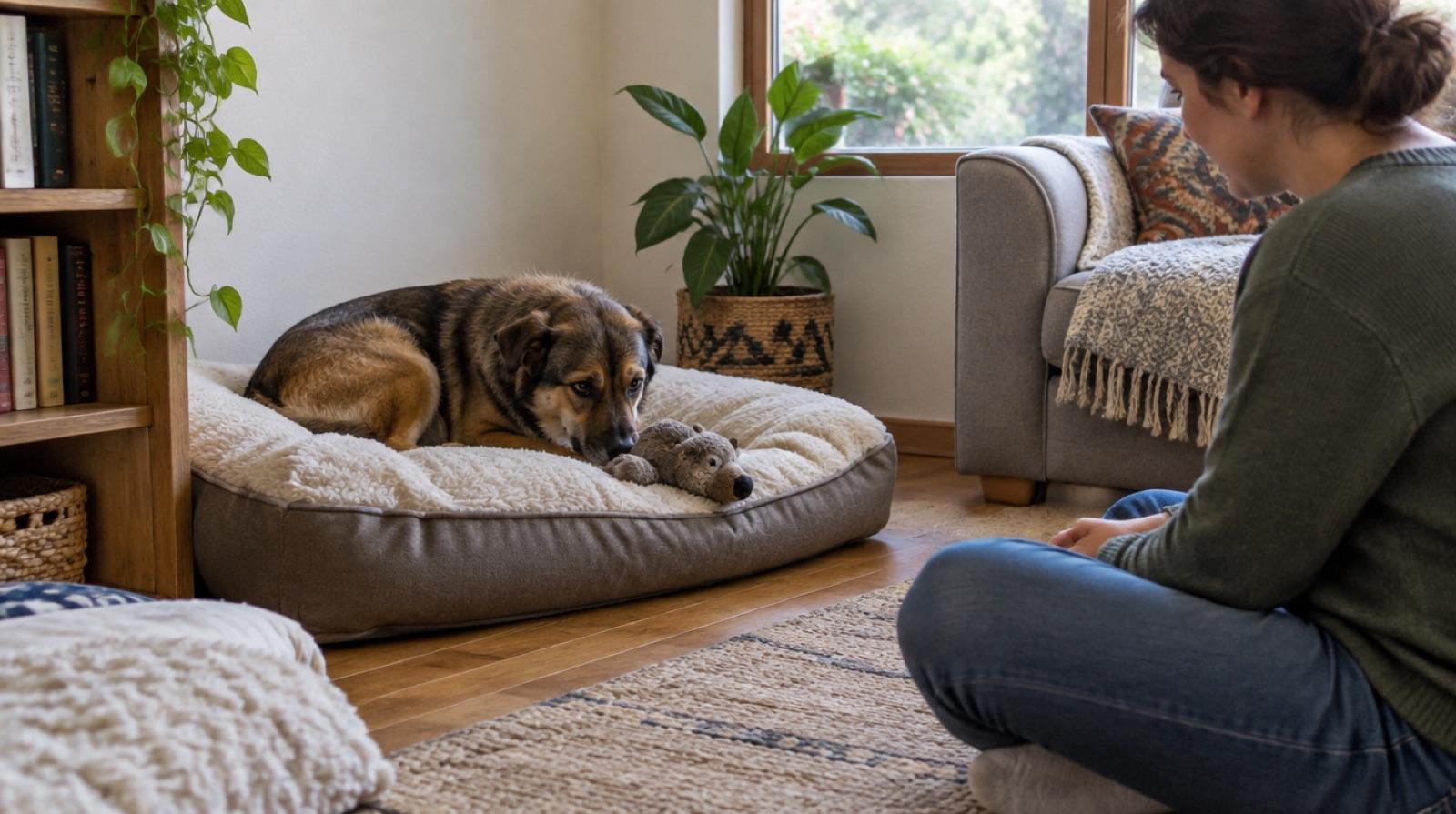
How long does a rescue dog take to settle?
Longer than most people expect, and it varies a lot. Three Australian sources put it this way:
- RSPCA South Australia: for some dogs settling might take a few days; for others it could be anytime between a few weeks and months.
- Animal Welfare League NSW asks adopters to understand that the move from shelter to home takes time, and some pets may need up to three months to fully settle.
- The RSPCA Knowledgebase says newly adopted dogs can take several months to properly adjust to their new environment.
A dog that was calm and friendly at the shelter may be withdrawn at home for a while, and a dog that is quiet at first may become livelier once it relaxes. Both are normal. RSPCA Victoria says that with any dog that has come into its care it has limited information on the dog's history, so you will both be learning.
LocalPetFinder is an adoption listings site. We do not rehome dogs ourselves; this guide pulls together the RSPCA's and Australian rescues' published advice, read in November 2026.
What is the 3-3-3 rule?
The 3-3-3 rule is a simple way to picture the settling-in period in three stages. In Australia the Animal Welfare League of South Australia publishes it and calls it just a general guideline. Here is how AWL SA describes each stage:
| Stage | What AWL SA says to expect | Your focus |
|---|---|---|
| First 3 days | Everything is new and overwhelming; hiding and keeping their distance; may not want to eat or drink; stressed body language | Safety: quiet house, few visitors, a safe space, no pressure |
| First 3 weeks | Starting to grow in confidence; forming routines; real personality and new behaviours start to show | Routine and reward-based training |
| First 3 months | Set in the routine; seeks your company more; trust and a bond have developed | Keep going: training, enrichment, gradual new experiences |
Source: Animal Welfare League SA, February 2023. The “Your focus” column summarises the RSPCA advice in the sections below.
What the rule is not: a deadline or a research result. We could not find a study that tested the 3-day, 3-week and 3-month marks, and AWL SA itself calls the rule just a general guideline, adding that some pets follow it closely while others take much longer. Treat it as a reassurance that week two being hard is normal, not as a test your dog passes or fails. If you are three months in and your dog still seems anxious, that is a reason to ask for help, not a sign the adoption has failed.
How do I prepare my home before the dog arrives?
- Dog-proof the house. RSPCA WA says to remove or secure chemicals, medications, electrical cords, batteries, toxic foods and poisonous plants. RSPCA South Australia adds shoes, cords and anything valuable or edible, with chew toys ready as alternatives.
- Check fences and gates. RSPCA WA says to make sure there are no gaps a dog could escape through, and that outdoor areas have shelter from sun, rain and extreme weather. A nervous new dog is an escape risk.
- Set up a safe space with a comfortable bed, fresh water, chew toys and enrichment, somewhere the dog can rest undisturbed (RSPCA WA).
- Have the gear ready. AWL NSW asks dog adopters to bring a lead, adjustable collar, harness and an appropriate car restraint. RSPCA Victoria says to have your supplies at home before pick-up so you can go straight home.
- Clear your diary. RSPCA South Australia suggests taking a week or two off work if possible, so you can supervise and spot stress or escape attempts.
What should the first day and night look like?
Quiet and boring, in the best way. RSPCA Victoria says to head straight home after pick-up with no stops, because your dog is likely to be feeling overwhelmed, and to keep things quiet for the first few days. If your dog is shy or fearful of other dogs, it suggests staying home for the first couple of days before venturing out for a walk; if your dog is boisterous, a brief short walk is all that is needed.
- Let the dog come to you. RSPCA Victoria says not to force interaction; a shy dog that is given time to approach in its own way does much better. RSPCA South Australia suggests a “consent test”: a gentle pat on the chest or shoulder for 2 to 3 seconds, then stop. If the dog leans in, carry on; if it turns away, give it space.
- Sleep where it feels safe. A bed or open crate in a quiet room works. RSPCA South Australia suggests a covered crate, a bed in a corner, or a blanket under a table, with any crate door left open. AWL SA suggests laying out blankets in a few places and seeing where your dog chooses to sleep.
- Never use the safe space as punishment, and do not shut the dog in it if that causes distress (RSPCA Victoria).
- Hold off on visitors, the beach and the dog park. RSPCA South Australia says big outings can be overwhelming at first.
- Give enrichment. Food puzzles and treat toys help a dog settle and link the new home with good things (RSPCA Victoria, RSPCA SA).
Learn the stress signals early. RSPCA South Australia lists barking or lunging, heavy panting, growling or retreating, refusing food, seeming shut down or overly alert, pacing, drooling, tense muscles, a tucked tail, ears back, lip licking and yawning when not tired. If you see them, the situation may be too much: give space and try again later.
How do I build a routine in the first weeks?
- Same times every day. RSPCA WA says to set consistent routines for feeding, toileting, exercise and rest, and keep the first days and weeks calm, predictable and low-pressure.
- Toilet training from day one. RSPCA South Australia says even adult dogs might not be toilet trained: take your dog out regularly, especially after meals, naps or play, and celebrate every success.
- Reward what you like. RSPCA South Australia suggests rewarding calm behaviour as it happens. The RSPCA supports reward-based training and says aversive methods must not be used (RSPCA Knowledgebase). RSPCA Victoria says it is never too early or too late to start.
- Practise short absences. RSPCA Victoria suggests “mock” departures of 5 to 10 minutes with a treat-dispensing toy, building up gradually and filming your dog to see how it copes.
- Keep other dogs at a distance at first. RSPCA Victoria advises avoiding off-lead areas such as dog parks until you know how your dog behaves with others, and staying at a distance from other dogs during the first couple of weeks.
- Book a vet visit. Even if the rescue has done the health checks, a visit to your own vet early on gives you a record and someone to call.
If you plan to use a crate, read crate training first: RSPCA Victoria says a crate is only for short periods and never replaces exercise and enrichment.
How do I introduce a rescue dog to my other pets?
Slowly, with supervision and an exit for everyone. RSPCA South Australia says not to expect instant friendship, to have separate areas ready if things get tense, and to supervise early interactions. Many rescues also arrange a meeting before adoption: AWL NSW, for example, requires an existing dog to attend a supervised dog-to-dog introduction.
| Introducing to | What the RSPCA advises |
|---|---|
| Another dog | Meet on lead and off the property, for example a short walk around the block, then come into the house together; keep both on lead until you are comfortable; separate them when no one can supervise in the first couple of weeks (RSPCA Victoria). Let them learn each other's scent first, meet somewhere neutral, and give separate feeding, sleeping and resting areas (RSPCA WA) |
| A cat | Start behind a physical barrier such as a baby gate or glass door; give the cat high escape routes and a dog-free safe space; keep sessions short and supervised; move at the pace of the more cautious animal (RSPCA WA, RSPCA Victoria). Some cats take several weeks or months to feel comfortable (RSPCA Victoria) |
| Children | Always supervise; let the dog approach in its own time; teach children to be calm and gentle; never force interactions; make sure the dog has a place to retreat (RSPCA WA) |
If either animal shows fear or stress, RSPCA WA says to slow down and go back a stage. RSPCA Victoria adds that yelling at two dogs that are growling adds fuel to the fire; calmly separate them and give everyone breathing space.
When should I call the rescue, a vet or a behaviourist?
Early, before small problems become habits. RSPCA WA puts it plainly: early support can help prevent small issues from becoming bigger challenges.
- The rescue knows your dog best. Many offer after-adoption support: RSPCA WA invites its adopters to call for tailored behaviour advice, and AWL NSW offers a 14-day veterinary service from the adoption date for health conditions relating to the animal's time in its shelter.
- Your vet for any health worry, a dog that keeps refusing food, vomiting, diarrhoea or lethargy, or a sudden change in behaviour. RSPCA WA lists a qualified dog trainer or your local vet as the people to ask if you are concerned about behaviour or stress.
- A reward-based trainer if your dog growls, barks or lunges at other dogs, or shows significant stress such as howling or destruction when left alone (RSPCA Victoria).
- A qualified behaviourist for separation anxiety or distress. The RSPCA Knowledgebase advises seeing one, and notes that a veterinary behavioural specialist can also do a medical assessment.
On separation problems specifically, University of Melbourne researcher Dr Diane van Rooy says separation anxiety is thought to affect one in every four to six dogs, that a dog barking for a minute and then settling is not separation anxiety, and that filming your dog when you leave is the best way to see what is happening (University of Melbourne). Our separation anxiety guide covers it in depth.
What if it feels like a mistake?
That feeling is common and often passes. Our puppy blues guide looks at a 2024 study of how many new dog owners feel overwhelmed and how long it lasted, and where to get support. Before deciding anything, talk to the rescue: it knows the dog, it may have practical fixes, and it will want to know if something is not working. Return policies are not the same everywhere, so ask your rescue what happens if the adoption does not work out, ideally before you sign. We have not found published national figures on how often adoptions are returned, so we will not guess at one.
Does the kind of dog change the first weeks?
- Ex-racing greyhounds may never have lived in a house. The RSPCA Knowledgebase says some have never been inside a home and may feel uncomfortable in a small area with unfamiliar people. See greyhound adoption in Australia.
- Senior dogs are often calmer but may need gentler routines and earlier vet checks. See adopting a senior dog.
- Puppies need toilet training, sleep management and socialisation; RSPCA Victoria recommends a well-run Puppy Preschool from 8 weeks of age. See puppy blues and crate training a puppy.
- Not sure what breed your dog is? What breed is my rescue dog? explains why shelter breed labels are often guesses, and what a DNA test can add.
Summer adoptions come with extra checks: heat and grass seeds are the two everyday risks on new walks. See dogs in hot weather and grass seeds and dogs.
Ready to meet your rescue dog?
If you have not adopted yet, adopting a dog in Australia covers fees, what they include and the rules in your state. Then browse the dogs listed right now by the rescues and shelters we aggregate:
Find a rescue dog near you
More from this series: barking dogs (a common worry with a new dog and the neighbours), bark collars, flying with a pet and cat enclosures and catios.
Frequently asked questions
What is the 3-3-3 rule for rescue dogs?▼
It is a rule of thumb that splits settling in into three stages: the first 3 days, when a dog is often overwhelmed; the first 3 weeks, when it starts to learn the routine and show more personality; and the first 3 months, when many dogs feel at home. Shelters such as the Animal Welfare League of South Australia publish it, and AWL SA itself calls it just a general guideline.
Is the 3-3-3 rule based on research?▼
Not that we could find. It is a guideline that shelters publish, not a study finding, and AWL SA, which publishes it, says every pet is different and will adjust at its own pace. The RSPCA describes the timing more loosely: RSPCA South Australia says some dogs settle in a few days and others take a few weeks to months, and the RSPCA Knowledgebase says newly adopted dogs can take several months to properly adjust.
How long does it take a rescue dog to settle in?▼
Anywhere from a few days to several months. RSPCA South Australia says some dogs settle in a few days and others take anywhere between a few weeks and months, AWL NSW tells adopters some pets may need up to three months to fully settle, and the RSPCA Knowledgebase says newly adopted dogs can take several months to properly adjust.
What should I do on the first day with a rescue dog?▼
Head straight home, with no stops at the shops or friends' houses, as RSPCA Victoria advises. Keep the house quiet, show your dog a safe space with a bed and water, let it explore at its own pace, and do not force cuddles. A shy dog may be better staying home for the first couple of days rather than going for a walk.
Where should a rescue dog sleep the first night?▼
Somewhere quiet that it can treat as its own safe space, such as a bed or open crate in a calm room. RSPCA South Australia suggests a covered crate, a bed in a corner or a blanket under a table, with any crate door left open so the dog can choose. AWL SA suggests putting blankets in a few spots and seeing where your dog chooses to sleep.
Is it normal for a rescue dog not to eat at first?▼
It is common in the first days. RSPCA South Australia lists refusing treats or food as a sign a new dog is overwhelmed, and AWL SA says a dog may not want to eat or drink in the first three days. If you are worried, or your dog is also vomiting, lethargic or has diarrhoea, call your vet.
Why is my rescue dog having toilet accidents?▼
Because it does not know your house rules yet. RSPCA South Australia says even adult dogs might not be toilet trained, so assume they do not know the rules, take them out regularly, especially after meals, naps and play, and praise every success.
How do I introduce my rescue dog to my other dog?▼
Slowly, on lead and off your property. RSPCA Victoria suggests a short walk around the block together and then coming into the house together, keeping both dogs on lead until you are comfortable they are getting along, and separating them when no one is home in the first couple of weeks. RSPCA WA adds separate feeding, sleeping and resting areas.
How do I introduce a rescue dog to my cat?▼
Start with a physical barrier such as a baby gate or glass door, and let them watch each other from a safe distance. RSPCA WA and RSPCA Victoria both say to give the cat high escape routes and a dog-free safe space, keep sessions short and supervised, and move at the pace of the more cautious animal. RSPCA Victoria says some cats take several weeks or months to feel comfortable.
When can I leave my new rescue dog alone?▼
Build up to it. RSPCA Victoria suggests practice departures of 5 to 10 minutes with a treat-dispensing toy, then gradually longer, filming your dog to see how it copes. RSPCA South Australia suggests taking a week or two off work if you can to supervise and gradually build alone time. Howling or destruction when alone is a reason to get help from a reward-based trainer or the rescue.
When should I call the rescue, a vet or a behaviourist?▼
Call the rescue first for anything about settling: many, such as RSPCA WA, offer behaviour advice to their adopters. See a vet for any health worry or a sudden change in behaviour; the RSPCA notes that aggression is commonly due to fear, anxiety or pain. The RSPCA advises a qualified behaviourist for separation anxiety or distress, and RSPCA Victoria suggests a reward-based trainer for fear of other dogs or stress when alone.
What if the adoption is not working out?▼
Talk to the rescue before deciding anything. Rescues know the dog and often have advice or support, and some include short-term vet help after adoption, such as AWL NSW's 14-day veterinary service for conditions linked to the dog's time in the shelter. Return policies differ, so ask your rescue what happens if it does not work out before you sign.
Sources
- RSPCA South Australia: Bringing home a rescue dog? Here’s what to do in the first week (28 May 2025)
- RSPCA Victoria: Bringing your new dog home
- RSPCA WA: Settling a dog into your home
- RSPCA Knowledgebase: What should I know about owning a greyhound? (updated 14 December 2025)
- Animal Welfare League SA: 3-3-3 things to remember when adopting your new best friend (February 2023)
- Animal Welfare League NSW: Adopt a pet
- University of Melbourne Pursuit: Dealing with separation anxiety in dogs (24 January 2020)
Keep reading
Adopting a dog in Australia
How adoption works, what fees include, state rules and renting with a dog.
Dog separation anxiety
The signs, what the research says, and when to call a behaviourist.
Puppy blues
The overwhelmed feeling many new owners have, and what helps.
Crate training
How RSPCA Victoria says to introduce a crate, and its limits.