The short answer
Separation anxiety is real distress when a dog is left alone: barking or howling, destruction such as scratching at doors, toileting inside, pacing, escaping or refusing food until you are home. RSPCA Australia calls it a mental health issue that requires veterinary treatment. It is different from boredom, which shows up in dogs left alone all day with nothing to do, and from chewing that happens whether you are home or not. Film your dog to find out which you have. Then build alone time in small steps, keep departures and returns calm, give a long-lasting food toy only when you leave, and exercise your dog before you go. If your dog is distressed every time, hurts itself or is not improving, start with your vet, who may refer you to a veterinary behaviourist and may discuss medication alongside training.
What is separation anxiety in dogs?
Separation anxiety is distress a dog shows when it is apart from its owner or family. The RSPCA Australia Knowledgebase describes it as signs of distress when a dog is separated from an owner or family group, and notes that dogs are highly social animals, so many become anxious when left without their people.
It is not a dog being naughty or spiteful. The RSPCA's page on excessive barking puts it plainly: separation anxiety is a mental health issue that requires veterinary treatment. Researchers often use the broader term “separation-related behaviour”, and the studies quoted below do. This guide uses the everyday term.
A University of Melbourne vet, Dr Diane van Rooy, who researched the genetics of separation anxiety in Labradors and golden retrievers, makes the key point: true separation anxiety involves real, ongoing distress. It is not a dog that barks for a minute after you leave and then goes to sleep.
What are the signs?
Between them, RSPCA Australia and the University of Melbourne list these signs:
- Noise: barking, howling or whining, sometimes continuously while you are out.
- Destruction: chewing, scratching at doors, and digging.
- Toileting inside in a dog that is otherwise house-trained.
- Escape attempts, sometimes through a broken window.
- Pacing and restlessness, or a dog that never fully relaxes when alone.
- Not eating or drinking until you get home.
- Self-harm: RSPCA Australia includes chewing or licking until wounds form.
Dr van Rooy notes that the signs are sometimes subtle: a hyper-vigilant dog that does not settle, or one that will not touch its food until you return. These dogs suffer quietly and their owners often do not know.
Is it separation anxiety or boredom?
This is the question to answer first, because the fixes differ. Boredom calls for more exercise and things to do. Separation distress needs a gradual training plan and often your vet.
| What you see | More likely | Why |
|---|---|---|
| Distress only when alone, ongoing, sometimes with refusing food or trying to escape | Separation distress | Real, ongoing distress tied to being apart from people (University of Melbourne) |
| Barking or digging in a dog left alone all day with nothing to do | Boredom or unmet needs | RSPCA Australia links this to too little exercise, mental stimulation or company |
| Chewing furniture whether people are home or not | Not separation anxiety | University of Melbourne: it happens with people present too |
| A minute of barking after you leave, then sleep | Normal | University of Melbourne: brief protest that settles is not separation anxiety |
| Accidents in a dog that was reliably house-trained | Check health first | RSPCA Victoria advises a vet visit when a trained dog suddenly starts having accidents |
Sources: RSPCA Australia Knowledgebase; RSPCA Victoria; Dr Diane van Rooy, University of Melbourne (2020). A guide, not a diagnosis.
The single most useful step, which Dr van Rooy recommends, is to film your dog while you are out. A phone or home camera shows you whether your dog is chewing a toy contentedly, sleeping, or pacing and crying at the door. Note how soon after you leave the behaviour starts and what the dog is doing when it does.
How common is separation anxiety?
Estimates vary widely, mostly because studies measure different things. The honest picture:
| Source | Population | Finding |
|---|---|---|
| Salonen et al. 2020, Scientific Reports | 13,700 Finnish pet dogs, owner questionnaire | 5% showed frequent separation-related behaviour; the authors note earlier studies found 14 to 20% |
| Dr Diane van Rooy, University of Melbourne, 2020 | Expert estimate | Thought to affect one in every four to six dogs, more common in older dogs |
| Dale et al. 2024, Animal Welfare | 145 puppies in the UK and Ireland | Owners of 46.9% reported at least one of 12 separation-related behaviours when alone at six months |
Figures quoted as each source states them. The studies use different definitions, so the numbers are not directly comparable.
The Finnish figure is low because the researchers counted only dogs that did these things often or very often; the authors suggest this as the likely reason. The puppy study is high because a single behaviour, even mild, counted. The useful takeaway is that some separation-related behaviour is common, and serious, ongoing distress is a smaller but real group.
An Australian survey points the same way. McGreevy and Masters (2008) surveyed owners of 690 Australian dogs in 485 households (readers of a dog magazine, so self-selected). Male dogs and dogs that were not desexed were more likely to score high for separation-related distress, as were dogs bought from pet shops compared with dogs that came from friends or family. Dogs that regularly played games with their owners scored lower, but dogs played with in the first 30 minutes after the owner came home scored higher. That last finding fits the standard advice to keep homecomings calm.
What causes it?
Usually a mix. Dr van Rooy describes interactions between a dog's genetics, its environment and its life experiences, and notes some family lines are reported to be at higher risk. Her own research found chromosome regions that seemed to raise or lower the risk in Labradors (not golden retrievers), and she says more work is needed.
The triggers she describes are often changes in routine:
- The holiday puppy. A puppy that is with someone all day over summer, then suddenly alone for hours when work and school go back.
- Loss of a family member, person or animal.
- A frightening event while alone, such as a bad thunderstorm.
Her advice is to make household changes as gradual as you can. If you are about to go back to the office after time at home, start leaving the dog for short, growing periods a few weeks beforehand rather than all at once.
How do you treat separation anxiety? A step-by-step plan
These steps come from the RSPCA Australia Knowledgebase and the University of Melbourne. They suit mild cases on their own. For moderate or severe distress, do them with your vet's involvement.
- Film first. Confirm it is separation distress, and note how long after you leave it starts. That time is your starting point.
- Stop leaving the dog for longer than it can cope with while you train. Use a sitter, family, a midday dog walker or a reputable doggy day care.
- Make departures and returns boring. RSPCA Australia suggests ignoring your dog for 15 to 30 minutes before you leave, then greeting it quietly when you come back and giving attention only once it is calm.
- Take the sting out of your leaving cues. Pick up your keys, put on your shoes or grab your bag, then sit back down. RSPCA Australia calls this habituation: the cues stop predicting that you are about to vanish.
- Build absences in tiny steps. This is desensitisation. Step outside for a few seconds, come back before the dog gets upset, and slowly lengthen the time. RSPCA Australia's greyhound advice starts with stepping just out of sight for a couple of seconds and building to a minute. Progress at the dog's pace, not the calendar's.
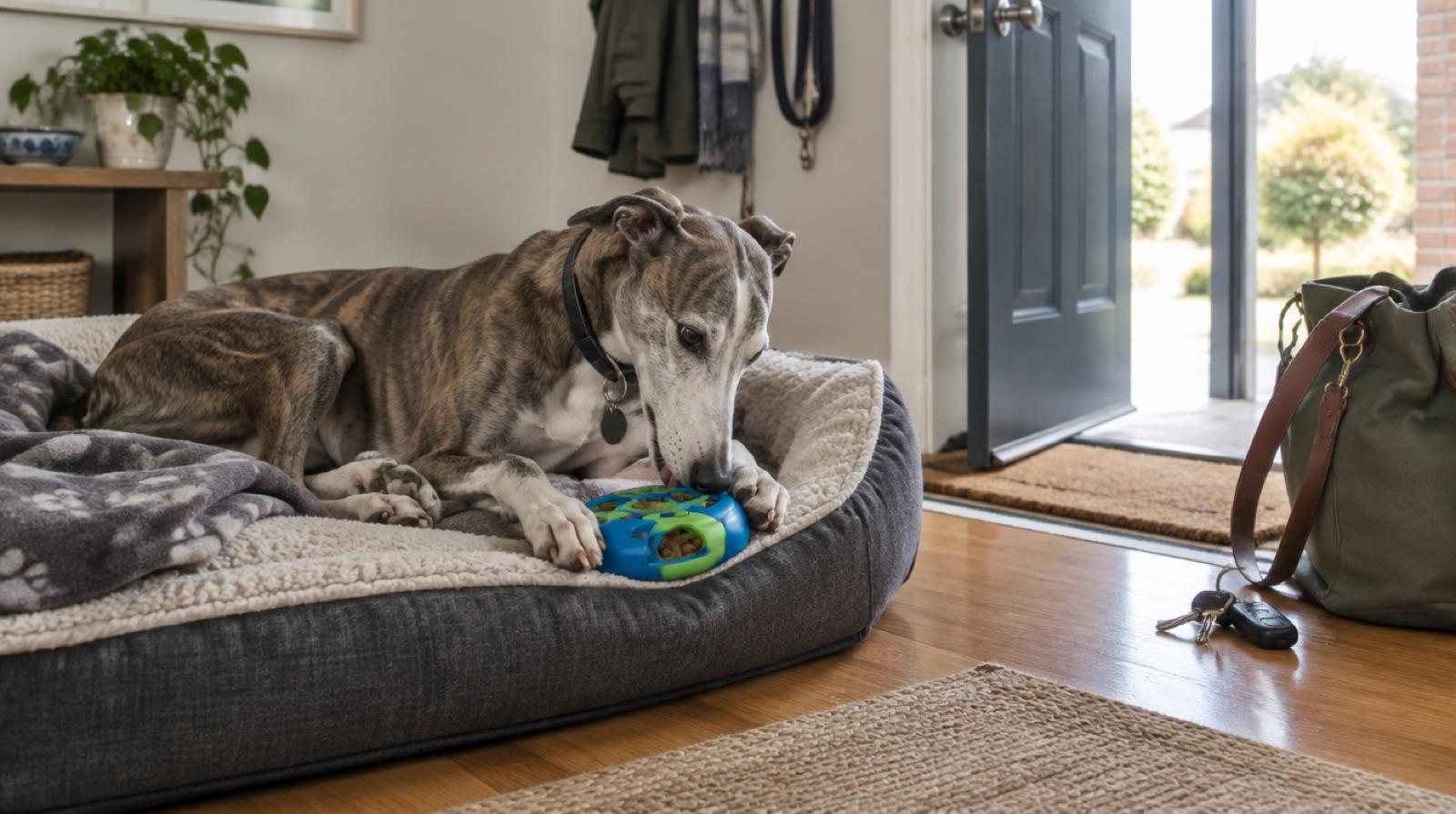
- Pair alone time with something good. A food toy stuffed so it takes at least 20 to 30 minutes to empty, given only when you leave and picked up when you return. RSPCA Australia notes this usually helps only mild cases, because a very anxious dog often will not eat when alone. If the toy is untouched on your video, that tells you something too.
- Exercise before you leave. A walk, then time to settle. Dr van Rooy suggests a morning walk and about half an hour of settling before you go. RSPCA Australia adds fetch or tug before leaving, safe chew items and new walking routes.
- Reward calm independence at home. RSPCA Australia suggests ignoring attention-seeking and rewarding the dog when it is relaxed on its own, so it learns that being apart from you, even in the next room, is fine.
- Never punish. The dog is distressed, not defiant. The RSPCA's training guidance supports reward-based methods and says aversive methods should not be used. In the 2024 puppy study, owners who used two or more aversive responses had puppies with higher odds of separation-related behaviour, although the authors stress the results are correlational.
Be patient. Dr van Rooy says separation anxiety can be managed and treated, but it requires commitment and time.
When should you see a vet or a veterinary behaviourist?
Start with your local vet if any of these apply:
- Your dog is distressed every time you leave, not just occasionally.
- It injures itself, damages doors or windows, or escapes.
- It toilets inside or stops eating when alone and was previously fine. A medical problem needs ruling out.
- You have tried the gradual plan for a few weeks and it is not getting better.
RSPCA Australia says your vet can advise you directly or refer you to a behavioural specialist who uses humane, reward-based training. Dr van Rooy notes there are veterinary behaviour specialists and vets with extra qualifications in behaviour. A veterinary behaviourist starts with a medical assessment to make sure there is no underlying health issue, as the RSPCA's greyhound guidance explains.
In severe cases, where the dog may hurt itself, RSPCA Australia says vets may suggest a combination of medication and behaviour modification. That is a conversation to have with your vet. Medication supports training rather than replacing it, and you should never give your dog medicine from your own cupboard or a friend's.
If cost is a worry, our cheap vet care guide lists charity clinics and concession options by state.
Do rescue dogs get separation anxiety more often?
Honestly, the evidence is thin, and you will see confident claims online that go well beyond it.
What the research does say: in the Finnish study, separation-related behaviour was most common in mixed-breed dogs and Wheaten Terriers. The authors suggested this might be because many of the mixed-breed dogs in their data were likely rescues, with poorer early lives or bad experiences. That is their explanation, not something they measured. The Australian survey found dogs from pet shops scored higher than dogs from friends or family; it did not single out rescue dogs.
What Australian rescues say is practical. The RSPCA's guidance on adopted greyhounds lists separation anxiety or distress among the signs that call for a qualified behaviourist, notes that a new dog may be unsettled when left alone at bedtime, and says it can take several months for a newly adopted dog to fully settle. In other words, a rescue dog that cries when you leave in week one is not necessarily a dog with separation anxiety. It may be a dog that has not settled yet.
The advantage of adopting an adult dog is that someone often already knows how it copes alone. Before you commit, ask the rescue or foster carer:
- How long has the dog been left alone in foster care, and what happened?
- Does it follow people from room to room, or settle on its own?
- How does it cope in a crate, a laundry or a yard?
- Has it ever escaped or damaged doors?
If your days are long and nobody is home, say so. A good rescue will steer you towards a dog that copes, or away from one that would struggle. Our adoption readiness check covers time alone along with budget and housing.
How do you prevent separation anxiety in a new puppy or dog?
Teach alone time on purpose, from the first week. The RSPCA Australia Knowledgebase says it is important to teach your puppy to be happy when alone, starting with very short periods, like a minute, and slowly building up. A crate the puppy enjoys can be that safe place; see our crate training guide for the steps.
- Practise from day one, even if you are home all day. Dr van Rooy suggests a couple of minutes at first, then slowly longer.
- Keep comings and goings low-key. No big fuss on the way out or on the way in.
- Leave something good: a favourite toy or a food-dispensing toy.
- Exercise first, then a settle, then leave.
- Plan for the end of holidays. If you are home for a few weeks after adopting, build up absences before you go back to work.
One finding from the 2024 UK puppy study is worth knowing, with its caveats: puppies restricted to a crate or room overnight at 16 weeks or younger had lower odds of separation-related behaviour at six months, and owners who fussed over the dog on return had higher odds. The sample was small (145 dogs) and the results are correlational, so treat them as a pointer, not a rule.
If you feel overwhelmed in the early weeks, that is common too; our puppy blues guide covers it.
Which dogs suit a home where everyone works?
No breed is immune; Dr van Rooy notes separation anxiety occurs in every breed. What matters more is the individual dog, its exercise needs and how it copes alone. If you are choosing a dog for a busy household, these guides help:
- Calm dog breeds that tend to settle more easily.
- Low-maintenance dog breeds with lighter exercise and grooming needs.
- Best apartment dogs, where barking and neighbours matter most.
- Adopting a senior dog, often already used to a household routine.
An adult rescue dog whose foster carer can tell you “she sleeps through the workday” is a safer bet for a busy home than any breed label.
Other Australian dog health and safety guides
Find a dog near you
Each page lists the dogs currently with the rescues we aggregate in that city, refreshed regularly. Calmer adults and seniors are often the easiest fit for a home with long workdays; ask the rescue how each dog copes alone.
Frequently asked questions
What is separation anxiety in dogs?▼
It is distress a dog shows when it is separated from its owner or family. The RSPCA Australia Knowledgebase describes it as signs of distress when a dog is separated from an owner or family group, such as toileting in the house, destructiveness, excessive barking, digging, pacing or trying to escape. It calls separation anxiety a mental health issue that requires veterinary treatment.
How do I know if it is separation anxiety or boredom?▼
Look at when it happens. Separation distress shows up when the dog is alone, often soon after you leave, and the dog seems genuinely upset. A University of Melbourne vet notes that a dog who barks for a minute and then settles does not have separation anxiety, and neither does a dog who destroys furniture whether people are home or not. RSPCA Australia says barking in a dog left alone all day with nothing to do may be boredom. Film your dog while you are out to find out.
How common is separation anxiety in dogs?▼
Estimates vary with how it is measured. A 2020 study of 13,700 Finnish pet dogs found 5% showed frequent separation-related behaviour, and the authors note earlier studies found 14 to 20%. A University of Melbourne vet writes that it is thought to affect one in every four to six dogs and is more common in older dogs.
Do rescue dogs have more separation anxiety?▼
The evidence is limited. In the 2020 Finnish study, separation-related behaviour was most common in mixed-breed dogs, and the authors suggested this might be because many of those dogs were likely rescues with harder early lives, but they did not measure that directly. RSPCA Australia notes a newly adopted dog can take several months to fully settle. Ask the rescue or foster carer how the dog copes alone before you adopt.
Can a puppy have separation anxiety?▼
Puppies can show separation-related behaviour. In a 2024 UK and Ireland study of 145 puppies, owners of 46.9% reported at least one such behaviour when the dog was left alone at six months old. RSPCA Australia and a University of Melbourne vet both advise teaching a new puppy to be alone from the start, beginning with a minute or two and building slowly.
How do you train a dog with separation anxiety?▼
Go gradually and keep the dog below the point where it panics. RSPCA Australia recommends calm departures and returns, practising your leaving cues without leaving, building absences slowly, a long-lasting food toy given only when you leave, and exercise before you go. Your vet can help directly or refer you to a reward-based behaviour professional.
Should I ignore my dog before I leave?▼
RSPCA Australia suggests ignoring your dog for 15 to 30 minutes before you leave and greeting it quietly when you return, giving attention once it is calm. The aim is to make comings and goings boring, so they stop being big emotional events.
Will getting a second dog fix separation anxiety?▼
Not reliably. A University of Melbourne researcher says another dog may help a dog that just needs any company, but it does not help a dog attached to one particular person or animal, and it is never a good idea to get another dog only as a treatment. You may end up with another set of problems.
Does a crate help with separation anxiety?▼
It depends on the dog. A crate can be a safe den for a dog that already likes it, but a dog in real panic can hurt itself trying to escape, and RSPCA Australia lists attempting to escape and self-harm among the signs. Film your dog before relying on a crate, and build any crate time gradually with rewards.
When should I see a vet about separation anxiety?▼
See your vet if your dog is distressed every time you leave, injures itself, damages exits, or the problem is not improving with gradual training. RSPCA Australia says your vet can advise or refer you to a behaviour professional who uses humane, reward-based methods. In severe cases your vet may discuss medication alongside training; never give a dog medicine that a vet has not prescribed.
Should I punish my dog for destruction or accidents while I was out?▼
No. The dog is distressed, not disobedient, and punishment adds fear. RSPCA Australia supports reward-based training and says aversive methods should not be used, and a 2024 study linked owners using aversive responses to more separation-related behaviour in young dogs.
How long does it take to fix separation anxiety?▼
There is no fixed timeline. A University of Melbourne researcher says separation anxiety can be managed and treated but requires commitment and time. Use a sitter, family, a dog walker or day care to cover long absences while you train, so the dog is not pushed past what it can cope with.
Sources
- RSPCA Australia Knowledgebase: What can I do if my dog is anxious when I am not at home?
- RSPCA Australia Knowledgebase: What causes dogs to bark excessively?
- RSPCA Australia Knowledgebase: What should I know about owning a greyhound?
- RSPCA Australia Knowledgebase: How can I socialise my puppy?
- RSPCA Australia Knowledgebase: What sort of training would you recommend?
- University of Melbourne, Pursuit: Dealing with separation anxiety in dogs (Dr Diane van Rooy, 2020)
- Salonen et al. (2020), Prevalence, comorbidity, and breed differences in canine anxiety in 13,700 Finnish pet dogs, Scientific Reports
- McGreevy and Masters (2008), Risk factors for separation-related distress and feed-related aggression in dogs: additional findings from a survey of Australian dog owners, Applied Animal Behaviour Science (abstract)
- RSPCA Victoria: Puppy toilet training
- Dale et al. (2024), Canine separation-related behaviour at six months of age (Generation Pup), Animal Welfare
Keep reading
Crate training a puppy
How to set up a crate, the gradual steps RSPCA Victoria publishes, toilet training and how long is too long.
Puppy blues: how long they last
Nearly half of new owners in a 2024 study felt it. What helps, and where to get support.
Calm dog breeds
Breeds and adult rescue dogs that tend to settle more easily at home.
Adopting a dog in Australia
How adoption works, fees by state and what to ask a rescue before you commit.