The short answer
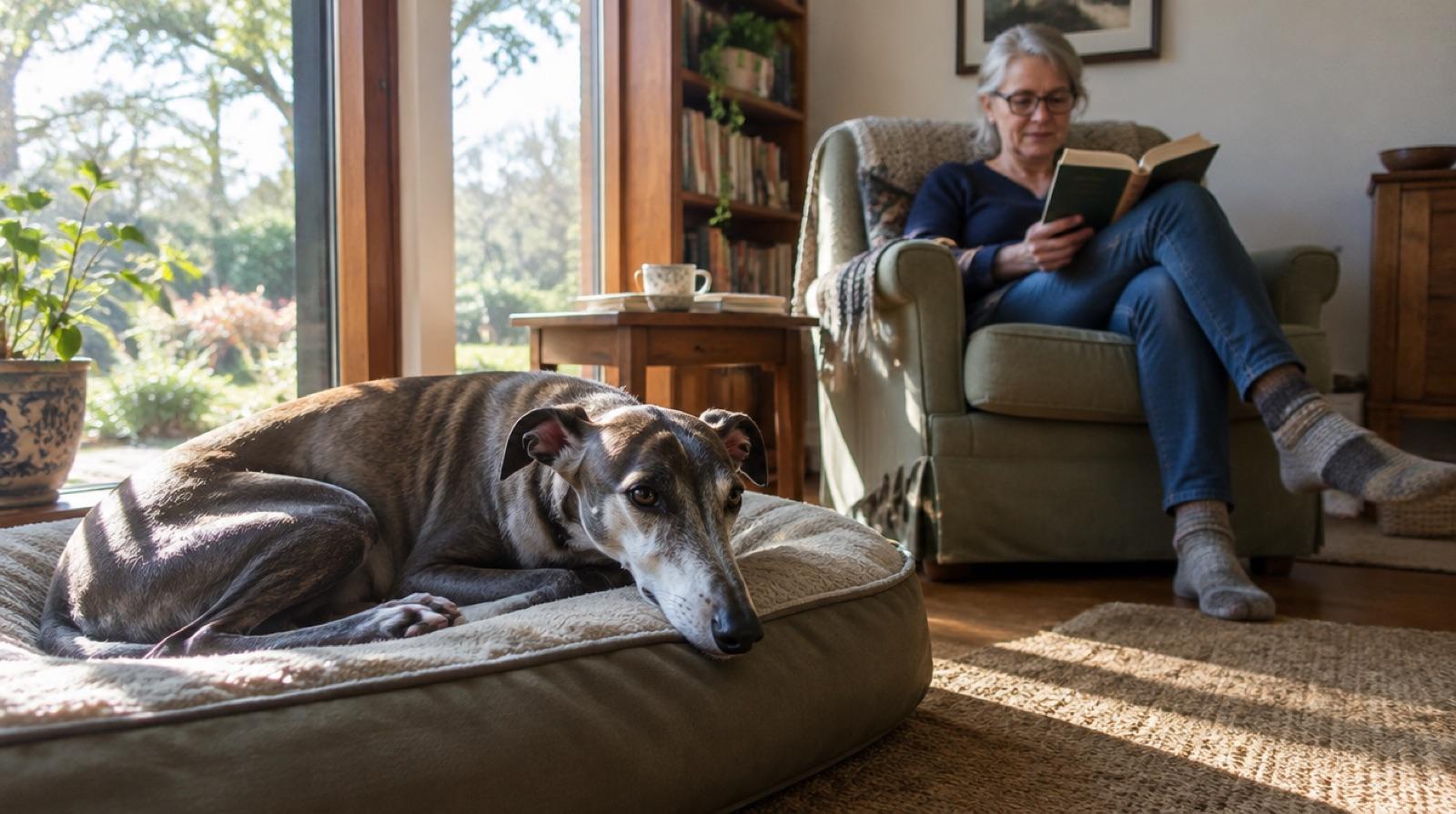
Look at the coat before the size. Short, smooth coats need little more than a regular brush, while long and curly “non-shedding” coats need regular brushing and professional clipping for life. The easy-care standouts are retired racing Greyhounds, which their adoption programs say sleep most of the day and need only a short daily walk, plus Whippets and Staffies. Flat-faced breeds look easy but carry high vet costs. The biggest saving of all is age: a calm adult or senior rescue dog is less work than a puppy of any breed.
What makes a dog low maintenance?
Four things create most of the work of owning a dog, and only one of them is closely tied to size.
- Coat. The biggest one. A short, smooth coat needs little more than a brush. A long or curly coat needs frequent brushing and, for many dogs, regular professional clipping. RSPCA Australia says it is usually advisable to use a reputable professional groomer to clip your dog.
- Exercise and drive. A dog that needs a long run and a job every day is a daily commitment in any weather. A calm dog that is happy with a stroll is not.
- Age. A puppy is high maintenance whatever its breed. An adult is usually house-trained and past chewing.
- Health and running costs. Some breeds carry predictable vet costs, and larger dogs eat more. This is where size counts.
There is no official low-maintenance rating for breeds, so the comparison below uses what the breed standards say about coat and temperament, plus published guidance from adoption programs and the RSPCA. Treat it as a guide to the breed, not a promise about one dog.
Low maintenance dog breeds compared
| Breed | Coat in the standard | Effort | The catch |
|---|---|---|---|
| Greyhound | “Fine and close” (standard) | Low. Often sleeps up to 16 to 20 hours a day; one or two short walks suit most (GAP WA) | Chase instinct; check your state's lead and muzzle rules |
| Whippet | “Fine, short, close in texture” (standard) | Low to moderate. “Highly adaptable” companion | Chase instinct; less common in rescue than Greyhounds |
| Staffordshire Bull Terrier | “Smooth, short and close” (standard) | Low grooming, moderate exercise | Strong and people-focused; needs training and company |
| Beagle | “Short, dense and weatherproof” (standard) | Low grooming, higher exercise | A scent hound with “great activity, stamina and determination”; recall takes work |
| Labrador Retriever | Short and dense with a weather-resistant undercoat (standard) | Easy coat, high energy when young | Sheds; easy to overfeed |
| Maltese | “Good length”, “silky texture” (standard) | Low exercise, high grooming | Regular brushing and clipping for life |
| Kelpie | “A double coat with a short dense undercoat” (standard) | High. “Almost inexhaustible energy” | Needs a job every day |
| Border Collie | Dense topcoat, “undercoat soft and dense” (standard) | High. “Instinctive tendency to work” | Double coat plus daily mental work |
Coat and temperament wording from the Dogs Australia breed standards; Greyhound care from Greyhounds As Pets WA. Checked 9 November 2026. The effort column is our editorial summary of those sources. Individual dogs vary.
The laziest dog breeds
If “lazy” means a dog that is happy to do very little, the retired racing Greyhound wins. Greyhounds As Pets WA calls Greyhounds low energy and lazy hounds, often sleeping up to 16 to 20 hours a day and generally needing only a short daily walk of around 20 minutes. They are big dogs, but they spend most of the day lying down. Retired racers come into adoption as adults, and you can see the Greyhounds listed right now on the breed page.
The other genuinely lazy dogs are not a breed at all. They are senior dogs. An older dog of almost any breed tends to want a soft bed, a sunny spot and a couple of gentle walks. The low-energy dogs listings collect dogs that shelters describe as calm, and our senior dog adoption guide covers what to expect.
Be careful with one kind of “lazy”. Flat-faced breeds often exercise little because they struggle to breathe. RSPCA Australia says brachycephalic dogs such as Pugs and French and British Bulldogs commonly have lifelong breathing problems, may be unable to exercise normally in warm and humid weather, and may need surgery and lifelong management. That is low exercise for the wrong reason, with high vet costs to match.
Why non-shedding usually means more work
This is the most common mistake people make when looking for an easy dog. A “non-shedding” coat does not drop hair; it holds it. The coat keeps growing, tangles against itself and mats. Poodles, Cavoodles and other doodles, Maltese and Shih Tzus all fall into this group.
The real cost is time and a standing appointment. RSPCA Australia notes that regular brushing removes knots and loose hair, and that clipping is usually best left to a reputable professional groomer. Our Cavoodle grooming guide sets out what that looks like in practice, and dogs that don't shed compares the low-shedding breeds. A short-coated dog that sheds a little is usually less work overall: you are choosing between a vacuum and a grooming bill.
If allergies are your reason for wanting a low-shedding dog, that is a separate question. ASCIA says all dog breeds cause allergies, although some do not shed as much dander, so less allergen is spread. The only reliable test is time with the specific dog. Browse low-shedding dogs in rescue with that in mind.
The highest maintenance dogs
The other end of the scale is high-drive working breeds and heavy double coats. The Kelpie standard describes “almost inexhaustible energy”, and the Border Collie standard an “instinctive tendency to work”. Both have double coats, and RSPCA Australia says double-coated dogs should normally be groomed every day to stop dead hair building up and can be prone to matting.
These are superb dogs for an active household with a job for them. They are not easy-care dogs, and Kelpie and Cattle Dog crosses are common in Australian rescue.
Find a low maintenance dog near you
Short-coated, easy-care rescue dogs and crosses from the shelters we aggregate in each city.
Age predicts your workload better than breed
A puppy of the easiest breed on this page will still take more work in its first year than an adult of almost any breed. House training, night waking, chewing and socialising do not care about coat type. RSPCA Australia notes that puppies and kittens are a particularly large time investment.
An adult rescue dog also comes with facts instead of a breed average. A foster carer can tell you what the coat actually does, whether the dog settles when left alone, and how it is with cats and children. RSPCA Australia encourages adopting from the RSPCA or another reputable rescue, and says RSPCA animals are vaccinated, wormed, microchipped and desexed as appropriate before adoption, which takes several jobs off your list on day one.
Mixed breeds count here too. Crosses and mixes make up a large share of rescue listings, and a Staffy cross or Greyhound cross with a short coat can be just as easy as either parent. Judge the dog, not the label. The what dog breed am I quiz and the adoption readiness check can help you work out what suits your routine, and our best family dogs guide covers homes with children.
Frequently asked questions
What is the most low maintenance dog breed?▼
Short-coated, calm breeds with modest exercise needs are the easiest to care for, and the retired racing Greyhound is the standout. Greyhounds As Pets WA says Greyhounds often sleep up to 16 to 20 hours a day, generally need only a short daily walk and have low-maintenance grooming needs. Whippets are similar in a smaller frame. Staffies, with a smooth, short coat, are another easy-care option that is common in Australian rescue.
What are the laziest dog breeds?▼
Retired racing Greyhounds have the best claim to the title: their adoption programs describe dogs that sleep most of the day. Beyond breed, the laziest dogs are usually older ones. A senior rescue dog that wants a sunny spot and two short walks is less work than a young dog of any breed. Ask rescues about their low-energy and senior dogs.
Are small dogs lower maintenance than big dogs?▼
Not reliably. Coat matters more than size. A short-coated Greyhound can be less work than a small long-coated dog like a Maltese, whose Dogs Australia standard describes a coat of good length and silky texture that needs regular brushing and grooming. Size does affect food and some vet costs, but it is not the main driver of daily effort.
Are non-shedding dogs low maintenance?▼
Usually not. Poodles, Cavoodles, Maltese and similar coats hold hair instead of dropping it, so the coat keeps growing and can mat. RSPCA Australia says it is usually advisable to use a reputable professional groomer for clipping. You swap vacuuming for regular brushing and a standing grooming appointment, which is often more time and money overall.
Are low-shedding dogs better for allergies?▼
They can be easier for some people, but no dog is allergy-free. ASCIA, the Australasian Society of Clinical Immunology and Allergy, says all dog breeds cause allergies, although some do not shed as much dander, so less allergen is spread. Spend time with the specific dog before you commit.
Which dog breeds are the highest maintenance?▼
High-drive working breeds and heavy double-coated breeds. The Dogs Australia standards describe the Kelpie as having almost inexhaustible energy and the Border Collie as having an instinctive tendency to work, and both have double coats. RSPCA Australia says double-coated dogs should normally be groomed every day to stop dead hair building up. These are excellent dogs for the right home, but they are not low effort.
Are flat-faced breeds like Pugs and French Bulldogs low maintenance?▼
Their exercise needs are low, but often because they cannot breathe well, not because they are easy dogs. RSPCA Australia says brachycephalic dogs commonly have lifelong breathing problems, a higher risk of heat-related illness, and eye, skin, ear and dental problems, and some need surgery. Expect higher vet costs and careful summer management.
Is an adult rescue dog lower maintenance than a puppy?▼
Almost always. A puppy of any breed means months of house training, night waking, chewing and socialising. An adult dog is usually house-trained, past the chewing stage and comes with a foster report on its coat, energy and how it copes when left alone. That information is worth more than any breed list.
Are Staffies low maintenance?▼
On coat, yes. The Dogs Australia standard describes the Staffordshire Bull Terrier coat as smooth, short and close, so grooming is minimal. Staffies are strong, people-focused dogs that still need daily exercise and training. They are also common in Australian rescue, so there is usually a good choice of adults with known temperaments; see the Staffies listed right now on the breed page.
What is the best low maintenance dog for a first-time owner?▼
A calm, short-coated adult rescue dog whose temperament is already known. Lower grooming and exercise needs free up your time for settling in and training, but the biggest advantage is knowing the dog's personality before you commit. Ask rescues about adult and senior dogs, and use the adoption readiness check to test your own routine.
Is a mixed breed dog low maintenance?▼
It can be. A mix of two short-coated breeds, such as a Staffy cross or a Greyhound cross, is often as easy to care for as either parent. A cross with a Poodle or another curly coat may need professional grooming. Judge the coat and energy of the actual dog rather than the label on the listing.
Sources
- Greyhounds As Pets WA: About the breed
- Dogs Australia: Greyhound breed standard
- Dogs Australia: Whippet breed standard
- Dogs Australia: Staffordshire Bull Terrier breed standard
- Dogs Australia: Beagle breed standard
- Dogs Australia: Labrador Retriever breed standard
- Dogs Australia: Maltese breed standard
- Dogs Australia: Cavalier King Charles Spaniel breed standard
- Dogs Australia: Australian Kelpie breed standard
- Dogs Australia: Border Collie breed standard
- RSPCA Australia Knowledgebase: Why and how should I groom my dog?
- RSPCA Australia Knowledgebase: What do I need to know about brachycephalic dogs?
- RSPCA Australia Knowledgebase: What do I need to know before I get a new pet?
- ASCIA: Pet allergy
Keep reading
Low maintenance dogs in Sydney
Short-coated, easy-care rescue dogs and crosses from Sydney and NSW shelters, refreshed regularly.
Best apartment dogs in Australia
Why quiet and settled beat small, and how strata and renting rules work in each state.
Cavoodle grooming
What a low-shedding coat really takes: brushing, clipping and how often to book the groomer.
Dog cost calculator
Estimate food, vet, grooming and insurance costs before you choose a dog.