The short answer
If your Dachshund is wobbling, knuckling or dragging its back legs, cannot stand, or cries out and will not move, this is an emergency: call or go to your nearest vet now. Back pain alone (a hunched or arched back, a stiff neck, not wanting to jump or be picked up) needs a vet the same day. IVDD is common in the breed: 15.7% of 2,031 Dachshunds in the DachsLife 2015 survey had a vet-diagnosed episode. Milder cases are often treated with strict rest and vet-prescribed pain relief; specialist consensus recommends surgery once a dog cannot walk. Keep your Dachshund lean and active, use ramps for furniture, and ask any breeder for both parents' back X-ray scores.
Why do Dachshunds get IVDD?
It comes with the shape. The Cornell University Riney Canine Health Center explains that chondrodystrophy, the body type with short legs relative to body length, goes with early hardening of the soft centre of each spinal disc, from birth to about one year of age. A hardened disc can rupture through its tough outer layer and press on the spinal cord or nerves. That is Type I IVDD, and the pressure is what causes pain, weakness and paralysis.
The University of Sydney Veterinary Teaching Hospital names intervertebral disc disease as a common cause of a dog losing use of its back legs, more often in Dachshunds, Corgis and other chondrodystrophic breeds. Cornell's list of predisposed breeds also includes Beagles, Cavalier King Charles Spaniels, Cocker Spaniels and both Corgi breeds, so this guide is useful well beyond Dachshunds. Because the disc was already weakened, a rupture can happen during an ordinary moment, not only after a big jump.
How common is IVDD in Dachshunds?
Studies from several countries agree that it is common, and that the risk differs between the six Dachshund varieties.
| Study | Population | What it found |
|---|---|---|
| DachsLife 2015 (Packer et al., Royal Veterinary College, 2016) | Online survey of owners of 2,031 Dachshunds; 83.9% UK-based, 9.5% (193 dogs) in Australia | 15.7% had a vet-diagnosed episode of IVDD. Highest in Standard Smooth-Haired (24.4%), lowest in Standard Wire-Haired (7.1%). The paper cites earlier estimates that 19 to 24% of Dachshunds show signs in their lifetime. |
| Bergknut et al. (JAVMA, 2012) | Insurance claims for 665,249 dogs with vet care cover in Sweden | Miniature Dachshunds had the highest rate of disc disease of any breed, 237.1 cases per 10,000 dog-years, against 27.8 for all dogs. Standard Dachshunds were second. |
| Packer et al. (PLoS ONE, 2013) | 700 dogs of many breeds at a UK referral hospital, 79 with thoracolumbar disc extrusion | Dogs with a longer back relative to height, overweight dogs and skeletally smaller dogs were at higher risk. |
| Jensen and Christensen (2000) | Eight families of Wire-Haired Dachshunds X-rayed in Denmark at 24 to 35 months | Disc calcification seen on X-ray was strongly heritable, the basis for the back-scoring schemes breeders use. |
DachsLife also found that older dogs and desexed dogs had higher odds of IVDD. That is an association in a survey, not a reason on its own to change desexing plans. Talk to your vet about timing if you have a Dachshund puppy.
What are the signs of IVDD, and when is it an emergency?
The Cornell Riney Canine Health Center lists these signs, and says early intervention provides the best outcome.
| What you see | What to do |
|---|---|
| Neck or back pain, a stiff neck or arched (hunched) back, crying out when moving, not wanting to jump, walk or be picked up | Phone your vet and get the dog seen the same day. |
| Weakness or wobbliness in the back legs, knuckling (walking on the top of a paw) or dragging the paws | This is an emergency: call or go to your nearest vet now. |
| Cannot stand or walk, paralysis of the back legs | This is an emergency: go to the nearest vet or 24-hour emergency hospital now. |
Do not wait overnight to see whether a wobbly dog improves. The specialist outcome data below shows how much worse the outlook becomes once a dog loses feeling in its legs. When you ring ahead, ask the clinic how best to move your dog.
One Australian twist: the University of Sydney's veterinary hospital points out that paralysis tick, especially in the tick season (typically September to March in NSW), is another common cause of a dog losing use of its back legs. In tick country, a weak Dachshund might not have a back problem at all, which is another reason to let a vet decide. See our guide to paralysis ticks in dogs and cats.
Rest or surgery: how is IVDD treated?
It depends on how badly the spinal cord is affected, and that is a decision for your vet or a veterinary neurologist or surgeon. Cornell summarises the general picture: milder cases may be treated with rest and pain relief prescribed by your vet, and more severe cases may need surgery.
The most detailed guidance comes from a 2020 paper by the Canine Spinal Cord Injury Consortium (CANSORT-SCI), an international group of veterinary neurology and surgery specialists. Moore and colleagues reviewed the evidence on sudden disc extrusions in the middle and lower back and made these points:
- Surgery once a dog cannot walk. The available evidence supports recommending surgical decompression for dogs that are non-ambulatory (cannot walk unaided) or worse.
- Strict rest is standard but poorly studied. Neurologists and surgeons treat strict activity restriction, usually called cage rest, as a vital part of both non-surgical and after-surgery care. It usually means confinement to a small pen or crate at all times except toileting. The paper notes its impact is poorly studied and recommended lengths vary, with some authors recommending as much as six to eight weeks. Your vet sets the length for your dog.
- Timing still matters, though the paper found no evidence for a fixed cut-off after which recovery becomes impossible.
The paper also summarises published outcome data (from a 2017 review by Langerhuus and Miles and earlier studies). These are averages across many dogs, not a forecast for yours.
| How the dog presents | Walking again, without surgery | Walking again, with surgery |
|---|---|---|
| Paralysed, no deep pain sensation | 10% | 61% |
| Paralysed, deep pain sensation present | 62% | 93% |
| Cannot walk, but can move the legs | 79% | 93% |
| Walking but wobbly | 48 to 84% | 95% |
| Back pain only | 60 to 100% | 97% |
Source: Moore et al. 2020, compiled from published case series. Outcome means regaining the ability to walk independently.
Rest at home only works if it is strict. A dog that already settles happily in a crate copes far better with weeks of confinement, which is one good reason to crate train a Dachshund puppy early. Your vet will refer you to a specialist if surgery is needed, and our guide to cheap vet care in Australia covers payment plans and hardship help.
How can I protect my Dachshund's back?
You cannot change the genetics, but you can change the load on the spine. Here is what has support, and how strong it is.
- Keep the dog lean. In the Packer 2013 referral study, overweight dogs were at higher risk of disc extrusion, and the authors say keeping high-risk dogs lean is particularly important. Cornell and the Dachshund Club of NSW both list weight management. Ask your vet for a target weight and measure meals.
- Keep the dog fit. In DachsLife, dogs exercised for more than an hour a day had lower odds of IVDD and dogs exercised for under 30 minutes had higher odds. The authors caution this could be reverse causation (dogs exercised less after a back problem), or it could reflect stronger muscles supporting the spine.
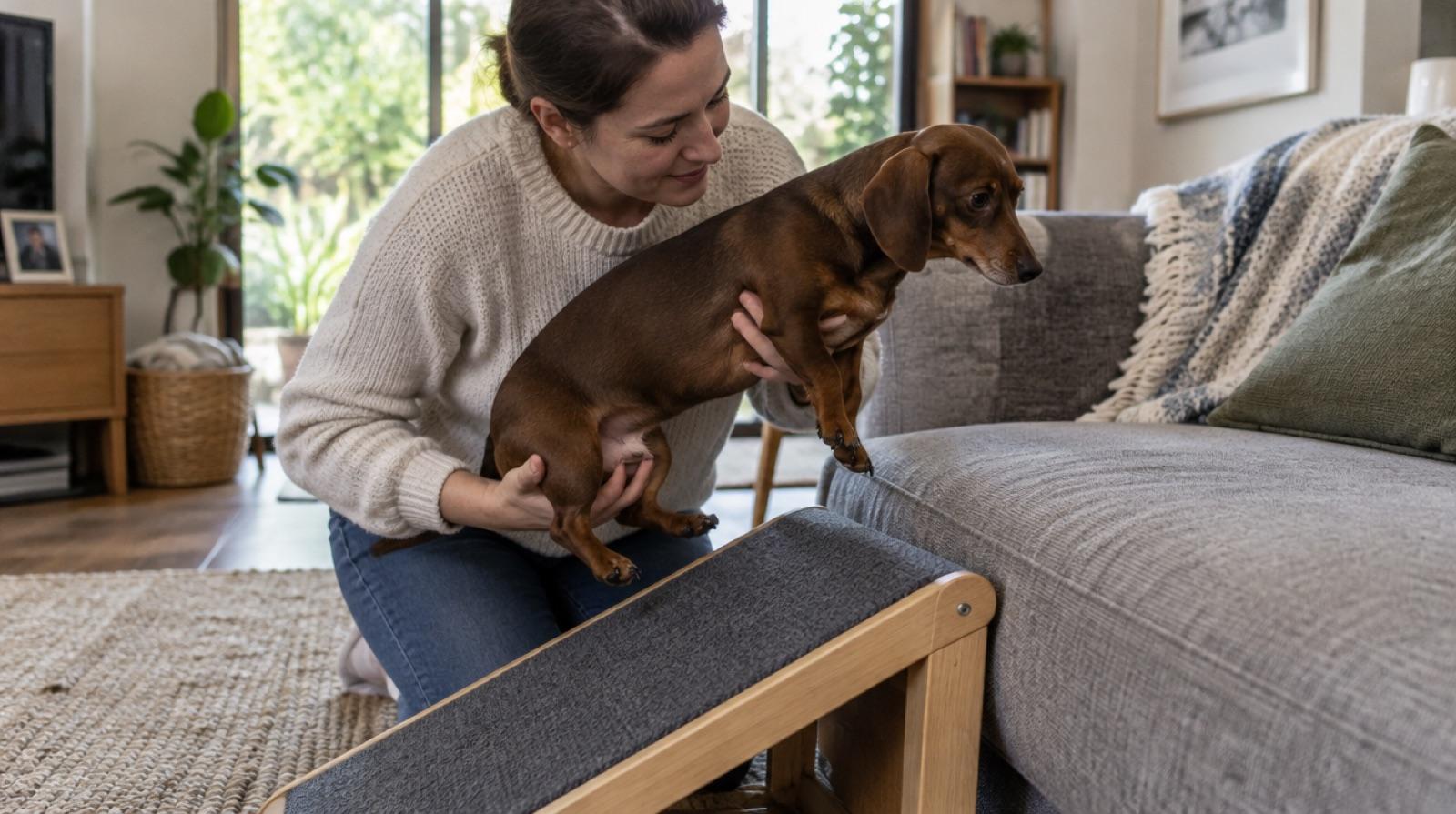
- Use ramps or steps for furniture and the car. Cornell recommends steps or ramps to reduce jumping on and off objects, and the club advises restricting excessive jumping. Be aware that DachsLife found dogs not allowed on furniture had higher odds of IVDD, which again may be reverse causation. Ramps are cheap and sensible; they are not a guarantee.
- Ask your vet about a harness. Cornell notes that low-stress options such as front-clip harnesses may be recommended when a harness is used.
- Learn how to lift your dog. Ask your vet or vet nurse to show you how to pick up a long-backed dog with the body supported. A demonstration is better than a diagram.
Stairs come up often. DachsLife asked owners about daily stair use and found only a weak trend, not statistically significant, towards higher odds in dogs that did not use a flight of stairs each day. That gives no evidence that ordinary stairs cause IVDD. After a back episode, your vet will tell you what is safe for your dog, including stairs.
Back scoring and the DNA test: what breeders can do
The Dachshund Club of NSW describes back scoring as five spinal X-rays taken under sedation, ideally between the ages of 2 and 4, then scored by a spinal analyst for calcified discs. The club stresses it is a breeder's tool, not a diagnosis of IVDD in that dog. Dachshund IVDD Support Australia (DISA) says X-ray screening and scoring is currently the only way to reduce the incidence of IVDD, and does not recommend relying on the CDDY DNA test sold as an IVDD test, which it says is not predictive of herniation.
If you are buying a puppy, ask for back scores on both parents. Our guide to Dachshund puppies: adopt or buy? covers the breed club price, registered breeders and how to spot a scam.
What other health problems do Dachshunds have?
The Dachshund Club of NSW health page (last updated February 2022) calls the Dachshund typically a healthy breed with a lifespan of 12 to 15 years, and lists these conditions alongside IVDD. Several are managed in registered breeding through DNA testing.
| Condition | Varieties named by the club | What it is |
|---|---|---|
| Progressive retinal atrophy (PRA) | Miniature Smooth, Long and Wire | Degeneration of the retina leading to loss of vision; risk managed by DNA testing |
| Sarcoglycan deficient muscular dystrophy | Miniature Smooth and Miniature Long | An inherited muscle disease first noticed at about six months, with exercise intolerance and a stiff gait; DNA testing available |
| Lafora disease | Miniature Wire-Haired | An inherited form of epilepsy; DNA testing available |
| Von Willebrand's disease | Standards | A mild to moderate bleeding disorder that matters most around surgery |
| Distichiasis | Miniature Long-Haired | Extra eyelashes on the eyelid margin that can irritate the eye |
| Pes varus | All | A bowed-leg bone deformity from early growth plate closure that can cause lameness |
| Cushing's disease | All | Overproduction of adrenal hormones, usually in older dogs |
Teeth deserve a mention too. The Royal Veterinary College's VetCompass study of 22,333 UK dogs found smaller breeds at higher risk of dental disease, so a Dachshund benefits from a brushing habit from day one. See our guide to dog dental care. Vaccination and parasite prevention are the same as for any dog; see puppy and kitten vaccinations, and in tick country talk to your vet about a tick prevention product suited to your dog.
Adopting a Dachshund, including one with a back history
Dachshunds and Dachshund crosses turn up regularly across the rescues we aggregate, mostly as young adults and adults. Rescue dogs usually come desexed, microchipped and vaccinated; RSPCA NSW, for example, says its animals are desexed, microchipped, vaccinated and health-checked. The Dachshund Club of NSW also runs a rescue service for older dogs, and the club's site links to Dachshund Rescue Australia, a registered charity that rehomes the breed nationally. A rescue Dachshund rarely comes with back scores, so ask about the dog itself:
- Has the dog had a back episode? Ask for the vet records, the treatment given and the vet's advice for the future.
- How does it move? Foster carers notice reluctance to jump, a hunched posture or a wobble.
- What does it weigh, and what is its ideal weight? An overweight rescue Dachshund is a fixable risk.
- Will it settle in a crate? If it ever needs strict rest, this matters a lot.
- Insurance. Moneysmart notes most insurers exclude pre-existing conditions, so a recorded back episode is unlikely to be covered. Price a policy before any new problem is found.
See the Dachshunds listed right now on our national Dachshund page, or by city: Sydney, Melbourne, Brisbane, Perth and Adelaide. Open to other small dogs? Browse small dogs in Sydney or Melbourne, and read adopting a dog in Australia. If a new dog leaves you feeling overwhelmed, the puppy blues are common and pass, and a Dachshund left alone a lot may need help with separation anxiety.
Other emergencies worth knowing
- Paralysis ticks: the other common cause of sudden back-leg weakness on the east coast.
- Snake bite in dogs: small, curious dogs are at real risk in the warmer months.
- Cane toads and dogs: the poisoning signs and what vet bodies say to do.
- Dog bloat (GDV): the emergency for large, deep-chested breeds.
Frequently asked questions
What is IVDD in Dachshunds?▼
Intervertebral disc disease (IVDD) is when a disc between the bones of the spine degenerates and bursts or bulges, pressing on the spinal cord. Cornell University's Riney Canine Health Center explains that in short-legged (chondrodystrophic) breeds such as the Dachshund, the soft centre of each disc hardens early in life, from birth to about one year, which makes a rupture more likely. Signs range from back pain to paralysis.
How common is IVDD in Dachshunds?▼
Common. In the DachsLife 2015 survey of 2,031 Dachshunds, mostly in the UK and including 193 in Australia, 15.7% had a vet-diagnosed episode of IVDD, rising to 24.4% in Standard Smooth-Haired Dachshunds and falling to 7.1% in Standard Wire-Haired. In Swedish insurance data on more than 665,000 dogs, Miniature Dachshunds had the highest rate of disc disease of any breed.
What are the signs of IVDD in a Dachshund?▼
Cornell lists neck or back pain, reluctance to jump, walk or be lifted, crying out when moving, a stiff neck or arched back, weakness in the back legs, knuckling or dragging the paws, wobbliness and paralysis. Wobbling, weakness, dragging or not being able to stand is an emergency: call or go to your nearest vet now.
Is IVDD an emergency?▼
It can be. Back pain alone needs a vet the same day. Any weakness, wobbling, dragging of the back legs or paralysis needs a vet immediately, because the outcome depends heavily on how badly the spinal cord is injured and how quickly it is treated. In NSW, the University of Sydney's veterinary hospital notes that paralysis tick can also cause loss of use of the back legs, which is another reason not to wait.
Can IVDD be treated without surgery?▼
Often, for milder cases. Cornell says milder cases may be treated with rest and pain relief from your vet, and more severe cases may need surgery. Strict rest, usually confinement to a crate or small pen except for toileting, is standard, though a 2020 specialist consensus paper notes its effect is poorly studied and recommended lengths vary. Your vet sets the plan, and following it to the end matters.
When does a Dachshund need IVDD surgery?▼
When it cannot walk. The CANSORT-SCI consensus paper by veterinary neurology and surgery specialists (2020) says the evidence supports recommending surgery for dogs that are non-ambulatory, meaning they cannot walk on their own, or worse. A dog that is getting worse despite rest, or keeps relapsing, is also usually assessed for surgery. Your vet or a specialist will explain the options for your dog.
Will my Dachshund walk again after IVDD?▼
Many do. In outcome data summarised in the 2020 consensus paper, 93% of dogs that could not walk but could still move their legs regained walking after surgery, compared with 79% treated without surgery. For dogs paralysed with no deep pain sensation, the figures were 61% with surgery and 10% without. Those are averages across many studies, not a promise for one dog.
Should Dachshunds use stairs or jump on the couch?▼
The evidence is weaker than the advice suggests. Cornell recommends steps or ramps to reduce jumping on and off furniture, and the Dachshund Club of NSW advises restricting excessive jumping. But the DachsLife survey found dogs not allowed on furniture had higher odds of IVDD, which the authors say may be reverse causation (owners restricting dogs after a back problem). Ramps are a cheap, sensible step; keeping the dog lean and active matters more.
Does weight matter for a Dachshund's back?▼
Yes. In a Royal Veterinary College study of 700 dogs at a UK referral hospital, being overweight and having a longer back relative to height both increased the risk of a thoracolumbar disc extrusion, and the authors say keeping high-risk dogs lean is particularly important. Cornell also lists maintaining an ideal body condition. Ask your vet for your dog's target weight.
Is there a DNA test for IVDD?▼
There is a DNA test for the CDDY gene variant linked to disc degeneration, but Dachshund IVDD Support Australia does not recommend relying on it, saying it is not predictive of disc herniation. The Dachshund Club of NSW and DISA point breeders to back X-ray screening and scoring instead, which the club describes as a breeder's tool, not a diagnosis.
What other health problems do Dachshunds have?▼
The Dachshund Club of NSW lists progressive retinal atrophy in miniatures, sarcoglycan deficient muscular dystrophy in some miniatures, Lafora disease in Miniature Wire-Haired, von Willebrand's disease in standards, distichiasis (extra eyelashes) in Miniature Long-Haired, pes varus (bowed back legs) and Cushing's disease. DNA testing manages several of these in registered breeding. Dental disease is also more common in small dogs.
Can I adopt a Dachshund with IVDD?▼
Yes, and many recover well, but go in with open eyes. Ask the rescue for the vet records of any back episode, what treatment was given, and what the vet advised for the future. Budget for a ramp, a harness and possible vet care, and remember that insurers generally exclude pre-existing conditions, so a past back episode is unlikely to be covered.
Sources
- Cornell University Riney Canine Health Center: Chondrodystrophy and intervertebral disc disease
- University of Sydney Veterinary Teaching Hospital: Surgery FAQs (loss of use of the back legs)
- Packer et al. 2016, Canine Genetics and Epidemiology: DachsLife 2015 (2,031 Dachshunds)
- Bergknut et al. 2012, JAVMA: IVD disease incidence in Swedish insured dogs
- Packer et al. 2013, PLoS ONE: conformation and the risk of disc extrusion (700 dogs)
- Jensen and Christensen 2000: inheritance of disc calcification in the Dachshund (Denmark)
- Moore et al. 2020 (CANSORT-SCI), Frontiers in Veterinary Science: managing acute thoracolumbar disc extrusion
- The Dachshund Club of NSW: The Dachshund health
- The Dachshund Club of NSW: Back scoring
- Dachshund IVDD Support Australia: IVDD screening
- Royal Veterinary College VetCompass: dental disease in dogs
- Moneysmart: Pet insurance
Keep reading
Dachshunds for adoption
Dachshunds and Dachshund crosses listed right now by the rescues we aggregate, by city.
Dachshund puppies: adopt or buy?
The breed club price, miniature vs standard, back scoring and scam red flags.
Dog dental care
Small dogs carry more dental disease. Brushing, chews and anaesthetic cleaning.
Crate training a puppy
A dog that is happy in a crate copes far better with vet-ordered rest.