The short answer
This is an emergency: call or go to your nearest vet now if your dog or cat has wobbly or weak back legs, a change in its bark or meow, retching, coughing, vomiting or drooling, or difficult, fast or grunting breathing, or if you find a tick or a tick crater. The RSPCA says to remove any ticks, keep your pet calm and at a comfortable temperature, give no food or water, and get to a vet as soon as possible. Prevention is a daily all-over tick search plus a tick prevention product your vet recommends for your pet. Never put a dog tick product on a cat.
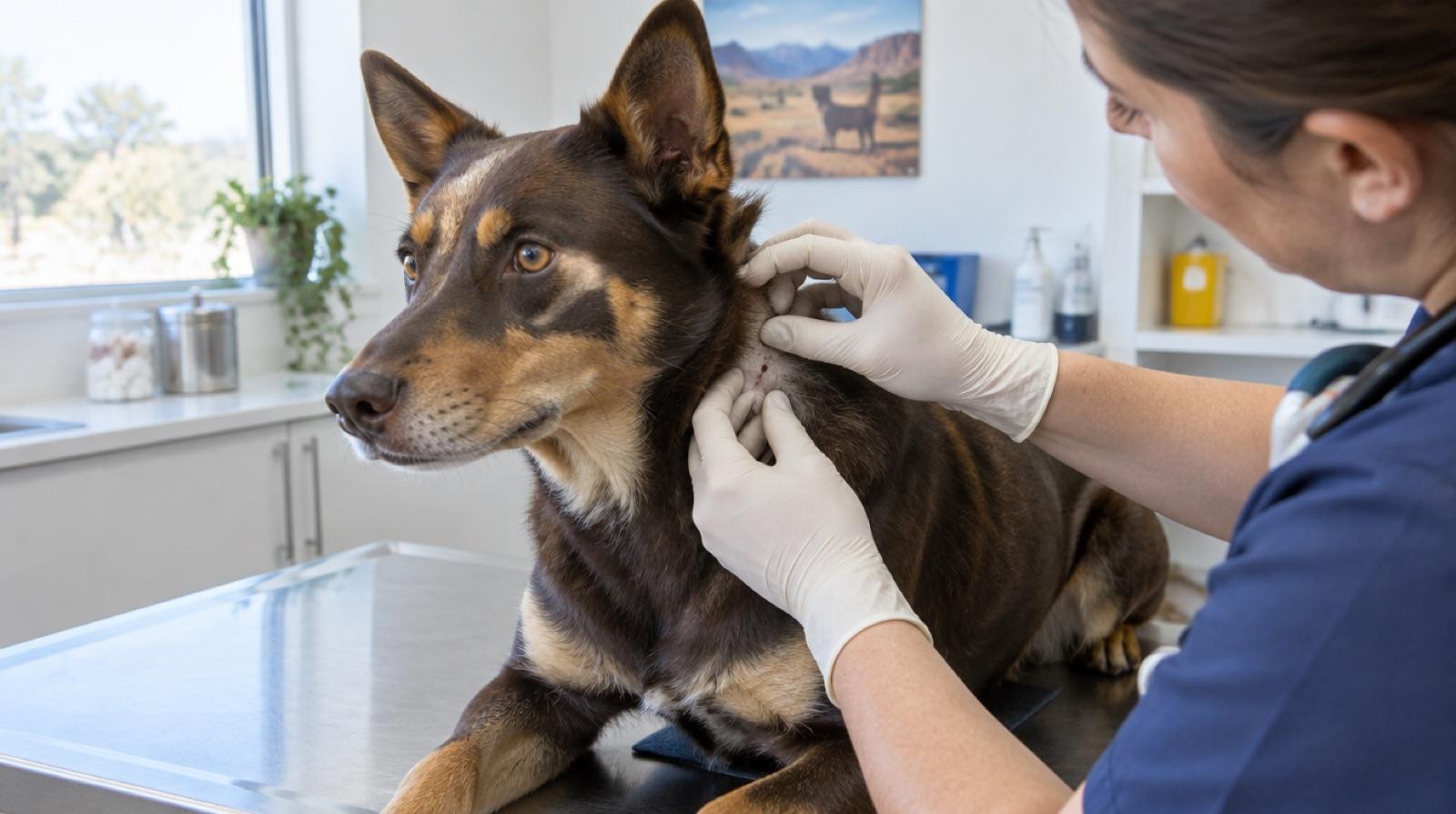
Signs that mean go to the vet now
- Wobbly or weak back legs, or not being able to get up
- A change in the sound of the bark, meow or voice
- Retching, coughing (sometimes moist) or vomiting
- Drooling, or loss of appetite
- Difficult, fast or grunting breathing
- A tick, or a raised red “crater” where a tick has been
Signs list from the RSPCA Knowledgebase. Do not wait to see whether it gets better. Find your nearest 24-hour hospital: Sydney, Brisbane, Gold Coast, Sunshine Coast, Cairns, Townsville, Melbourne.
What is tick paralysis?
Tick paralysis is poisoning by a tick. The paralysis tick, Ixodes holocyclus, attaches to a dog or cat and feeds on its blood, and as it feeds it releases a toxin that affects the nervous system. The RSPCA describes the result as a serious and potentially fatal condition that needs urgent veterinary attention. The RSPCA's signs list starts with the back legs and includes paralysis spreading to the front legs and difficult breathing, and it says affected pets cannot protect their airway when they swallow.
Its natural hosts are native animals: marsupials, birds and reptiles. Dogs and cats pick ticks up when they live in or near bush or scrub, or walk through it. A University of Sydney team that studied 3,479 dog and cat cases from a real-time disease surveillance program also names a second species, Ixodes cornuatus, as a cause of tick paralysis in Australia (Eppleston, Kelman and Ward, 2013).
LocalPetFinder is an adoption listings site, not a vet. Everything on this page comes from the RSPCA and from published Australian veterinary research, read in November 2026. It is general information and does not replace your own vet.
What are the signs of tick paralysis in dogs and cats?
The RSPCA lists the same signs for dogs and cats. A pet may show one or several, and the order varies:
| What you might notice | How the RSPCA describes it |
|---|---|
| Back legs | Loss of coordination in the hind legs (wobbliness), weakness, or not being able to get up |
| Voice | A change in the sound of the bark, meow or voice |
| Throat and stomach | Retching, coughing (sometimes a moist cough), vomiting, excessive drooling |
| Eating | Loss of appetite |
| Spreading weakness | Progressive paralysis that reaches the front legs |
| Breathing | Difficult or rapid breathing, grunting noises when breathing |
| Anything else | Any other abnormal behaviour or symptom |
Source: RSPCA Knowledgebase, read 10 November 2026.
A change in the bark or a new cough is easy to put down to something else. In tick country, it is worth checking for a tick before you assume anything. A tick that has fed looks blueish to light grey, and where one has attached the skin can go red with a raised thickening the RSPCA calls a crater. A crater is evidence that a tick was there, even if it has dropped off.
What should I do if I find a paralysis tick?
The RSPCA sets out the same steps whether you found a tick, found a crater, or are seeing signs:
- Take your pet to your vet as soon as possible. Tick paralysis is a serious and potentially fatal condition that needs veterinary attention.
- Stay calm and keep your pet calm, at a comfortable temperature, not too hot or too cold.
- Search for ticks and remove them as soon as possible (see the next section).
- Give nothing by mouth. No food, no water, nothing. The toxin can stop a pet protecting its airway when it swallows, so food or water can be breathed into the lungs and cause aspiration pneumonia.
- Keep searching. Some dogs and cats carry many ticks at one time.
Removing the tick is not the end of it. The RSPCA is clear that a pet with a tick needs a vet as soon as possible, because tick paralysis is life threatening.
How do you remove a tick from a dog or cat?
This is how the RSPCA Knowledgebase describes it. It also says your vet can show you the best way, which is worth asking at your next check-up so you are not learning on the day.
- Wear disposable gloves if you have them.
- Have a container with a lid, or a zip lock bag, ready with some alcohol in it to kill the tick.
- Do not squeeze or disturb the body of the tick.
- Aim to remove the tick by its head, at the point where it goes into the skin. Mouth parts left behind are likely to cause inflammation and possibly a local infection.
- A tick remover helps: a fork-like device that slides either side of the tick without touching its body.
- After removing it, dab the area with a mild antiseptic.
- Then keep your pet calm, keep searching for more ticks, and go to the vet.
Where and when are paralysis ticks found?
The RSPCA says the paralysis tick is generally found on the eastern seaboard, from North Queensland down to Victoria, and can also be found inland in suitable habitats. Pets that live in or near bush or scrub are the ones that pick them up. The season depends on how far north you are:
| Where | What the source says | Source |
|---|---|---|
| The north of the range | Paralysis ticks may be found all year round | RSPCA |
| More southern areas | The season generally begins in spring and finishes in late autumn; it can start earlier and end later, for example after a mild winter | RSPCA |
| Australia-wide cases | Distinctly seasonal, most in spring; most cases on the east coast, with NSW and Queensland the majority; a cluster on the NSW south coast | University of Sydney study |
| South-east Queensland cats | Cases all year round, with more in spring than any other season (2,077 cats, 2008 to 2016) | Leister et al, 2018 |
| Inland | Can be found inland in suitable habitats | RSPCA |
The RSPCA's description of the range does not name Western Australia, South Australia, Tasmania or the Northern Territory, but it also says ticks can be found inland in suitable habitats, and pets travel. Ask a local vet what applies where you walk. If you are taking a dog or cat to the east coast, or to bush anywhere in the range, ask your vet about tick prevention before you go and start the daily search from day one. The RSPCA also notes other ticks, including the brown dog tick, bush tick and kangaroo tick, which can spread disease such as tick fever, so a daily check is useful anywhere.
How do I search my dog or cat for ticks?
The RSPCA calls a thorough daily search the most essential preventive measure, and says to do it at least once a day even if a tick product has been applied. Use your fingertips to feel through the coat, because ticks and craters feel like small lumps on the skin.
- Start at the front. Most ticks are found forward of the front legs, especially on the face, neck and ears. Begin at the nose and work slowly over the face, forehead, both sides of the ear flaps, around the eyes and lips, and every skin fold.
- Take the collar off and search the whole neck, including the folds.
- Work down the shoulders and front legs, between each toe, under the feet and in the armpits.
- Then the rest: chest, back, sides, belly, groin, around the tail and bottom, thighs, back legs and between the back toes.
Long or thick coats hide ticks well. In the cat study above, vets found extra ticks when they clipped the coat in 9% of the cats that were clipped (80 of 872), which shows how easy they are to miss.
How can I prevent tick paralysis?
The RSPCA recommends four layers, and none of them works as well alone:
- Avoid tick habitat in tick season. Don't walk your dog through bush or scrub known to harbour ticks during the season. At home, keep lawns and shrubs short and remove compost from the backyard.
- Use a tick prevention product. Talk to your vet about a tick prevention product that is suited to your dog or cat, and follow the label exactly. We do not recommend any product or brand.
- Search every day, as above, even when a product is in use.
- Know the signs, and act on them straight away.
Why the daily search still matters: the University of Sydney study found that some dogs and cats got tick paralysis during the period their preventive product was meant to be effective, and its authors recommend daily tick searches because prevention is not 100% guaranteed across the whole population (Eppleston et al, 2013).
Never use a dog tick product on a cat.
The RSPCA warns that some dog products are highly toxic to cats and can kill cats. Use only products made for the species you are treating, cat products for cats and dog products for dogs, and follow the label carefully.
Is tick paralysis different in cats and dogs?
The signs and the first steps are the same, but the research and the product rules differ. Here is what the two Australian studies we used actually measured:
| Dogs | Cats | |
|---|---|---|
| Signs and first aid | The same RSPCA signs list and steps apply to both | |
| Higher risk of dying | Dogs under 6 months old and toy breeds were at significantly higher risk of death (University of Sydney, 3,479 dog and cat cases) | The same study found no significant risk factors for death in cats. In the south-east Queensland cat study, a high gait score and a body temperature under 35°C on arrival were linked to death |
| Outcome with treatment | Not reported as a single figure in the dog data we used | 54 of 1,742 cats (3%) died within 5 days; the authors call the overall risk of death for treated cats low |
| Tick products | Dog products only, chosen with your vet | Cat products only; some dog products can kill cats (RSPCA) |
Sources: Eppleston, Kelman and Ward, 2013; Leister et al, 2018; RSPCA Knowledgebase.
The cat figure is reassuring but it describes cats that reached one of four emergency clinics and got treatment. It is not a reason to wait. If you have a puppy or a toy breed, such as those on our toy dog breeds page, the University of Sydney finding is a reason to be quicker still.
What happens at the vet, and what does it cost?
Your vet will search for and remove ticks and decide on treatment. In the south-east Queensland cat study, cats that received the treatment the authors recommend were less likely to die, clipping the coat was linked to a lower risk of death, and 6% of cats were recommended a breathing machine (mechanical ventilation). Where ventilation was recommended but not done, 15 of 17 cats (88%) died, against 4 of 22 (18%) that were ventilated (Leister et al, 2018). That is the clearest reason not to wait: the sicker a pet is on arrival, the harder the treatment.
There is no standard price. Vets set their own fees, and the bill depends on how sick the pet is and how long it stays in hospital. Ask for an estimate when you arrive. If money is the worry, our cheap vet care guide lists charity clinics, concession discounts and hardship funds, and explains why pet insurance only helps if you have it before something happens.
Adopting a dog or cat in tick country
Some rescues include parasite treatment before an animal goes home. RSPCA ACT, for example, says every animal available for adoption is given parasite prevention (flea, tick and worming treatments), and the RSPCA's Adopt A Pet site says its dogs and cats are desexed, microchipped and vaccinated. What is included varies by rescue, so ask three questions when you adopt: what parasite treatment has the animal had, when is the next dose due, and is the product for dogs or for cats. Then book your own vet to set up ongoing prevention.
If you are new to it, our guides to adopting a dog and adopting a cat cover the rest of the first weeks, and puppy and kitten vaccinations covers the first vet visits.
Find a rescue pet near you
Dogs and cats listed right now by the rescues and shelters we aggregate, with each animal's health details on its profile.
Other health guides for new owners
- Snake bite in dogs: the other warm-weather emergency, with the RSPCA pressure-bandage step.
- Cane toads and dogs: signs of poisoning and the government first-aid step.
- Bloat (GDV) in dogs: the deep-chested-dog emergency.
- Dachshund IVDD and health: back problems in long-backed dogs.
- Dog dental care: the everyday care that prevents bigger bills.
- Dog separation anxiety and crate training a puppy: the first weeks at home.
Frequently asked questions
What are the first signs of tick paralysis in a dog?▼
The RSPCA lists wobbliness or weakness in the back legs, a change in the sound of the bark, retching, coughing or vomiting, drooling and loss of appetite as signs, and the paralysis can spread to the front legs and affect breathing. If you see any of these, or find a tick or a tick crater, treat it as an emergency: remove any ticks you find and go to a vet straight away.
What are the signs of tick paralysis in a cat?▼
The signs the RSPCA lists apply to cats as well as dogs: wobbly or weak back legs, a change in the meow or voice, retching, coughing, vomiting, drooling, loss of appetite, difficult, rapid or grunting breathing, and any other abnormal behaviour. Any of these in a cat that goes near bush or scrub in tick areas is a reason to see a vet now.
Is tick paralysis an emergency?▼
Yes. The RSPCA calls tick paralysis a serious and potentially fatal condition that needs urgent veterinary attention. Remove any ticks you find, keep your pet calm and at a comfortable temperature, give nothing by mouth, and take your pet to your vet or the nearest emergency vet as soon as possible, even if the signs seem mild.
Should I give my dog water if it has a paralysis tick?▼
No. The RSPCA says not to offer food or water or give anything by mouth, because the toxin can stop a pet protecting its airway when it swallows. Food or water can then be breathed into the lungs and cause aspiration pneumonia. Keep your pet calm and drive straight to the vet.
How do I remove a paralysis tick?▼
The RSPCA advises wearing disposable gloves, not squeezing the tick's body, and removing it by the head at the point where it enters the skin, so the mouth parts are not left behind. A fork-like tick remover helps. Put the tick in a lidded container or zip lock bag with some alcohol, dab the spot with mild antiseptic, keep searching for more ticks and then go to a vet. Your vet can show you the best way to remove a tick.
Can my pet still get sick after the tick is removed?▼
Yes, which is why the RSPCA says to take your pet to a vet as soon as possible after you find a tick, not just to remove it and wait. Some pets also carry more than one tick at a time, and in a south-east Queensland study of 2,077 cats, extra ticks were found at coat clipping in 9% of the cats that were clipped.
Where are paralysis ticks found in Australia?▼
The RSPCA says the paralysis tick is generally found on the eastern seaboard, from North Queensland down to Victoria, and also inland in suitable habitats, on animals that live in or near bush or scrub. A University of Sydney study of 3,479 cases found most were on the east coast, with New South Wales and Queensland accounting for the majority. If you live elsewhere and travel east with your pet, ask your vet about tick prevention before you go.
When is paralysis tick season?▼
It depends on where you are. The RSPCA says paralysis ticks may be found all year round in the north, while in more southern areas the season generally begins in spring and finishes in late autumn, and it can start early after a mild winter. University research on Australian cases found most occur in spring.
How do I prevent tick paralysis?▼
The RSPCA recommends four things: avoid bush and scrub walks known to harbour ticks during tick season, keep lawns and shrubs short and remove compost, talk to your vet about a tick prevention product suited to your pet, and search your pet's skin and coat at least once a day. The daily search matters even with a product, because a University of Sydney study found some animals got tick paralysis while their product was meant to be working.
Can I use my dog's tick product on my cat?▼
No. The RSPCA says never to use any dog tick control product on cats, because some dog products are highly toxic to cats and can kill them. Use only products made for the species you are treating, follow the label, and ask your vet which product suits your cat.
How much does tick paralysis treatment cost?▼
There is no single price, because vets set their own fees and the cost depends on how sick the pet is. Severe cases can need intensive care and a breathing machine. Ask the hospital for an estimate when you arrive. Our cheap vet care guide lists charity clinics and hardship help, and pet insurance only helps if the policy is in place before anything happens.
Do rescue pets come with tick treatment?▼
Often, but check each animal. RSPCA ACT, for example, says every animal available for adoption is given parasite prevention (flea, tick and worming treatments). Ask the rescue what parasite treatment your new pet has had and when the next dose is due, then talk to your own vet about ongoing prevention if you live or walk in tick country.
Sources
- RSPCA Knowledgebase: How can I protect my dog or cat from tick paralysis?
- Eppleston, Kelman and Ward (2013), University of Sydney: Distribution, seasonality and risk factors for tick paralysis in Australian dogs and cats, Veterinary Parasitology
- Leister, Morton, Atwell and Webster (2018): Clinical presentations, treatments and risk factors for mortality in cats with tick paralysis caused by Ixodes holocyclus, 2077 cases (2008 to 2016), Journal of Feline Medicine and Surgery
- RSPCA ACT: Adoption process
- RSPCA Adopt A Pet: How to adopt
Keep reading
Snake bite in dogs
The signs, the RSPCA first aid, and how to keep snakes out of the yard where most dog bites happen.
Cane toads and dogs
Where cane toads live, the signs of poisoning and the government first-aid step.
Puppy and kitten vaccinations
Core and non-core vaccines and the schedule, from WSAVA, AVA and RSPCA guidance.
Cheap vet care in Australia
Charity clinic prices, concession discounts and help with an emergency bill, state by state.