The short answer
If your dog is retching with nothing coming up, has a swollen or tight belly, is drooling, pacing or cannot settle, or has pale gums or collapses, this is an emergency: call or go to your nearest vet now. Do not wait to see if it passes, and do not try to treat it at home. Bloat mainly affects large, deep-chested dogs such as Great Danes, Saint Bernards, Weimaraners, Standard Poodles and German Shepherds, but any dog can be affected. To lower the risk, feed at least two meals a day and avoid exercise just before and after eating, as RSPCA Australia advises. For a high-risk dog, ask your vet about a preventive gastropexy, an operation that stops the stomach twisting.
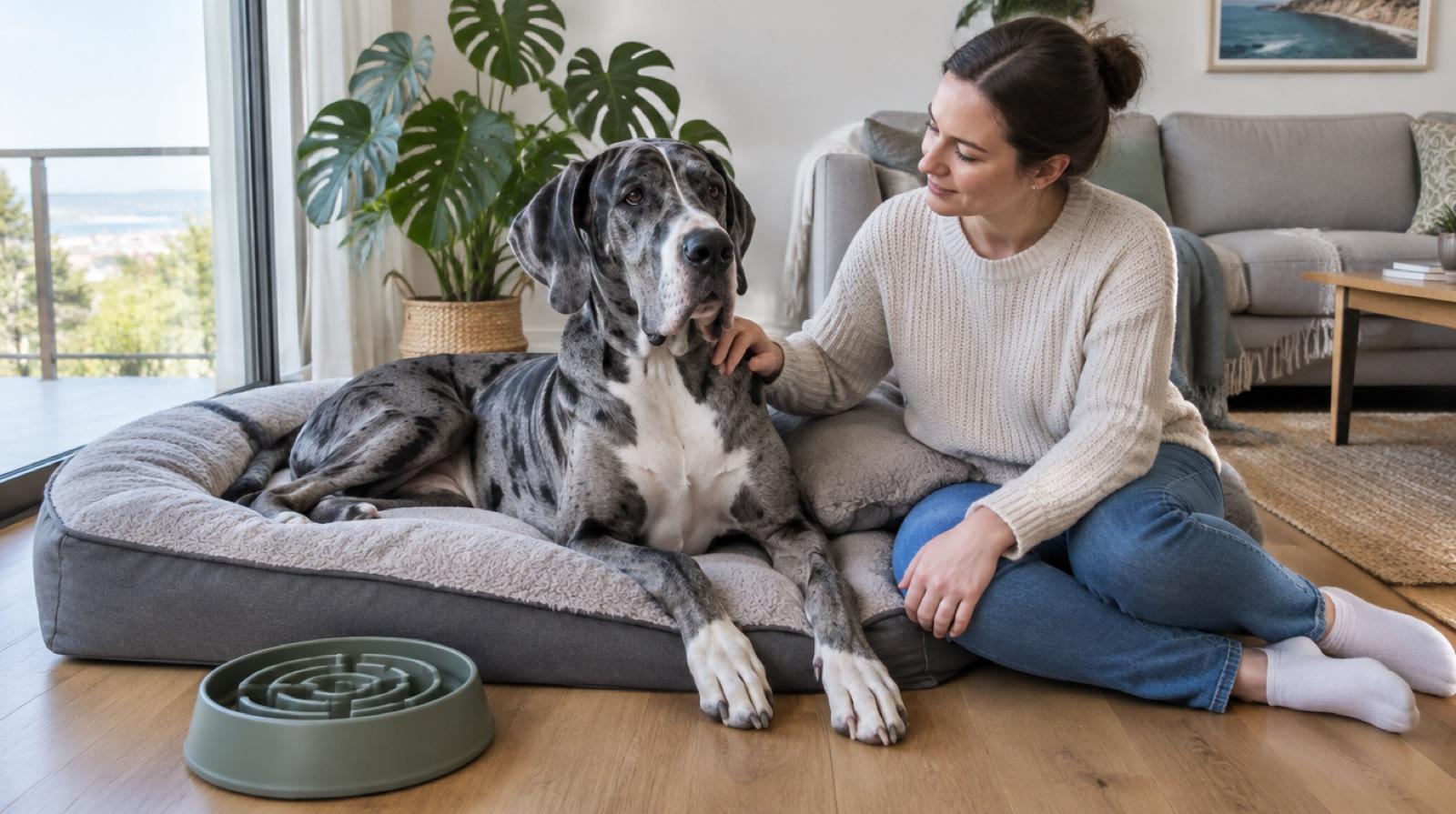
What is bloat in dogs?
Bloat is the everyday name for two linked problems. In gastric dilatation, the stomach fills with gas, food, fluid or foam. In gastric dilatation-volvulus (GDV), the swollen stomach then rotates, which the NSW Greyhound Welfare and Integrity Commission describes as a turn of up to 360 degrees that often cuts off the blood supply to the stomach and spleen and puts pressure on blood flow to the rest of the body.
The University of Sydney Veterinary Teaching Hospital explains that the stomach keeps filling with air, blood flow to it can be compromised, and it can rupture. Affected dogs arrive as an emergency, and if decompression and surgery are not done in a timely way the result can be fatal. The NSW Greyhound Welfare and Integrity Commission notes that a vet can confirm the diagnosis quickly with X-rays, which is why every suspected case goes straight to a vet.
What are the emergency signs of bloat?
Learn these well enough to recognise them in a few seconds. The lists below follow the NSW Greyhound Welfare and Integrity Commission fact sheet, written for greyhounds but describing the same condition in any deep-chested dog.
| Stage | Signs to look for | What to do |
|---|---|---|
| Early | Quieter or lazier than usual, a change in behaviour, poor appetite, a swollen belly (not always visible), continual lip licking, heavy drooling, drinking more, a hunched or tucked-up look | Call your vet or nearest emergency vet now and go |
| More serious | Vomiting, retching or gagging with nothing coming up, straining to pass a motion, dark red gums that turn pale or white, collapse (usually in the back end first) | This is an emergency: go to the nearest vet immediately |
A swollen belly is the sign most people expect, and the fact sheet points out it is not always visible in a deep-chested dog. Retching without bringing anything up, together with restlessness, is the combination worth knowing best.
What should I do if I think my dog has bloat?
Go to a vet now. The NSW Greyhound Welfare and Integrity Commission calls GDV a veterinary emergency and says not to delay or wait for further signs, because the longer the wait, the higher the risk and the poorer the outlook.
- Phone ahead from the car. The fact sheet advises warning the clinic that you think your dog may have bloat, so the team can prepare for emergency surgery.
- Go to an emergency vet immediately, as the fact sheet advises. At night, that means a 24-hour emergency hospital.
- Do not try to treat it at home. The vet needs to see the dog.
- Know your nearest 24-hour hospital before you need it. Save its address and phone number in your phone today.
At the clinic, the vet will confirm the diagnosis with X-rays. The fact sheet explains that a simple dilation may be relieved by passing a stomach tube under general anaesthetic, while a twisted stomach usually leaves two options, emergency surgery or humane euthanasia. Your vet will explain what they find and what they recommend.
How many dogs survive bloat?
Speed decides most of it. Two Australian studies give a clear picture.
- Sydney, 736 dogs. Song and colleagues (Australian Veterinary Journal, 2020) reviewed the records of confirmed GDV cases at two Sydney specialist referral and emergency hospitals from July 1999 to July 2019. Of 736 dogs, 460 had surgery and 276 were euthanased. Survival after surgery was 81.7% with general surgeons and 88.7% with specialist surgeons. Dogs that arrived between 3 am and 9 am, and dogs where more than 3 hours passed between arriving and finishing surgery, had higher odds of dying.
- South-east Australia, 260 dogs. Boller and colleagues at the University of Melbourne (Frontiers in Veterinary Science, 2020) studied dogs with GDV seen at 24 emergency clinics in Victoria and NSW in 2017 and 2018. 41% did not survive to discharge, and most of those were euthanased before surgery. Of the dogs that had surgery, 86% went home.
In the original Purdue cohort study (below), 30 of the 105 dogs that developed GDV died, or 28.6%. The Sydney study points to speed: dogs that reached the end of surgery within 3 hours of arriving did better.
Which dog breeds are most at risk of bloat?
Large and giant breeds with a deep, narrow chest carry the highest risk. The best-known evidence is a prospective study from Purdue University led by Larry Glickman. Glickman and colleagues (JAVMA, 2000) recruited 1,914 dogs of 11 breeds at dog shows in the United States, none with a history of GDV, and owners were contacted about once a year to find out whether their dog had developed GDV. The incidence was 23 cases per 1,000 dog-years in the seven large breeds and 26 per 1,000 dog-years in the four giant breeds, and the cumulative incidence over the study was 5.7% across all breeds. GDV became more likely as dogs aged.
A follow-up decision analysis by Ward, Patronek and Glickman (2003) used that data and published breed lifespans to estimate lifetime risk in five breeds. It ranged from 3.9% for the Rottweiler to 36.7% for the Great Dane. Australian sources name a similar group: the RSPCA Knowledgebase lists Great Danes, Saint Bernards, Irish Setters, German Shepherds, Rottweilers, Doberman Pinschers, Weimaraners and Standard Poodles among others, and the RSPCA feeding guide names Boxers and German Shepherds.
| Breed | Named by |
|---|---|
| Great Dane | Purdue cohort (estimated lifetime risk 36.7%, the highest of the five breeds modelled), RSPCA, University of Sydney, University of Queensland |
| Saint Bernard | Purdue cohort, RSPCA |
| Weimaraner | Purdue cohort, RSPCA, University of Queensland |
| Standard Poodle | Purdue cohort, RSPCA, University of Sydney, University of Queensland; Poodles had the highest occurrence in the 2026 Dog Aging Project analysis |
| Irish Setter | Purdue cohort, RSPCA |
| Irish Wolfhound | Purdue cohort |
| Newfoundland | Purdue cohort, University of Sydney |
| Akita | Purdue cohort |
| Bloodhound | Purdue cohort |
| Collie | Purdue cohort |
| Rottweiler | Purdue cohort (estimated lifetime risk 3.9%, the lowest of the five modelled), RSPCA |
| German Shepherd | RSPCA, University of Sydney, University of Queensland |
| Doberman | RSPCA, University of Sydney |
| Boxer | RSPCA |
| Greyhound | NSW Greyhound Welfare and Integrity Commission (deep-chested breed) |
Two cautions keep this list honest. First, the Purdue dogs were purebred show dogs in the United States, so the numbers describe those breeds in that setting, not every dog in Australia. Second, a breed missing from the table is not safe. The 2026 Dog Aging Project analysis of 47,444 United States companion dogs found a much lower owner-reported lifetime prevalence across all dogs (0.23%) and higher odds in purebred dogs, males, dogs over 40 kg, dogs with a low body condition score, and Poodles and Poodle crosses. If you own a large, deep-chested cross, ask your vet about your own dog's risk.
Other risk factors from the second Purdue paper, on 1,637 dogs, were older age, having a first-degree relative (parent, sibling or offspring) that had GDV, eating faster, and eating from a raised bowl. The University of Queensland's Dr Jayne McGhie adds that high-drive working dogs, anxious dogs and fast eaters are at higher risk.
Can you prevent bloat in dogs?
You can lower the risk, not remove it. The University of Sydney's veterinary hospital is plain about this: even when owners follow the advice, bloat with or without a twist can still happen. These are the steps Australian vet and welfare bodies publish.
- Feed at least two meals a day. The RSPCA says adult dogs should be fed at least twice a day to avoid bloat, and the University of Sydney suggests smaller meals two to three times a day.
- No exercise straight before or after a meal. Both the RSPCA and the University of Sydney say this. The NSW Greyhound Welfare and Integrity Commission uses an hour either side of a meal.
- Slow down a fast eater. The commission suggests increasing eating time and says slow-eating bowls can help. Eating faster was a risk factor in the Purdue study.
- Feed from a bowl on the floor. The commission advises feeding as close to the ground as possible, and the Purdue study linked raised bowls with higher risk.
- Change food gradually. The commission advises changing diets over 7 to 10 days rather than overnight.
- No gulping water or chasing the hose. The University of Sydney warns against hose chasing, which promotes swallowing water and air, and the commission advises offering water in small amounts after exercise and letting the dog cool down until the panting settles.
Be aware that the evidence on feeding is not settled. The Dog Aging Project analysis found no link between GDV and diet type or the number of meals fed per day. The feeding steps are cheap and sensible, but for a high-risk breed, knowing the signs and talking to your vet about a gastropexy matter more.
What is a preventive gastropexy?
A gastropexy is an operation that fixes the stomach to the inside of the body wall so it cannot rotate. The University of Sydney's veterinary hospital says vets sometimes perform it electively to prevent GDV, either as an open operation (some owners have it done at the same time as desexing, especially in female dogs) or by keyhole surgery, which uses a much smaller incision. It suggests calling the hospital to discuss whether it is recommended for your dog.
The University of Queensland's small animal hospital performs the keyhole version on Queensland Police Service dogs and other at-risk dogs. Its surgeons describe a permanent attachment between the stomach wall and the body wall that reduces the risk of the stomach twisting, and say they perform it on at-risk dogs to greatly reduce their risk of developing GDV. It is an elective procedure while the dog is healthy, with the dog going home the same day.
The decision analysis by Ward, Patronek and Glickman found preventive gastropexy was the preferred choice in all five breeds it modelled, with the estimated reduction in deaths from GDV ranging from 2.2-fold in the Rottweiler to 29.6-fold in the Great Dane. The authors also note that it raises ethical questions that vets and breeders need to consider. A gastropexy is surgery under general anaesthetic, so the right answer for your dog is a conversation with your vet, not a rule.
What does bloat surgery cost, and does insurance help?
Emergency GDV surgery is one of the most expensive things that can happen to a dog. We do not quote a figure because no Australian vet body or hospital we could find publishes a standard price, and vets set their own fees. The emergency hospital will give you an estimate on arrival. For help with costs, see our guide to cheap vet care in Australia, which covers charity hospitals, payment plans and hardship funds.
The University of Melbourne study is a hard read for any owner of a big dog. Among the 260 dogs it followed, 10% of insured dogs were euthanased before surgery, compared with 37% of uninsured dogs, and 80% of insured dogs went home compared with 53% of uninsured dogs. The authors concluded that euthanasia before surgery was mainly driven by cost. If you want insurance, buy it while your dog is healthy: Moneysmart notes that most insurers exclude pre-existing conditions and that policies have waiting periods and benefit limits, so read them carefully.
Adopting a large or giant breed dog
Bloat risk is not a reason to pass on a big dog. It is a reason to go in prepared. Large and giant dogs and their crosses come into rescue across Australia, and most arrive as adults, the age group where the Purdue study found risk rises. RSPCA NSW, for example, says its dogs are desexed, microchipped, vaccinated and health-checked before adoption. A few questions are worth asking:
- Has the dog had a gastropexy? It may be noted in the desexing or surgery records, or done during an earlier bloat episode.
- Has it ever bloated? Ask for the records, including whether a gastropexy was done at the time.
- How does it eat? Foster carers know whether a dog gulps its food, which tells you whether a slow feeder is worth buying on day one.
- Where is your nearest 24-hour vet? Find out before the dog comes home.
Browse the big dogs listed right now: Sydney, Melbourne, Brisbane, Perth and Adelaide. For a Great Dane specifically, read Great Dane puppies: adopt or buy?, and for the whole process see adopting a dog in Australia. Not sure a giant breed fits your home and budget? Try the dog cost calculator and the adoption readiness check.
Other Australian emergencies every dog owner should know
- Paralysis ticks in dogs and cats: the signs, where the tick lives, and why it is a vet-now emergency.
- Snake bite in dogs: what a bite can look like and what to do on the way to the vet.
- Cane toads and dogs: the poisoning signs and the first aid that vet bodies publish.
- Dachshund IVDD: when a back problem becomes an emergency in a long-backed dog.
For everyday health, see dog dental care, puppy and kitten vaccinations, crate training a puppy and dog separation anxiety.
Frequently asked questions
What are the signs of bloat in a dog?▼
The classic signs are retching or trying to vomit with nothing coming up, a swollen or tight belly, heavy drooling, restlessness or pacing, and a dog that cannot settle. The NSW Greyhound Welfare and Integrity Commission also lists earlier signs such as lethargy, continual lip licking and a hunched, tucked-up look, and later signs such as pale gums and collapse. Any of these in a large, deep-chested dog is an emergency: call or go to your nearest vet now.
Is bloat in dogs an emergency?▼
Yes. Bloat, or gastric dilatation-volvulus (GDV), is a life-threatening emergency. The University of Sydney's veterinary hospital says that if decompression and surgery are not done in a timely way, it can be fatal. Do not wait until morning or to see if it settles. Ring the nearest vet or emergency hospital on the way so the team can prepare.
Can I treat bloat at home?▼
No. Bloat needs a vet. The NSW Greyhound Welfare and Integrity Commission says a vet can confirm the diagnosis quickly with X-rays, and that emergency surgery or humane euthanasia are usually the only treatment options for a twisted stomach. It says not to delay or wait for further signs, because the longer the wait, the higher the risk. Put the dog in the car and go.
Which dog breeds get bloat the most?▼
Large and giant deep-chested breeds. The Purdue study by Glickman and colleagues followed 1,914 dogs of 11 large and giant breeds, including the Great Dane, Saint Bernard, Weimaraner, Irish Setter, Akita, Bloodhound and Standard Poodle. A later analysis using that work estimated a lifetime risk of 36.7% for the Great Dane. RSPCA Australia also names German Shepherds, Rottweilers, Dobermans and Boxers. Any dog can bloat, though.
What is a gastropexy?▼
A gastropexy is surgery that attaches the stomach to the inside of the body wall so it cannot twist. The University of Sydney's veterinary hospital says it can be done as an open operation, sometimes at the same time as desexing, or by keyhole (laparoscopic) surgery. Ask your vet whether it is recommended for your dog.
Does a gastropexy stop all bloat?▼
It is aimed at the twist, which is what makes bloat so deadly. The University of Queensland describes it as reducing the risk of the stomach twisting, not removing all risk. So a dog that has had a gastropexy and shows signs of bloat still needs to see a vet straight away.
Should I feed my dog from a raised bowl?▼
The evidence does not support raised bowls for preventing bloat. In the Purdue study of 1,637 large and giant breed dogs, a raised feed bowl was associated with a higher risk of GDV, not a lower one. The NSW Greyhound Welfare and Integrity Commission advises feeding as close to the ground as possible. Ask your vet if your dog has a medical reason for a raised bowl.
Does feeding two meals a day prevent bloat?▼
It is the standard advice, and the evidence is mixed. RSPCA Australia advises feeding adult dogs at least twice a day and not exercising them straight before or after eating, especially deep-chested dogs. A 2026 Dog Aging Project analysis of United States dogs found no link between the number of meals a day and GDV. Follow the feeding advice, but rely on knowing the signs and asking your vet about a gastropexy for a high-risk dog.
Do dogs survive bloat?▼
Many do when they reach surgery quickly. In a study of 736 dogs with GDV at two Sydney referral and emergency hospitals, survival after surgery was 81.7% with general surgeons and 88.7% with specialist surgeons, and dogs that reached the end of surgery more than 3 hours after arriving did worse. Getting there fast is the part you control.
Does pet insurance matter for bloat?▼
In one Australian study, yes. Researchers at the University of Melbourne looked at 260 dogs with GDV at 24 emergency clinics in south-east Australia in 2017 and 2018. 10% of insured dogs were euthanased before surgery, compared with 37% of uninsured dogs, and 80% of insured dogs went home against 53% of uninsured dogs. Insurance only helps if it starts before any problem is recorded.
How do I know if a rescue dog has had a gastropexy?▼
Ask the rescue for the dog's vet and surgery records. A gastropexy may have been done electively at desexing, which the University of Sydney's veterinary hospital says some owners choose, or during surgery for an earlier bloat episode, which the NSW Greyhound Welfare and Integrity Commission says is when it is usually performed. If there are no records, your vet can discuss whether the surgery suits the dog.
Sources
- University of Sydney Veterinary Teaching Hospital: Surgery (GDV and gastropexy)
- University of Queensland: preventive gastropexy surgery for police dogs (2015)
- NSW Greyhound Welfare and Integrity Commission: Gastric dilation and volvulus fact sheet
- RSPCA Australia Knowledgebase: What should I feed my dog?
- RSPCA Australia Knowledgebase: How should I exercise my puppy?
- Glickman et al. 2000, JAVMA: incidence and breed-related risk factors for GDV (1,914 dogs)
- Glickman et al. 2000, JAVMA: non-dietary risk factors for GDV (1,637 dogs)
- Ward, Patronek and Glickman 2003, Preventive Veterinary Medicine: benefits of prophylactic gastropexy
- Song et al. 2020, Australian Veterinary Journal: 736 GDV cases at two Sydney hospitals
- Boller et al. 2020, Frontiers in Veterinary Science: pet insurance and GDV in south-east Australia
- McCord et al. 2026, JAVMA: GDV in the Dog Aging Project cohort
- Moneysmart: Pet insurance
Keep reading
Great Danes for adoption
Great Danes and Dane crosses listed right now by the rescues we aggregate, by city.
Great Dane puppies: adopt or buy?
The club price guide, the health tests to ask for, and what bloat means for a Dane owner.
Dachshund IVDD and other health problems
The other emergency every long-backed dog owner should recognise.
Dog dental care
Brushing, chews, and why cleaning is done under anaesthetic.