The short answer
This is an emergency: call or go to your nearest vet now if your dog has mouthed or licked a cane toad and is drooling, has red gums, is vomiting, staggering or wobbly, or having a seizure. The WA Government's first aid is to wipe all poison from the mouth with a damp cloth for 10 to 15 minutes, rinsing the cloth regularly, while you get vet advice. Most treated dogs recover, but speed matters. Cane toads come out at night, so keep dogs supervised after dark and lift water bowls out of reach.
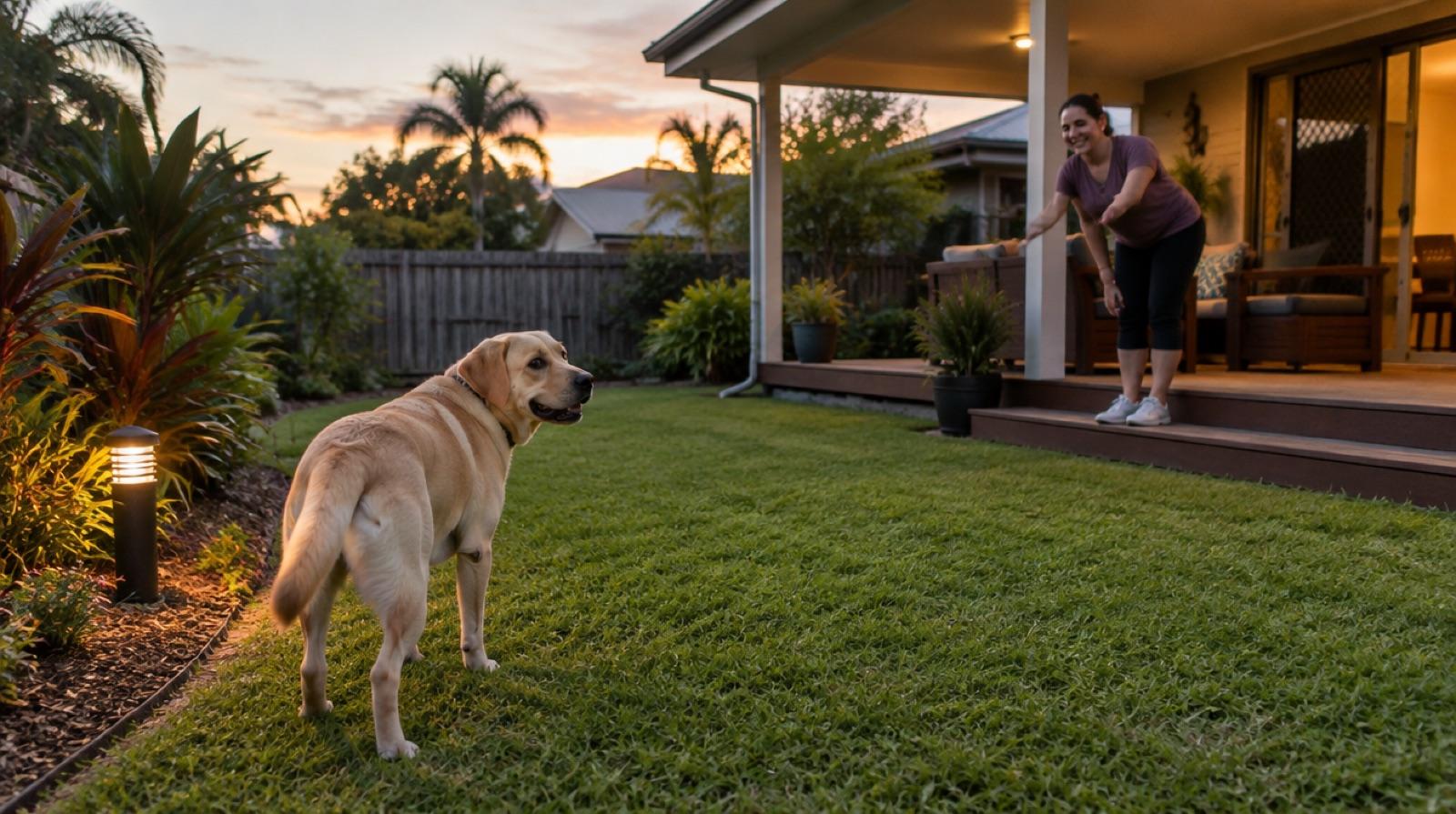
If your dog has mouthed a cane toad
- Call your vet or the nearest emergency vet now and tell them it is a cane toad.
- Wipe all poison from your dog's mouth with a damp cloth for 10 to 15 minutes, rinsing the cloth regularly (WA Government first aid).
- Go in straight away if your dog is staggering, vomiting, seizing, or not improving, or if the vet says to.
First-aid step quoted from the WA Department of Biodiversity, Conservation and Attractions. 24-hour hospitals: Brisbane, Gold Coast, Sunshine Coast, Townsville, Cairns, Darwin.
Why are cane toads dangerous to dogs?
Cane toads are a large, warty, introduced amphibian, up to 20cm long, brought to Australia in 1935 to control agricultural pests. They did not control the pests but spread widely (Queensland Government). Their defence is a toxic milky substance from a large gland on each shoulder. The NSW Government calls cane toads a lethal threat to domestic pets when ingested, and the Queensland Government says they can harm domestic animals if eaten.
Dogs are poisoned in two ways, the NSW Government explains: by biting or mouthing a toad, or by drinking from a water bowl a toad has sat in, because toads need to hydrate often and can leave toxin behind. It calls the idea that cane toads can shoot or spray toxin an urban myth, although the NT Government says the toxin can be sprayed lightly if a toad is handled roughly.
LocalPetFinder is an adoption listings site, not a vet. This page is built from state government pages and published Australian veterinary research, read in November 2026. It is general information, not veterinary advice.
Where are cane toads found in Australia?
The Queensland Government says cane toads are now found in Queensland, New South Wales, the Northern Territory and Western Australia. Each state describes its own picture:
| State or territory | What the government says | Source |
|---|---|---|
| Queensland | Established throughout Queensland; found in many habitats including urban and urban-fringe areas | Business Queensland |
| New South Wales | Established in north-east NSW to the Clarence River; everyone has a biosecurity duty to help stop them spreading further | NSW Government |
| Northern Territory | Cane toads are a major pest in the NT and are spreading throughout northern Australia | NT Government |
| Western Australia | Spreading in the north; a declared pest north of the 26th parallel; the front advances about 50km a year on average, and drivers heading south from Derby are asked to check their load | DBCA; Explore Parks WA |
Read 10 November 2026. WA's DBCA publishes a map of the WA cane toad front line (2023 to 2025) on its cane toad management page.
Toads also hitch rides. The WA parks service says they travel by truck, caravan, boat and even plane, so a toad can turn up well outside these areas. If you find one somewhere new, the NSW and WA governments ask you to photograph it and report it, for example through FeralScan ToadScan. Many native frogs look similar, so do not assume.
What are the signs of cane toad poisoning?
Signs usually start at the mouth. The WA Government lists drooling, vomiting, loss of coordination, staggering and seizures. A Brisbane study of 90 dogs with suspected toad poisoning, treated at an emergency clinic over 30 months, recorded how often the main signs appeared (Reeves, 2004):
| Sign | How often (90 Brisbane dogs) |
|---|---|
| Increased salivation (drooling) | 78% of cases |
| Red gums and mouth lining | 63% of cases |
| Seizures | 31% of cases |
If your dog shows any of these signs after time in the yard at night in toad country, call a vet and mention cane toads.
What should I do if my dog mouths a cane toad?
Ring a vet first. The phone call costs nothing and the vet can tell you whether to come straight in. While you are getting advice, the WA Department of Biodiversity, Conservation and Attractions publishes this first-aid step (Explore Parks WA):
“First aid involves wiping all poison from the animal's mouth with a damp cloth for 10-15 minutes, rinsing the cloth regularly.”
- Go in straight away if your dog is staggering, vomiting, wobbly or seizing, if it is not improving, or if the vet says to.
- Follow the vet's instructions for anything beyond the wipe. This page does not give any other home treatment, on purpose.
- Leave the toad alone while you help your dog. The NSW Government advises wearing gloves if you do need to handle one later.
The outlook is usually good when dogs get help: in the Brisbane study, 96% of the 90 dogs survived, and the WA Government says dog deaths from cane toad poisoning are rare. Those dogs reached a vet. That is the point of acting fast.
Which dogs are most at risk?
In the Brisbane study, small breed dogs made up 76% of cases, and Jack Russell, Silky and Fox Terriers were the most represented breeds (Reeves, 2004). That is one clinic over 30 months, so treat it as a pattern, not a rule. If you have or are adopting a Jack Russell, Australian Silky Terrier or Fox Terrier in toad country, plan the yard around it.
The study also found cases all year round, with the fewest in winter, so toad-proofing is not only a summer job. Any dog can be poisoned; small dogs are simply over-represented in that clinic's cases.
How do I keep my dog away from cane toads?
Prevention is mostly about night-time and water. From the government pages:
- Watch the evenings. The NSW Government tells people to look for toads at night, when they come out. Bring dogs in, or take them out on a lead, after dark in toad areas.
- Lift the water bowl. The NSW Government advises raising your pet's water bowl out of reach of cane toads, because a toad can leave toxin in it.
- Remove breeding spots. The Queensland Government lists removing eggs from frog ponds among its controls, and the NT Government says to check water containers in your garden for cane toad eggs or tadpoles and empty any you are not using.
- Check the yard before letting the dog out at night. Listen too: the NSW Government says the cane toad's call sounds like a running motorbike.
- When travelling north, the WA parks service reminds people to protect pets from toads, and not to carry toads south by accident in the car or caravan.
How do I deal with cane toads humanely?
Confirm it is a cane toad first. The WA Government says not to kill an animal until it has been confirmed as a cane toad, because many native frogs look similar, and DBCA publishes an identification guide. Then follow your state government's method. The NSW Government says cane toads should be treated humanely and its Local Land Services video describes the method it recommends; the Queensland Government page and fact sheet set out the controls it accepts. Wear gloves, keep pets and children away, and report what you find so the spread can be mapped.
Do cane toads affect cats too?
Yes. The NSW Government says cane toads can affect cats and dogs, by biting the toad or by drinking from a bowl it has used. Most of the published advice and research we found is about dogs. Treat the same signs in a cat the same way: call a vet now.
Adopting a dog in cane toad country
Cane toads are a fact of life for dog owners across Queensland and the north, and a little planning goes a long way. Before you bring a rescue dog home, walk the yard at night, raise the water bowl and decide where the dog will sleep. Ask the rescue or foster carer how the dog behaves around frogs, lizards and birds, so you know what to plan for.
Our adopting a dog guide covers the first weeks, dog separation anxiety helps if your dog will sleep inside away from you, and the dog breed quiz can help you think about size and energy before you choose.
Find a rescue dog in Queensland and the NT
Dogs listed right now by the rescues and shelters we aggregate.
Other health guides for new owners
- Paralysis ticks in dogs and cats: the other big Queensland and east coast emergency.
- Snake bite in dogs: signs and the RSPCA first aid.
- Bloat (GDV) in dogs: the deep-chested-dog emergency.
- Dachshund IVDD and health: back problems in long-backed dogs.
- Dog dental care and puppy and kitten vaccinations: everyday prevention.
- Crate training a puppy: a safe spot for a young dog at night.
Frequently asked questions
What are the signs of cane toad poisoning in a dog?▼
The WA Government lists drooling, vomiting, loss of coordination, staggering and seizures. In a Brisbane emergency clinic study of 90 dogs with suspected toad poisoning, the most common signs were increased salivation (78% of cases) and red gums and mouth lining (63%), and 31% had seizures. A dog that has mouthed a toad and is drooling, vomiting or wobbly needs a vet now.
What should I do if my dog licked a cane toad?▼
Call your vet or nearest emergency vet straight away. The WA Government's first-aid advice is to wipe all poison from the animal's mouth with a damp cloth for 10 to 15 minutes, rinsing the cloth regularly. Then follow the vet's instructions, and go in immediately if your dog is staggering, vomiting, seizing or not improving.
Can a dog die from a cane toad?▼
It can happen, which is why the NSW Government calls cane toads a lethal threat to domestic pets when ingested. The WA Government also says dog deaths from cane toad poisoning are rare, and in a Brisbane study of 90 dogs treated at an emergency clinic, 96% survived. Those dogs reached a vet, so treat any toad contact as urgent.
Where are cane toads found in Australia?▼
The Queensland Government says cane toads are now found in Queensland, New South Wales, the Northern Territory and Western Australia, and are established throughout Queensland. The NSW Government says they are established in north-east NSW to the Clarence River. In Western Australia they are spreading through the north, where the cane toad is a declared pest north of the 26th parallel.
Are cane toads in Sydney?▼
The NSW Government describes where cane toads are currently established as north-east NSW to the Clarence River, and says everyone in NSW has a duty to help stop them spreading from there. If you think you have found one, its video advises putting on gloves, containing the animal, taking photos and reporting it, for example through FeralScan. A number of native frogs are often mistaken for cane toads, so confirm the identification first.
When are cane toads most active?▼
The NSW Government's cane toad video says the best time to look for them is the warmer months, October to May, and to check at night, when cane toads come out to forage and call for a mate. In the Brisbane study of 90 dogs, poisoning cases were reported all year round, with the fewest over the winter months. Keeping your dog in, or close, after dark in toad areas is the simplest protection.
Which dogs are most at risk from cane toads?▼
Small dogs made up 76% of cases in a Brisbane emergency clinic study of 90 dogs with suspected toad poisoning, and Jack Russell, Silky and Fox Terriers were the most represented breeds. Any dog can be poisoned, though, so supervise every dog outside at night in toad country.
Can a dog get sick from water a cane toad sat in?▼
Yes. A NSW Government video on cane toads explains that a toad can leave toxin behind in a pet's water bowl, and a pet that drinks from it can become very sick. It advises raising your pet's water bowl out of reach of cane toads if you notice them on your property.
Can cats be poisoned by cane toads?▼
Yes. The NSW Government says cane toads can affect cats and dogs, either by the pet biting a toad or by drinking from a bowl a toad has used. Most of the published advice we found is written about dogs, but the same signs and the same urgent trip to the vet apply to a cat.
Is it legal to kill cane toads?▼
Cane toads are a pest and the state governments encourage control, but they ask that it is done humanely and only once you are sure it is a cane toad, because many native frogs look similar. In Queensland the cane toad is not a prohibited or restricted animal but everyone has a general biosecurity obligation; check the Queensland, NSW or WA government cane toad page for the methods each accepts.
Do cane toads spray poison?▼
Not in the way people fear. The NSW Government calls it an urban myth that cane toads can shoot or spray toxin. The NT Government says the toxin is usually on the toad's skin but can be sprayed lightly if the toad is handled roughly. The toxin is a milky substance from a large gland on each shoulder, and the NSW Government says pets are poisoned by biting a toad or by drinking from a water bowl a toad has sat in. Wear gloves, and eye protection as the NT Government advises, if you handle one.
Sources
- Queensland Government (Business Queensland): Cane toad
- NSW Government: Cane toad control
- WA Government (DBCA Explore Parks): Cane toads, an invasive threat
- WA Government (DBCA): Cane toad management
- Northern Territory Government (NT.GOV.AU): Cane toads
- FeralScan: ToadScan
- Reeves (2004): A retrospective report of 90 dogs with suspected cane toad toxicity, Australian Veterinary Journal
Keep reading
Paralysis ticks in dogs and cats
The signs, the RSPCA tick removal steps and prevention, for Queensland and the east coast.
Snake bite in dogs
Signs, the RSPCA pressure-bandage step, and why most dog bites happen in the yard.
Small dogs for adoption in Brisbane
Small rescue dogs listed now by Brisbane shelters and rescues.
Cheap vet care in Australia
Charity clinic prices, concession discounts and help with an emergency bill.