The short answer
Crate training is fine for most puppies when it is gradual, reward-based and used for short periods. The RSPCA Australia Knowledgebase calls a puppy crate an ideal secure place where a puppy can sleep safely and be left alone, and RSPCA Victoria says to crate only for short periods and never in place of exercise and enrichment. Pick a crate the puppy can stand, turn and lie down in, put it in a central part of the home, and start with the door open, treats and meals inside. Close the door for a few seconds, then minutes, and build up over weeks. Young puppies should not go more than two to three hours in a crate without a toilet break, and no puppy should be crated all day. Never force a puppy in or use the crate as punishment.
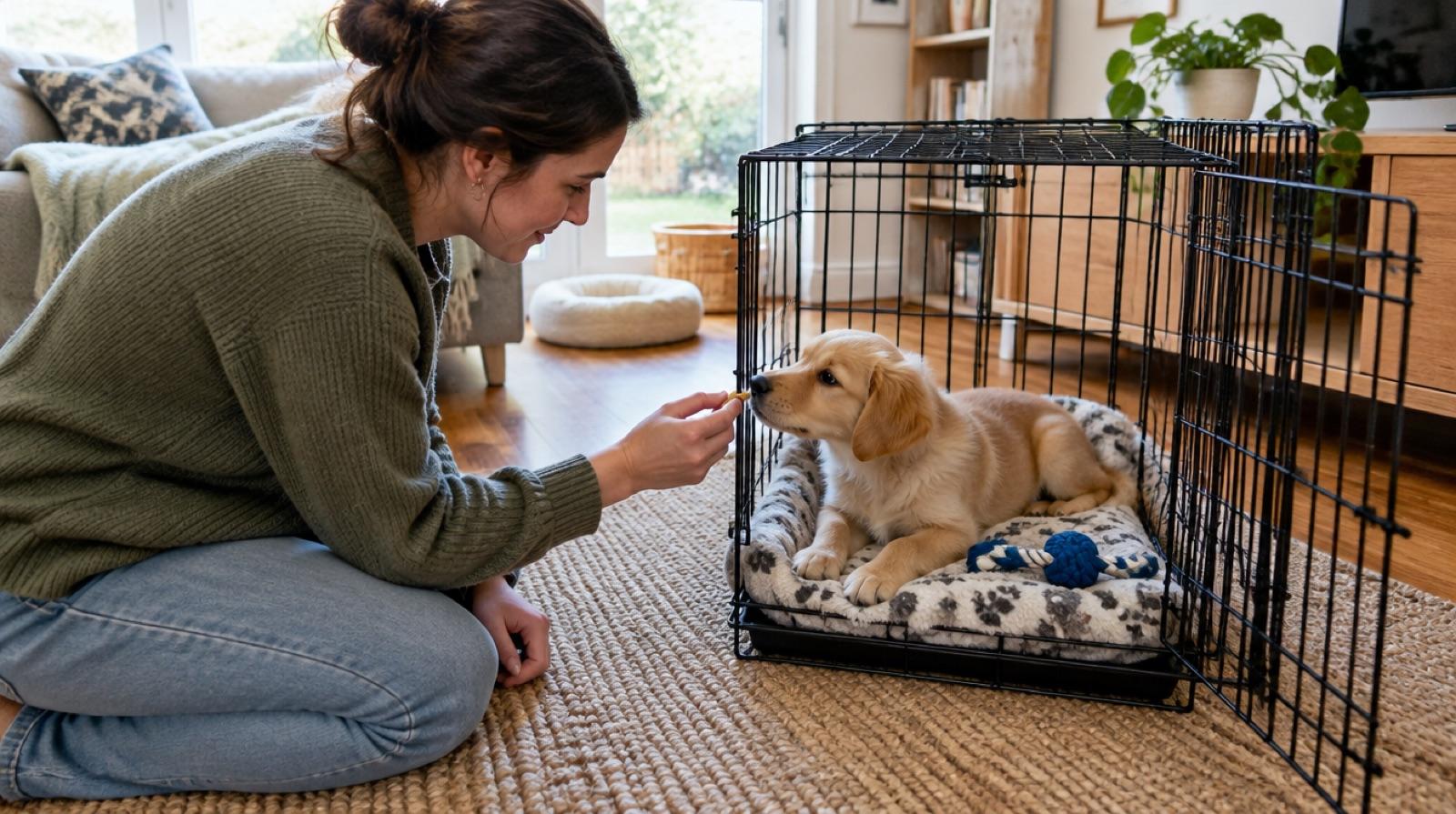
Should you crate train a puppy?
For most puppies, yes, with limits. The RSPCA does not treat a crate as cruel or as essential. It treats it as a useful tool when used properly.
What the RSPCA says, in its own words
- RSPCA Australia Knowledgebase: “A puppy crate is an ideal secure place where your puppy can sleep safely and be left alone.” It adds that it is important to teach your puppy to be happy when they are alone.
- RSPCA Victoria: crate training “teaches them boundaries and provides them with a safe space of their own.”
- RSPCA Victoria: “You should only crate your dog for short periods of time.”
- RSPCA Victoria: “Crate training should never take the place of appropriate exercise and enrichment.”
RSPCA Victoria lists practical benefits: many dogs seek out their crate when they feel uncertain or unsafe, and a dog that is happy in a crate is easier and safer to take to the vet, travel with, or keep quiet after surgery or an injury. A crate the puppy likes also helps with toilet training, because dogs tend not to toilet where they sleep.
If you would rather not use a crate, RSPCA Victoria suggests a puppy-proof pen instead. The goal is the same: a safe, comfortable space where the puppy can be left for short periods without chewing cables or toileting on the rug.
What size crate, and where should it go?
| Choice | What RSPCA Victoria advises |
|---|---|
| Size | Big enough for your dog to stand up, turn around and lie down |
| Type | Plastic, wire or collapsible fabric; not recommended to leave a dog for long periods in a fabric crate |
| Daytime location | A central part of your home |
| Night location | A familiar area |
| Bedding | Make it inviting and comfortable with the dog's favourite blankets |
Source: RSPCA Victoria, Crate training your dog, read November 2026.
For a puppy that will grow a lot, buy for the adult size and use a divider panel to keep the space snug while it is small, then move the panel back as it grows. Ask the rescue or breeder for an expected adult size; with a mixed-breed rescue puppy that is an estimate, so err larger.
In an Australian summer, think about heat. Keep the crate out of direct sun and away from hot windows, make sure air moves through it, and always leave water available when the puppy will be in there for more than a short spell.
How do you crate train a puppy, step by step?
These steps follow RSPCA Victoria's crate method and the RSPCA Australia Knowledgebase's carrier training steps, which use the same principles. Move to the next step only when the puppy is relaxed at the current one.
- Let the puppy investigate. Put the crate in place with the door open or removed. Let the puppy explore on its own terms. Reward any sniffing, touching or stepping in with a treat and quiet praise.
- Make inside the best place in the house. Toss treats and toys in, and reward the puppy for settling in there. Keep the door open. RSPCA Victoria says not to close the door in the first few interactions.
- Feed meals in the crate. Put the bowl inside and add a cue word such as “crate” or “bed”. Once the puppy walks in readily for meals, ask it to go in first, then put the food inside.
- Close the door briefly during a meal. Once the puppy eats happily inside, close the door for short periods while it eats. As training progresses, leave the door closed for a few minutes after it finishes, then lengthen the closed-door time after meals bit by bit.
- Sit nearby, then step away. When the puppy stays calm in the closed crate for about 10 to 15 minutes after a meal, start extending the time. Give a treat as it goes in, sit quietly nearby for a few minutes and reward calm behaviour, then carry on with your day and return regularly to reward it.
- Practise short absences. The RSPCA Australia Knowledgebase suggests starting alone time with a very short period, like a minute, and slowly building up as the puppy gets used to it. A long-lasting chew helps.
- Introduce nights last. RSPCA Victoria says to start night crating only once the puppy is happy in the crate with you nearby. Provide toys, and if the puppy seems distressed, covering the crate with a blanket may help.
Expect it to take time. RSPCA Victoria says it can take weeks until a dog is comfortable, and strongly recommends working with a reward-based trainer.
About whining. RSPCA Victoria advises ignoring whining and rewarding only when the puppy is settled, so crying does not become the way to open the door. Balance that against the bladder: a young puppy may need a toilet break overnight and may whine to tell you. If it has been a while, take it out on a lead, let it toilet, reward, and put it back with no play. If the puppy is in real distress rather than protesting, you have moved too fast; go back a step.
How long can a puppy be in a crate?
Here is everything the Australian RSPCA guidance actually states, and nothing more:
| Situation | What the source says |
|---|---|
| Young puppy, daytime | No more than two to three hours in the crate without a toilet break |
| Puppy, whole day | Should not spend all day in a crate, as this can affect muscle development and condition |
| Overnight | Young puppies and senior dogs may need toilet breaks at night and may whine to let you know |
| Adult dog | No hour limit published; how long crate training takes varies with age, temperament, past experiences and your relationship with the dog |
| Any dog | Only short periods; never in place of exercise and enrichment |
Source: RSPCA Victoria, Crate training your dog, read November 2026.
You may have seen a rule of thumb such as “one hour per month of age”. We could not find an Australian vet body or the RSPCA publishing that rule, so we do not repeat it. Go by the two to three hour toilet-break limit for young puppies, your puppy's signals, and common sense.
If you work full days, a crate is not the answer to who looks after the puppy. A puppy-proof pen with a toilet area, a midday visit from a family member or dog walker, or puppy day care covers the gap. If that is not possible for the first months, an adult dog that is already toilet trained and used to being alone may suit your household better.
How does crate training help toilet training?
Dogs tend to keep their sleeping area clean, so a crate of the right size encourages a puppy to hold on until you take it out. RSPCA Victoria builds its toilet training method around a crate or pen for exactly that reason. The crate does not toilet train the puppy. Your timing and rewards do.
Take the puppy out:
- first thing in the morning and when it wakes from a nap;
- straight after you let it out of the crate or pen;
- after eating, drinking, play or a walk;
- when it sniffs the floor away from its play area, circles, paces, whines or suddenly changes what it is doing.
RSPCA Victoria says puppies need to go to the toilet every one to two hours, and suggests setting a timer for every hour.
The routine RSPCA Victoria describes:
- When the timer goes, clip on the lead and take the puppy to its toilet spot. Do not play.
- If nothing happens in five minutes, go back inside, watch the puppy closely, and try again every five minutes.
- When it goes, say your cue word and reward straight away. The RSPCA Australia Knowledgebase says within a second or two, with a high-value treat and praise.
- Put the puppy back in its crate or pen and reset the timer.
Accidents will happen. The RSPCA Australia Knowledgebase says young puppies cannot fully control their bladders. If you catch one mid-accident, calmly interrupt and take it outside. If you find it afterwards, clean up without reacting. Never punish; the Knowledgebase warns against old methods like rubbing a dog's nose in urine, which harm welfare and can teach a dog to hide from you to toilet. Clean the spot with a non-ammonia product (the Knowledgebase) or an enzymatic cleaner made to neutralise odours (RSPCA Victoria), so the smell does not draw the puppy back.
How long it takes. RSPCA Victoria treats initial toilet training as complete once the puppy has toileted in its designated spot for four weeks, with reinforcement after that. If a puppy that was doing well suddenly starts having accidents, it advises a vet visit to check for a health problem.
Can you crate train an adult rescue dog?
Yes. RSPCA Victoria says crate training works for adult dogs as well as puppies, and that how long the training takes depends on the dog's age, temperament, past experiences and its relationship with you. That last part matters with a rescue dog, because you often do not know its history.
- Ask first. The rescue or foster carer may know whether the dog has used a crate, and how it reacted.
- Start from step one, even with an adult. Door open, treats, meals inside, and no closing the door until the dog walks in by choice.
- Watch for panic, not just protest. Frantic attempts to get out, damage to the crate or any injury mean stop. Some dogs with a history of confinement do better with a pen or a closed room.
- Give it time to settle. The RSPCA's guidance on adopted greyhounds notes it can take several months for a newly adopted dog to fully settle, and that a new dog may be unsettled when left alone at bedtime.
Adult dogs can be toilet trained the same reward-based way; the RSPCA Australia Knowledgebase covers puppies and adult dogs together and notes every dog learns at its own pace. A rescue dog that was house-trained in foster care may still have a few accidents in a new home while it learns where the door is.
If your dog is distressed whenever it is left, crate or no crate, read our dog separation anxiety guide and talk to your vet.
What should you never do with a crate?
- Never force a puppy in. The RSPCA Australia Knowledgebase says forcing a pet into a carrier makes fear worse; the same applies to a crate.
- Never use it as punishment. RSPCA Australia supports reward-based training and says aversive methods should not be used. A crate that means “you are in trouble” stops being a safe space.
- Never crate all day, or as a substitute for exercise, play, company and toilet breaks (RSPCA Victoria).
- Do not leave a dog for long periods in a fabric crate (RSPCA Victoria).
- Do not let children or other pets bother a puppy in its crate. It should be a place to rest. When introducing a dog to a cat, the RSPCA Australia Knowledgebase advises against keeping one animal in a crate while the other approaches, which can be threatening for the confined animal.
- Do not leave a puppy crated in a hot room or car. Heat builds quickly in an enclosed space.
Does crate training prevent separation anxiety?
It may help as part of teaching a puppy to be alone, but no study shows it prevents separation anxiety. A 2024 UK and Ireland study of 145 puppies found that puppies restricted to a crate or room overnight at 16 weeks or younger had lower odds of separation-related behaviour at six months. The authors stress the sample was small and the results are correlational, so they cannot show the crate caused the difference.
The safer takeaway matches the RSPCA's advice: teach a puppy from the start that short spells alone are normal and safe, whether in a crate, a pen or a puppy-proof room.
Other Australian puppy health and safety guides
- Puppy and kitten vaccination schedules, including when your puppy can go to puppy school
- Dog separation anxiety
- Paralysis ticks in dogs and cats
- Snake bite in dogs
- Cane toads and dogs
- Dog bloat (GDV)
- Dachshund IVDD and health
- Dog dental care
Find a puppy or dog near you
Each page lists the dogs currently with the rescues we aggregate in that city, refreshed regularly. RSPCA Australia says its adoptable animals have been vaccinated, wormed, microchipped and desexed as appropriate, and an adult dog may already be toilet trained. Not sure whether to adopt or buy? Read puppies for sale: adopt or buy first, or try the adoption readiness check.
Frequently asked questions
Is crate training good for puppies?▼
It can be, when it is done gradually and the crate is used for short periods. The RSPCA Australia Knowledgebase calls a puppy crate an ideal secure place where a puppy can sleep safely and be left alone. RSPCA Victoria says a crate teaches boundaries and gives a dog a safe space of its own, but that you should only crate your dog for short periods and it should never replace exercise and enrichment.
What size crate does my puppy need?▼
Big enough for the dog to stand up, turn around and lie down, which is RSPCA Victoria's guidance. For a puppy that will grow a lot, plan for its adult size; a divider lets the space grow with the puppy. RSPCA Victoria does not recommend leaving a dog for long periods in a fabric crate.
How long can a puppy stay in a crate?▼
RSPCA Victoria says young puppies should not spend more than two to three hours in a crate without a toilet break, and that a puppy should not spend all day in a crate because it can affect muscle development and condition. We could not find an Australian vet body that publishes an hours-per-month-of-age rule, so we do not give one.
How do I start crate training a puppy?▼
Put the crate in a central part of the home, make it comfortable, and let the puppy explore it on its own terms with the door open. Reward any interest with treats and praise, then feed meals inside. Once the puppy eats happily in there, close the door for short periods while it eats, then leave it closed for a few minutes after the meal and build up slowly. RSPCA Victoria says it can take weeks until a dog is comfortable.
Should I ignore my puppy crying in the crate?▼
Partly. RSPCA Victoria advises ignoring whining and rewarding the puppy only once it is settled, so it does not learn that crying opens the door. But it also notes that young puppies may need toilet breaks overnight and may whine to tell you. Take a crying puppy out to toilet calmly and quietly, then straight back in, with no play.
Where should the crate go at night?▼
Somewhere familiar, and introduce night crating only once the puppy is happy in the crate with you nearby, as RSPCA Victoria advises. Young puppies may need a toilet break at night and may whine to let you know, so keep the crate where you will hear it. RSPCA Victoria says covering the crate with a blanket may help a puppy that seems distressed.
How often does a puppy need to go to the toilet?▼
Often. RSPCA Victoria says puppies need to go every one to two hours, and suggests setting a timer for every hour. Take the puppy out after waking, after being let out of the crate, after eating or drinking, and when it sniffs the floor, paces, whines or suddenly changes activity.
How long does toilet training a puppy take?▼
Weeks, not days. RSPCA Victoria treats initial toilet training as complete once the puppy has toileted in its designated spot for four weeks, and says you will still need to reinforce it after that. The RSPCA Australia Knowledgebase notes every dog learns at its own pace and young puppies cannot fully control their bladders, so accidents are expected.
Should I punish my puppy for accidents?▼
No. RSPCA Victoria says never punish a puppy for an accident, and the RSPCA Australia Knowledgebase warns against outdated methods such as rubbing a dog's nose in urine, which harm welfare and can teach the dog to avoid toileting in front of you. Calmly interrupt, take the puppy outside, reward it when it goes there, and clean the spot with a non-ammonia or enzymatic cleaner.
Can you crate train an adult rescue dog?▼
Yes. RSPCA Victoria says crate training works for adult dogs as well as puppies, and that how long the training takes depends on the dog's age, temperament, past experiences and your relationship with it. Go slowly with a rescue dog, whose history you may not know, and stop if it panics. Ask the rescue or foster carer whether the dog has used a crate before.
Should I use a crate if my dog has separation anxiety?▼
Only with care. Some anxious dogs find a crate calming and others panic and can hurt themselves trying to escape. Film your dog before relying on a crate, build crate time gradually, and talk to your vet about separation distress, which RSPCA Australia describes as a mental health issue that requires veterinary treatment.
What should I never do with a crate?▼
Never force a puppy in, never use the crate as punishment, and never use it in place of exercise, company or toilet breaks. RSPCA Australia says not to force a pet into a carrier because it makes fear worse, and supports reward-based training only. When introducing a dog to a cat, it also advises against keeping one animal in a crate while the other approaches.
Sources
- RSPCA Australia Knowledgebase: How can I socialise my puppy?
- RSPCA Australia Knowledgebase: How can I train my pet to feel comfortable in a transport carrier?
- RSPCA Australia Knowledgebase: How can I toilet train my puppy or adult dog?
- RSPCA Australia Knowledgebase: What sort of training would you recommend?
- RSPCA Australia Knowledgebase: Introducing a new dog or puppy to your cat
- RSPCA Australia Knowledgebase: What should I know about owning a greyhound?
- RSPCA Australia Knowledgebase: Where should I go for a new companion animal?
- RSPCA Victoria: Crate training your dog
- RSPCA Victoria: Puppy toilet training
- Dale et al. (2024), Canine separation-related behaviour at six months of age (Generation Pup), Animal Welfare
Keep reading
Dog separation anxiety
How to tell distress from boredom, the gradual alone-time plan, and when to see your vet.
Puppy vaccination schedule
When the C3 and C5 are due, what core means, and why the 16-week dose matters.
Puppy blues
The exhausted, trapped feeling after a new puppy, how long it lasts and what helps.
Puppies for sale: adopt or buy?
Rescue puppies, registered breeders, state breeder rules and scam red flags.