The short answer
Cabin: only Virgin Australia carries pets in the cabin, for small dogs and cats up to 8kg including the carrier, on selected domestic routes, booked by phone; Virgin publishes its in-cabin fee on its Pets in Cabin page, so check it before booking. Qantas allows only approved service dogs in the cabin. Hold: both airlines fly pets as cargo in an IATA-approved crate; Qantas Freight from 12 weeks of age, Virgin from 8 weeks. Snub-nosed breeds must be booked through an approved pet travel specialist to fly in the hold on both. Tasmania requires proof of hydatid tapeworm treatment within 14 days before a dog arrives; WA has no paperwork for dogs and cats. Check the airline's page before you book: these rules change.
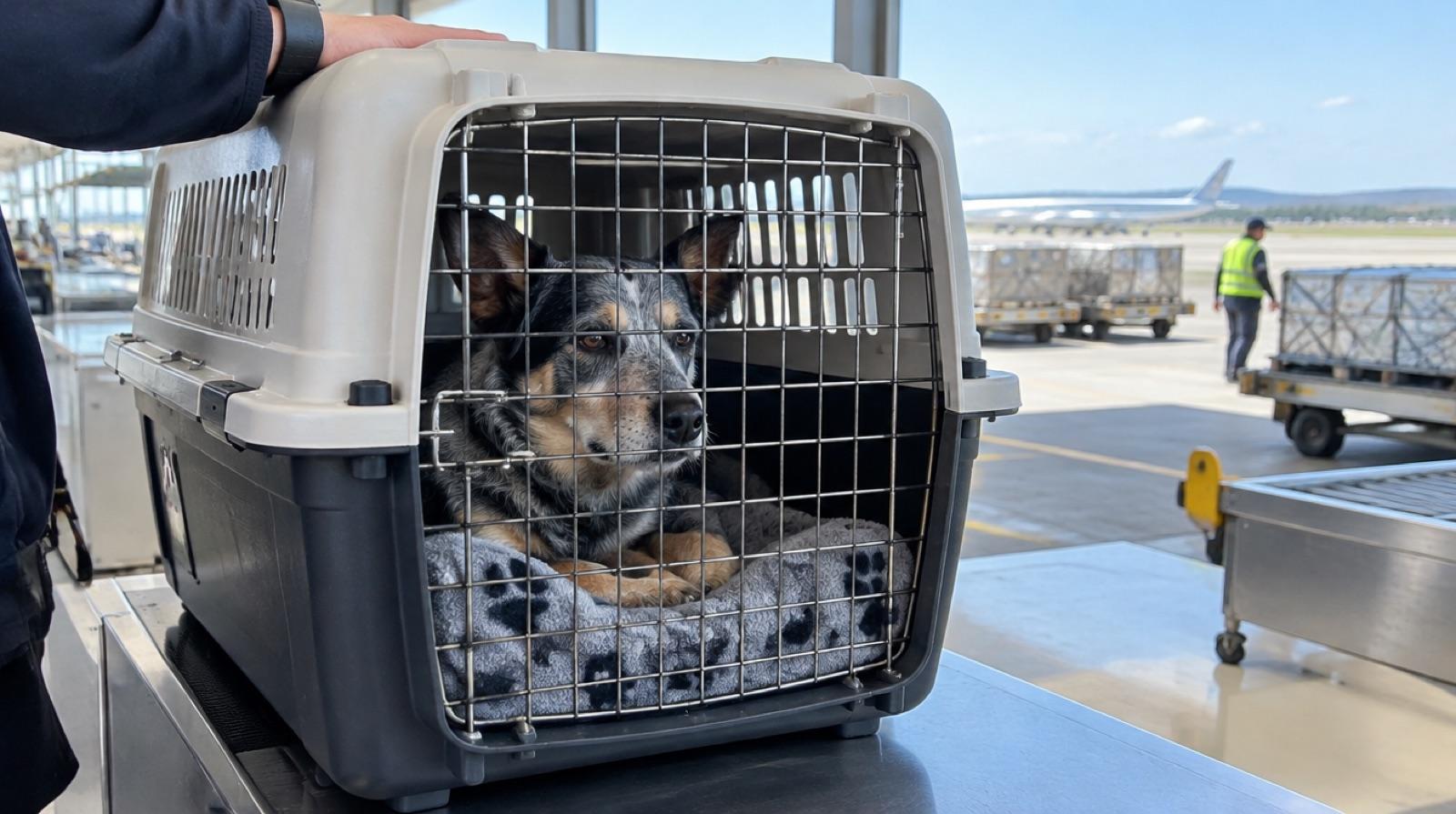
Can you take a dog on a plane in Australia?
Yes, on domestic flights, in one of two ways. A small dog or cat can ride in the cabin with you on Virgin Australia's Pets in Cabin service, on the routes that offer it. Any other pet flies in the temperature-controlled cargo hold, booked with Qantas Freight or Virgin Australia Cargo, either by you or through a pet transport company. Qantas Freight says it does not accept pet bookings on any Jetstar service.
| Qantas | Virgin Australia | |
|---|---|---|
| Pets in the cabin | No. Only approved service dogs | Small dogs and cats, 8kg max with carrier, selected routes |
| Pets in the hold | Yes, through Qantas Freight, on selected Qantas domestic flights (QF400 and above) | Yes, through Virgin Australia Cargo; a transport partner is preferred |
| Minimum age | 12 weeks | 8 weeks (vet certificate from 8 to 12 weeks; some cabin routes need 16 weeks) |
| Older pets | Vet certificate for pets over 12 years | Vet certificate for pets over 12 years |
| Snub-nosed breeds | Hold only, booked through an approved pet travel specialist | Cargo through an approved transporter; cabin with a vet fit-to-fly form |
| Sedation | Asks owners not to sedate | Not recommended; vet certificate if your vet advises it |
| Published price | None: depends on weight and crate size | Cabin: fee published on Virgin's Pets in Cabin page; check it before booking. Cargo: no published price |
Sources: Qantas Freight FAQs, Qantas service dogs, Virgin Pets in Cabin, Virgin Australia Cargo, all read 11 November 2026. We do not quote prices; airline rules and fees change, so check with the airline before you book.
LocalPetFinder lists rescue pets; we are not a travel agent or pet transporter and have no arrangement with any airline. This is general information from the airlines' and governments' own pages.
How does Qantas pet travel work?
Qantas carries pets in the hold through Qantas Freight, which covers dogs (other than service dogs), cats, rabbits, guinea pigs, some birds and fish. You can book dogs and cats online yourself, except snub-nosed breeds. The main rules from its pet travel FAQs:
- Age: at least 12 weeks; pets over 12 years need a vet certificate saying they are healthy enough to fly.
- Crate: you supply a suitable IATA-approved crate. Bookings do not include one; Qantas sells crates by phone on 13 12 13.
- Flights: only selected Qantas domestic flights (QF400 and above), never Jetstar, and space is limited. Qantas suggests checking which flights can take your pet before you book your own seat. It cannot guarantee your pet travels on your flight.
- Weight: if pet plus crate is over 50kg, call first. Rex aircraft cannot take a total over 32kg.
- Weather: no animals are carried when the temperature is expected above 35°C or below 5°C; pets are rebooked at no extra cost.
- No sedation, no coat: Qantas asks you not to sedate your pet, and says the hold is kept at 18 to 22°C so a coat or blanket is not needed.
- Connections: 120 minutes to transfer a pet in Brisbane, Melbourne, Perth and Sydney, 90 minutes elsewhere.
- Insurance: Qantas Freight does not insure your pet's travel.
- Restricted dogs: active racing greyhounds are not carried; retired greyhounds only on selected routes through specialists. American Staffordshire Terriers (pure or cross) must travel in a reinforced CR-82 or approved guard dog cage.
How does Virgin Australia Pets in Cabin work?
Virgin Australia calls itself Australia's first airline to take small pets, dogs and cats only, in the cabin. When we checked its Pets in Cabin page on 11 November 2026, the service was available from Cairns, Melbourne, Sunshine Coast, Gold Coast and Adelaide. The rules:
- Size: a small cat or dog, with the pet and carrier together weighing no more than 8kg.
- Carrier: soft-sided, well ventilated, escape-proof and leak-proof, no more than 44cm long, 28cm wide and 28cm high, big enough for the pet to stand, sit, turn and lie down, with all but one opening secured with cable ties before you arrive. Virgin measures carriers at the airport.
- On board: the pet stays in its closed carrier under the seat in front for the whole flight. Pet owners sit in designated seats. One pet per guest.
- Booking: by phone on 13 67 89, more than 72 hours before travel; check in in person at least 75 minutes before departure.
- Who cannot book: anyone travelling alone with an infant, under-18s travelling alone, and people travelling alone with an assistance animal.
- Vet certificate (within 14 days) if the pet is unwell, recently injured or operated on, a snub-nosed breed (with a fit-to-fly form), between 8 and 12 weeks old, over 12 years, pregnant, or if your vet recommends sedation.
- Not allowed: bark collars of any kind; prohibited breeds (see below).
- Price: Virgin publishes its Pets in Cabin fee on the same page, charged per pet, per flight, on top of your fare. Virgin says it may change the fee at any time, so check the current fee with Virgin before booking.
Virgin says a pet that is not approved or eligible for the cabin may be able to travel in the cargo hold instead.
How does Virgin Australia Cargo carry pets?
Virgin Australia Cargo says booking through one of its listed animal transport partners is preferred, because they can supply crates, collect and deliver door to door, and book any flight, including yours. You can book directly with Virgin Cargo on 13 82 87 if you know the requirements, but then you cannot put your pet on a flight you are taking.
- Pet plus container no more than 65kg; animals older than 8 weeks.
- Usually one animal per container. Exceptions: up to three animals from the same litter, under 6 months old and under 14kg each; or two compatible animals of comparable size, each under 14kg.
- Containers must meet Virgin and IATA rules and fit the aircraft; strong animals that can break plastic need a metal or wooden crate. Virgin's A320 and Saab 340 aircraft do not carry animals.
- Lodge no earlier than 120 minutes before departure (latest acceptance is generally 90 minutes before). Collect from 30 minutes after arrival; animals not collected within 90 minutes may be handed to a transporter at your cost.
- Virgin recommends no food for at least eight hours before travel. A pet that soils its crate before boarding is not loaded until the crate is cleaned.
Can snub-nosed breeds fly?
Yes, but under stricter rules on both airlines, and it is worth asking whether the trip is necessary. Qantas Freight says flat-faced breeds have a significantly higher risk of health complications because of their short snouts and compromised airways, a condition called Brachycephalic Obstructive Airway Syndrome (BOAS), and that breathing difficulty gets worse in warm weather, when a pet is anxious, or when it is not used to its crate.
| Rule | Qantas Freight | Virgin Australia |
|---|---|---|
| How to book | Only through a Qantas Freight-approved pet travel specialist | Cargo: only through a brachycephalic-approved transport company. Cabin: by phone, with a vet fit-to-fly form |
| Vet check | The specialist's vet completes a BOAS check | Vet check required |
| Times and routes | Set by the specialist and Qantas | Cargo: no same-day connections, no flights leaving 9am to 6pm local time, and only between Adelaide, Brisbane, Canberra, Gold Coast, Hobart, Launceston, Melbourne, Newcastle, Perth and Sydney |
| Breeds listed (examples) | Pug, French Bulldog, British/English Bulldog, Boxer, Boston Terrier, Shih Tzu, Pekingese, Lhasa Apso, Chow Chow, King Charles Spaniel, Dogue de Bordeaux; Persian, Himalayan and Exotic Shorthair cats. Qantas applies its list to purebreds only; Virgin's cabin list includes crosses of the listed breeds | |
Sources: Qantas Freight brachycephalic breeds, Qantas Freight FAQs, Virgin Australia Cargo, Virgin Pets in Cabin, read 11 November 2026. Each airline's full list is on its page.
Heat is the shared thread. Book cooler times of day, get the crate training done well before the flight, and see our guide to dogs in hot weather. If you are thinking of adopting a flat-faced breed, our Pug, French Bulldog and British Bulldog guides cover their breathing and heat risks in more depth.
Which breeds can't fly?
Both airlines refuse breeds that cannot be imported into Australia under federal law. Qantas Freight lists the Pit Bull and American Pit Bull Terrier, Dogo Argentino, Japanese Tosa, Brazilian Fila and Presa Canario. Virgin Australia lists those plus several wolfdog breeds (Czechoslovakian, Saarloos, Kunming and Italian), and domestic cats crossed with wild cat species. These overlap with the restricted breeds in state law; our Staffy vs Pit Bull guide explains the difference, and wolf dogs in Australia covers the import ban.
What about assistance animals?
Assistance animals travel in the cabin free on both airlines, under their own rules. Qantas accepts service dogs (guide, hearing or assistance dogs) trained and accredited through set pathways, such as an Assistance Dogs International member or a pathway under Queensland or South Australian law, with a current Public Access Test, a weight of no more than 45kg, and an application at least 14 days before travel. It does not accept emotional support, therapy or comfort dogs that are not trained to alleviate a disability, or any animal other than a dog, in the cabin.
Virgin Australia accepts assistance animals trained to help a person alleviate the effects of a disability that meet public hygiene and behaviour standards, with documents from a listed organisation or further evidence such as a Public Access Test. Therapy animals are not generally treated as assistance animals. Virgin reminds handlers that assistance animals going to Tasmania or WA, even in transit, must meet that state's biosecurity rules.
What does a pet transport company do?
A pet transport company (sometimes called a pet travel specialist or pet shipper) books your pet's flight with the airline's cargo arm and handles the parts you would otherwise do yourself. Virgin Australia Cargo says its partners can offer different services, including:
- Crate hire, sized to your pet and the aircraft.
- Door-to-door collection and delivery, and lodging at the cargo terminal.
- Kennelling services, and help with comfort stops.
- Booking any available flight, including the one you are on.
For snub-nosed breeds, an approved specialist is not optional on either airline. Qantas Freight says its approved specialists must belong to the International Pet and Animal Transportation Association (IPATA) or the Animal Transport Association, use an Australian Veterinary Association member vet for the BOAS check, and hold a signed agreement with Qantas. Ask any company which airlines approve it, what is included in the quote, and how your pet will be cared for if the flight is delayed. Get a written quote: we do not recommend individual companies.
How do you get a dog ready for a flight?
The crate matters most. Qantas says breathing trouble in flat-faced dogs gets worse when a pet is not used to its crate, and the same stress affects any dog. Start weeks ahead, so the crate is a familiar, safe place: our guide to crate training a puppy works for adult dogs too.
- See your vet for a health check, any certificate your airline needs, and advice on managing stress. Qantas asks owners not to sedate; Virgin says sedation is not recommended and needs a vet certificate if your vet advises it.
- Get the right crate early: IATA-approved for the hold, or a soft carrier within Virgin's limits for the cabin. Your pet must be able to stand, turn around and lie down.
- Check the weather at both ends. Qantas will not fly animals above 35°C or below 5°C.
- Feed lightly. Virgin recommends no food for eight hours before a cargo flight, and a toilet stop before you leave.
- Check identification: microchip details current, and a tag with your phone number.
- Check the destination rules if you are flying to Tasmania or WA (next section).
What are the rules for taking a pet to Tasmania or WA?
These are the two states whose biosecurity rules both airlines point to. They apply whether your pet flies, drives or comes on the ferry.
| Tasmania | Western Australia | |
|---|---|---|
| Dogs | Treated for hydatid tapeworm within 14 days before entry, with the active ingredient and dose rate Biosecurity Tasmania specifies, and evidence carried (a vet statement, a statutory declaration, or the packet and receipt). Checked within the last 24 hours and found free of brown dog tick. A declaration form is on the page | No major entry restrictions; no specific vaccinations, vet certificates or paperwork required |
| Exemptions | Tasmanian dogs returning after no more than 14 days away (with proof), puppies 12 weeks and under (with proof of age), accredited assistance dogs (accreditation documents and a biosecurity declaration, including the tick check), greyhounds racing in Tasmania within six days of arrival, and law enforcement dogs | Not applicable |
| Cats | No import restrictions; the cat should be healthy and its vaccinations up to date | No major entry restrictions |
| Also | Dingoes, foxes and wolves are not permitted | Brush seeds out of the coat and check bedding before arrival; some birds and other animals are prohibited or need permits |
Sources: Biosecurity Tasmania: dogs, Biosecurity Tasmania: animals, WA DPIRD, read 11 November 2026.
Why Tasmania is strict: Biosecurity Tasmania says it is the only Australian state provisionally free of hydatid disease, and that the brown dog tick, which spreads the dog disease ehrlichiosis, is not known to be established there. A dog that arrives without proof, or treated more than 14 days earlier, is given treatment by Biosecurity Tasmania at the port of arrival; a fee for service is charged and the owner risks an on-the-spot fine. Biosecurity Tasmania notes its full import conditions are now in the Tasmanian Animal Biosecurity Manual, linked from its page. Ask your vet for a worming product that meets Biosecurity Tasmania's rule and keep the evidence with the dog.
What about flying a pet into Australia from overseas?
That is a separate, federal process. The Department of Agriculture, Fisheries and Forestry (DAFF) says cats and dogs must arrive with a valid biosecurity import permit and meet all import requirements, and it runs the post-entry quarantine facility at Mickleham in Victoria. Requirements depend on the country the pet comes from, so start with DAFF's page well ahead. Qantas Freight says international pet travel from Australia must be booked through a pet travel specialist.
Is driving a better option?
For many trips, yes, especially for flat-faced, very young or nervous dogs. The RSPCA's road trip advice and its transport policy come down to a few rules:
- Never leave your dog unattended in the car. The RSPCA says dogs can very quickly suffer potentially fatal heat stress, even in mild weather.
- Restrain your dog. The RSPCA's restraint article describes a crash-tested car harness on the back seat, a secured crash-tested crate, or a cargo barrier (which protects people but may not protect the dog). Road rules on restraint differ by state.
- Practise first. Get a dog used to the car with reward-based training, well before the trip.
- Stop often for toilet breaks, water and on-lead exercise, and keep your dog on a lead in unfamiliar places.
- Plan the health side: vaccinations and parasite treatment up to date, enough medication, and advice from your vet about the place you are going, such as paralysis tick or heartworm prevention.
- Check identification: the RSPCA says to make sure your microchip registry is recognised nationally, not just in your state.
Adopting a pet from another city
Adopting close to home avoids a flight altogether, and lets you meet the animal first. If the right animal is listed with a rescue in another city or state, ask the rescue before anything else whether it adopts interstate, whether it needs to meet you in person, and how it would want the animal to travel. If a flight is agreed, the rules above apply, and a dog that already rests calmly in a crate will find the trip easier.
Our adopting a dog and adopting a cat guides cover the steps and fees, and a rescue dog's first weeks covers settling in after the trip.
Find a rescue pet near you
Dogs and cats listed right now by the rescues and shelters we aggregate.
Other guides for dog owners
- Barking dogs and the law and bark collars in Australia (Virgin bans bark collars in the cabin).
- Grass seeds and dogs: worth knowing before a country road trip.
- Dog separation anxiety: if your dog struggles when left, plan the trip around it.
- Dog-friendly camping in Australia: where you can take a dog once you arrive.
- Cat enclosures and catios: for cat owners.
Frequently asked questions
Can my dog fly in the cabin in Australia?▼
Only on Virgin Australia, and only if it is small. Virgin's Pets in Cabin service takes small dogs and cats with a combined pet and carrier weight of no more than 8kg, on selected domestic routes, booked by phone. Qantas says it does not accept animals other than approved service dogs in the aircraft cabin; pets fly in the hold through Qantas Freight.
How much does Virgin Pets in Cabin cost?▼
Virgin Australia publishes its Pets in Cabin fee on its Pets in Cabin page. The fee is charged per pet, per flight, on top of your own fare; Virgin says it may change the fee at any time, and the fee that applies is the one published when you book. Check the current price on Virgin's page or with Virgin before booking. We do not quote prices.
How much does Qantas pet travel cost?▼
Qantas Freight does not publish a single price. It says that, like any other air freight, your pet's weight and the size of the crate determine the cost. Bookings do not include a crate; you supply one or buy one separately.
How old does a puppy have to be to fly?▼
It depends on the airline. Qantas Freight says all pets must be at least 12 weeks old. Virgin Australia accepts cats and dogs from 8 weeks, in the cabin and in cargo, but needs a vet certificate for animals between 8 and 12 weeks, and says some cabin routes need pets over 16 weeks.
Can snub-nosed dogs fly in Australia?▼
Yes, but with extra rules. Qantas and Virgin both say brachycephalic (snub-nosed) breeds such as Pugs, French Bulldogs, British Bulldogs, Boxers and Persian cats must be booked through an approved pet travel specialist or transporter to fly in the hold. Virgin will not carry them in cargo on flights leaving between 9am and 6pm local time. In Virgin's cabin they need a vet's fit-to-fly form.
Should I sedate my dog for a flight?▼
No, unless your vet specifically recommends it. Qantas asks owners not to sedate pets, because staff need to assess a pet's health at the freight terminal and a sedated pet can look unwell. Virgin says sedation is not recommended and, if your vet does recommend it, your pet must travel with a vet certificate. Ask your vet about other ways to manage stress.
Will Qantas fly my pet in hot weather?▼
Not in extreme heat or cold. Qantas Freight says it will not carry any animals when the temperature is expected to be above 35°C or below 5°C, and it will rebook at no extra cost. It also suggests avoiding the middle of the day in summer and early or late flights in winter.
What do I need to take a dog to Tasmania?▼
Proof that your dog was treated for hydatid tapeworm within 14 days before arriving, plus a declaration that it was checked within the last 24 hours and found free from brown dog tick. Biosecurity Tasmania accepts a vet statement, a statutory declaration, or other evidence such as the pill packet and purchase receipt, and its page names the treatment it requires. Ask your vet which product qualifies. Cats have no import restrictions.
Do pets need paperwork to enter Western Australia?▼
Not dogs and cats. The WA Department of Primary Industries and Regional Development says there are no major entry restrictions for cats and dogs and no specific vaccinations, vet certificates or paperwork are required. It asks owners to brush seeds out of the coat and check bedding before arrival. Some birds and other animals are prohibited from entering WA or need a permit.
Can I fly on the same plane as my dog?▼
Usually, but it is not guaranteed. Qantas Freight says it will do all it can to put your pet on your flight but cannot guarantee it. Virgin Australia Cargo says that if you book directly with it, you cannot book your pet on a flight you are travelling on, so the pet is not left unattended; booking through a transport partner allows it.
Can I bring my dog home from overseas?▼
Only by meeting the federal import rules. The Department of Agriculture, Fisheries and Forestry says cats and dogs must arrive in Australia with a valid biosecurity import permit and meet all import requirements, and its page links to its post-entry quarantine facility in Mickleham, Victoria. Requirements depend on the country the pet comes from, so start with DAFF's page well ahead.
Is it better to drive or fly with a dog?▼
It depends on the dog and the distance. Flying is quick but stressful, and snub-nosed, very young, old or unwell pets face extra risk, which is why airlines ask for vet checks. Driving means hours in the car, so the RSPCA says to restrain your dog safely, stop for toilet and exercise breaks, and never leave it unattended in the car. Talk to your vet before either.
Sources
- Qantas Freight: Pet travel FAQs
- Qantas Freight: Pets
- Qantas Freight: Brachycephalic breeds
- Qantas: Travelling with a guide, assistance or hearing dog
- Virgin Australia: Flying with animals and pets
- Virgin Australia: Pets in Cabin
- Virgin Australia Cargo: Animals in cargo
- Virgin Australia: Travelling with your assistance animal
- Biosecurity Tasmania (NRE Tas): Requirements for bringing a dog into Tasmania
- Biosecurity Tasmania (NRE Tas): Animals and animal products
- WA DPIRD: What can I bring into Western Australia?
- Department of Agriculture, Fisheries and Forestry: Bringing cats and dogs to Australia
- RSPCA Knowledgebase: Taking my dog on a road trip
- RSPCA Knowledgebase: Restraining my dog in the car
- RSPCA Policy F7: Transportation of companion animals
Keep reading
Crate training a puppy
How to teach a dog to rest calmly in a crate, step by step, from RSPCA and vet guidance.
Dogs in hot weather
Heatstroke signs, hot cars and which dogs are most at risk in an Australian summer.
A rescue dog’s first weeks
What to expect and how to help a new dog settle in, from sourced advice.
Cat enclosures and catios
Types of cat enclosure, what a good one needs, and cat curfew rules by state.