The short answer
A Staffy (Staffordshire Bull Terrier) is a recognised breed that is not restricted anywhere in Australia: the Dogs Australia standard describes a compact dog of 36 to 41 cm and 11 to 17 kg. The American Pit Bull Terrier has no Dogs Australia standard, cannot be imported, and is restricted, prohibited or prescribed in every state; selling or giving one away is banned in every state except Tasmania, which requires council approval of the new owner. The American Staffordshire Terrier is a separate, legal breed. Looks alone cannot settle which is which, so adopt through a rescue that has assessed the dog, keep its paperwork, and register it with your council.
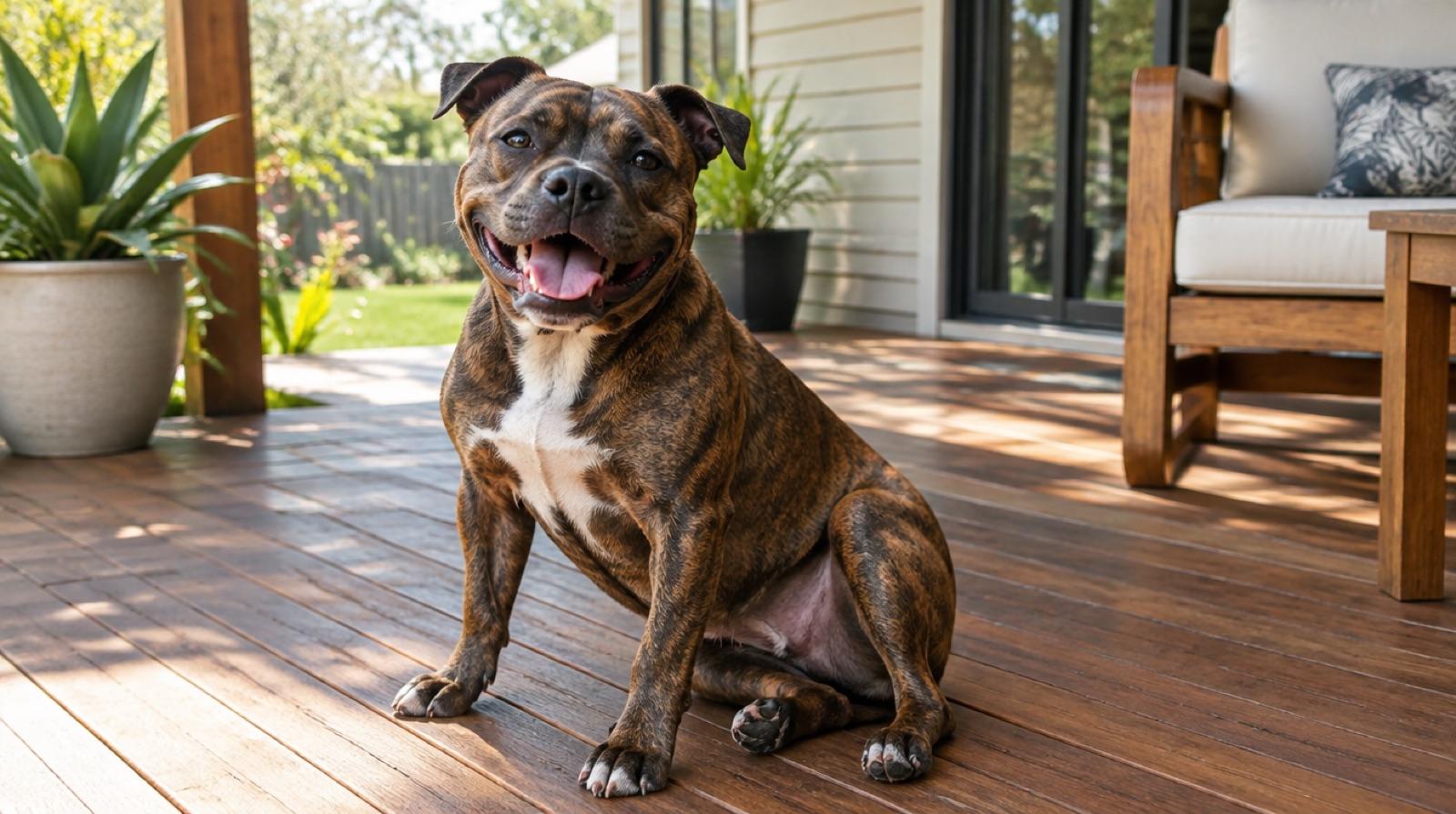
What is the difference between a Staffy and a pit bull?
The biggest difference in Australia is legal, not physical. The Staffordshire Bull Terrier is a recognised breed, listed by Dogs Australia in the Terrier group with its own breed standard, and no state or territory restricts it. The American Pit Bull Terrier is one of five breeds that cannot be imported into Australia, it is restricted (or prohibited, or prescribed) in every state, and it does not appear on the Dogs Australia breed listing at all.
Then there is the word “pit bull” itself. RSPCA Australia points out that “pit bull” is not a recognised pure breed: it is “a descriptive label given to dogs that loosely share some physical features.” In everyday speech, people use it for almost any muscular, short-coated, broad-headed dog, which is exactly why Staffies and Staffy crosses get caught up in it.
A third breed sits in the middle of the confusion: the American Staffordshire Terrier (Amstaff). It is a separate, recognised and unrestricted breed with its own Dogs Australia standard. The Dogs Australia breed page explains that the Staffordshire Terrier was renamed the American Staffordshire Terrier in 1972, when the American Kennel Club also admitted the Staffordshire Bull Terrier as a breed with a standard of its own.
Staffy vs Amstaff vs American Pit Bull Terrier side by side
The Staffy and Amstaff columns come from the Dogs Australia standards and breed pages, read on 10 November 2026. The pit bull column is deliberately thin: there is no Dogs Australia standard to compare against.
| Staffordshire Bull Terrier | American Staffordshire Terrier | American Pit Bull Terrier | |
|---|---|---|---|
| Recognised by Dogs Australia | Yes, Group 2 (Terriers) | Yes, Group 2 (Terriers) | No; not on the breed listing |
| Restricted in Australia | No, in every state and territory | No, in every state and territory | Yes, in every state; not in the ACT; in the NT, check with your council |
| Height at the shoulder | 36 to 41 cm | Dogs about 46 to 48 cm; bitches about 43 to 46 cm | No Dogs Australia standard |
| Weight | Dogs 13 to 17 kg; bitches 11 to 15.4 kg | Not set; in proportion to height | No Dogs Australia standard |
| Temperament (standard) | “Bold, fearless and totally reliable”; “highly intelligent and affectionate especially with children” | “Keenly alive to his surroundings. His courage is proverbial” | No Dogs Australia standard |
| Coat | Smooth, short and close | Short, close, stiff to the touch and glossy | No Dogs Australia standard |
| Colours | White, red, fawn, black, blue, any of these with white, any brindle; black and tan or liver unacceptable | Any colour, solid, parti or patched; all white, more than 80% white, black and tan, and liver not encouraged | No Dogs Australia standard |
| Breeder health tests (breed page) | L2-HGA and hereditary cataract (HC) DNA tests | Cerebellar ataxia DNA test; cardiac, hip and elbow problems can affect the breed | Cannot be bred or sold legally in most states |
Sources: Dogs Australia Staffordshire Bull Terrier standard (last updated 1 November 2025) and breed page; American Staffordshire Terrier standard (last updated 1 December 1997) and breed page; Dogs Australia breed listing, August 2026; state pages in the law table below.
Size is the most useful clue. A purebred Staffy is a compact dog under knee height on most adults, and the standard sets a weight ceiling of 17 kg for a male. But a rescue dog labelled Staffy cross can be any size, because the other half of its family tree is unknown.
What does the law say in each state?
Every state names the American Pit Bull Terrier (or “pit bull terrier”) alongside the same four other import-banned breeds: the Dogo Argentino, Fila Brasileiro, Japanese Tosa and Perro de Presa Canario. No state lists the Staffordshire Bull Terrier or the American Staffordshire Terrier.
| State | How the pit bull is treated | Key rule | Staffy restricted? | Official source |
|---|---|---|---|---|
| NSW | Restricted dog: American pit bull terrier or pit bull terrier, plus four other breeds and any dog a council officer declares restricted. A dog assessed as a cross of a restricted breed can be declared too | Must not be sold, advertised, given away or transferred | No | NSW Office of Local Government |
| VIC | Restricted breed: American Pit Bull Terrier (or Pit Bull Terrier) and four other breeds; a trained council officer assesses a dog against the approved standard | Must not be sold, given away or transferred, except surrendered to a pound or shelter or passed on after the owner dies; breeding one is a criminal offence | No | Agriculture Victoria |
| QLD | Prohibited dog breed: American pit bull terrier or pit bull terrier and four other breeds | A person must not own or be responsible for one without a reasonable excuse, or supply one | No | Queensland Government |
| WA | Restricted breed: American pit bull terrier, pit bull terrier and the other import-banned breeds, including a mix where one of the breeds is restricted | Advertising, selling, transferring, buying or breeding one is an offence under the Dog Act 1976 | No | WA Dog Regulations 2013 |
| SA | Prescribed breed: American Pit Bull Terrier and four other breeds (SA says it has no banned breeds) | Must not be sold, given away or advertised; desexed, muzzled in public | No | Dog and Cat Management Board |
| TAS | Restricted breed: American Pit Bull Terrier (or Pit Bull Terrier) and four other breeds; the council declares a particular dog, and the state FAQs say cross-breeds are not declared | Can be sold or given away only once the new owner has council approval; desexing, a muzzle and a short lead in public apply once declared | No | Tasmanian Government |
| ACT | No restricted breeds; each dog is assessed on its own behaviour | Dangerous dog rules apply to any breed | No | ACT City Services |
| NT | We found no Northern Territory government page listing restricted breeds; check with your council | Council by-laws apply; the City of Darwin by-laws set rules for dogs declared dangerous | No | City of Darwin |
Every state and territory page re-read 10 November 2026; for the Northern Territory we found no government page listing restricted breeds, so check with your council. General information, not legal advice. Follow the link for your state before you rely on a detail, and ask your council about local rules.
Two points matter for anyone adopting. First, the restriction is about the dog, not the person: in NSW it is an offence “to sell, advertise for sale, give away, or transfer ownership of a proposed or declared restricted dog,” according to the Office of Local Government, and South Australia's Dog and Cat Management Board says the same of its prescribed breeds. That is why restricted dogs do not appear on adoption lists. Second, separate from any breed list, any dog of any breed can be declared dangerous or menacing after an incident, everywhere in Australia.
Why can't you tell them apart by looks?
Because people, including experts, are not good at reading a mixed dog's ancestry from its face and body. Two studies are the clearest evidence.
| Study | What they compared | What they found |
|---|---|---|
| Olson, Levy and colleagues, 2015, The Veterinary Journal | 16 staff at four shelters labelled 120 dogs by eye; the dogs were DNA tested | Staff collectively labelled 52% of the dogs pit bull-type; DNA put 21% in that group. Individual staff picked up between 33% and 75% of the dogs DNA flagged |
| Voith and colleagues, 2009, Journal of Applied Animal Welfare Science | Breeds named by adoption agencies for 20 adopted dogs, against a DNA breed test | Of 16 dogs given a named breed, DNA found that breed as a main breed in 4 (25%) |
Both studies are small, so the exact numbers will not carry over to an Australian pound. The direction is the point: a visual label, whether “Staffy cross” or “pit bull type”, is a guess. RSPCA Australia goes further for pit bulls in particular, saying DNA testing is not possible because these dogs “do not share a genetic signature.” Our guide to what breed your rescue dog is covers what DNA tests sold in Australia can and cannot tell you.
Looks also say little about behaviour. In a 2022 study in Science of more than 18,000 dogs, breed explained just 9% of the variation in individual behaviour. RSPCA Australia's position is that each dog should be assessed on its actual behaviour, not its breed or appearance.
What does this mean if you adopt a Staffy cross?
For most adopters, nothing dramatic. A Staffy or Staffy cross is treated like any other dog, and Staffy-type dogs are among the most listed dogs in the rescues, shelters and council pounds we aggregate, so you have real choice. A few habits make the legal side straightforward:
- Adopt through a rescue, RSPCA, AWL or council pound that has assessed the dog. Ask how it described the breed and why.
- Keep the paperwork: the adoption contract, the rescue's breed description, vet records and the microchip transfer.
- Register the dog with your council (in NSW, on the NSW Pet Registry), giving the breed as the rescue recorded it, for example “Staffordshire Bull Terrier cross”.
- Train and socialise early. The Staffy standard describes “indomitable courage and tenacity,” and a dog pushed into a scuffle does not back off easily. Calm, reward-based training protects the dog as much as anyone.
- Walk away from private sellers advertising “pitbull” or “pit cross” puppies. In most states it is an offence to sell or give away a restricted dog, and buying one can leave you owning a dog you cannot legally keep.
If a council ever questions your dog's breed, the process depends on your state. In NSW, the Office of Local Government says a council issues a notice of intention first; you then have 28 days to lodge an objection and can get a certificate from an approved breed assessor confirming the dog is not a restricted breed or cross. If the dog is assessed as a cross, an approved temperament assessor can certify that it does not pose a threat to the public. Get legal advice early if you receive a notice.
Renting can be harder than the law suggests, because some landlords and strata committees still hesitate over bull breeds. Our renting with pets guide covers each state's rules, and the Sydney and Melbourne guides to Staffies, restricted breed law and housing (and the Melbourne version) go into local detail.
Is a Staffy or an Amstaff the right dog for you?
Both breeds are described by their clubs as people dogs. The Staffordshire Bull Terrier Society of NSW text on the Dogs Australia breed page calls the Staffy an all-purpose companion, “especially for families with children,” that needs a daily walk or run and must be well trained or it may become unruly. The Amstaff breed page says the breed “is not suited to all households” and needs a home willing to train and socialise it, exercise it and include it in family life.
- A Staffy suits an active household that wants a compact, affectionate, sturdy dog and will put time into training and careful introductions to other dogs.
- An Amstaff suits a similar home that can handle a bigger, stronger dog, and owners with some experience of strong dogs on lead.
- Neither suits someone away all day with no plan for exercise, or a home that wants a dog to run freely with every dog at the park.
For a purebred puppy, our Staffy puppies: adopt or buy guide covers the club price guide, the DNA tests a breeder should show you and how to check a breeder number. Before applying, try the adoption readiness check and the dog cost calculator, and if you are still choosing a breed, the dogs for first-time owners guide.
See Staffies and Staffy crosses for adoption
Listed by the rescues, shelters and council pounds we aggregate, with each rescue's notes on children, cats and other dogs. Every listing links to the rescue, where you apply directly.
Staffies in Australia →Find a Staffy near you
- Sydney: Staffies for adoption, mixed-breed dogs and our Sydney Staffy adoption guide
- Melbourne: Staffies for adoption, mixed-breed dogs and our Melbourne Staffy adoption guide
- Brisbane: Staffies for adoption, mixed-breed dogs and our Brisbane Staffy adoption guide
- Perth: Staffies for adoption, mixed-breed dogs and our Perth Staffy adoption guide
- Adelaide: Staffies for adoption, mixed-breed dogs and our Adelaide Staffy adoption guide
Many Staffy crosses are listed simply as mixed breed, so the mixed-breed pages are worth a look too. The what dog breed am I quiz can help if you are weighing a Staffy against other breeds.
Frequently asked questions
Is a Staffy a pit bull?▼
No. The Staffordshire Bull Terrier is a recognised breed with its own Dogs Australia standard, and it is not a restricted breed anywhere in Australia. The American Pit Bull Terrier is a different dog: Dogs Australia does not list it as a breed, and it is restricted, prohibited or prescribed in every state. The confusion comes from looks, because both are short-coated, muscular bull-and-terrier types.
Are pit bulls illegal in Australia?▼
The American Pit Bull Terrier is one of five breeds that cannot be imported into Australia, and every state restricts it. Queensland prohibits owning one without a reasonable excuse, and selling or giving one away is banned in every state except Tasmania, where the council must approve the new owner first. Victoria and Western Australia also make breeding one an offence. The ACT has no restricted breeds, and we found no Northern Territory government list, so check with your NT council. Always check your state's official page.
How can you tell a Staffy from a pit bull?▼
Not reliably by looks alone. Size is the clearest clue: the Dogs Australia standard sets the Staffordshire Bull Terrier at 36 to 41 cm and 11 to 17 kg, a compact dog. But mixed-breed dogs vary, and research shows even experienced shelter staff disagree. In a 2015 study at four shelters, staff labelled 52% of 120 dogs as pit bull-type while DNA put 21% in that group. A visual guess is not a legal finding.
Is an American Staffordshire Terrier a pit bull?▼
Not in Australian law. The American Staffordshire Terrier is a separate breed with its own Dogs Australia standard, and Victoria and Tasmania's official pages both say it is not restricted. No state lists it. It is bigger than a Staffy, with the standard giving about 46 to 48 cm for dogs and 43 to 46 cm for bitches. The Dogs Australia breed page says breeders should DNA test for cerebellar ataxia.
Is it safe to adopt a Staffy cross in Australia?▼
Yes, for most people. Staffies and Staffy crosses are among the dogs most often listed by the rescues we aggregate, and selling or giving away a restricted dog is banned in most states, so rescues and pounds do not knowingly rehome one. Keep the adoption papers, the microchip record and the rescue's breed description, register the dog with your council, and ask the rescue how it assessed the dog.
Can a council say my Staffy cross is a pit bull?▼
In some states, yes. In NSW a council officer can declare a dog restricted, including a cross-breed of a restricted breed, and Western Australia's law covers a mix where one breed is restricted. Tasmania's official FAQs say cross-breed dogs are not declared restricted breed dogs there. In NSW you have 28 days after the notice of intention to lodge an objection, and you can get a certificate from an approved breed assessor confirming the dog is not a restricted breed or cross. Get legal advice if this happens.
Can a DNA test prove my dog is not a pit bull?▼
Not on its own, according to RSPCA Australia, which says pit bull is not a recognised pure breed and that DNA testing is not possible because these dogs do not share a genetic signature. A DNA test can tell you which recognised breeds appear in a dog's ancestry. Whether a dog is restricted is decided under your state's law and process, such as an approved breed assessor in NSW.
Are Staffies dangerous?▼
No breed is dangerous by label, and the Staffordshire Bull Terrier is not on any Australian restricted list. Its Dogs Australia standard describes it as highly intelligent and affectionate, especially with children, and bold, fearless and totally reliable. RSPCA Australia says breed is a poor predictor of an individual dog's behaviour. Any dog of any breed can be declared dangerous or menacing after an incident, so training and supervision matter.
Do I have to tell the council my dog is a Staffy?▼
Register your dog with your council or state registry like any other dog, and give the breed honestly as the rescue recorded it, for example Staffordshire Bull Terrier cross. A Staffy is not a restricted breed, so no restricted-dog permit applies. In NSW, registration is on the NSW Pet Registry. Keep the rescue's paperwork with your registration records.
Can I rent with a Staffy?▼
The law treats a Staffy like any other dog because it is not a restricted breed, but some landlords and strata committees still hesitate over bull breeds. What a landlord may refuse depends on your state's tenancy law. A reference from your rescue or trainer and the dog's adoption notes can help your application. Our renting with pets guide covers each state's rules.
Why are so many dogs in rescue labelled Staffy cross?▼
Partly because the Staffy is popular and partly because of how shelters label dogs. A dog that arrives with no history is named by how it looks, and a short-coated, broad-headed, muscular mix often gets called a Staffy cross. Research on visual breed labels shows they are often wrong: in a 2009 study, DNA found the agency's named breed as a main breed in only 4 of 16 dogs.
Sources
- Dogs Australia: Staffordshire Bull Terrier breed standard
- Dogs Australia: American Staffordshire Terrier breed standard
- Dogs Australia: Staffordshire Bull Terrier breed page
- Dogs Australia: American Staffordshire Terrier breed page
- Dogs Australia: Breed listing (August 2026)
- NSW Office of Local Government: Restricted dogs
- Agriculture Victoria: Owning a restricted breed dog
- Agriculture Victoria: Standard for restricted breed dogs
- Queensland Government: Regulated dogs
- WA Dog Regulations 2013
- WA Dog Act 1976
- Dog and Cat Management Board (SA): Prescribed breeds
- Tasmanian Government: Restricted breed FAQs
- ACT City Services: Dangerous dogs
- City of Darwin: Animal by-laws and infringement offences
- RSPCA Knowledgebase: What is the RSPCA’s view on breed specific legislation?
- Olson et al. (2015), Inconsistent identification of pit bull-type dogs by shelter staff, The Veterinary Journal
- Voith et al. (2009), Comparison of adoption agency breed identification and DNA breed identification of dogs
- Morrill et al. (2022), Ancestry-inclusive dog genomics challenges popular breed stereotypes, Science
Keep reading
Staffy puppies: adopt or buy?
Why so many Staffies are in rescue, the DNA tests a breeder should show you, and the club price guide.
What breed is my rescue dog?
Why shelter breed labels are so often wrong, and what a DNA test can tell you.
Staffies for adoption
Staffies and Staffy crosses listed by the rescues and pounds we aggregate, by city.
Renting with pets in Australia
What each state lets a landlord refuse, and how to make a strong pet application.