The short answer
A catio is an enclosed outdoor space, usually mesh or netting on a frame, that lets your cat outside without leaving your property. The main types are window boxes, balcony enclosures, freestanding runs and full-yard cat-proof fencing. RSPCA NSW says a good one has shade and rain cover, hiding spots, high platforms, resting places, water and a litter tray. Containment law differs across Australia: the ACT requires 24-hour containment for cats born after 1 July 2022; councils in Victoria, South Australia, Queensland and Darwin, among others, set curfews or full-time containment; NSW and Tasmania have no state containment rule; and a WA Bill to let councils set containment laws was still before Parliament on 11 November 2026. Check your council before you rely on any detail.
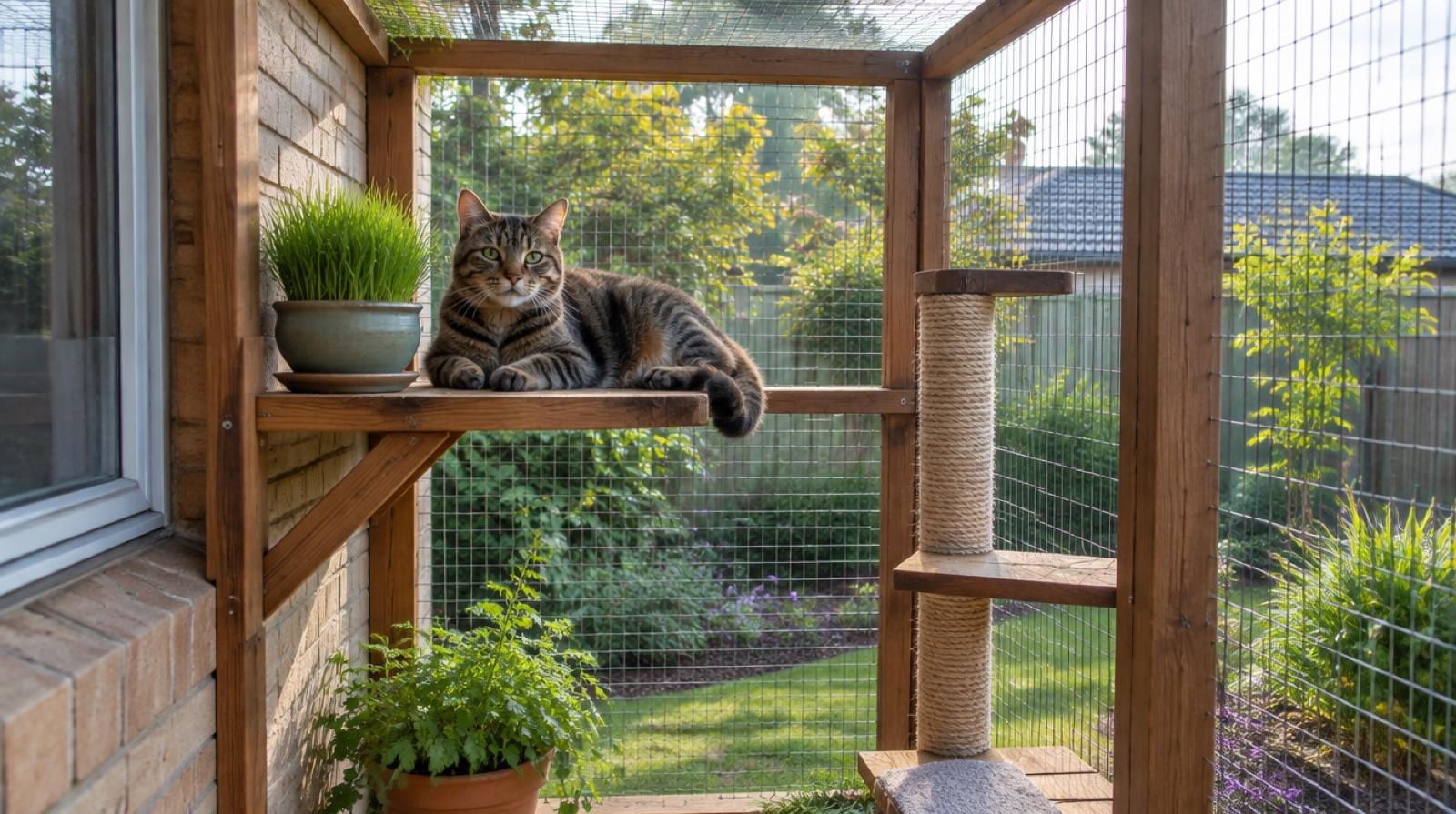
What is a catio or cat enclosure?
A catio (cat patio) is an enclosed outdoor area for a cat. It is usually wire mesh or netting on a timber or metal frame, with a roof so the cat cannot climb out. RSPCA NSW describes it as a way to give a cat the outdoor experience while giving you peace of mind, and notes it can attach to your cat's indoor space through a window or cat flap.
“Cat enclosure” is the wider term. It covers anything from a small box on a window ledge to a fully netted backyard. RSPCA Australia's containment policy defines containment as keeping a cat within your property boundary, either indoors or in an escape-proof outdoor area made with cat-proof fencing, netting or rigid wire.
LocalPetFinder lists rescue cats; we do not build or sell enclosures. This guide is general information from the RSPCA and from government pages read in November 2026. It is not legal advice.
Why keep a cat contained?
Two reasons come up on every official page: the cat's own safety, and wildlife.
- Safety. RSPCA Australia says roaming cats are at risk of injury and death from road accidents, fighting and disease, and that two in three cat owners have lost a pet to a roaming-related incident, with a third of these involving cars.
- Wildlife. A Threatened Species Recovery Hub fact sheet estimates each roaming pet cat in Australia kills on average 115 native animals a year, and that pet cats together kill around 230 million native animals a year. The NSW Government (July 2026) puts the toll from domestic cats at an estimated 53 million reptiles, 61 million birds and 67 million mammals a year.
- Night-only is not enough for wildlife. The same fact sheet says keeping a cat in at night helps nocturnal mammals and frogs, but native birds and reptiles are active by day. It also cites an Adelaide study in which 39% of 177 cats whose owners thought they were inside overnight were in fact leaving home.
RSPCA Australia's position is nuanced. Its policy supports containment in an environment that meets a cat's needs, says ideally all cats should have safe, escape-proof outdoor access, and also says mandatory 24/7 containment may increase the potential for negative impacts on animal welfare and the community, compared with voluntary containment, by imposing it on people and cats who are not suited or capable of doing it well. That is why a well-set-up enclosure matters as much as the rule.
The RSPCA NSW Keeping Cats Safe at Home project, supported by the NSW Government and its Environmental Trust, reports that its first phase (2021 to 2024), which combined targeted desexing and microchipping with an education campaign promoting voluntary containment, reduced roaming cats by 51% in the Blue Mountains, 35% in Campbelltown and 25% in Tweed Shire council areas.
What types of cat enclosure are there?
Pick by the space you have and how much of it the cat can use. These are generic types; we do not recommend any product or maker.
| Type | What it is | Suits | Watch for |
|---|---|---|---|
| Window box | A small mesh box fixed outside a window the cat reaches from inside | Apartments and small homes | Little room to move; full sun on a hot wall; secure fixing |
| Balcony enclosure | Netting or mesh closing in a balcony or verandah | Units and townhouses with a balcony | Strata or landlord consent; gaps at the edges; shade |
| Attached catio | A walk-in or crawl-in enclosure against the house, entered by a window or cat flap | Houses with a courtyard or side path | May need council approval if fixed to the house; the access point |
| Freestanding run | A self-contained enclosure in the yard, sometimes joined to the house by a mesh tunnel | Houses with yard space | Shelter from rain and heat; the cat must be carried in if there is no tunnel |
| Cat-proof fencing | Escape-proof tops on existing fences, such as netting, rolling cylinders, smooth sheeting or inward-leaning wire | Whole backyards | Neighbour agreement for shared fences; trees and sheds the cat can climb |
Catios joined to the house by a window or cat flap, and the fence-top types, are from RSPCA NSW; NRE Tasmania describes netting an existing balcony or pergola. The other rows are general descriptions, not from a named source.
RSPCA NSW also lists supervised time outside on a harness as an option where a catio is not possible, while noting it will not suit every cat and takes careful training.
What makes a good catio?
Size matters less than what is in it. These are the design points RSPCA NSW sets out for a furnished enclosure:
- Shade and rain protection. Covered sections so the cat can get out of the sun and the wet. Australian summers make this the first thing to plan.
- Hiding spots. Secluded shelters the cat can retreat to if it feels threatened.
- Elevated platforms. Shelves and perches give a high lookout, which helps cats feel safe.
- Resting places with cushions or blankets.
- Access to the house, ideally a direct, raised entry such as a window, so the cat can come and go.
- Litter tray and water, kept away from each other and from resting places.
- Scratching surfaces, cat grass, toys and a hammock, plus a seat for you, so the enclosure is a shared, pleasant space.
- A safe spot. RSPCA NSW's containment guide says to place the catio out of sight of dogs and other cats, and not to put bird baths or feeders close to it.
Check the build for escape routes: gaps at ground level, loose netting, and branches or roofs that touch the outside. For a whole-yard system, anything the cat can climb near the fence line is the weak point.
What are the cat containment and curfew rules in each state?
Of the official pages we read, only the ACT's sets a territory-wide containment rule. Elsewhere the state pages either leave cat confinement to councils or do not address it. This is what each official page says.
| State | State-wide rule | Council rules |
|---|---|---|
| ACT | Cats born after 1 July 2022 must be contained on the owner's premises 24 hours a day. In 17 declared cat containment suburbs, all cats must be contained regardless of age (ACT City Services) | Territory-run; no separate council layer |
| NSW | The Companion Animals Act 1998 does not require you to keep your cat indoors. Cats are banned from wildlife protection areas and public places where food is prepared or eaten (NSW Office of Local Government) | Councils declare and signpost wildlife protection areas; voluntary containment is encouraged |
| VIC | No state-wide rule on the state's page; cats 3 months and older must be registered with the council | Many councils require cats to be confined at certain hours or at all times, or restrict them from some areas (Agriculture Victoria) |
| QLD | Not stated on a state page we found; check your council | Set by council local laws. Brisbane and Logan, for example, require cats to stay within the owner's property |
| SA | No state-wide curfew; under state law all cats must be microchipped, and cats born after 1 July 2018 desexed (City of Marion) | Councils may make by-laws fixing periods when cats must be confined, including curfews (Law Handbook SA) |
| WA | No state containment rule. The Cat Amendment (Local Laws) Bill 2026 was at Legislative Council second reading (since 16 September 2026) when we checked on 11 November 2026, so it was not yet law (Parliament of WA) | If passed, local governments could restrict cats to owners' premises, prohibit them from public areas or set curfews (WA Government) |
| TAS | No requirement under the Cat Management Act 2009 to contain a cat, though it is strongly encouraged (NRE Tasmania) | Councils may make containment by-laws; multiple cat and cat breeding permits may carry conditions to stop cats wandering onto other people's property |
| NT | Not stated on a territory page we found; check your council | City of Darwin by-laws require dogs and cats to be properly contained on the premises and under effective control (on a leash) outside it (City of Darwin) |
Official pages read 11 November 2026. Rules differ by council: check yours before you rely on any detail. General information, not legal advice.
Which councils have cat curfews?
Too many to list, and they change every few years as councils renew their animal plans. These examples show the range, each from the council's own page:
| Council | Rule, as the council states it |
|---|---|
| Wyndham (VIC) | Existing 10pm to 6am curfew extended to 24-hour containment from 1 January 2026, with fines for the extended hours from December 2026 |
| Nillumbik (VIC) | 24/7 cat confinement order from 30 September 2025, with an education and transition period to October 2027 |
| Wellington (VIC) | 24-hour cat curfew in place across the shire (order made December 2022) |
| Merri-bek (VIC) | From 1 April 2027: 7pm to 7am for cats registered before that date, 24 hours for cats registered after it |
| Adelaide Hills (SA) | All cats kept at home at all times since 1 January 2022, unless on a leash or similar |
| Marion (SA) | Cats confined to the property from 8pm to 7am daily since 1 January 2023 |
| Brisbane (QLD) | Under the Local Animals Law 2017, cats must not wander outside the property where they are kept |
| Logan (QLD) | Cats must be contained within the property boundary; the enclosure must stop the cat going over, under or through the fence |
Several of these councils phase rules in, so the date a rule is made, the date it starts and the date fines begin can all differ. If you are moving, look up the new council before the cat arrives.
Do you need council approval to build a catio?
Sometimes. Containment rules govern the cat; planning and building rules govern the structure, and they treat a catio like any small shed or pergola. So the answer depends on size, height, how close it is to the boundary and whether it is fixed to the house, and it differs by state and council.
Two official examples show how this works. In NSW, small low-impact works that meet the state's standards can be exempt development needing no planning approval, but exempt development cannot take place on land on the State Heritage Register, and separate council or other approvals may still be needed. In WA, the City of Nedlands exempts animal enclosures from development approval only if they are on a residential zoned lot, set back at least 2 metres from lot boundaries, meet the deemed-to-comply outbuilding rules, are for small animals or a dog only, and are not commercial.
Before you build anything large, roofed or attached to the house, ask your council. In a unit, ask the owners corporation or body corporate as well, because balconies and outside walls are often common property.
Should you build it yourself or use a builder?
A small window box or a netted balcony is within reach for a handy owner. A walk-in catio fixed to the house, or a whole-yard fence system, is more work and more likely to need approval. Whoever builds it, the same checks apply:
- Is it fully escape-proof, roof included?
- Does it have shade, shelter and somewhere to hide (see the design list above)?
- Does it need council, strata or landlord approval?
- For shared fences, have you talked to the neighbour first?
- Can you clean it, and reach the litter tray and water easily?
Prices vary too much by size and material to give a figure, and we do not quote products. Get written quotes for anything built to order.
Can an indoor-only cat be happy?
Yes, with the right setup. The RSPCA's enrichment guide says cats can live happily indoors as long as they are entertained, and that boredom and lack of activity can lead to obesity, anxiety, aggression and urinary tract problems. What it recommends:
- Separate places to eat, drink, toilet, scratch, play and rest, with more of each for more cats.
- Resting places at different heights, plus enclosed spots to hide and sleep.
- A window perch for something to watch, and cat-friendly plants for smell.
- Food puzzles, short play sessions with wand toys that end with a treat, and toys swapped every few days.
- Time with you, at the level your cat is comfortable with.
RSPCA Australia adds that a safe outdoor enclosure, where you have one, gives a contained cat more choice and stimulation. If you are moving an outdoor cat to life at home, its policy says to take steps to ease the change, including seeking vet or behaviour advice where necessary.
Can you have a catio if you rent?
Usually, if your landlord agrees in writing. Freestanding runs and netting that clips or tucks in without drilling are easier to agree to than a structure fixed to the building. Tenancy rules on pets differ by state; our guide to renting with pets in Australia covers each one. For apartment living, an adult cat that is already used to indoor life is often the easiest fit.
Adopting a cat for an indoor or contained home
If you can only offer an indoor home, or an indoor home plus a catio, choose a cat that suits it. Adult cats in foster care come with a known history, so a rescue can usually tell you whether a cat has lived indoors and how it copes. Ask whether the rescue has any conditions about indoor living or containment, and tell them what you can offer.
Our adopting a cat guide covers the steps, fees and state laws, cost of owning a cat covers the budget, and the what cat breed am I quiz helps narrow down the type of cat that suits you.
Find a rescue cat near you
Cats listed right now by the rescues and shelters we aggregate, including cats suited to indoor homes.
Thinking about two? A pair entertains each other indoors. See bonded pairs in Sydney or Melbourne, or browse senior cats and ask the rescue how each one has lived.
Other guides for new pet owners
- Flying with a pet in Australia: Qantas and Virgin rules, and Tasmania and WA entry rules.
- A rescue dog's first weeks: settling a new dog in.
- Dogs in hot weather, grass seeds and dogs, barking dogs and the law and bark collars in Australia.
- Paralysis ticks in dogs and cats: one more reason a contained cat is a safer cat on the east coast.
Frequently asked questions
What is a catio?▼
A catio is an enclosed outdoor space for a cat, usually netting or wire mesh on a frame, attached to the house through a window or cat flap or standing on its own in the yard. It lets a cat be outside, in the sun and fresh air, without being able to leave your property. RSPCA NSW describes catios as a way to give a cat the outdoor experience while keeping it safe at home.
Why should I keep my cat in an enclosure?▼
To keep your cat safe and to protect wildlife. RSPCA Australia says roaming cats risk injury and death from road accidents, fighting and disease, and that two in three cat owners have lost a pet to a roaming-related incident, a third of them involving cars. A 2021 Threatened Species Recovery Hub fact sheet estimates each roaming pet cat in Australia kills on average 115 native animals a year.
Is it cruel to keep a cat contained?▼
Not if its needs are met. RSPCA Australia's containment policy says contained cats need an environment that meets their physical and mental needs, lets them express normal feline behaviour and keeps stress low, and that ideally every cat should have safe, escape-proof outdoor access. The policy also says some cats are unable to cope with containment, and that easing a cat into it should include vet or behaviour advice where needed.
Is there a cat curfew in Victoria?▼
Not state-wide. Agriculture Victoria says many councils have their own cat laws, and some require cats to be confined to the owner's property during certain hours or at all times. Wyndham, Nillumbik and Wellington are examples of councils with 24-hour containment orders. Check your own council's page, because the hours and start dates differ.
What are the cat laws in NSW?▼
The NSW Office of Local Government says the Companion Animals Act 1998 does not require you to keep your cat indoors. Cats are banned from wildlife protection areas, which councils declare and signpost, and from public places where food is prepared or eaten. Cats must be microchipped and registered, and a cat not desexed by 4 months needs an annual permit.
Do cats have to be contained in Canberra?▼
Yes, for many cats. ACT City Services says every cat born after 1 July 2022 must be contained on the owner's premises 24 hours a day, and in 17 declared cat containment suburbs all cats must be contained regardless of age. Containment can mean the house or apartment, an enclosed backyard or courtyard area, a cat crate or a leash.
Can WA councils make cats stay home?▼
Not yet in general. The Cat Amendment (Local Laws) Bill 2026, which would let WA local governments make local laws restricting cats to their owners' premises or setting curfews, was at second reading in the Legislative Council when we checked the Parliament of WA's bill page on 11 November 2026. The WA Government says the Bill would allow those local laws if passed. Check your local government's page for the rules that apply now.
Do I need council approval to build a catio?▼
It depends on the structure, not the cat. Planning and building rules apply to a cat enclosure the way they apply to any small structure, and they differ by state and council. The City of Nedlands in WA, for example, exempts animal enclosures from development approval only if they meet its setback, outbuilding and other conditions. Ask your council before you build anything large or attached to the house.
What does a cat enclosure need inside it?▼
RSPCA NSW lists shade and rain protection, hiding spots, elevated platforms, comfortable resting places, access to and from the house, a litter tray and a water source kept apart from each other, scratching surfaces and cat grass. It also suggests placing the enclosure out of sight of dogs and other cats, and not putting bird baths or feeders right next to it.
Can I have a catio if I rent?▼
Often, with your landlord's agreement. Freestanding enclosures and mesh that does not need drilling are easier to agree on than fixed structures. Get written consent before you attach anything to the building or a fence, and check your state's tenancy rules for pets. Our guide to renting with pets in Australia covers each state.
Is an indoor-only cat happy?▼
It can be. The RSPCA says cats can live happily indoors as long as they are entertained, and that boredom and lack of physical activity can lead to problems such as obesity, anxiety, aggression and urinary tract infections. Separate places to eat, drink, toilet, scratch, play and rest, high perches and hiding spots, food puzzles and play and time with you all help.
Should I adopt a cat that is used to living indoors?▼
If you cannot offer safe outdoor access, it is a good idea. A rescue can usually tell you how an adult cat has lived in foster care. Our listing pages for Sydney, Melbourne, Brisbane, Perth and Adelaide each have an indoor cats page showing the cats listed right now as suited to indoor homes.
Sources
- RSPCA Australia: Keeping Cats Safe at Home
- RSPCA Australia policy A8: Cat containment
- RSPCA Australia: How to create a cat-friendly contained environment
- RSPCA Knowledgebase: Cat enrichment brochure
- RSPCA NSW: About the Keeping Cats Safe at Home project
- RSPCA NSW: Cat enclosures (2026 Keeping Cats Safe at Home guide)
- RSPCA NSW: How to keep your cat safe at home
- Threatened Species Recovery Hub: Responsible cat ownership in Australia (fact sheet)
- NSW Government: Meow-vellous response to Keeping Cats Safe at Home (2 July 2026)
- NSW Office of Local Government: Nuisance pets
- ACT City Services: Cats
- Agriculture Victoria: Legal requirements for cat owners
- Law Handbook SA: Powers of local councils (dogs and cats)
- Parliament of Western Australia: Progress of Bills
- NRE Tasmania: Roaming and nuisance cats FAQs
- City of Darwin: Animal by-laws and infringement offences
Keep reading
Adopting a cat in Australia
The steps, rescue fees by state, desexing and registration law, and settling a rescue cat in.
Renting with pets in Australia
What each state’s tenancy law says about pets, and how to ask your landlord.
Cost of owning a cat
First-year and yearly costs of a cat in Australia, from published sources.
Flying with a pet in Australia
Qantas and Virgin pet rules, snub-nosed breeds, and Tasmania and WA entry rules.