The short answer
Dogs bark too much when something is wrong: boredom, loneliness, fear, a trigger like people walking past, or separation anxiety, according to the RSPCA Australia Knowledgebase. Keep a diary of when it happens, then fix the cause: more exercise and things to do, block the view of the street, and reward your dog when it is quiet rather than yelling, which tends to make barking worse. If the barking happens only when the dog is alone, or the dog seems distressed, start with your vet. If it is a neighbour's dog, talk to them first, then use mediation, then complain to your council. Every state and territory gives councils a way to deal with nuisance barking, with orders and fines, but the steps differ by council, so check yours.
Why do dogs bark?
Barking is normal. The RSPCA Australia Knowledgebase points out that people have encouraged and selected for barking over generations of domestication, and that what counts as “excessive” is partly subjective. The Australian Veterinary Association (AVA) describes barking as normal behaviour used for alerting, warning and attention-seeking, which can also become excessive and linked to a behavioural illness.
When barking goes on and on, RSPCA Australia says it is usually a sign of something underneath. The main causes it lists:
| Cause | What it often looks like | Where to start |
|---|---|---|
| Boredom, loneliness, frustration | A dog left alone all day with nothing to do barks continuously, sometimes digs | Exercise, food puzzles, company, a midday visit |
| Fear | Barking at approaching people or dogs, or at noises such as fireworks, storms or lawnmowers | Reduce exposure, build positive associations, see your vet if severe |
| Territorial behaviour | Barking at visitors and people walking past the house | Block the view, reward calm, pair passers-by with treats |
| Separation anxiety | Barking only when alone, with destruction, toileting inside or self-harm | Your vet first; see our separation anxiety guide |
| Pain or illness | New barking in a dog that used to be quiet | Vet check |
| Attention-seeking | Barking at you for food, play or to be let out | Ignore the barking, reward quiet |
Sources: RSPCA Australia Knowledgebase (causes; neighbour barking; training); Agriculture Victoria (medical conditions and physical needs as causes). A guide, not a diagnosis.
How do you find out why your dog is barking?
Keep a diary. RSPCA Australia suggests it should answer these questions:
- When and where does the dog bark?
- Is it linked to particular sights or sounds?
- Does it happen when you are home, or only when you are away?
- Is the dog left alone for long periods with nothing to do?
- Does it get daily exercise, chances to do natural dog things, and mental stimulation?
If you are out all day, ask a neighbour (many owners have no idea their dog barks while they are gone) or leave a phone or camera recording. A recording shows you whether the dog is barking at the postie for two minutes or howling at the door for two hours. Those are different problems with different fixes.
How do you stop a dog barking? Step by step
These steps come from the RSPCA Australia Knowledgebase, RSPCA NSW, Agriculture Victoria and the Dog and Cat Management Board in South Australia. Expect it to take weeks of consistent effort, not days.
- Rule out a health problem. RSPCA Australia recommends talking to your vet in the first instance, especially if barking is new or the dog seems anxious. Pain can drive barking.
- Meet the dog's needs. More physical exercise, and more mental exercise: training sessions, sniffing walks, food hidden around the yard, food puzzle toys. The Dog and Cat Management Board also suggests a friend or family member visiting during the day, doggy day care or a dog walker for a dog alone most of the day.
- Remove or reduce the trigger. If your dog barks at people passing, limit its view of the street or footpath, or bring it inside during busy times such as school pick-up. RSPCA NSW suggests keeping toys in a box and rotating them so the yard stays interesting.
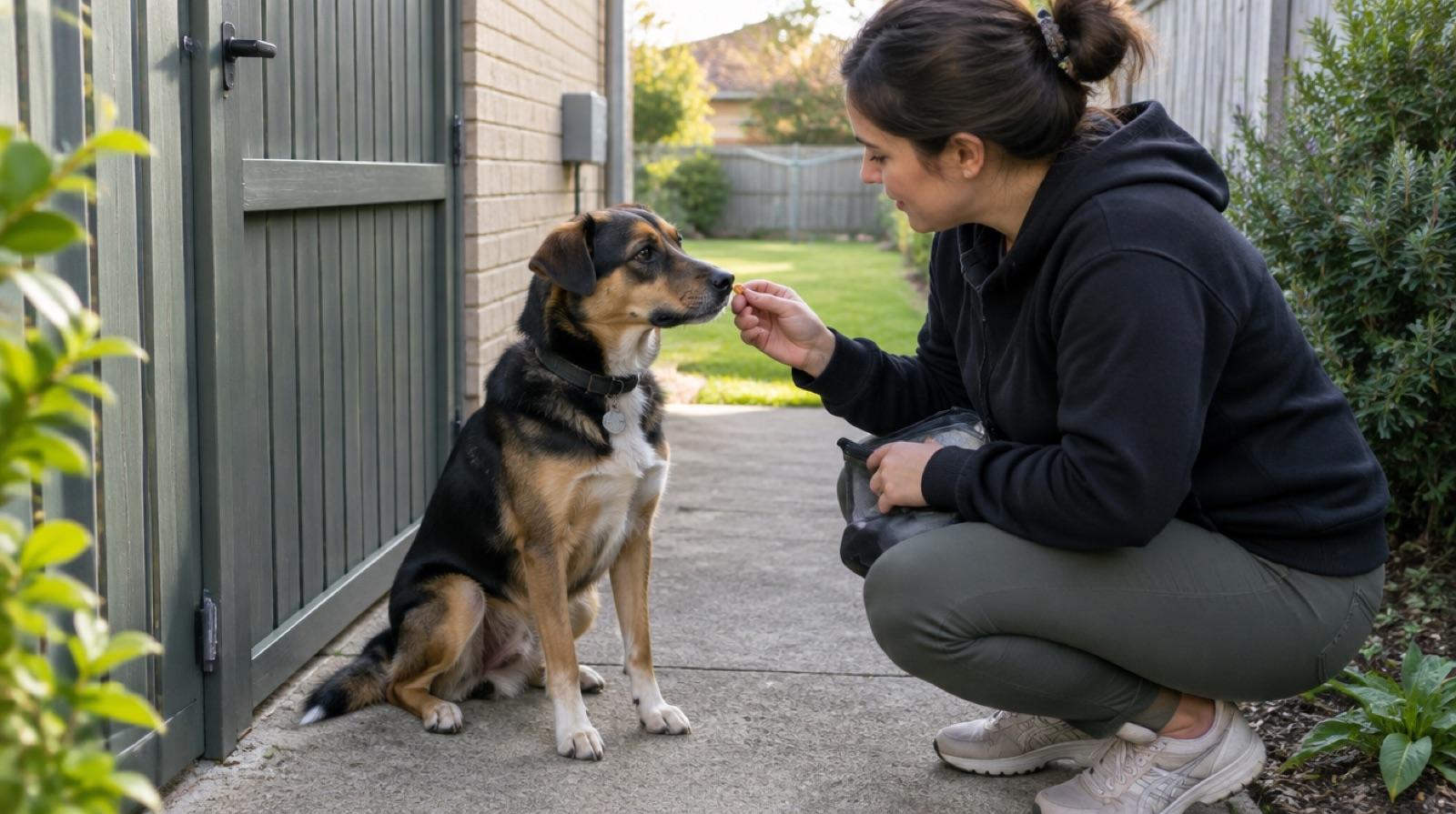
- Reward quiet. RSPCA Australia's rule is simple: when the dog is quiet, give a tasty treat; when it barks, ignore it. Train a calm behaviour you can ask for instead, and reward it often.
- Change how your dog feels about the trigger. RSPCA NSW suggests giving treats when the dog sees the neighbour or the postie, ideally before it barks, so the arrival predicts something good. With a friendly neighbour, they can hand over the treats themselves.
- Teach your dog to be alone. Short absences built up slowly, calm departures and returns. RSPCA NSW advises keeping comings and goings quiet and fuss-free.
- Get help if it persists. RSPCA Australia advises a reward-based dog trainer, your vet or a qualified veterinary behavioural specialist if barking continues, particularly where separation anxiety is suspected.
If cost is holding you back from a vet visit, our cheap vet care guide lists charity and concession options by state.
What should you not do?
- Do not yell. The RSPCA's training guidance explains that a dog may treat shouting as attention, so the barking continues.
- Do not punish. RSPCA Australia says training should not involve punishment, which tends to make barking worse, and that aversive methods must not be used in training.
- Do not reach for a bark collar. RSPCA Australia's barking advice lists yelling, spraying water and anti-bark collars as punishment that may stop barking temporarily but often makes the problem worse, because it can increase fear, anxiety and even aggression. The AVA says collars designed to inflict pain, discomfort or fear, including electronic and citronella collars, should not be used on dogs. Electric collars are illegal in NSW, South Australia and the ACT. Our bark collars guide sets out the law in each state.
- Do not leave a dog alone for longer than it can cope with while you work on it. Cover long days with a sitter, family or a dog walker.
- Do not get a second dog as a fix. A University of Melbourne vet notes that another dog may help a dog that just wants company but not one attached to a particular person, and advises never getting another dog only as a treatment. Our separation anxiety guide covers this.
When is barking a sign of separation anxiety?
When it happens mainly while the dog is alone and comes with other signs of distress. RSPCA Australia describes continuous barking as one possible symptom of separation anxiety, along with destructive behaviour, toileting inside and self-harm such as chewing or licking until wounds form. It calls separation anxiety a mental health issue that requires veterinary treatment.
The difference matters. A bored dog barks because it has nothing to do; it improves with exercise and enrichment. A dog with separation anxiety is not coping with being alone, and more toys will not fix it. That dog needs a gradual training plan and usually your vet. Our dog separation anxiety guide covers how to tell them apart and the step-by-step alone-time plan RSPCA Australia describes.
What can you do about a neighbour's barking dog?
Nuisance barking is the most common complaint local councils in Australia receive, according to the RSPCA Australia Knowledgebase. The usual order, as the official pages describe it:
- Talk to the owner. Calmly, without blame. Tell them when the barking happens and how it affects you. Many owners do not know their dog barks while they are out.
- Try free mediation. Victoria's Dispute Settlement Centre, the ACT's Conflict Resolution Service and the NT's Community Justice Centre are named on the official pages linked below; ask your council what is available where you live.
- Keep a diary. Dates, times, how long, and how it affected you (sleep, work calls, conversations). Councils ask for one, often for a set number of consecutive days.
- Complain to your council (in the ACT, Domestic Animal Services). Expect to give your name and the dog's exact address (ACT Domestic Animal Services, for example, does not investigate anonymous complaints), and you may need to give evidence if it goes to court.
RSPCA Australia also suggests neighbours can help: encourage the owner to get reward-based help, support enrichment ideas, and help with gradual desensitisation if something you do (like walking past the fence) is the trigger. If you think a dog is barking because it is mistreated or has no food, water or shelter, that is a welfare matter for your state's RSPCA or animal welfare authority, not a noise complaint.
How do barking dog complaints work in each state and territory?
Every state and territory has a way to deal with barking that unreasonably disturbs other people (in Queensland and the Northern Territory, through council local laws and by-laws), but the law, the paperwork and what happens next differ. This table summarises what each Act or official government page says. Councils run the process and each one sets its own steps and evidence requirements, so check your own council's page before you start.
| State or territory | Law | Who handles it | What the official page says can happen |
|---|---|---|---|
| New South Wales | Companion Animals Act 1998 (nuisance order); Protection of the Environment Operations Act 1997 (noise) | Local council; or the Local Court directly | Council can issue a nuisance order after warning the owner, who has 7 days to object in writing; the order lasts six months and cannot be appealed. A council officer can also issue a prevention notice under the POEO Act. You can apply to the Local Court for a noise abatement order yourself. (NSW EPA) |
| Victoria | Domestic Animals Act 1994 | Local council | Council may ask you to keep a diary for a few weeks and may need support from another affected neighbour, then issue a warning or a formal Notice to Comply; if not complied with, an infringement notice, then possible legal action for a court order. Free advice from the Dispute Settlement Centre. (Agriculture Victoria) |
| Queensland | Council local laws | Local council | The Queensland Government says councils may have their own restrictions on barking dog noise. Example: Brisbane City Council's Animals Local Law 2017 treats noise as excessive above a total of 6 minutes in any hour (7am to 10pm) or 3 minutes in any 30 minutes (10pm to 7am); it uses a diary, then a Compliance Notice, then infringement notices. (Queensland Government; Brisbane City Council) |
| Western Australia | Dog Act 1976, section 38 | Local government (authorised persons) | A dog is a nuisance if its barking persistently occurs or continues so that it unreasonably interferes with the peace, comfort or convenience of any person. A complaint is lodged on a prescribed form; an authorised person satisfied there is a nuisance can issue an order, which has effect for six months; breaching it is an offence. (Dog Act 1976; WA Government) |
| South Australia | Dog and Cat Management Act 1995, section 45A(5) | Local council (or the Dog and Cat Management Board) | Persistent barking that unreasonably interferes with a person's peace and comfort is an offence. Councils usually ask for a diary; the owner may be fined or given a control (barking dog) order requiring all reasonable steps to reduce noise. Barking is excluded from the separate Local Nuisance and Litter Control Act. (Dog and Cat Management Board; SA Law Handbook) |
| Tasmania | Dog Control Act 2000, sections 46 to 49A | Local council (general manager) | A dog is a nuisance if its barking persistently occurs or continues so that it unreasonably interferes with the peace, comfort or convenience of any person in any premises or public place. A complaint is made on an approved form with any fee, which is refunded if the complaint has substance. Council can serve an abatement notice (appealable to the Tasmanian Civil and Administrative Tribunal within 14 days) or start proceedings. (Dog Control Act 2000) |
| ACT | Domestic Animals Act 2000 (animal nuisance) | Domestic Animal Services | Excessive disturbance because of noise is animal nuisance. Try the Conflict Resolution Service first; a complaint needs a 10-day animal noise diary and is not accepted anonymously. The owner is told and given time; the registrar may then issue a Nuisance Notice, and proceedings may follow. An authorised person may seize an animal they reasonably believe is causing a nuisance. (ACT City Services) |
| Northern Territory | Council by-laws | Local council; police where there are no council by-laws | Each council has its own by-laws. Example: City of Darwin generally investigates barking above 6 minutes in any hour (7am to 10pm) or 3 minutes in any 30 minutes (10pm to 7am), uses a seven-day diary, and may issue an infringement notice or prosecute. Legal Aid NT says you can also apply to the local court for a noise abatement order. (City of Darwin; Legal Aid NT) |
Summarised from each official page or Act on 11 November 2026. Rules differ by council: check yours. Not legal advice.
Two things are true almost everywhere. First, the owner is usually warned and given a chance to fix it before any penalty: the offence is often failing to comply with an order, not the barking itself. Second, a complaint lives or dies on evidence, which is why councils lean so heavily on diaries, recordings and statements from more than one neighbour.
Your dog got a barking complaint. What now?
Take it seriously, but do not panic. A first letter is usually a heads-up, not a fine. Councils such as Brisbane give owners time (28 days in Brisbane's case) to resolve it.
- Find out when the barking happens. Record the dog while you are out for a few days.
- Talk to the neighbour who complained, if you can. Ask what times are worst.
- Work through the steps above, starting with a vet check and more exercise and enrichment.
- Tell the council what you are doing. Rangers often help with information, and a council can see you are acting.
- If the dog barks mainly when alone and seems distressed, treat it as possible separation anxiety and book a vet appointment.
Renting? A barking complaint can also reach your landlord or strata. Our renting with pets guide covers what landlords and strata can and cannot do in each state.
Choosing a quieter dog: what to look for when you adopt
If you live close to neighbours or are out for long workdays, think about barking before you adopt rather than after. The honest answer is that the individual dog matters more than the breed label, and that a bored, under-exercised or lonely dog of any breed can bark. A few practical points:
- Ask the rescue or foster carer directly. Does the dog bark at the fence, at people passing, when left alone? An adult dog that has lived in a foster home comes with real answers; a puppy does not.
- Match energy to your life. A high-drive working dog with nothing to do is a common recipe for a barker. Our calm dog breeds and low-maintenance dog breeds guides cover dogs with lighter needs.
- Living in a unit? See best apartment dogs in Australia.
- Consider an older dog. Many senior dogs are already used to a household routine; see adopting a senior dog.
- Be honest about time alone. Our adoption readiness check covers hours alone along with budget and housing, and the dog breed quiz matches energy level to your lifestyle.
A newly adopted dog may also bark or whine more in the first weeks while it settles. That is not always a sign of a long-term problem; see our guide to a rescue dog's first weeks.
More Australian dog care guides
Find a dog near you
Each page lists the dogs currently with the rescues we aggregate in that city, refreshed regularly. Calmer adults and apartment-friendly dogs are a good place to start if noise matters; ask the rescue how each dog behaves at home.
Frequently asked questions
Why does my dog bark so much?▼
Usually because a need is not being met or something is setting it off. RSPCA Australia lists boredom, loneliness, frustration, fear, territorial behaviour and separation anxiety, and says excessive barking is usually a sign of an underlying issue such as pain, fear or distress, a trigger like passers-by, or too little exercise, mental stimulation or company. Keeping a diary of when and where your dog barks is the quickest way to find out which.
How do I stop my dog barking?▼
Work out the cause first, then fix that. RSPCA Australia recommends reward-based training: reward your dog when it is quiet and do not reward barking. Add exercise, food puzzles and company for a bored dog, block the view of the street for a dog that barks at passers-by, and see your vet if the barking is new or the dog seems distressed. Punishment tends to make barking worse.
Should I yell at my dog when it barks?▼
No. RSPCA Australia notes a dog may take shouting as attention, so the barking continues, and that punishment tends to make the problem worse. It is more effective to ignore the barking and consistently reward the dog when it is quiet.
Is barking a sign of separation anxiety?▼
It can be, if it happens when the dog is alone and comes with other signs. RSPCA Australia says continuous barking can be one symptom of separation anxiety, alongside destructive behaviour, toileting inside and self-harm, and calls separation anxiety a mental health issue that requires veterinary treatment. Film your dog while you are out, and see your vet if you suspect it.
Do anti-bark collars work?▼
They do not fix the reason a dog barks. RSPCA Australia says punishment such as anti-bark collars may stop barking temporarily but often makes the problem worse by increasing fear, anxiety and even aggression. The Australian Veterinary Association says collars designed to inflict pain, discomfort or fear, including electronic and citronella collars, should not be used on dogs. Electric collars are also illegal in some states.
What can I do about my neighbour's barking dog?▼
Start with a calm conversation, because many owners do not know their dog barks while they are out. RSPCA Australia suggests telling them when it happens and how it affects you, without blame. If that fails, free mediation services exist in several states and territories, and you can then complain to your local council, which is responsible for following up nuisance barking complaints.
How long can a dog legally bark in Australia?▼
There is no single national limit. Each state's law uses wording like barking that persistently occurs or continues to a degree that unreasonably interferes with a neighbour's peace, comfort or convenience, and councils judge it on evidence. Some councils publish their own guide: Brisbane City Council, for example, says animal noise is excessive if it goes on for more than a total of 6 minutes in any hour between 7am and 10pm, or 3 minutes in any 30 minutes between 10pm and 7am.
How do I make a barking dog complaint?▼
Contact your local council (in the ACT, Domestic Animal Services; in parts of the NT not covered by council by-laws, the police). Councils commonly ask you to talk to the owner first, keep a barking diary for a set number of days, give your name and the exact address, and be willing to give evidence. In the ACT, for example, anonymous complaints are not investigated. In NSW and the NT you can also ask the Local Court for a noise abatement order.
What happens after a barking complaint is made?▼
Usually the owner is told about the complaint and given time to fix it. If the barking continues and the council has enough evidence, it can issue a formal order or notice (called a nuisance order, notice to comply, abatement notice, control order or nuisance notice depending on the state), and the owner can then be fined or taken to court for not complying.
Can the council take my dog away for barking?▼
Not as a first step. Councils usually start with warnings and orders. In South Australia, the Dog and Cat Management Board says councils cannot seize a dog for barking unless a control order is in place and they reasonably believe it has been breached. In Tasmania, a court dealing with a nuisance offence can make orders including removing the dog from premises. In the ACT, an authorised person may seize an animal they reasonably believe is causing a nuisance. Acting early on the cause avoids getting anywhere near that point.
Are some dog breeds quieter than others?▼
Individual dogs vary a lot, so ask the rescue about the specific dog. Bored or under-exercised dogs of any breed can bark, which is why exercise, enrichment and company matter more than the label. If noise is a concern, an adult rescue dog whose foster carer can tell you how much it barks at home is the safest choice, and our calm dog and apartment dog guides cover breeds with lighter needs.
Should I see a vet about my dog's barking?▼
Yes, especially if the barking is new, the dog seems distressed or training is not helping. RSPCA Australia recommends talking to your vet in the first instance; they can check for pain or illness and may refer you to a reward-based behaviourist. In some rare cases medication is used alongside training, which is a decision for your vet.
Sources
- RSPCA Australia Knowledgebase: What causes dogs to bark excessively?
- RSPCA Australia Knowledgebase: My dog is barking excessively, what should I do?
- RSPCA Australia Knowledgebase: My neighbour’s dog is constantly barking and disturbing me, what should I do?
- RSPCA Australia Knowledgebase: Is it important to train my dog? What sort of training would you recommend?
- RSPCA NSW: Dogs barking, tips and advice
- Australian Veterinary Association: Use of behaviour-modifying collars on dogs (policy)
- NSW Environment Protection Authority: Dealing with barking dogs
- Agriculture Victoria: Barking dogs
- Queensland Government: Reporting environmental nuisance
- Brisbane City Council: Animal noise complaints
- Government of Western Australia: Cats and dogs (nuisance barking dogs)
- Western Australian Legislation: Dog Act 1976 (official version as at 28 November 2024)
- Dog and Cat Management Board (SA): Barking
- Law Handbook (Legal Services Commission of SA): Barking dogs
- Tasmanian Legislation: Dog Control Act 2000
- ACT City Services: Animal nuisance and dog barking
- City of Darwin: Nuisance barking
- Legal Aid NT: Facts about dogs
- University of Melbourne, Pursuit: Dealing with separation anxiety in dogs (Dr Diane van Rooy, 2020)
Keep reading
Dog separation anxiety
How to tell distress from boredom, and the gradual alone-time plan RSPCA Australia describes.
Bark collars in Australia
The types, where electric collars are illegal, and what RSPCA Australia and the AVA say.
A rescue dog’s first weeks
What settling in looks like and how to help a new dog feel safe at home.
Best apartment dogs
Dogs that tend to suit small spaces and shared walls, and what strata rules say.