The short answer
Most Australian national parks ban dogs, so start with state forests and the parks that list dog-friendly campgrounds. In NSW, Forestry Corporation says dogs are welcome in all state forests if they are under your control. In Victoria, all state forests are open to dogs except Murrindindi Scenic Reserve and Stevensons Falls Reserves. Queensland, WA, Tasmania, the ACT and the NT each name a handful of campgrounds or reserves where dogs on a lead are allowed. Caravan parks set their own rules. Watch for 1080 bait signs, carry water, and check your dog for ticks every day on the east coast.
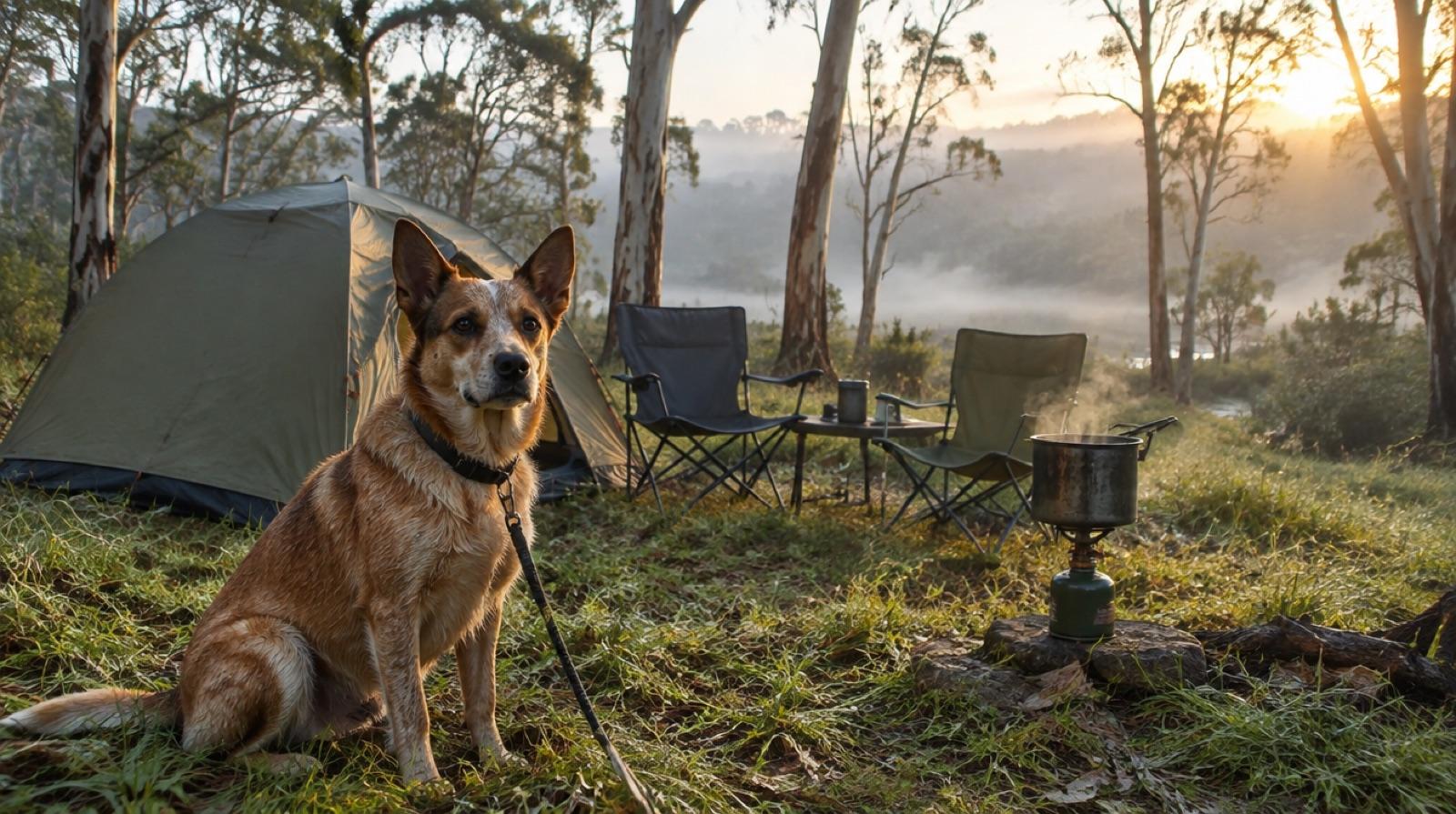
Are dogs allowed in national parks in Australia?
Almost never. This is the rule people most often get wrong when they plan a camping trip with a dog. Every state and territory parks body says dogs and other pets are generally not allowed in its national parks. The reasons are the same everywhere: a dog's presence and scent stress native animals, dogs can chase or kill wildlife, they can spread disease and weeds, and they can be hurt themselves by native animals or poison baits. The Queensland Parks and Wildlife Service spells this out, and the ACT Parks page adds that kangaroos may defend themselves and injure or kill a dog.
The good news is that a “no” in the national park rarely means a “no” for the whole region. State forests, regional parks, some conservation parks and reserves, and many caravan parks do allow dogs. The trick is knowing which body runs the land you are standing on, because the rules change at the boundary. A national park and a state forest can share a fence line, and the dog-friendly side is the forest.
Driving through is a separate question. Most states let you drive through a national park on a public road with your dog inside the car, but you cannot stop at lookouts, picnic areas or walks. Tasmania adds that you cannot leave a dog in a parked car in a reserve while you go for a short walk.
Dog friendly camping rules by state
Each row comes from that state's own parks or forests body. Rules checked November 2026. Park rules and campground lists change, so follow the link and read the signs on the day before you rely on a detail.
| State | National parks | Where dogs are allowed | Lead rule | Official source |
|---|---|---|---|---|
| NSW | Not permitted in most national parks and reserves. | All state forests. Some regional parks and historic sites, in listed areas. | State forests: under your control at all times. Regional parks: mostly on-leash. | Forestry Corporation of NSW, NSW National Parks |
| VIC | Not allowed in most national parks, including their beaches. On-lead areas in a few. | All state forests except Murrindindi Scenic Reserve and Stevensons Falls Reserves. Many other parks and reserves. | State forests: Victorian Government rules allow off-leash in most areas, but on-leash or under control within 100 metres of facilities. Parks Victoria advises keeping dogs on a lead. | Parks Victoria, Victorian Government |
| QLD | Not allowed. On-the-spot fines apply. | Some conservation parks, state forests and recreation areas. Overnight in a short list of camping areas. | On a leash at all times. | Queensland Parks and Wildlife Service |
| WA | Generally not permitted in parks. | Designated dog areas and a listed set of campgrounds. | On a lead at all times when camping. | DBCA Parks and Wildlife Service |
| SA | Not allowed in most national parks. Some parks welcome dogs on leads. | Dog-friendly parks (filter “Dog walking” in Find a Park). ForestrySA forest reserves, but not native forest reserves. | Parks: lead no longer than 2 metres, on designated trails. ForestrySA campgrounds: lead no longer than 3 metres. | National Parks and Wildlife Service SA, ForestrySA |
| TAS | Generally not allowed in national parks and reserves. | Reserves signed as dog friendly, such as parts of the Bay of Fires Conservation Area. | On lead at all times in campgrounds. | Tasmania Parks and Wildlife Service |
| ACT | Not allowed in Namadgi National Park or Tidbinbilla Nature Reserve. | On-leash in many listed nature reserves, including Woods Reserve campground. Off-leash in four signed non-urban areas. | On-leash (preferably no longer than 2 metres) except in off-leash areas. | ACT Parks |
| NT | Pets generally not permitted in parks and reserves. | A few listed parks. Camping with a dog at Redbank Waterhole in Owen Springs Reserve. | Follow the signs for each park. | NT Government |
Checked November 2026 against each official page linked above. Assistance animals have their own rules in every state; see the linked page for yours.
Dog friendly camping in NSW
In NSW the answer is simple: camp in a state forest. Forestry Corporation of NSW says your dog is welcome in all state forests across NSW. Its conditions are short:
- your dog must be under your control at all times;
- always pick up after your dog;
- pack enough food and water for your dog on long forest trips;
- respect other campers who do not have dogs, and keep noise to a minimum.
Some forests go further. Forestry Corporation's page for Cumberland State Forest in Sydney asks you to keep your dog on a leash at all times there, and camping is not permitted in that forest. Forestry Corporation also warns that many state forests sit next to national parks, where dogs are prohibited, so stay inside the state forest.
Which NSW state forests have dog-friendly campgrounds?
In a December 2025 summer camping release, Forestry Corporation said NSW has almost 500 state forests and many offer camping where dogs under their owner's control are welcome. It names some of the most popular family and dog-friendly campgrounds as Mogo, Blowering Dam, Bago and Tumut state forests in southern NSW; Strickland, Chichester and Heaton state forests in central NSW; and Coopernook, Wild Cattle Creek and Styx River state forests in the north. Campfires are allowed outside fire bans only, and the release asks campers to check forest and road closures and the NSW Rural Fire Service before they set out.
Can dogs go in NSW national parks or regional parks?
NSW National Parks and Wildlife Service (NPWS) says dogs and other pets are not permitted in most NSW national parks and reserves. Its dogs in parks page lists the exceptions, which are mostly regional parks and historic sites. The ones most useful for camping trips:
- Goolawah Regional Park (Mid North Coast): on-leash at Delicate campground, off-leash at Delicate Beach.
- Hill End Historic Site: on-leash at campgrounds, picnic areas, public roads and walking tracks.
- Murray Valley, Murrumbidgee Valley, Euston and Leacock regional parks, among others: on-leash dogs permitted in all areas.
- Worimi Regional Park: on-leash on a 3 km section of beach south of Birubi Headland.
- Coffs Coast Regional Park: specified beaches and Woolgoolga Lake only.
NPWS also says Hartley and Hill End are “living” towns where dogs may be allowed on-leash, but asks you to check with the local office first. If you need to drive through a national park, pets must stay in the vehicle on a public road and you cannot stop to visit the park or use its facilities, apart from safety stops and public toilets.
Dog friendly camping in Victoria
Parks Victoria says all state forests, except Murrindindi Scenic Reserve and Stevensons Falls Reserves, are open to dogs, and advises keeping your dog on a lead and under your control during your visit. The state forest rules on vic.gov.au say dogs can be off-leash in most areas of a state forest. In a campground or visitor area, which means within 100 metres of facilities like car parks, picnic tables, toilets, fire pits or information shelters, your dog must be on-leash or under your control, so that it comes back straight away even when it is distracted or excited. Where the two official sources differ, the lead is the safer choice.
Two exceptions to watch. Forest parks are not the same as state forests: dogs are normally prohibited in forest parks but may be allowed in specific areas, and the Victorian Government asks you to call 136 186 to confirm before you visit. And wherever you are, your dog must not disturb native animals or sensitive vegetation, and you take its mess home.
How does camping in a Victorian state forest work?
The state forest camping rules let you camp anywhere in a state forest if you set up at least 20 metres from waterways and stay no longer than 28 consecutive nights. Explore Outdoors Victoria says state forest campgrounds are free and first come, first served, and that dogs are welcome at day visitor areas and campgrounds provided they are on a leash or under your immediate control. It asks you to bury dog poo at least 100 metres from waterways, camping and picnic areas, in a hole at least 20 cm deep.
Which Victorian parks have dog-friendly campgrounds?
Dogs are not allowed in most Victorian national parks, including beaches that are part of a national park. Parks Victoria does list on-lead areas in a few national parks, and some campgrounds in parks and reserves where you can camp with a dog:
- Lake Eildon National Park: Jerusalem Creek Campground.
- Great Otway National Park: on-lead camping areas including Lake Elizabeth and Johanna Beach.
- Wombat-Lerderderg National Park: designated roads, tracks, picnic areas and camping areas.
- Gippsland Lakes Coastal Park: dog-friendly car-based camping at Paradise Beach, west of Loch Sport.
- Cape Conran Coastal Park: camping with dogs allowed in some areas.
- Marlo Coastal Reserve: Corringle Foreshore Campground, on-lead.
- Kurth Kiln Regional Park: free bush camping sites, on-lead.
Parks Victoria says you can be fined for having a dog where dogs are not allowed, or off-leash in a dog-friendly park. Always carry a lead, even in off-lead areas, and bring a friend if you are walking more than two dogs.
Looking for a camping companion?
Many rescue profiles say how a dog is with other dogs, children and new places. Current listings from the shelters we aggregate, usually desexed and microchipped before they go home.
See adoptable dogs →The rules in the other states and territories
Queensland
The Queensland Parks and Wildlife Service says dogs and other pets are welcome in some conservation parks, state forests and recreation areas, but not in national parks, and on-the-spot fines apply. Where dogs are allowed, they must be on a leash at all times (the QPWS legal requirements say the same). Dogs can stay overnight in only a few QPWS camping areas:
- Amamoor Creek camping area, Amamoor State Forest
- Dogwood Creek camping area, Barakula State Forest
- Clancys camping area, Benarkin State Forest
- Glastonbury Creek camping area, Brooyar State Forest
- all camping areas in Inskip Peninsula Recreation Area
- Kalpower camping area, Kalpowar State Forest
- both camping areas in Tuan State Forest
- Wongi Waterholes camping area, Wongi State Forest
- Flinders Beach and Main Beach camping areas, Minjerribah Recreation Area
You can drive through a Queensland national park with a dog only on gazetted roads, with the dog inside the vehicle, and without stopping at day-use areas or lookouts. Beach driving with a dog is not permitted in the Cooloola (except a designated dog-friendly area), K'gari (Fraser Island), Moreton Island or Bribie Island recreation areas.
Western Australia
DBCA's Parks and Wildlife Service says pets are generally not permitted in parks. When camping, dogs must be on a lead at all times and are allowed only at listed campgrounds: Big Brook Arboretum, Sues Bridge and Warner Glen (Blackwood River National Park); Baden Powell, Charlies Flat, Chuditch, Nanga Brook, Nanga Mill, Nanga Townsite, Stringers, Tonys Bend and Yarragil (Lane Poole Reserve); Logue Brook; Canebrook Pool and Stockton Lake (Rapids Conservation Park); and Greens Island Campground (One Tree Bridge). WA is also where 1080 baiting matters most for campers (see below).
South Australia
National Parks and Wildlife Service South Australia says most national parks do not allow dogs, but some welcome dogs on leads. In those parks, keep your dog on designated walking trails and on a lead no longer than 2 metres. Use the Find a Park tool with the “Dog walking (restrictions apply)” filter. NPWS SA also warns that poison baits may be laid to control foxes and that baits can be fatal to dogs. For camping, ForestrySA forest reserves are the other option: dogs are not permitted in any native forest reserve, and in on-lead zones (campgrounds, picnic areas and busy trails) the lead must be no longer than 3 metres. ForestrySA's camping terms say dog access varies by site and some sites do not permit dogs.
Tasmania
Tasmania Parks and Wildlife Service says dogs and other pets are generally not allowed in national parks and reserves, unless a sign says you can bring a dog or you have special permission. Some reserves allow dogs with conditions, and some have seasonal restrictions, so check the dog zone map for the area. In the Bay of Fires Conservation Area dogs are allowed at most campsites except Jeanneret Beach. In any campground, dogs must be on lead at all times, must stay within the camping area and must not disturb wildlife or other campers.
Australian Capital Territory
ACT Parks lists reserve by reserve where dogs can go. Dogs are not allowed in Namadgi National Park, Tidbinbilla Nature Reserve or the other reserves on its no-dogs list, and fines may be imposed. They are allowed on-leash in many Canberra Nature Park reserves, and at Woods Reserve in the campground only. Off-leash is allowed at four non-urban recreation areas: Murrays Corner, the signposted part of Point Hut Crossing, Shepherd's Lookout Track in Woodstock Nature Reserve, and Uriarra Crossing.
Northern Territory
The NT Government says pets are generally not permitted in NT parks and reserves, and you may get an on-the-spot fine. A few parks are listed where you can visit with a dog, some only in car parks. In the Alice Springs region, dogs are allowed south of the Waterhouse Range in Owen Springs Reserve and may camp with you at Redbank Waterhole campground (enter and exit through the southern entrance). The Darwin-region places on the list (such as Holmes Jungle Nature Park and parts of Casuarina Coastal Reserve) are for walks, and the page names no campground there.
Are caravan parks and holiday parks dog friendly?
Many are, but there is no single rule. Council-run and private caravan and holiday parks each set their own pet policy, and it can differ by site type, season or dog size. We do not list individual parks here, because a park's policy is only reliable on that park's own website or booking page. Before you book, ask:
- Are dogs allowed on the site or cabin I am booking, and in peak season?
- Does the dog need to be on a lead the whole time?
- Is there a limit on number, size or breed, and is there an extra fee?
- Can the dog be left alone at the site?
- Where can I walk the dog nearby, and is the beach or reserve next door dog friendly?
The last question matters. A dog-friendly caravan park next to a national park still cannot take your dog into the park.
What is 1080 and where are baits laid?
1080 (sodium fluoroacetate) is a poison used in baits to control foxes, feral cats and wild dogs, and it is fatal to pet dogs. It is the biggest hidden danger for a dog on a camping trip, especially in WA.
- WA: DBCA says areas baited by the Parks and Wildlife Service “should always be considered unsafe for domestic pets”, and that pet owners must avoid taking domestic animals into areas managed for foxes or feral cats. Aerial fox baiting runs several times a year across around 3.8 million hectares, and DBCA publishes a Western Shield 1080 poison risk area map.
- NSW: NPWS says poisonous baits are often laid to control foxes and can be fatal to dogs. Forestry Corporation says baiting programs take place periodically in state forests, that 1080 baits are always signposted, and that you should contact your vet immediately if you suspect your dog has eaten one.
- Victoria: Parks Victoria says poison baits may be laid to control foxes or other feral animals and can be fatal to dogs.
- SA and ACT: NPWS SA and ACT Parks both warn that fox baits can be fatal to dogs, and ForestrySA asks campers to watch for feral animal control signs.
What to do: read the signs at every entry point, keep your dog on a lead and close where baiting is possible, and do not let it scavenge carcasses. If you think your dog has eaten a bait, go to the nearest vet immediately. Do not wait for symptoms.
Ticks, snakes and heat: the other camping risks
Paralysis ticks
The RSPCA Knowledgebase says the paralysis tick is generally found on the eastern seaboard, from North Queensland down to Victoria, and inland in suitable habitat. In the north it can be found all year; further south the season generally runs from spring to late autumn. Tick paralysis is life-threatening. Search your dog by hand at least once a day on any east-coast trip, even if it is on a tick product, starting at the nose and working back (most ticks are found forward of the front legs). Ask your vet which tick prevention suits your dog before you go. If you find a tick, remove it, keep the dog calm and get to a vet as soon as possible. If your dog is travelling to the east coast from another state, sort out tick prevention before you leave.
Snakes
Explore Outdoors Victoria advises keeping your dog on a lead and avoiding long grass, and says a dog bitten by a snake needs a vet immediately. Keep the dog still and calm and drive to the nearest vet. Do not try to treat a bite yourself.
Heat
Summer camping is when most dogs get into trouble with heat. Dogs feel the heat far more than people, so give constant shade and fresh water, walk early and late, and never leave a dog in a car or a closed tent in the sun. Some breeds cope with heat worse than others; ask your vet. Forestry Corporation of NSW asks you to pack enough food and water for your dog on long forest trips, and many bush campgrounds have no tap, so carry more than you think you need.
What to pack for camping with a dog
- A lead plus a long tie-out line and a ground stake. A QPWS camping article suggests a long rope and a corkscrew ground spike for relaxing around camp.
- Water and a bowl, enough for the whole stay if the campground has none.
- Food in a sealed container, plus a few days extra.
- Poo bags, and a sealed bag to carry them out (most parks and forests have no bins).
- A bed or mat and something warm for cold nights, especially in Victoria, Tasmania and the ACT.
- A tick remover on the east coast, and your vet-recommended tick prevention already applied.
- A collar with an ID tag with your mobile number; check the microchip details are current.
- The address of the nearest vet to where you are camping, and the nearest after-hours emergency hospital.
- A copy of the park's rules or a screenshot of the campground page, as mobile reception is often patchy.
Is a newly adopted rescue dog ready for camping?
Probably not on the first weekend. A dog that has just come out of a shelter or foster home is still learning who you are, where home is and what its new name sounds like. A campground puts strange people, other dogs, wildlife smells, campfires and a tent all into one night. That is a lot to ask before the dog trusts you.
A practical test before the first trip:
- Does the dog come back when called, every time, with distractions around? If not, it stays on a lead the whole trip, which is the rule in most dog-friendly campgrounds anyway.
- Is it calm on a lead when another dog walks past?
- Can it settle and sleep somewhere new, such as a friend's house or a crate in the car?
- Has it seen your vet since adoption, and is tick prevention sorted for where you are going?
If camping is a big part of your life, say so when you apply to adopt. Many profiles on the rescues we aggregate describe how a dog is with other dogs and new places, and the rescue's foster carers are the best people to ask whether a particular dog would enjoy a night under canvas. Rescue dogs usually arrive desexed and microchipped, which matters if a nervous dog slips its lead in a forest. Browse dogs in Sydney, Melbourne, Brisbane, Perth, Adelaide, Hobart, Canberra or Darwin, and see our other Australia-wide guides.
Frequently asked questions
Are dogs allowed in national parks in Australia?▼
Mostly no. Every state and territory parks body says dogs and other pets are generally not allowed in national parks, mainly to protect native wildlife. There are a few exceptions: Parks Victoria lists on-lead areas in some national parks, such as Jerusalem Creek Campground in Lake Eildon National Park, and the NT lets dogs use the sealed roads and car parks of Charles Darwin National Park. Assistance animals are allowed under each state's own conditions.
Where can I camp with my dog in NSW?▼
State forests are the main option. Forestry Corporation of NSW says dogs are welcome in all NSW state forests, as long as the dog is under your control at all times. Dogs are not allowed in most NSW national parks, but NSW National Parks lists some regional parks that allow on-leash dogs, including Goolawah Regional Park (Delicate campground) and Murray Valley Regional Park. Caravan and holiday parks set their own rules, so check each park's policy.
Are dogs allowed in NSW state forests?▼
Yes. Forestry Corporation of NSW says dogs are welcome in all state forests across NSW. Your dog must be under your control at all times, you must pick up after it, and you should keep noise down for other campers. Some forests add their own rule, for example Cumberland State Forest requires a leash at all times. Many state forests border national parks, where dogs are prohibited, so stay inside the forest boundary.
Where can I camp with my dog in Victoria?▼
Victorian state forests are the easiest choice: Parks Victoria says all state forests except Murrindindi Scenic Reserve and Stevensons Falls Reserves are open to dogs. Parks Victoria also lists dog-friendly camping in some parks, including Jerusalem Creek Campground (Lake Eildon National Park), on-lead camping areas in Great Otway National Park such as Lake Elizabeth and Johanna Beach, Paradise Beach in Gippsland Lakes Coastal Park and the bush camping sites in Kurth Kiln Regional Park.
Do dogs need to be on a lead in Victorian state forests?▼
Not everywhere. The Victorian Government says dogs can be off-leash in most areas of a state forest, but in a campground or visitor area (within 100 metres of facilities like car parks, picnic tables, toilets or fire pits) the dog must be on-leash or under your control, which means it comes back straight away when called. Parks Victoria's own advice is stricter: always keep your dog on a lead and under your control during your visit. Forest parks are different: dogs are normally prohibited there, so call 136 186 before you go.
Where can I camp with a dog in Queensland?▼
Only in a few places run by Queensland Parks and Wildlife Service. Dogs are not allowed in Queensland national parks, but the QPWS dogs and pets page lists dog-friendly camping areas including Amamoor Creek (Amamoor State Forest), Clancys (Benarkin State Forest), Glastonbury Creek (Brooyar State Forest), all camping areas in Inskip Peninsula Recreation Area, and Flinders Beach and Main Beach in Minjerribah Recreation Area. Dogs must be on a leash at all times, and on-the-spot fines apply.
Can I take my dog camping in WA national parks?▼
Generally no, but DBCA (Parks and Wildlife Service WA) lists a number of campgrounds where dogs on a lead are allowed. They include campgrounds in Lane Poole Reserve, Big Brook Arboretum, Sues Bridge and Warner Glen in Blackwood River National Park, Logue Brook, Canebrook Pool and Stockton Lake in Rapids Conservation Park, and Greens Island Campground at One Tree Bridge. DBCA also warns that 1080 baits are often laid to control foxes and are fatal to domestic animals.
What is 1080 and why does it matter for dogs?▼
1080 (sodium fluoroacetate) is a poison used in baits to control foxes, feral cats and wild dogs. It is fatal to pet dogs. DBCA says areas baited by the Parks and Wildlife Service in WA should always be considered unsafe for domestic pets, and the parks bodies in NSW, Victoria, South Australia and the ACT all warn that fox baits can be fatal to dogs. Read the signs at every entry point, keep your dog close, and get to a vet immediately if you think it has eaten a bait.
Are dogs allowed in Tasmanian national parks?▼
Generally no. Tasmania Parks and Wildlife Service says dogs and other pets are not allowed in national parks and reserves unless a sign says dogs are allowed or you have special permission. Some reserves do allow dogs, such as parts of the Bay of Fires Conservation Area, where dogs are allowed at most campsites except Jeanneret Beach. In campgrounds dogs must be on lead at all times and cannot be left in a parked car while you walk.
Can I take my dog to Namadgi National Park or Tidbinbilla?▼
No. ACT Parks says dogs are not allowed in Namadgi National Park or Tidbinbilla Nature Reserve, and fines may apply. Dogs are allowed on-leash in many Canberra Nature Park reserves and at Woods Reserve (in the campground only), and off-leash in four signed non-urban areas, including Uriarra Crossing and Murrays Corner.
Is my new rescue dog ready to go camping?▼
Usually not in the first few weeks. A newly adopted dog is still learning your routine, your voice and its new name, and a campground full of strange smells, people and other dogs is a big step. Wait until the dog comes back reliably when called, settles on a lead, and copes with other dogs nearby. Before the first trip, ask your vet about tick prevention for where you are going and check the microchip details are in your name.
Are caravan parks dog friendly?▼
Many are, but each park sets its own rules. Holiday and caravan parks, whether council-run or private, decide whether dogs are allowed, on which sites, in which season and with what conditions (a lead at all times, a limit on number or size, or an extra fee). Check the park's own pet policy before you book, and ask where you can walk the dog nearby, because the national park next door may not allow it.
Sources
- NSW National Parks and Wildlife Service: Pets in national parks
- NSW National Parks and Wildlife Service: Dogs in parks
- Forestry Corporation of NSW: Dogs in state forests
- Forestry Corporation of NSW: Managing pests and weeds in state forests
- Forestry Corporation of NSW: Free summer camping for every family, and their dog
- Parks Victoria: Dog-friendly parks
- Victorian Government: State forest recreational activities (dogs)
- Victorian Government: Camping in state forests
- Explore Outdoors Victoria: Taking your dog on outdoor trips
- Queensland Parks and Wildlife Service: Dogs and pets
- Queensland Parks and Wildlife Service: Camping legal requirements
- DBCA Explore Parks WA: Pets in parks
- DBCA: 1080 baiting in Western Australia
- National Parks and Wildlife Service South Australia: Dogs in parks
- ForestrySA: Dogs in the forest
- ForestrySA: Camping terms and conditions
- Tasmania Parks and Wildlife Service: Dogs in parks
- ACT Parks: Dogs
- ACT Parks: Namadgi National Park
- NT Government: Rules for pets in parks
- Queensland Parks and Wildlife Service: Camping with your four-legged friend in South East Queensland
- RSPCA Knowledgebase: Protecting your dog or cat from tick paralysis
Keep reading
Dogs for adoption in Sydney
Rescue dogs listed across the Sydney shelters we aggregate, refreshed regularly, with temperament notes on many profiles.
Dogs for adoption in Melbourne
Rescue dogs from Melbourne shelters, for Victorians planning weekends in the state forests.
Dog beaches in Sydney
Where dogs can go off-lead on Sydney beaches, council by council.
Adoption readiness check
A short, honest quiz on time, budget and household before you bring a dog home.