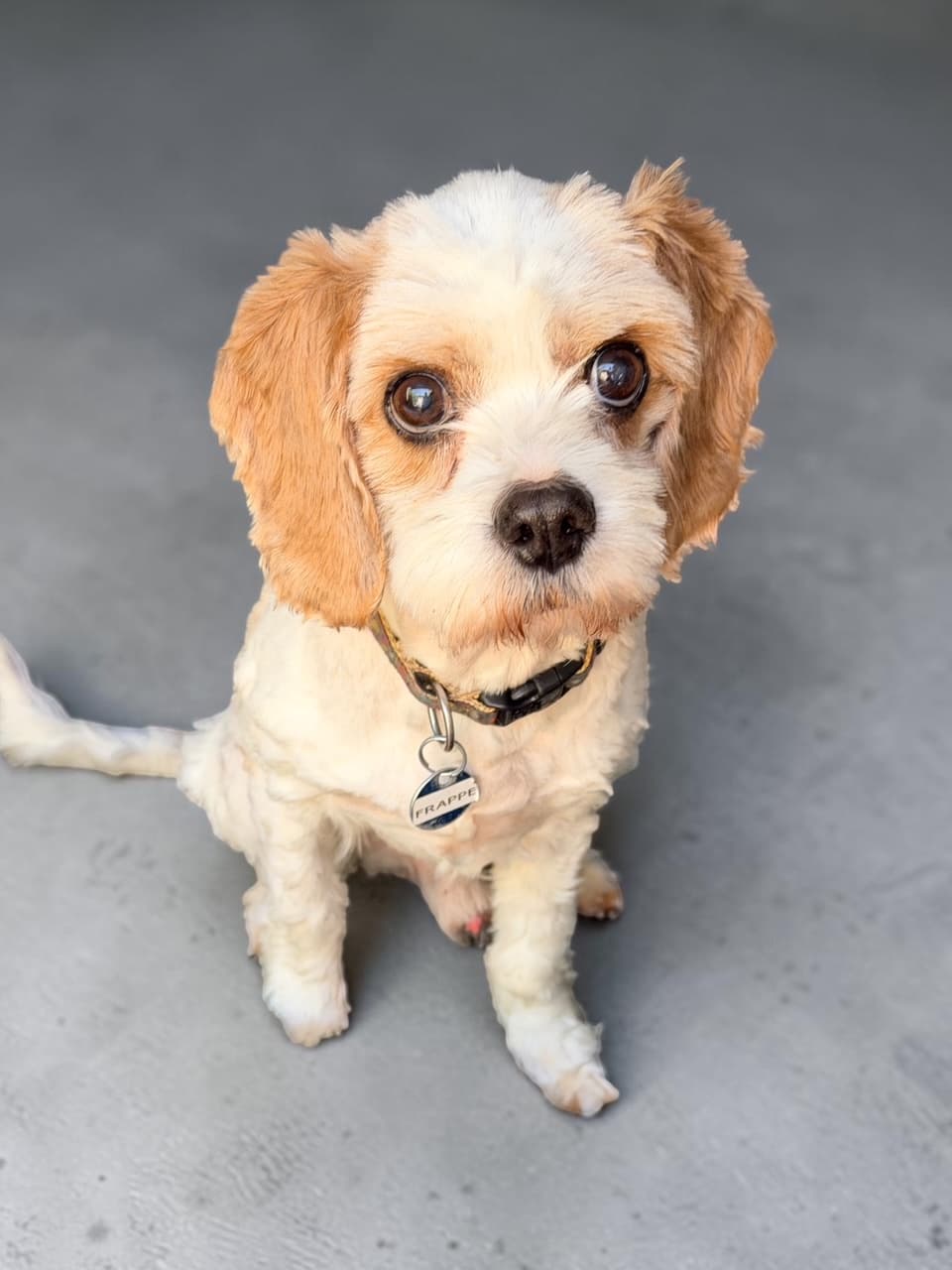
Frappe
About 11 years old • Cavalier X Poodle
The Cavalier King Charles Spaniel is a small, gentle toy spaniel bred purely for companionship, and it shows. Cavaliers are affectionate, soft-natured and endlessly people-focused, happiest curled up beside their person or trotting along on a walk. They usually weigh around five to eight kilos, carry a silky coat with feathering on the ears, legs and tail, and are known as one of the friendliest and most adaptable of the small breeds, good with children, strangers and other pets.
Cavaliers reach Sydney and NSW rescue through owner life changes, moves and, sometimes, buyers who did not plan for the grooming or for how strongly the breed dislikes being left alone. Because they bond so hard to their people, Cavaliers can struggle with separation anxiety if left for long days. Purebred Cavaliers place quickly, so Cavalier crosses appear more often, and the foster carer or shelter notes on temperament and health matter more than the breed label.
A Cavalier suits an owner or family who wants a devoted, gentle lap companion and who is home often enough to keep it company, understands the coat care and takes the known heart and neurological health risks seriously. Browse the Cavaliers and Cavalier crosses currently listed from rescues and shelters across Sydney and New South Wales.
Get notified when a Cavalier King Charles Spaniel is listed
We will email you when a Cavalier King Charles Spaniel or Cavalier King Charles Spaniel cross becomes available for adoption in Sydney, from a rescue or an owner rehoming.
Need to rehome a Cavalier King Charles Spaniel?
If you can no longer keep your Cavalier King Charles Spaniel, listing it for rehoming on LocalPetFinder connects it directly with adopters across Sydney and NSW, and keeps it out of a shelter. It is free.
List your dog for rehoming →Cavalier King Charles Spaniel Adoption Guides
The pre-adoption reading list specific to Cavalier King Charles Spaniels in Sydney and NSW.
Cavalier King Charles Spaniel Adoption in Sydney
Where to adopt a Cavalier or Cavalier cross, why they end up in rescue, and the honest health commitment.
Cavalier Health Issues
The near-universal heart disease MVD, the neurological condition syringomyelia, and the signs to watch.
Cavalier Temperament & Care
The gentle velcro companion: family, apartment and senior life, grooming, and separation needs.
Cavalier King Charles Spaniel Adoption FAQ
Where can I adopt a Cavalier King Charles Spaniel near me in Sydney?
LocalPetFinder lists Cavalier King Charles Spaniels available for adoption from rescues across Sydney and New South Wales, including the Inner West, Eastern Suburbs, Northern Beaches, Western Sydney and the Sutherland Shire. Rescues that regularly take in dogs of this type include RSPCA NSW at Yagoona and Animal Welfare League NSW at Kemps Creek, alongside foster-based groups. Listings update regularly, so browse the Cavalier King Charles Spaniels above and apply directly through the rescue.
Are there Cavalier King Charles Spaniel rescues near Sydney?
Yes. Several Sydney and NSW rescues regularly have Cavalier King Charles Spaniels and Cavalier King Charles Spaniel crosses, including RSPCA NSW, Animal Welfare League NSW, Sydney Dogs and Cats Home, Monika's Doggie Rescue and Maggie's Rescue, plus breed-focused foster networks. A dedicated single-breed rescue is not always active, so the fastest path is to set an alert here and watch the general rescues. Use LocalPetFinder to see which rescues currently have Cavalier King Charles Spaniels available near you.
Where can I adopt a Cavalier King Charles Spaniel puppy in Sydney?
Purebred Cavalier King Charles Spaniel puppies are uncommon in Sydney rescue and are usually adopted very quickly, so the best strategy is to set an alert here and be ready to apply fast. Most Cavalier King Charles Spaniels in rescue are young adults, older dogs, or Cavalier King Charles Spaniel crosses, and these make just as loving a pet as a purebred puppy while often being calmer and already part house-trained. A rescue puppy or young dog costs a few hundred dollars fully desexed, vaccinated and microchipped, against several thousand from a breeder with a waitlist. If you searched "cavalier king charles spaniel puppies sydney" or "cavalier king charles spaniel puppies for sale", browse the Cavalier King Charles Spaniels above and set an alert for new arrivals.
Are these Cavalier King Charles Spaniels for sale in Sydney?
Not for sale, for adoption, which is usually the better deal. Every Cavalier King Charles Spaniel here comes from a Sydney or NSW rescue, not a breeder or classified seller, and the adoption fee already includes desexing, vaccination and microchipping. That fee is typically a few hundred dollars, against often several thousand from a breeder with none of the vet work done. If you searched "cavalier king charles spaniel for sale sydney", adopting gets you a vetted dog for a fraction of the price.
Where can I buy a Cavalier King Charles Spaniel in Sydney, and should I?
You can buy from a registered breeder, but it is worth weighing against adoption first. A reputable breeder often charges several thousand dollars and may have a waitlist, while a rescue Cavalier King Charles Spaniel costs a few hundred dollars fully vetted and may be available now. Be cautious of cheap "for sale" ads on classified sites and marketplaces, which are a known hotspot for scams and backyard breeding. The ACCC Scamwatch has documented deposit scams for pets that do not exist. For most Sydney families, adopting a rescue Cavalier King Charles Spaniel is cheaper, faster and gives a dog in need a home.
Are Cavaliers good apartment and companion dogs?
Yes, they are one of the best small companion breeds for apartment and unit life. Cavaliers are quiet, adaptable and gentle, and they settle happily into a smaller home as long as they get daily walks and plenty of company. The main caution is that they are so people-focused they can develop separation anxiety if left alone for long work days, so they suit someone who is home often or can arrange a daycare or walker. Strata or landlord approval is still needed before adopting, however small the dog.
What health problems do Cavaliers have?
Two breed-specific conditions are worth understanding. The main one is mitral valve disease, a heart condition that becomes common with age and often starts as a murmur your vet can hear, so regular checks matter. The breed is also associated with syringomyelia, a neurological condition linked to skull shape that can cause discomfort. Cavaliers can also have hip and kneecap issues and eye conditions. A rescue Cavalier arrives desexed, vaccinated, microchipped and vet-checked, and any known issue is noted. Ask your vet about heart monitoring.
Are Cavaliers good family dogs?
Very much so. Cavaliers are gentle, patient and affectionate, and they are usually excellent with children and with other dogs and cats, which is why they are such a popular family breed. Their small size means young children should be supervised so the dog is handled gently, but temperamentally they are about as easygoing as small dogs come. Each rescue listing notes how the individual dog has gone with children and other pets in foster care.
How much exercise and grooming does a Cavalier need?
Cavaliers need only moderate exercise, around thirty to sixty minutes a day of walking plus play, which suits smaller homes and less active owners. The silky coat needs brushing several times a week to prevent matting, especially the feathering behind the ears and legs, and the ears should be checked regularly. In a Sydney summer, walk in the cooler parts of the day, and keep year-round paralysis tick prevention up if you walk in bushland or coastal areas.