The short answer
Most white cats carry dominant white, a variant of the KIT gene that stops pigment reaching the coat; it is different from white spotting (white patches) and from albinism, which is rare. The same gene can leave the eyes blue and the inner ear without the pigment cells it needs, so white cats are more often deaf: hearing-tested studies of white purebred cats found 20.2% (Germany, 2009) and 30.3% (UK kittens, 2019) deaf in one or both ears, rising to 44% to 50% with two blue eyes. Most white cats hear normally, and a deaf cat can live a full life indoors. In Australia, white cats need protection from the sun, which can cause skin cancer on the ears and nose. Rescue fees go by age, not colour (RSPCA NSW lists $220 for an adult cat, checked 10 November 2026; a reference, not a quote).
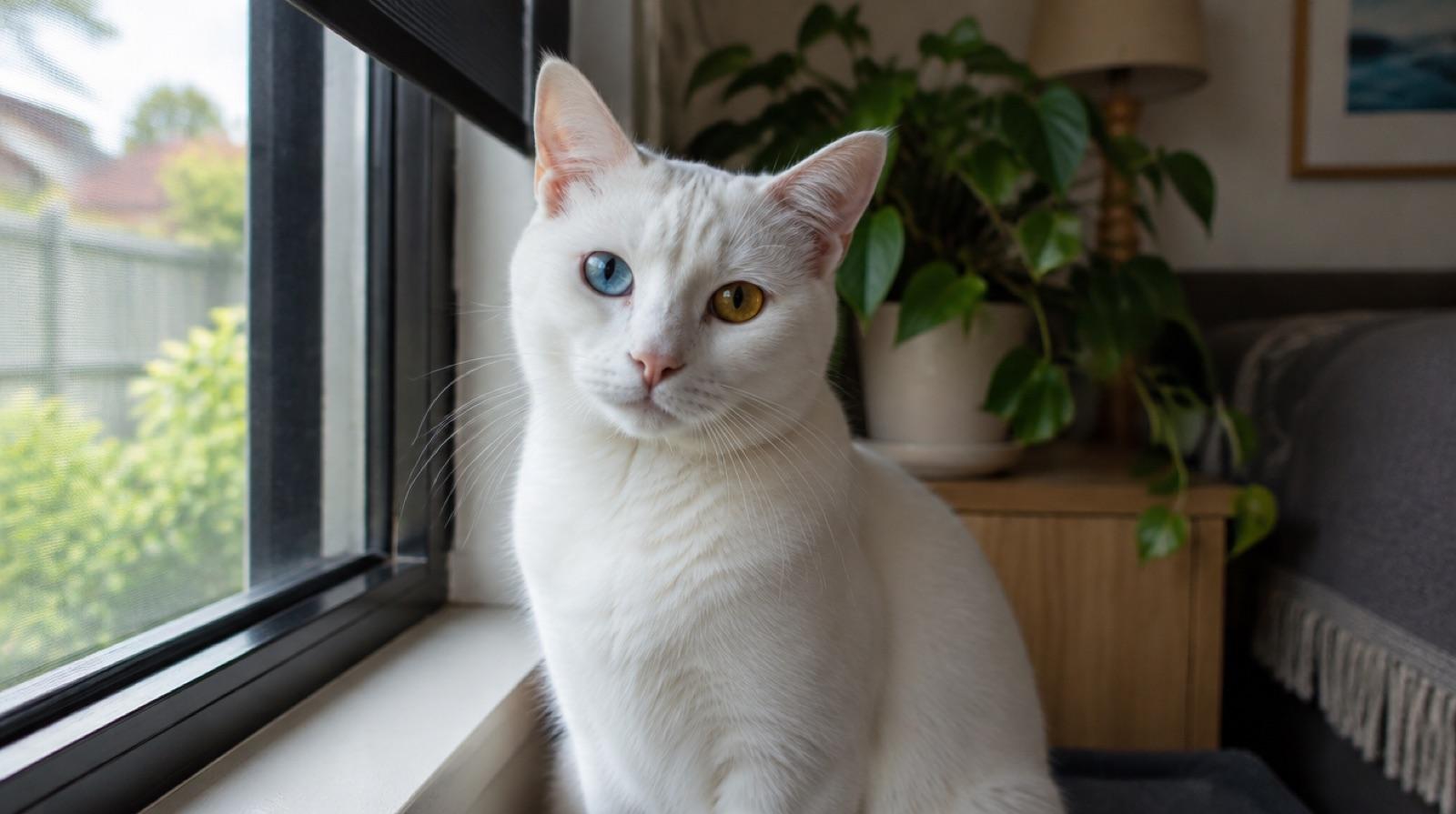
What makes a cat white?
Three different things can produce a white cat, and they are not the same:
| Type | Gene | What you see | Linked to deafness? |
|---|---|---|---|
| Dominant white | KIT (a short retrovirus insertion) | White all over; eyes blue, odd or any colour | Yes, in some cats |
| White spotting | KIT (a full-length insertion) | White patches, from a locket to a mostly white van | Not on UC Davis's test page |
| Albino | TYR (tyrosinase) | No pigment; the albino cats studied had blue eyes | Not established |
Sources: David et al. 2014 for both KIT variants; Imes et al. 2006 for albinism.
Dominant white. A 2014 study in the journal G3 by David and colleagues found that dominant white comes from a fragment of an old retrovirus inserted into a gene called KIT, which guides pigment cells as they spread through the developing body. The study says dominant white has complete penetrance for an unpigmented coat, meaning every cat that carries it is white, whatever other colour genes it has, but only incomplete penetrance for deafness and blue eyes. That is why white cats vary: some have blue eyes, some gold, some one of each; some are deaf and most are not. Cats with two copies were more likely than cats with one copy to have blue eyes and to be deaf.
Because it is dominant, a white cat with one copy passes it to about half its kittens. Two white parents that each carry one copy can, by simple Mendelian arithmetic, have coloured kittens about a quarter of the time. The colour was always there in the genes; dominant white just stopped it showing.
White spotting. A longer version of the same KIT insertion gives patches of white instead: the white on a tuxedo, a calico or a mostly white “van.” A cat with a lot of white spotting can look almost white, so a shelter listing that says “white” may mean either. Look for a coloured patch on the head or tail.
Albino. True albinism is a different gene. Imes and colleagues (2006) linked it to a mutation in tyrosinase (TYR), the same gene behind the Siamese and Burmese colour patterns, in a pedigree of Oriental and Colourpoint Shorthair cats; the albino cats in that study had blue eyes. It is rare, so a white cat in rescue is almost certainly dominant white or heavily white-spotted, not albino.
Are white cats deaf?
Some are, and far more often than coloured cats, but most white cats hear normally. The best numbers come from studies that tested hearing with a brainstem auditory evoked response (BAER), which measures the hearing nerve's response to clicks and picks up deafness in one ear as well as both.
| Eye colour (white cats) | UK kittens, Mari 2019 (n = 132) | German cats, Cvejic 2009 (n = 84) | Cornell summary |
|---|---|---|---|
| No blue eyes | 22.2% | 19% | 17 to 22% |
| One blue eye (odd-eyed) | 44.4% | 20% | 40% |
| Two blue eyes | 50% | 44% | 65 to 85% |
| All white cats in the study | 30.3% (15.9% both ears, 14.4% one ear) | 20.2% (10.7% both ears, 9.5% one ear) | Not given |
Deaf means deaf in one or both ears. Sources: Mari, Freeman, Van Dijk and De Risio (2019), client-owned purebred white kittens aged 6 to 21 weeks; Cvejic, Steinberg, Kent and Fischer (2009), client-owned purebred white cats presented for pre-breeding hearing tests (eye colour was recorded for 55 of the 84; eye-colour figures as reported in the 2019 paper); Cornell Feline Health Center, which cites researchers without naming the population.
What the numbers say, in plain terms:
- White matters, not just blue. In the UK study, deafness was found only in the solid white kittens; none of their 61 coloured littermates were deaf.
- Blue eyes raise the odds. White kittens with at least one blue eye were 3.2 times more likely to be deaf than white kittens without. International Cat Care puts it as three to five times the risk for two blue eyes and about twice for one.
- One ear is as common as two. Both hearing-tested studies found unilateral deafness about as often as bilateral. A cat deaf in one ear can seem completely normal.
- Breed may matter. In the UK study, deafness in white kittens ranged from 46.7% of Turkish Vankedisi and around 44% of Maine Coons and Norwegian Forest Cats to 8.3% of Persians and 4.8% of Russians. The authors call those breed numbers small and ask for cautious reading.
- Older figures run higher. The 2019 authors note that early studies of crossbred white cats in research colonies found 50% to 96% deaf. Those colonies were bred differently from pet cats, which is why the client-owned studies are the better guide for a pet.
Why it happens. Pigment cells do more than colour fur. The 2019 paper explains that melanocytes in part of the inner ear called the stria vascularis keep up the high potassium level the hearing cells need. The David paper, citing earlier work, notes that the inner ears of white kittens look normal at birth and show degenerative changes within the first week of life. The deafness is congenital, and Cornell and International Cat Care both say there is no treatment for it.
What about odd-eyed white cats?
An odd-eyed cat has one blue eye and one of another colour. Blue in a cat's eye means little or no pigment in the iris. The David study describes dominant white as having incomplete penetrance for iris hypopigmentation, which is why a white cat may have two blue eyes, one, or none. Cat registries treat odd eyes as a white-cat feature. The Coordinating Cat Council of Australia Turkish Angora standard lists odd-eyed, with one blue eye and the other green, green-gold or amber, among acceptable eye colours, and notes that blue or odd eyes are only allowed for white cats or cats with white; the same note appears in its Sphynx standard.
Hearing: in the 2019 UK study, 44.4% of white kittens with one blue eye were deaf in at least one ear. The Cornell Feline Health Center adds a striking detail: if a white cat with one blue eye is deaf in only one ear, that ear is invariably on the same side as the blue eye. The 2019 UK study did not fully bear that out: of the 4 odd-eyed kittens deaf in one ear, the deaf side matched the blue eye in 2. Cornell also says blue-eyed white cats are not more prone to blindness than other cats; that is a myth, probably a mix-up with deafness.
See the white cats listed right now
White and mostly white cats from the Australian rescues we aggregate, refreshed regularly. Kittens, adults and seniors.
Browse white cats →How do you know if a white cat is deaf?
International Cat Care lists the signs owners notice:
- being easily startled, because the cat does not hear people approach;
- not responding when you call or speak;
- having no fear of loud noises;
- sleeping very deeply and not waking with noise.
Those signs catch a cat deaf in both ears. A cat deaf in one ear may show nothing at all. The reliable answer is a BAER test, which International Cat Care describes as simple and non-invasive and says is done at veterinary specialist centres; your vet can refer you. The 2019 paper notes the BAER response is fully mature by about 20 days of age, and its kittens were tested from six weeks. International Cat Care says many breeds now insist on white cats being checked for deafness to avoid breeding from affected cats. If you adopt a white cat from rescue, ask whether its hearing has been checked.
What is it like living with a deaf cat?
Usually much like living with any cat, with a few changes. International Cat Care says there is no reason a deaf cat cannot enjoy a long, happy and healthy life. The Cat Protection Society of NSW factsheet on living with a deaf cat, and the Cornell Feline Health Center, give the practical rules:
- Indoors, or a secure enclosure. Cat Protection says deaf cats should be indoor-only because they cannot hear danger approaching. Cornell names roaming dogs and speeding cars.
- Let the cat see you first. Approach from the front, step so the floor vibrates, and switch on a light if it is dark. International Cat Care suggests heavy footsteps or a clap as you approach.
- Use light and hand signals. Cat Protection suggests pairing a signal with a routine, such as flicking a light twice at feeding time, and consistent hand signals in place of words.
- Consider a hearing friend. Cat Protection suggests a second cat that can hear, or adopting a bonded pair who already know each other, because the hearing cat can teach routines.
- Mind the sun too. Cat Protection reminds owners that deaf cats are commonly white, so skin cancer risk applies; indoor living helps both.
Deaf cats are often misread as nervous or grumpy because they startle, Cat Protection says. Give a newly adopted deaf cat time, and you may find the opposite. Bonded pairs are listed on the bonded pairs page for Sydney and the other city pages.
Do white cats need sun protection in Australia?
Yes. This is the main care point for a white cat here. The Cat Protection Society of NSW says cats with light-coloured fur on the nose or ears are more susceptible to sunburn, and that white cats are the most susceptible to skin cancer. RSPCA South Australia says squamous cell carcinoma is the most common skin cancer in white cats, usually on the ears, nose and eyelids where hair is thin, and can be painful, disfiguring and fatal if left untreated.
- Keep them in during the strong sun. Cat Protection advises keeping white cats inside all the time, or at least during the hottest part of the day (11am to 4pm). An enclosed run with shade is a good middle path.
- No human sunscreen. Cat Protection says it is toxic to cats. Ask your vet about a cat-safe product if your cat goes outside.
- Check the ears and nose. Cat Protection lists reddening, flaky skin, sores, hair loss, over-grooming and black discolouration at the ear tips as signs to show a vet. Early detection matters, RSPCA SA says.
Indoor living suits a white cat on both counts, deafness and sun. See the indoor cats pages below, and our hairless cat breeds guide for the other cats that need shade.
Do white cats have a different personality?
There is no good evidence that they do. In a 2012 survey of 189 people by Delgado and colleagues, reported by UC Berkeley, white cats were among the colours rated more aloof; participants rated colour groups rather than particular cats, so the study measured expectations. The lead author warned that such beliefs could affect which cats get adopted.
That may show in shelters. Miller, Ward and Beatty (2019, University of Sydney) analysed 2,584 cats adopted from a metropolitan Sydney shelter between 2016 and 2019 and found white cats stayed longer before adoption than black cats; no other colour differed significantly from black. Elsewhere the picture differs: a Kentucky study of 7,983 cats found an adoption rate of 18.8% for white cats against 10.0% for black. One reading of the Sydney result is that a white cat in a Sydney shelter may wait a little longer than its personality deserves. A deaf white cat that startles easily can be misread too, as above.
Which cat breeds come in white?
White is a colour, not a breed, and it appears in many pedigree breeds; the CCCA Sphynx and Turkish Angora standards, for example, both make rules for white cats' eyes. One breed recognised in Australia is defined by it: the Foreign White, which has a standard at the CCCA, the Australian Cat Federation and ANCATS. ANCATS says it began in the United Kingdom in the early 1960s, when a white cat mated with a Siamese, and the CCCA standard describes a medium-sized, svelte cat with a wedge-shaped head and clear, deep, brilliant blue eyes, in shorthair and longhair forms.
In rescue, almost every white cat is a Domestic Shorthair or Domestic Longhair, an ordinary moggy with no registered breed. Our Domestic Shorthair guide explains the label, and moggy colours and patterns covers the rest of the range, including black, ginger and tabby cats.
How do you adopt a white cat?
Through rescue, the same way as any cat. Fees go by age and rescue, not colour. RSPCA NSW lists $220 for a cat over six months and $270 for a kitten, and the Cat Protection Society of NSW lists $150 per cat or kitten, or $250 for two (both checked 10 November 2026). These are reference figures, not quotes; check the rescue's own page.
Questions worth asking about a white cat: Has its hearing been checked, or does the carer think it is deaf? Is it used to living indoors? Any sun damage on the ears or nose? Does it have a bonded friend? A deaf cat is sometimes listed on a special-needs page, and the right home for one is a calm indoor household that is happy to learn a few hand signals. For the wider decisions, see adopting a cat in Australia, male or female cat, the cost of owning a cat, and the what cat breed am I quiz.
Find a white cat near you
These pages list white cats from local rescues, refreshed regularly. Each listing links straight to the rescue, where you apply.
- Sydney: white cats, special-needs cats, indoor cats
- Melbourne: white cats, special-needs cats, indoor cats
- Brisbane: white cats, special-needs cats, indoor cats
- Perth: white cats, special-needs cats, indoor cats
- Adelaide: white cats, special-needs cats, indoor cats
- Australia-wide: all white cats, cream cats and tuxedo cats
Not sure yet? The adoption readiness check takes five minutes, and the dog or cat? quiz helps if you are still deciding on the species.
Frequently asked questions
Are all white cats deaf?▼
No. Most white cats hear normally, but deafness is far more common in white cats than in coloured ones. In a UK study of 132 hearing-tested white purebred kittens (Mari and colleagues, 2019), 30.3% were deaf in one or both ears, and none of their 61 coloured littermates were. A German study of 84 white purebred cats (Cvejic and colleagues, 2009) found 20.2%.
Are white cats with blue eyes deaf?▼
They are more likely to be, but many hear. In the 2019 UK kitten study, 50% of white kittens with two blue eyes were deaf, against 22.2% with no blue eyes. In the 2009 German study the figures were 44% and 19%. Cornell University's Feline Health Center cites higher research figures of 65 to 85% for all-white cats with two blue eyes. Only a hearing test tells you about one cat.
Why are white cats deaf?▼
Because the gene that makes them white also affects the inner ear. A 2014 study in G3 by David and colleagues traced dominant white to an insertion in the KIT gene and found deafness genetically linked to it. Pigment cells (melanocytes) are needed in part of the inner ear called the stria vascularis to keep hearing working, and dominant white cats can lack them. The deafness is present from birth and cannot be treated.
What is an odd-eyed cat?▼
An odd-eyed cat has one blue eye and one of another colour, such as green, gold or amber. It is most often seen in white cats or cats with a lot of white. The Coordinating Cat Council of Australia's Turkish Angora standard accepts odd eyes, with one blue eye and the other green, green-gold or amber, and says blue or odd eyes are only allowed for white cats or cats with white.
Are odd-eyed cats deaf?▼
Sometimes, often in one ear. In the 2019 UK study, 44.4% of white kittens with one blue eye were deaf in one or both ears. Cornell University's Feline Health Center says that when a white cat with one blue eye is deaf in only one ear, that ear is on the same side as the blue eye, though in the 2019 study the sides matched in only 2 of 4 such kittens. A cat deaf in one ear can seem completely normal.
Is a white cat an albino?▼
Almost never. Most white cats carry dominant white, which stops pigment reaching the coat. True albinism is a separate, rare condition: a 2006 study by Imes and colleagues linked it to a mutation in the tyrosinase (TYR) gene in a pedigree of Oriental and Colourpoint Shorthair cats. The albino cats in that study had blue eyes.
Do white cats get sunburnt in Australia?▼
Yes, and it can lead to skin cancer. The Cat Protection Society of NSW says white cats are the most susceptible to skin cancer and advises keeping them inside all the time, or at least from 11am to 4pm. RSPCA South Australia says squamous cell carcinoma is the most common skin cancer in white cats. Never use human sunscreen on a cat; Cat Protection says it is toxic to cats.
How can I tell if my white cat is deaf?▼
Watch, then ask your vet about a BAER test. International Cat Care lists signs such as being easily startled, not responding when called, having no fear of loud noises and sleeping through noise. A cat deaf in one ear often shows no signs. The brainstem auditory evoked response (BAER) test measures hearing directly and is done at veterinary specialist centres.
Can a deaf cat live a normal life?▼
Yes. International Cat Care says there is no reason a deaf cat cannot enjoy a long, happy and healthy life. The Cat Protection Society of NSW says deaf cats should live indoors, or with a secure enclosure, because they cannot hear danger, and suggests vibration, lights and hand signals to communicate. It also suggests adopting a deaf cat with a hearing companion.
Are white cats less friendly?▼
There is no good evidence that they are. In a 2012 survey of 189 people by Delgado and colleagues, white cats were rated as more aloof, but the participants were rating colour groups, not particular cats. That measured people's expectations. Personality depends on the individual cat, so ask the rescue or foster carer how that cat behaves.
Do white cats wait longer in Australian shelters?▼
In one Sydney study they did. Miller and colleagues (2019, University of Sydney) analysed 2,584 cats adopted from a metropolitan Sydney shelter and found white cats stayed longer than black cats; no other colour differed significantly from black. A larger Kentucky study found white cats had a higher adoption rate than black ones, so results vary by shelter.
How much does it cost to adopt a white cat?▼
The same as any other cat at that rescue; fees go by age and rescue, not colour. As reference points, RSPCA NSW lists $220 for a cat over six months and $270 for a kitten, and the Cat Protection Society of NSW lists $150 per cat or $250 for two (checked 10 November 2026). These are references, not quotes.
Sources
- David et al. (2014): Endogenous retrovirus insertion in the KIT oncogene determines White and White spotting in domestic cats, G3
- Imes et al. (2006): Albinism in the domestic cat is associated with a tyrosinase (TYR) mutation, Animal Genetics
- Cvejic et al. (2009): Unilateral and bilateral congenital sensorineural deafness in client-owned pure-breed white cats, J Vet Intern Med
- Mari et al. (2019): Prevalence of congenital sensorineural deafness in client-owned purebred kittens in the United Kingdom, J Vet Intern Med
- Cornell Feline Health Center: White cats and blindness/deafness
- International Cat Care: Inherited deafness in white cats
- Cat Protection Society of NSW: Living with a deaf cat factsheet
- Cat Protection Society of NSW: Skin cancer in cats factsheet
- RSPCA South Australia: Protect white pets from sunburn
- CCCA Foreign White breed standard (November 2023)
- CCCA Turkish Angora breed standard (February 2025)
- Miller, Ward and Beatty (2019): Population characteristics of cats adopted from an urban cat shelter and the influence of physical traits and reason for surrender on length of stay, Animals
- Carini, Sinski and Weber (2020): Coat color and cat outcomes in an urban U.S. shelter, Animals
- UC Berkeley: Delgado et al. (2012) cat colour perception survey
Keep reading
White cats for adoption
White cats listed by Australian rescues, refreshed regularly.
Tuxedo cats
White spotting on a black cat: the other white gene, and why it is not linked to deafness.
Hairless cat breeds
Sphynx, Peterbald and Donskoy: the other cats that need sun care in Australia.
Moggy colours and patterns explained
Every Domestic Shorthair coat, from tabby to colourpoint, with the genes behind each.