The short answer
The hairless cat breeds recognised in Australia are the Sphynx and the Peterbald (by all three councils we checked: CCCA, ACF and ANCATS), plus the partly hairless Lykoi (CCCA and ACF) and the Elf (ANCATS only). The Donskoy, the Russian breed behind the Peterbald, is not on any of the three lists, though Europe's FIFe recognises it. Most “hairless” cats carry fine down, and all of them need regular baths, sun protection and warmth. None is hypoallergenic: Australia's allergy specialists, ASCIA, say all cat breeds can cause allergies. Purebred hairless cats are rare in rescue, and a breeder Sphynx runs to thousands of dollars (reference figures checked 10 November 2026, not quotes).
What is a hairless cat?
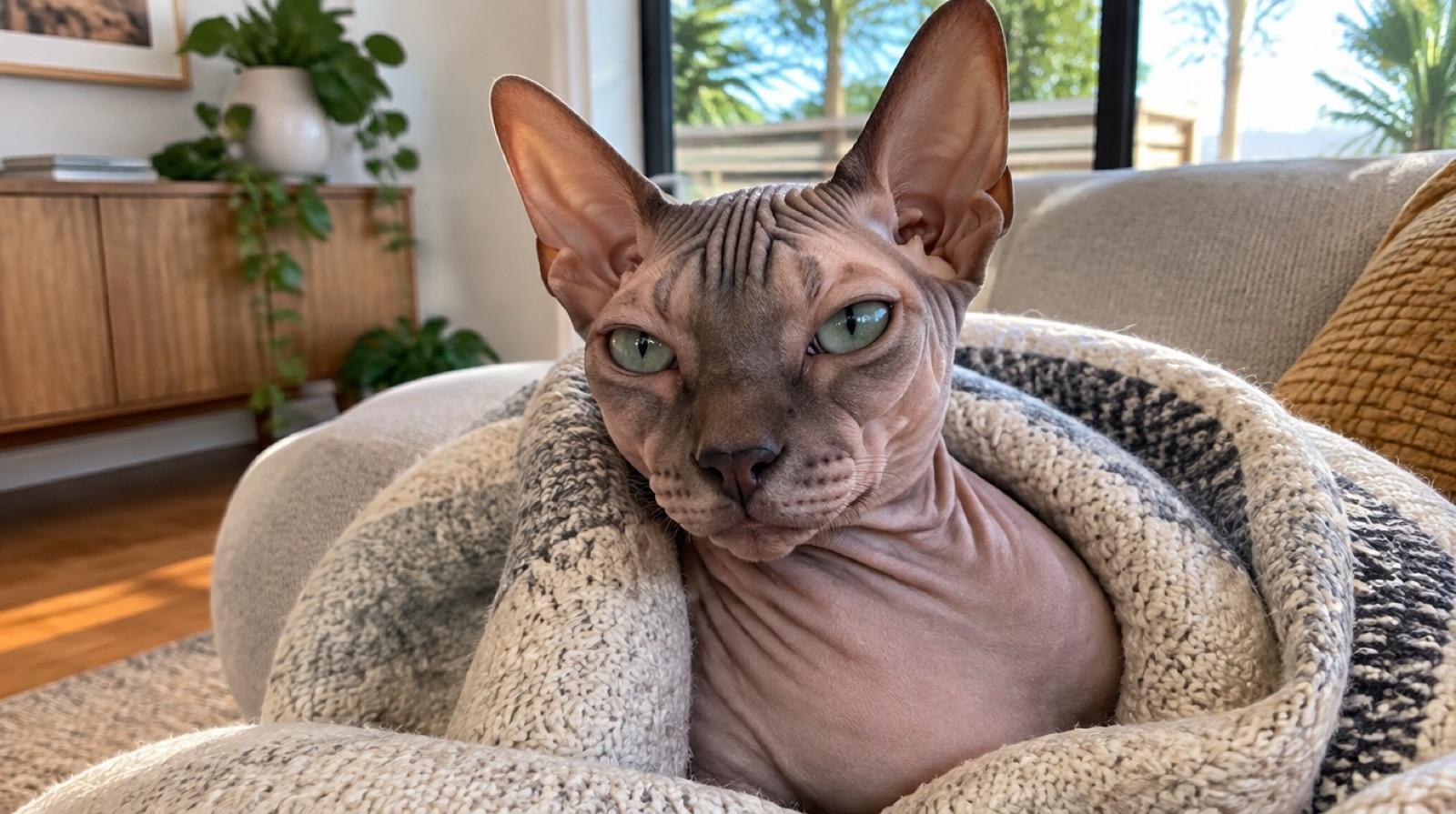
A hairless cat is a breed selected for a coat so sparse that the cat looks bare. Very few are bald to the touch. The Coordinating Cat Council of Australia (CCCA) standard says a Sphynx “appears hairless” but may be covered with very short, fine down, with soft hair allowed on the backs of the ears, the bridge of the nose, the feet and the tail. It describes the texture as chamois-like. International Cat Care compares the down to the skin of a peach.
The look comes from a genetic change in how hair grows, and different breeds got there by different routes. That matters to an owner: the gene behind a breed decides whether its kittens are reliably bald, whether the coat can grow back with age, and whether coated cats turn up in the same litter. It is also why “hairless cat” covers several breeds, not one.
Which hairless cat breeds do Australian councils recognise?
Australia has more than one cat registry. We read the breed standards lists of the three national bodies on 10 November 2026: the CCCA, the Australian Cat Federation (ACF) and Australian National Cats (ANCATS). Here is where the hairless and part-hairless names land.
| Breed | CCCA | ACF | ANCATS | What the coat is |
|---|---|---|---|---|
| Sphynx | Yes | Yes | Yes | Appears hairless, fine down; recessive gene |
| Peterbald | Yes | Yes | Yes | Bald, flock or brush coat; dominant gene |
| Lykoi | Yes | Yes | Not listed | Partly hairless black roan with a bare face mask |
| Elf | Not listed | Not listed | Yes | ANCATS: a hybrid of the American Curl and the Sphynx |
| Donskoy (Don Sphynx) | Not listed | Not listed | Not listed | Recognised overseas by FIFe; dominant hairlessness |
| Bambino, Ukrainian Levkoy | Not listed | Not listed | Not listed | No Australian council standard found |
Sources: the breed standards pages of the CCCA, ACF and ANCATS, read 10 November 2026. “Not listed” means we found no standard or breed entry on that council's site on that date; lists change, so check with the council before you rely on it.
Why does recognition matter if you just want a pet? Because registration is the only paper proof of breed. A seller advertising a “registered Donskoy kitten” in Australia should be able to tell you which body registered it, and the answer will not be one of these three. That is not proof of a scam (some breeders register with overseas bodies), but it is a question worth asking before you pay anything. Our kittens for sale guide sets out each state's seller rules.
Sphynx, Peterbald, Donskoy, Lykoi: how do they differ?
Sphynx
The breed most people mean. The Cat Fanciers' Association (CFA) traces it to a hairless kitten born in Toronto in 1966, and says the trait is a natural recessive gene. The CCCA standard describes a medium-sized, muscular cat with wrinkled skin, large ears and eyes, prominent cheekbones and “surprising weight for size,” and allows all colours and patterns. Colour is judged on the skin: the CFA standard describes a tabby Sphynx's “skin ground color,” and notes that sun exposure intensifies all colours. Our Sphynx kittens guide covers buying one in detail.
Peterbald
The CCCA Peterbald standard says the breed came from Russia, from a cross between a Donskoy and an Oriental Shorthair. It looks like a bald Oriental: a long, svelte body, a wedge-shaped head and large flared ears, in the colours accepted for Siamese and Orientals. Its coat is the surprise. The standard names three textures: hairless (the preferred one), flock (residual hair no more than 2 mm long) and brush (a wiry coat 5 mm or longer, from sparse to dense). A Peterbald born with coat can lose it from the top of the head down over time, and a heavy brush coat will not fall out. So a kitten's coat is not always the adult's coat.
Donskoy (Don Sphynx)
A Russian breed and the parent of the Peterbald. FIFe, the European cat federation, recognised it as the Don Sphynx in 2011; its standard describes a solid, medium-sized cat that is soft and warm to the touch, with curly, thick whiskers that may be broken off. It is not recognised by the CCCA, ACF or ANCATS, so a Donskoy cannot be registered as one with those bodies.
Lykoi
Partly hairless rather than bald. The CCCA Lykoi standard describes a natural mutation from the domestic population, recognised only in a black roan (a mix of black and white hairs), with a hairless mask joining the nose, muzzle, eyes and ears. The amount of coat varies from almost hairless to almost fully coated as the hair cycles, and the standard allows for pigment spots or full tanning on skin exposed to sunlight. That last point is a reminder that bare skin reacts to the sun.
Elf, Bambino and other names
ANCATS lists the Elf and describes it as a hybrid developed by crossing the American Curl with the Sphynx; neither the CCCA nor the ACF lists it. You will also see Bambino and Ukrainian Levkoy online. We found no standard for either at any of the three Australian councils, so treat any local ad for them with extra care and ask exactly which registry the parents are recorded with.
What genes make a cat hairless?
Two different ones, and the difference shows up in litters.
- Sphynx: a recessive change in KRT71. A 2010 study in Mammalian Genome by Gandolfi and colleagues found a single-letter DNA change at a splice site in the keratin 71 gene (KRT71) in Sphynx cats, and proposed it as the hairless allele. The same gene carries the Devon Rex curly-coat variant; the study suggested an order of dominance from normal coat, to hairless, to Devon curl. Recessive means a kitten needs two copies to be bald (the study found most Sphynx carried two, or one plus the Devon Rex variant), and two coated carriers can have a hairless kitten. It is also why the CFA says coated Sphynx are occasionally available.
- Donskoy and Peterbald: a dominant trait. The OMIA database (Online Mendelian Inheritance in Animals) records Don Sphynx hairlessness as autosomal incompletely dominant, from a 2000 Russian study, and notes that a 2013 study ruled out KRT71 as the cause; the exact gene is not yet known. The CCCA Peterbald standard likewise says a dominant gene produces the lack of hair and can show up in several ways. One copy is enough to affect the coat, which helps explain why Peterbald coats vary so much.
If you like the fine, close coat but not full baldness, the Devon Rex and Cornish Rex pages show those breeds when rescues list them.
See Sphynx and hairless cats listed right now
Purebred hairless cats are rare in rescue, so the listing pages and alerts help you catch one when it appears. Each listing links to the rescue, where you apply directly.
Browse Sphynx cats →What does a hairless cat need in Australia?
No brushing, but the care moves to the skin, and both the Australian sun and a southern winter matter.
| Need | Why | What owners do |
|---|---|---|
| Sun protection | Thin or no hair can burn badly, and severe, continued sunburn can lead to serious health problems later (RSPCA SA) | Indoors or a shaded, enclosed run; no human sunscreen (Cat Protection Society of NSW) |
| Warmth | No coat to hold heat; the CFA calls the Sphynx a body heat magnet | Warm beds, blankets, a draught-free room in winter |
| Bathing | Very oily skin with no coat to absorb it (CFA) | Regular baths with a wash your vet recommends |
| Ears and skin checks | International Cat Care lists yeast-related skin disease and ear infections in the Sphynx | Regular ear cleaning and checks; see a vet for redness, sores or smell |
| Heart checks | ACVIM lists the Sphynx among breeds at increased HCM risk | Ask for parents' scan reports; keep up your own vet checks |
Sun. This is the Australian point. RSPCA South Australia says many dogs and cats with white, thin or no hair can suffer severe sunburn, and that the most common skin cancer in white cats is squamous cell carcinoma, which can be painful, disfiguring and fatal if left untreated. The Cat Protection Society of NSW advises keeping at-risk cats inside all the time, or at least during the hottest part of the day (11am to 4pm), and warns never to use human sunscreen, which it says is toxic to cats. Ask your vet about a cat-safe product.
Cold. The CFA says Sphynx crave attention and are body heat magnets that will spend hours glued to your side. The CCCA standard describes the breed as quite warm to the touch, and FIFe says the same of the Don Sphynx. A cat with no coat leans on you, the heater and its bedding for warmth, which matters far more in Melbourne, Canberra or Hobart than in Darwin.
Skin and ears. The CFA says the Sphynx has very oily skin that needs regular bathing. International Cat Care lists skin diseases with more yeast on the skin, and ear infections, among problems seen in the breed. Bath time is the usual moment for ears, eyes and claws. Peterbalds and Lykoi vary with how much coat they carry, so ask the breeder or rescue what that cat's routine has been.
Heart. The ACVIM consensus statement on feline cardiomyopathies names the Sphynx among pedigree breeds believed to be at increased risk of hypertrophic cardiomyopathy (HCM). We found far less published health data for the Peterbald, Donskoy or Lykoi; that is a gap in the evidence, not proof they are trouble-free. Ask any breeder what heart screening the parents have had and see the dated reports. The Sphynx tests a good breeder does are set out in our Sphynx kittens guide, and city detail is in our Sphynx skin and sun care guides for Sydney, Brisbane and the Gold Coast.
This is general information, not veterinary advice. Your vet can tell you what your own cat's skin, heart and ears need.
Are hairless cats hypoallergenic?
No cat breed is hypoallergenic, and no hair does not mean no allergen. If someone at home has a cat allergy or asthma, see a doctor before you bring any cat home.
Cat allergy is not about hair. The Australasian Society of Clinical Immunology and Allergy (ASCIA) says all cat breeds can cause allergies, and International Cat Care says the Sphynx can still cause allergic reactions because cat allergy is usually caused by an allergen in saliva. The CFA adds that a freshly bathed Sphynx is unlikely to spark severe symptoms, but that this “does not add up to a low-allergen cat.” Our hypoallergenic cats guide covers the evidence and how to test your reaction to one cat over several visits.
Is a hairless cat right for you?
- Good fit: an indoor household, someone home a lot, people who like a cat on the lap or under the doona, and owners happy to bathe a cat and keep up vet checks.
- Think twice: long days away, a cat that would roam outdoors in full sun, a cold house with no heating, or a tight budget for vet bills.
- Not a reason to choose one: allergies, for the reasons above.
The CFA describes the Sphynx as people-centred, active and needy of attention, and says children should be old enough to understand that the skin is delicate and not suited to rough play. Temperament varies between individual cats, so ask how a particular cat behaves. If you are not sure what kind of cat suits you, try the what cat breed am I quiz, or dog or cat? if you are still choosing the species. The types of cats guide and small cat breeds cover the wider range.
Can you adopt a hairless cat?
Yes, now and then, but purebred hairless cats are rare in Australian rescue. When one does come through it is usually an adult, so ask the rescue what it knows about the cat's skin, heart and history. The practical plan is to watch the Sphynx listing page for your city, set an alert, and meet other affectionate cats while you wait.
Fees go by the rescue and the cat's age, not breed. RSPCA NSW lists $220 for a cat over six months and $270 for a kitten, and the Cat Protection Society of NSW lists $150 per cat or kitten, or $250 for two (both checked 10 November 2026). Breeder prices are far higher: in November 2026 only three Sphynx member breeders published a price on their own websites, one from $2,500 and two at $3,000, too few for a range. All are reference figures, not quotes.
Buying instead? A registered breeder who shows you heart reports for both parents is a reasonable choice if you want a particular breed. Scamwatch warns that scammers advertise popular breeds and pets that do not exist, so see the kitten with its mother in person or on a live video call before you pay. The CCCA Sphynx standard withholds awards for any evidence of shaving or other hair removal, a hint that shaved “hairless” kittens are a known trick. The Sphynx kittens guide lists the red flags.
Find a hairless cat near you
These pages list Sphynx and Sphynx-cross cats from local rescues, refreshed regularly, with indoor-suited cats alongside.
- Sydney: Sphynx cats, indoor cats
- Melbourne: Sphynx cats, indoor cats
- Brisbane: Sphynx cats, indoor cats
- Perth: Sphynx cats, indoor cats
- Adelaide: Sphynx cats, indoor cats
- Australia-wide: the Sphynx breed page, plus Devon Rex and Cornish Rex
City guides to adopting a Sphynx: Sydney, Melbourne, Brisbane, Perth and Adelaide. Before you apply, the adoption readiness check takes five minutes, and adopting a cat in Australia explains how the process works.
Frequently asked questions
What is a hairless cat?▼
A hairless cat is a cat bred for a coat so sparse it looks bare. Most are not completely hairless: the Coordinating Cat Council of Australia says a Sphynx appears hairless but may be covered with very short, fine down, with a little hair allowed on the ears, nose, feet and tail. The best known is the Sphynx; the Peterbald, Donskoy and the partly hairless Lykoi are others.
Which hairless cat breeds are recognised in Australia?▼
The Sphynx and the Peterbald are recognised by all three Australian cat councils we checked: the Coordinating Cat Council of Australia (CCCA), the Australian Cat Federation (ACF) and Australian National Cats (ANCATS). The partly hairless Lykoi has a CCCA and an ACF standard. ANCATS also lists the Elf, which it describes as a hybrid of the American Curl and the Sphynx (all checked 10 November 2026).
Is the Donskoy recognised in Australia?▼
Not by the three Australian councils we checked. The Donskoy (also called Don Sphynx) is not on the CCCA, ACF or ANCATS breed lists as of 10 November 2026. The European federation FIFe does recognise it, as the Don Sphynx, since 2011. Its Russian offshoot, the Peterbald, is recognised in Australia.
Is a Peterbald the same as a Sphynx?▼
No. The CCCA standard says the Peterbald came from Russia, from a cross between a Donskoy and an Oriental Shorthair, and describes a long, slim, wedge-headed cat. Its hairlessness comes from a dominant gene, so the coat can range from bald to a short wiry brush coat, and it can change with age. The Sphynx comes from a recessive change in a gene called KRT71 and has a more muscular, rounded body.
Are hairless cats hypoallergenic?▼
No. The Australasian Society of Clinical Immunology and Allergy (ASCIA) says all cat breeds can cause allergies, and International Cat Care says the Sphynx can still cause allergic reactions because cat allergy usually comes from an allergen in saliva. The Cat Fanciers' Association says bathing reduces allergen on the skin but does not add up to a low-allergen cat. See a doctor before bringing any cat home if someone has a cat allergy.
Do hairless cats get sunburnt in Australia?▼
Yes. RSPCA South Australia says dogs and cats with white, thin or no hair can suffer severe sunburn, and that the most common skin cancer in white cats is squamous cell carcinoma. The Cat Protection Society of NSW advises keeping at-risk cats inside, or at least inside from 11am to 4pm, and warns that human sunscreen is toxic to cats. A hairless cat is safest indoors or in a shaded, enclosed run.
Do hairless cats get cold?▼
They need more warmth than a coated cat. The Cat Fanciers' Association calls the Sphynx a body heat magnet that will spend hours glued to your side, and the CCCA standard describes the breed as quite warm to the touch. In a Melbourne, Canberra or Hobart winter, plan for warm beds, blankets and a draught-free room.
How often do hairless cats need a bath?▼
Regularly. The Cat Fanciers' Association says the Sphynx has very oily skin that needs regular bathing, because there is no coat to soak up the oil. Ears, eyes and claws are usually cleaned at the same time. Ask your vet which wash suits your cat's skin, and how often, rather than following a fixed schedule from the internet.
Do hairless cats have health problems?▼
The Sphynx has the best documented risks. The ACVIM consensus statement on feline cardiomyopathies names it among pedigree breeds believed to be at increased risk of hypertrophic cardiomyopathy (HCM), a thickening of the heart muscle, and International Cat Care lists skin and ear problems in the breed. We found much less published health data for the Peterbald or Donskoy, so ask any breeder what heart screening they do and see the reports.
Can you adopt a hairless cat from a rescue in Australia?▼
Sometimes, but purebred hairless cats are rare in Australian rescue. Watch the Sphynx listing page for your city and set an alert so you hear about new arrivals early. If the people-focused personality is what draws you, rescues list affectionate Domestic Shorthairs all year, desexed and microchipped, for a standard rescue fee.
How much does a hairless cat cost in Australia?▼
From a breeder, several thousand dollars. In November 2026 only three Sphynx member breeders published a price on their own websites, one from $2,500 and two at $3,000, too few to call a range. A rescue cat costs the normal fee, for example $220 for an adult cat at RSPCA NSW (checked 10 November 2026). These are reference figures, not quotes.
Are there hairless cats with some fur?▼
Yes. The Lykoi is partly hairless: the CCCA standard describes a black roan coat with a hairless mask around the nose, eyes and ears, and says the amount of coat varies from almost bare to almost fully coated as the hair cycles. Peterbalds can carry a short flock or brush coat, and the Cat Fanciers' Association notes that coated Sphynx are occasionally available because the hairless gene is recessive.
Sources
- Coordinating Cat Council of Australia: Breed standards
- CCCA Sphynx breed standard (February 2025)
- CCCA Peterbald breed standard (November 2023)
- CCCA Lykoi breed standard (November 2024)
- Australian Cat Federation: Breed standards
- Australian National Cats (ANCATS): Breeds
- FIFe: Breeds and Don Sphynx standard
- Gandolfi et al. (2010): The naked truth: Sphynx and Devon Rex cat breed mutations in KRT71, Mammalian Genome
- OMIA: Hypotrichosis, Don Sphynx
- Cat Fanciers' Association: Sphynx breed profile
- International Cat Care: Sphynx
- RSPCA South Australia: Protect white pets from sunburn
- Cat Protection Society of NSW: Skin cancer in cats factsheet
- ACVIM consensus statement on feline cardiomyopathies (2020)
- ASCIA: Pet allergy
Keep reading
Sphynx kittens: adopt or buy?
Member-breeder prices, the heart scans to ask for, and the scams to avoid.
Hypoallergenic cats in Australia
What the allergy evidence says, and how to test whether you react to one cat.
White cats
Deafness, odd eyes and sun care: the other cats that need shade in Australia.
Best cat breeds for Australian homes
How the popular breeds compare on temperament, care and cost.