The short answer
A Great Pyrenees (Pyrenean Mountain Dog) is a livestock guardian that the Dogs Australia standard sets at a minimum of 50 kg for dogs and 40 kg for bitches, with most considerably bigger. If you need a working guardian for stock, or want a puppy from hip and elbow scored parents, a Dogs Australia registered breeder is the sensible route. If you want a companion, an adult from rescue lets you see the size, coat and night barking before you commit. None of the breeder or club websites we read in November 2026 published a puppy price, so ask each breeder. Any fee on this page is a reference read on 12 November 2026, not a quote; fees change, so check with the breeder or rescue.
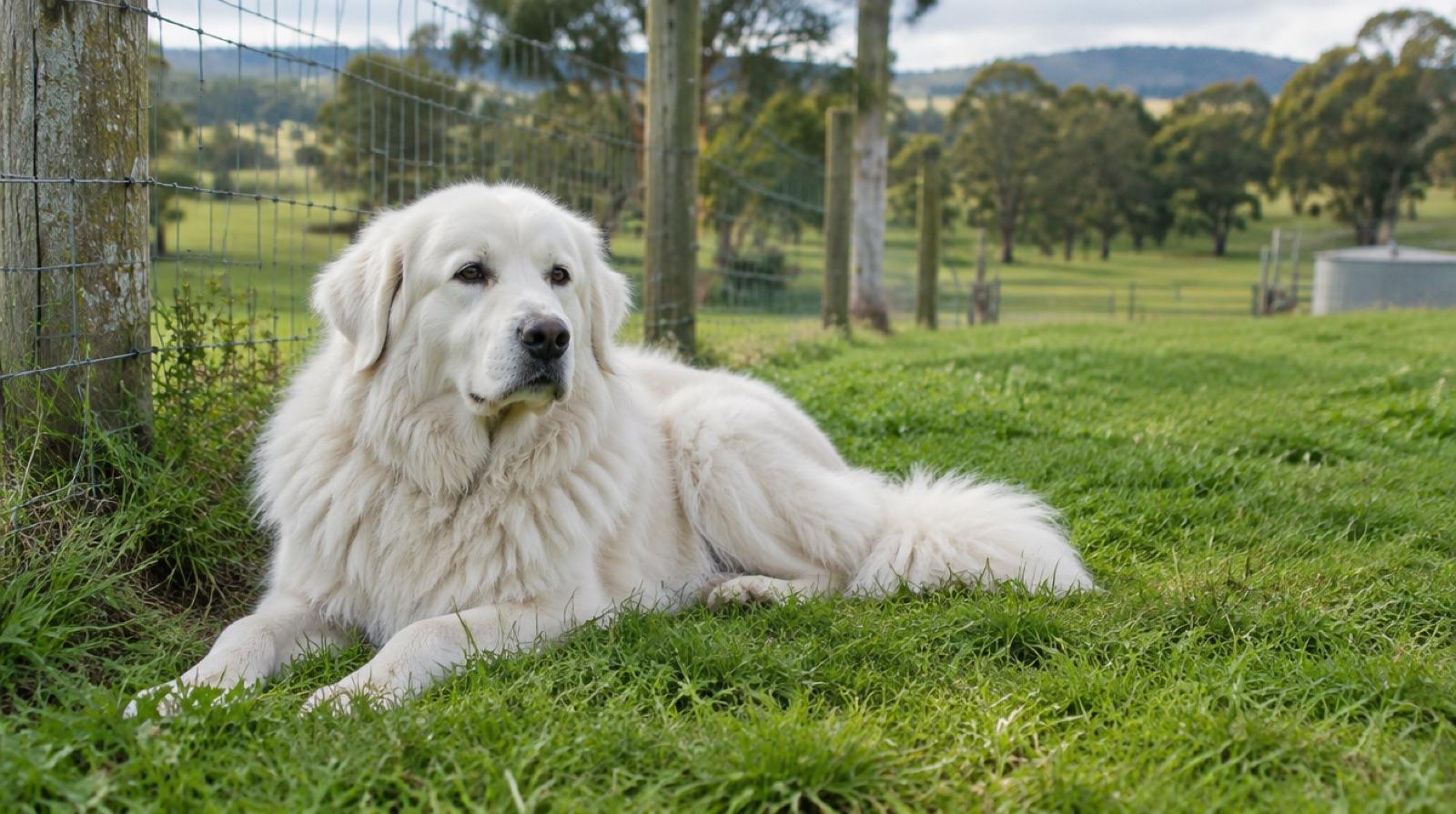
Should you adopt or buy a Great Pyrenees?
Start with what the dog was bred for. The Dogs Australia breed standard calls the Pyrenean Mountain Dog “A natural guard dog protecting shepherd and sheep” and asks for a temperament that is “Quietly confident. Nervousness and unprovoked aggression highly undesirable.” The Dogs Australia breed profile adds that it is strong willed, independent and reserved, and can be slow to learn new commands and slow to obey.
If you run sheep, goats, alpacas or poultry and want a working guardian, a registered breeder who raises pups around stock is the most reliable route. If you want a big, calm companion, an adult from rescue lets you meet the dog first. Dogs Victoria says that although the breed is still used in its traditional role, most Pyreneans are much-loved family companions. The route to avoid is a cheap “Great Pyrenees” puppy from an ad, bought for a small yard because it looked like a polar bear cub.
| Route | Reference cost | What you usually get | Main risk |
|---|---|---|---|
| Dogs Australia registered breeder | No breeder or club website we read published a price (November 2026); ask each one | A pedigree puppy; ask for both parents' hip and elbow results and how the pups were raised | The dog may not suit your property; ask about waiting times |
| General rescue or council pound | The standard fee, for example $500 for an adult dog at RSPCA NSW | A Pyrenean or cross when one is listed, desexed, microchipped and vaccinated | How the dog was raised may be unknown |
| Online ad with no checkable breeder | Anything | Unknown parents, unscored hips, a cross sold as purebred, or a puppy that does not exist | Untested parents and scams |
Reference only, not quotes. The RSPCA NSW fee was read on 12 November 2026. Breeders and rescues set their own prices and change them, so check with them.
What is a Great Pyrenees bred to do?
Guard, not herd. The Pyrenean Mountain Dog Club of Victoria explains that shepherds in the Pyrenees Mountains of south-west France used the breed for centuries to guard their flocks from wolves and bears. From dusk till dawn the dog is more alert, giving an occasional warning bark; a predator that comes close is chased off, but not so far that the flock is left unguarded. The club calls it a thinking dog that decides what to do without a shepherd's constant direction.
The breed still does that job here. A 2016 Queensland Department of Agriculture and Fisheries fact sheet names the Great Pyrenees among the more common guardian breeds and describes guardian dogs as acting independently of humans, staying with or near livestock and aggressively repelling predators. The National Wild Dog Action Plan lists Pyrenean Mountain Dogs among the guardian breeds available in Australia, with Maremmas by far the most numerous. Dogs Victoria says the breed was first brought to Australia in 1843 to guard sheep.
| Trait | What the source says |
|---|---|
| Size | Minimum height dogs 70 cm, bitches 65 cm; minimum weight dogs 50 kg, bitches 40 kg; most will considerably exceed this (breed standard) |
| Colour | White, or white with patches of badger, wolf grey, paler shades of lemon, orange or tan on the head, ears or base of tail (breed standard) |
| Coat | Profuse fine undercoat under a longer, coarser outer coat, with a mane round the neck (breed standard); the undercoat is shed in spring (Dogs Victoria) |
| Hind legs | Strongly made double dewclaws on each hind leg, an identifying feature of the breed (breed standard) |
| Temperament | Confident, gentle (especially with children) and affectionate; strong willed, independent, wary of strangers (Dogs Australia profile) |
| Training | “Pyreneans are managed, not trained”, though some basic obedience is needed (Dogs Victoria) |
| Exercise | The mature dog will take as much or as little exercise as it is allowed (Dogs Victoria); up to 1 hour a day (Royal Kennel Club) |
Sources: Dogs Australia breed standard, Dogs Australia breed profile, Dogs Victoria and the Royal Kennel Club, read 12 November 2026.
Can a Great Pyrenees live in the suburbs?
Some do, but be honest about three things: barking, roaming and visitors. Dogs Australia's profile says the breed protects its flock by barking and, being nocturnal, tends to bark at night unless trained against it. It also says a Pyrenean will patrol its perimeter and may wander away if left off its leash in an unenclosed space, and that it is wary of strangers who are not allowed in the house. The UK Royal Kennel Club lists the breed as needing a large house and a large garden.
The Queensland fact sheet is frank about guardian dogs in general: they can be aggressive and may injure pets or confront unfamiliar people, such as visitors who approach protected livestock, limitations which may rule them out on smaller properties or in densely settled areas. It also lists the problems that poorly trained, entire or improperly bred (crossbred) guardian dogs can cause, including roaming and barking constantly, causing complaints.
If you are in a town or suburb and still drawn to the breed, check three things first: whether your fences will hold a large dog that likes to patrol, whether your neighbours can live with night barking, and whether someone is home most of the day. Our guide to barking dogs in Australia explains what councils can do, and the Great Pyrenees temperament and ownership guide covers daily life with one.
How is a working guardian puppy raised?
With the stock, from early on. The Queensland Department of Agriculture and Fisheries' 2016 fact sheet advises choosing a suitable breed and reputable breeder, rearing pups with livestock from eight weeks of age, keeping enough contact that you can still handle them, and making sure any bonding between owner and dog happens with the herd. It says guardian dogs must be desexed, that most work well within a year, and that they may need up to two years to mature fully. It says failure can usually be put down to poor selection, improper rearing, cross-breeding or trying to train a dog that is too old.
So if you want a working dog, ask the breeder whether the pups have been raised around the kind of stock you keep. The National Wild Dog Action Plan points to the Best Practice Manual for the Use of Livestock Guardian Dogs by Linda van Bommel for training and housing advice.
Which health checks should a Pyrenean breeder show you?
Hips and elbows for both parents, at the least. Dogs Victoria calls the Pyrenean Mountain Dog generally a healthy breed in which health conditions do occur occasionally, and recommends asking breeders what health testing they do. Here is what the UK and New Zealand kennel clubs list; use it to ask an Australian breeder questions, not as an Australian rule.
| Check | Royal Kennel Club (UK) | Dogs New Zealand |
|---|---|---|
| Hip scoring | Best practice | Mandatory |
| Elbow scoring | Best practice | Mandatory |
| Eye testing | Best practice | Not listed |
| Hearing (BAER test) | Not listed | Mandatory |
| DNA profile (parentage) | Not listed | Mandatory |
| DNA test for canine multifocal retinopathy | Not listed | Optional |
| Genetic diversity | Good practice: prioritise it | Not listed |
Sources: Royal Kennel Club and Dogs New Zealand accredited breeder health tests, read 12 November 2026. This is a buying checklist, not veterinary advice. Our Great Pyrenees health guide covers what these conditions mean once you own one.
Ask to see the actual certificates for both parents, with names that match the litter papers. Bloat is the emergency to know about in any big, deep-chested dog: Cornell University's College of Veterinary Medicine says gastric dilatation-volvulus (GDV) is life-threatening, occurs suddenly, and that large, deep-chested dogs are most at risk. If your dog retches with nothing coming up, has a swollen belly or is restless and drooling more than usual, call or go to your nearest vet now. Our dog bloat (GDV) guide covers the signs.
How long do Great Pyrenees live?
The honest answer is that the sources do not agree, so plan for at least a decade. Dogs Victoria gives an average life span of 10 to 15 years, while the UK Royal Kennel Club lists under 10 years.
The best recent data is small. A 2026 Royal Veterinary College study of giant breeds seen at UK first-opinion vet practices in 2019 (O'Neill and colleagues, 2026) found that the 11 Pyrenean Mountain Dogs recorded as dying had a median age at death of 11.0 years. Eleven dogs is too few to be sure, and it is a UK population. Across all 1,068 giant-breed dogs that died in that study, the median age at death was 8.94 years.
For an adopter, that cuts both ways. A puppy gives you the most years. An adult from rescue gives you fewer, but with the size, nature and health already known. Our senior dog adoption guide covers what to expect from an older dog.
Can a Great Pyrenees cope with an Australian summer?
Constant panting, rapid breathing, pale or red gums, drooling, vomiting, weakness or collapse on a hot day can be heatstroke, which the RSPCA calls a life-threatening emergency. Start cooling the dog with room-temperature or cool water and get to a vet immediately.
With care. Dogs Australia's profile says the breed tends to be somewhat lazy in warm weather and particularly enjoys cold weather and snow. The RSPCA Knowledgebase on heatstroke says to exercise dogs at the coolest times of day, to give a cool, shaded, well-ventilated area and water at all times, to avoid hot ground, and never to leave a dog in a car. A heavy, double-coated dog in a hot backyard needs real shade and airflow. Our dogs in hot weather guide has the full picture.
See the Great Pyrenees listed right now
Pyreneans and Pyrenean crosses from the rescues, shelters and council pounds we aggregate, with each rescue's notes on children, other pets and time alone. Numbers change daily; every listing links to the rescue, where you apply directly.
How much is a Great Pyrenees puppy from a registered breeder?
We quote no breeder price, because none of the breeders whose own websites we read published one. In November 2026 we read the own websites of Australian Pyrenean Mountain Dog breeders and the Pyrenean Mountain Dog Club of Victoria site, leaving out classified and listing sites, and found no current puppy price and no club guide price. We cannot speak for every breeder, so ask each one.
Ask for the price in writing and compare what it includes: the parents' hip and elbow results, a vet check, vaccination and microchip, whether the puppy is on the Limited or Main Register, whether it was raised with stock, and whether the breeder will take the dog back if it does not suit you. The dog cost calculator gives a first-year budget beyond the purchase.
Survey of breeders' own websites, November 2026. Prices change; check with the breeder.
What do Great Pyrenees in rescue look like?
The history matters. A rescue Pyrenean or Pyrenean cross may have come off a farm or out of a town backyard, so ask the rescue how the dog was raised, how it is with visitors, other dogs, cats and children, how it handles fences, and whether it barks at night in its foster home. Numbers change daily, so check the live listings and set an alert on the Great Pyrenees breed page.
The Pyrenean Mountain Dog Club of Victoria asks people who find a lost Pyrenean, or learn of one in a shelter, to contact the club. If what you want is a big, gentle dog rather than a guardian, browse large dogs listed by rescues too: Sydney, Melbourne, Brisbane, Perth, Adelaide.
What does a rescue Pyrenean cost?
| Rescue | Fee as published | Read |
|---|---|---|
| RSPCA NSW, dog over 12 months | $500 | 12 Nov 2026 |
| RSPCA NSW, puppy under 12 months | $620 | 12 Nov 2026 |
Reference only, not a quote. These are the fees RSPCA NSW published on the date shown; fees change and other rescues set their own, so check with the rescue. RSPCA NSW says its fees ensure pets are desexed, microchipped, vaccinated and health-checked. Read our guide to adopting a dog in Australia.
How do Great Pyrenees puppy scams work?
Never pay for a Great Pyrenees puppy you have not seen with its mother, in person or on a live video call. A seller who wants money first and will only email or text matches the warning signs the Queensland Government lists.
The Queensland Government's puppy farm page lists low prices for popular or pedigree breeds, being asked for payment before you have met the puppy, a breeder who cannot give a valid breeder identification number (BIN), and a seller who only communicates by email or text. Scamwatch warns about unbelievably low prices, being told to pay in unusual ways such as money order or pre-loaded card, and paying for big-ticket items before inspecting them in person. Watch for these in Pyrenean ads:
- No hip or elbow answer. A breeder of a 50 kg breed should know both parents' results.
- A membership number you cannot check. Check it with the state body or Dogs Australia yourself, not through a link the seller sends.
- No double dewclaws. The breed standard calls the double dewclaws on each hind leg an identifying characteristic. Ask about them, and ask what the parents are.
- “Great in any backyard”. A seller who says this about a livestock guardian does not know the breed, or does not care where the puppy goes.
Our guide to puppies for sale in Australia has the state-by-state table of breeder numbers, how to check each one, and what to do if you have already paid.
Is a Great Pyrenees restricted anywhere in Australia?
No state or territory restricted or prohibited breed list names the Pyrenean Mountain Dog, but a council officer can still assess an individual dog. The breeds named in state law are the American Pit Bull Terrier, Japanese Tosa, Dogo Argentino, Fila Brasileiro and Perro de Presa Canario; the ACT has no restricted breeds, and the Northern Territory has no territory-wide list, so check with your council. Our Staffy vs pit bull guide sets out the state-by-state law.
When is a registered breeder the better choice?
Rescue is not right for everyone. If you need a working guardian for stock, a puppy from a breeder who raises pups with animals around them, then reared by you with your stock, is the method the government guidance describes. A breeder also makes sense if you want a purebred puppy from scored parents, or you have watched the rescue listings for months and no adult has suited your home. Check these before you pay:
- Registration. Ask for the breeder's prefix and membership number and check them with Dogs Australia or your state body, plus any state breeder number on the official register.
- Hip and elbow results for both parents, and ask about eyes and hearing.
- How the pups are raised. With stock, in a house, or both, and which suits your plans.
- Questions about you. A good Pyrenean breeder asks about your fencing, neighbours and stock. One who asks nothing is a warning.
- A written contract covering health, register type, desexing and whether the breeder will take the dog back.
Is a Great Pyrenees the right dog for you?
The appeal is real. The breed club says that for families wanting a companion, the Pyrenean is trustworthy and protective of young children, and Dogs Australia calls it confident, gentle and affectionate, with a general demeanour of composure, patience and loyalty. But it is also huge, independent, territorial and loud at night, with a coat that sheds.
Not sure? Try the what dog breed is right for me quiz and the adoption readiness check, and read best guard dogs in Australia, which compares the Pyrenean with other guardian breeds, and big dog breeds.
Find a Great Pyrenees near you
Great Pyrenees and Pyrenean crosses listed by rescues, by city:
- Great Pyrenees for adoption in Sydney
- Great Pyrenees for adoption in Melbourne
- Great Pyrenees for adoption in Brisbane
- Great Pyrenees for adoption in Perth
- Great Pyrenees for adoption in Adelaide
Local guides to adopting a Great Pyrenees, with the rescues that serve each city: Sydney, Melbourne, Brisbane, Gold Coast, Perth, Adelaide.
Weighing up other big dogs? Our Maremma, Bernese Mountain Dog, Newfoundland, Saint Bernard and Dogue de Bordeaux guides cover the same questions.
Frequently asked questions
Is a Great Pyrenees the same as a Pyrenean Mountain Dog?▼
Yes. Dogs Australia's breed profile says the Pyrenean Mountain Dog is known as the Great Pyrenees in North America, and that it should not be confused with the Pyrenean Mastiff, which is a separate breed. In Australia the registered name is Pyrenean Mountain Dog.
How much is a Great Pyrenees puppy in Australia?▼
We have no current published figure to quote. In November 2026 we read the own websites of Australian Pyrenean Mountain Dog breeders and the Pyrenean Mountain Dog Club of Victoria, and none published a puppy price. Prices on classified and listing sites are left out because we cannot check who is selling. Ask each breeder for the price in writing and what it includes.
Should I adopt or buy a Great Pyrenees?▼
Buy from a Dogs Australia registered breeder if you need a working livestock guardian raised around stock, or want a puppy from hip and elbow scored parents. Adopt if you want a companion and are happy with an adult or a cross, because an adult's size, coat, barking and manners with visitors are already known. Either way, be sure you can live with a large, independent dog that barks at night.
How big does a Great Pyrenees get?▼
Very big. The Dogs Australia breed standard sets minimums, not maximums: dogs at least 70 cm at the shoulder and 50 kg, bitches at least 65 cm and 40 kg, and it says most will considerably exceed this. Plan for a dog heavier than many adults can lift.
Do Great Pyrenees bark a lot?▼
Often, and mostly at night. Dogs Australia's profile says the breed protects its flock by barking and, being nocturnal, tends to bark at night unless trained against it. The Pyrenean Mountain Dog Club of Victoria describes the dog as more alert from dusk till dawn, giving an occasional warning bark. Talk to your neighbours and check your council's nuisance barking rules before you commit.
Is a Great Pyrenees a good family dog?▼
It can be, in the right home. Dogs Australia's profile calls the breed confident, gentle (especially with children) and affectionate, but also strong willed, independent and wary of strangers. Dogs Victoria says that although the breed is still used in its traditional role, most Pyreneans are much loved family companions. Supervise children with any dog this size.
What health tests should a Pyrenean breeder show me?▼
Hip and elbow scores for both parents at the least. The UK Royal Kennel Club lists hip, elbow and eye testing as best practice for the breed and prioritising genetic diversity as good practice. Dogs New Zealand makes hip and elbow scoring, a DNA profile and a BAER hearing test mandatory for its accredited breeders. Use these lists as questions for an Australian breeder.
How long do Great Pyrenees live?▼
The sources differ. Dogs Victoria gives an average life span of 10 to 15 years, while the UK Royal Kennel Club lists under 10 years. In a 2026 UK veterinary records study of giant breeds, the 11 Pyrenean Mountain Dogs that died had a median age at death of 11.0 years, which is too few dogs to be sure. Plan for a decade or more of care.
Can a Great Pyrenees live in the suburbs?▼
Some do, but it is a big ask. Dogs Australia's profile says the breed may wander away if off leash in an unenclosed space and barks at night, and the UK Royal Kennel Club lists a large house and large garden. A 2016 Queensland Department of Agriculture and Fisheries fact sheet says guardian dogs can confront unfamiliar people, such as visitors who approach protected livestock, which may rule them out on smaller properties or in densely settled areas.
How much does it cost to adopt a Great Pyrenees?▼
You pay the rescue's standard fee. RSPCA NSW listed $620 for a puppy under 12 months and $500 for a dog over 12 months when we read its fee page on 12 November 2026. That is a reference, not a quote; fees change and other rescues set their own, so check with the rescue.
Is the Great Pyrenees a restricted breed in Australia?▼
No state or territory restricted or prohibited breed list names the Pyrenean Mountain Dog, but a council officer can still assess an individual dog. The ACT has no restricted breeds, and the Northern Territory has no territory-wide list, so check with your council.
How do I avoid Great Pyrenees puppy scams?▼
Do not pay for a puppy before you have met it with its mother, in person or on a live video call. The Queensland Government lists low prices for pedigree breeds, being asked to pay before meeting the puppy, no valid breeder identification number and a seller who only uses email or text as warning signs. Check a breeder's membership with the state body yourself.
Sources
- Dogs Australia: Pyrenean Mountain Dog breed standard (last updated 6 July 2011)
- Dogs Australia: Pyrenean Mountain Dog breed profile
- Dogs Victoria: Pyrenean Mountain Dog
- Pyrenean Mountain Dog Club of Victoria: About the breed
- Royal Kennel Club (UK): Pyrenean Mountain Dog breed page and health tests
- Dogs New Zealand: Accredited breeder health tests for the Pyrenean Mountain Dog
- O'Neill and others (2026), Giant dog breeds under primary veterinary care in the UK, Companion Animal Health and Genetics
- Queensland Department of Agriculture and Fisheries: Wild dog facts, livestock guardian animals (3 July 2016)
- National Wild Dog Action Plan: Guardian animals
- Cornell University College of Veterinary Medicine: Gastric dilatation-volvulus
- RSPCA Australia Knowledgebase: How can I protect my dog from heatstroke?
- Queensland Government: Puppy farms
- Scamwatch: Buying and selling scams
- RSPCA NSW: Adoption fees
Keep reading
Great Pyrenees listed by rescues
Pyreneans and Pyrenean crosses listed right now by the rescues, shelters and pounds we aggregate across Australia.
Great Pyrenees temperament and ownership
The guardian nature, night barking, fencing and space needs of a Pyrenean at home.
Maremma: adopt or buy?
The other white livestock guardian, and why suburbs are hard on guardian breeds.
Puppies for sale: adopt or buy?
The breeder number each state requires, how to check it, and rescue puppy fees.