The short answer
Big dog breeds run from large dogs of about 25 kg or more, such as the German Shepherd (60 to 65 cm, 30 to 40 kg for males) and Rottweiler (about 50 kg for males), to giant breeds such as the Irish Wolfhound (at least 79 cm), Great Dane (at least 76 cm and 54 kg) and Newfoundland (64 to 69 kg for males), all from Dogs Australia breed standards. Many giants are described in their standards as gentle. The trade-offs are real: more food, vet bills that scale with weight, a higher risk of bloat (an emergency) and hip and elbow problems, and a shorter life, often under 10 years for giant breeds according to their clubs. Figures are breed standards and published averages, not a promise for any one dog, and costs are reference only, not a quote. An adult rescue dog lets you see the size, temperament and health you are taking on.
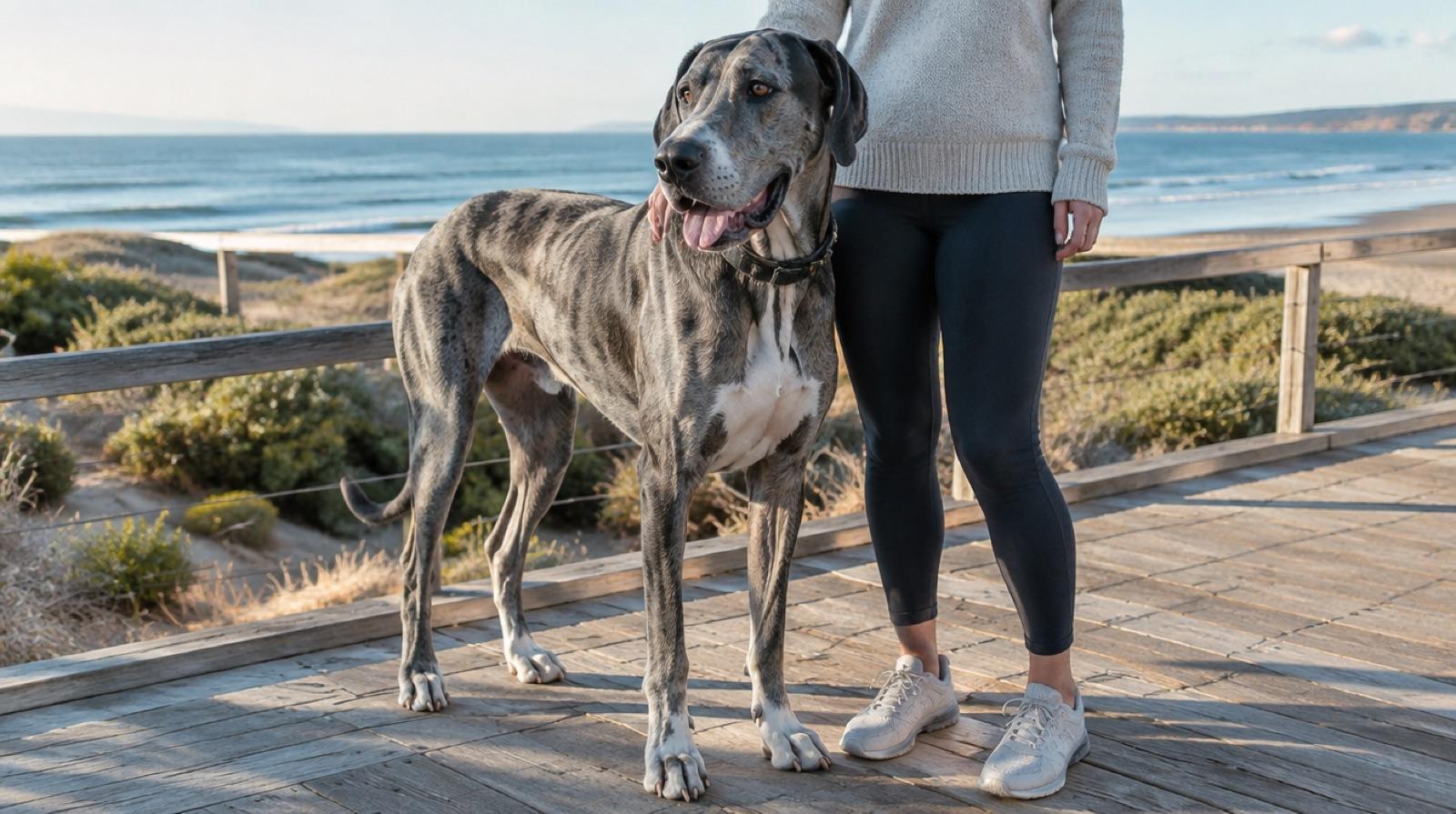
What counts as a big dog breed?
There is no official line. Dogs Australia, the national body for purebred dogs, publishes a breed standard for each breed it recognises, with a height and sometimes a weight, but it groups breeds mainly by type (Gundogs, Hounds, Working Dogs, Utility and so on), not by size. Even the standards use the words loosely: the Boxer standard calls a 30 kg dog “medium sized”.
So this guide uses two working labels. Large means roughly 25 kg or more, which is the line our large dog listings use. Giant means the breeds whose standards set minimum or average weights of around 40 to 70 kg, or heights of 70 cm and up at the shoulder. Every height below is measured at the withers, the top of the shoulder.
Which are the giant dog breeds?
These are the biggest breeds Dogs Australia recognises, with the sizes their standards give. Where a standard sets no weight, the table says so rather than guessing.
| Breed | Height (dogs / bitches) | Weight (dogs / bitches) | Standard's temperament words |
|---|---|---|---|
| Irish Wolfhound | Minimum 79 cm / 71 cm; dogs average 81 to 86 cm | Minimum 54.5 kg / 40.5 kg | “Lambs at home, lions in the chase” |
| Great Dane | Minimum 76 cm / 71 cm (over 18 months) | Minimum 54 kg / 46 kg | “Kindly without nervousness, friendly and outgoing” |
| St Bernard | 70 to 90 cm / 65 to 80 cm | Not set in the standard; the Saint Bernard Club gives 70 to 80 kg / 60 to 70 kg | “Friendly by nature. Temperament calm to lively; watchful” |
| Leonberger | 72 to 80 cm / 65 to 75 cm | Not set | “Self-assured and playful. Neither timid nor aggressive” |
| Newfoundland | Average 71 cm / 66 cm | 64 to 69 kg / 50 to 54.5 kg | “Exceptionally gentle and docile nature” |
| Pyrenean Mountain Dog | Minimum 70 cm / 65 cm | Minimum 50 kg / 40 kg | “Quietly confident” |
| Mastiff | Not specified | Not specified | “Calm, affectionate to owners, but capable of guarding” |
| Bernese Mountain Dog | 64 to 70 cm / 58 to 66 cm | Not set | “Good-natured and devoted to his own people” |
| Bullmastiff | 64 to 69 cm / 61 to 66 cm | 50 to 59 kg / 41 to 50 kg | “High spirited, alert and faithful” |
| Cane Corso | 64 to 68 cm / 60 to 64 cm | 45 to 50 kg / 40 to 45 kg | “Guardian of property, family and livestock” |
Source: Dogs Australia breed standards, checked 10 November 2026; St Bernard weights from The Saint Bernard Club. A standard describes the breed ideal, not a promise about any one dog.
Read the temperament column with care. A standard describes what breeders aim for, and an individual dog's upbringing counts for a lot. Breeds bred to guard, such as the Mastiff, Bullmastiff and Cane Corso, need early socialisation and an experienced owner; our guard dog guide covers the law and the responsibilities that come with them.
Which are the large dog breeds?
One step down from the giants are the large breeds most Australians know, many of which turn up in rescue, often as crosses.
| Breed | Height (dogs / bitches) | Weight (dogs / bitches) |
|---|---|---|
| Greyhound | 71 to 76 cm / 69 to 71 cm | Not set |
| Dobermann | Ideal 69 cm / 65 cm | Not set |
| Akita | 66 to 71 cm / 61 to 66 cm | Not set |
| Rottweiler | 61 to 68 cm / 56 to 63 cm | About 50 kg / about 42 kg |
| Rhodesian Ridgeback | 63 to 69 cm / 61 to 66 cm | 36.5 kg / 32 kg |
| Alaskan Malamute | 63.5 cm / 58.5 cm | 38.5 kg / 34 kg |
| Weimaraner | 59 to 70 cm / 57 to 65 cm | About 30 to 40 kg / 25 to 35 kg |
| German Shepherd | 60 to 65 cm / 55 to 60 cm | 30 to 40 kg / 22 to 32 kg |
| Golden Retriever | 56 to 61 cm / 51 to 56 cm | Not set |
| Labrador Retriever | 56 to 57 cm / 55 to 56 cm | Not set |
| Boxer | 56 to 61 cm / 53 to 58.5 cm | About 30 kg / about 28 kg |
Source: Dogs Australia breed standards, checked 10 November 2026. Many standards set height only; a well-built dog of the right height usually lands in a fairly narrow weight range, which your vet can confirm.
Several of these breeds have their own guides: German Shepherds, Rottweilers, Dobermanns, Labradors and Golden Retrievers, Boxers and Malamutes.
Which big dogs are true gentle giants?
“Gentle giant” is a nickname, not a breed trait, but some giant breed standards really do ask for it. The Newfoundland standard asks for an “exceptionally gentle and docile nature”, the Great Dane one for a dog that is “kindly without nervousness, friendly and outgoing”, and the Irish Wolfhound one sums the breed up as “lambs at home, lions in the chase”, a reminder that a sighthound can still chase.
The breed clubs add the practical side. The Great Dane Club of NSW, writing on the Dogs Australia site, says Danes are well behaved with children and other pets with supervision, need half an hour to an hour of walking a day, and would not thrive as a “backyard” dog. Dogs Victoria describes the St Bernard as quite comfortable indoors. A calm, slow-moving giant can suit a quieter household better than a busy medium-sized working dog, provided you have the room and the budget. Our breed guides go further: Great Dane, Saint Bernard and Bernese Mountain Dog.
How much space does a big dog need?
Less than people assume, and in different places than they assume. Most giant breeds are not high-energy dogs, and breed clubs keep saying the same thing: the dog wants to be inside with you. What a big dog needs is floor space to lie down, a car it fits in, and a yard with a fence it cannot lean over or jump. The Saint Bernard Club says an average fenced yard is adequate, with daily short walks.
- Stairs and lifts: carrying an injured 60 kg dog is not possible for most people, so think about steps before you need to.
- Renting and strata: leases and strata by-laws can restrict pets; read our renting with pets guide for your state's rules before you apply.
- Children and older people: Dogs Victoria warns that a Great Dane can easily knock over children and the elderly, so supervise, and train a solid sit and loose-lead walk early.
- Drool and hair: the Saint Bernard Club states plainly that there is no such thing as a “dry mouth” St Bernard.
If you live in an apartment, our apartment dogs guide lists the breeds that cope best, and the Greyhound is a big dog that Greyhounds As Pets WA says adapts well to small homes and apartments.
What does a big dog cost to feed and keep?
More than a small dog, in two predictable places: the food bowl and the vet. We could not find a published Australian figure that splits running costs by dog size, so here is what the sources do say.
- Food: the Great Dane Club of Victoria says Danes need more food than a Labrador-sized dog. Food is also the largest single cost for all owners: Animal Medicines Australia's 2025 survey estimated Australians spend $9.8 billion a year on pet food, almost half of all pet spending.
- Medicines and vet care: “In companion animals drug dosages are calculated on the basis of body weight, typically as mg of drug per kg,” wrote the authors of a 2024 study of 14,259 dogs in UK vet clinics, adding that for big dogs the quantity, and therefore the cost, of medication “can be substantially higher than for smaller animals” (Becker and Hughes, Frontiers in Veterinary Science).
- Everything else: beds, crates, collars, car restraints and boarding all come in a bigger, dearer size.
For a baseline, Animal Medicines Australia found dog-owning households spent an estimated $2,520 a year on average in its 2025 survey, across dogs of every size. Expect a giant breed to sit above that average. That figure is a published reference from September 2025, not a quote. Plug your own numbers into the dog cost calculator, and see cheap vet care and dog desexing costs for the vet side.
What is bloat, and why does it matter for big dogs?
Bloat, properly gastric dilatation volvulus (GDV), is when the stomach fills with gas and can twist on itself. Cornell University's College of Veterinary Medicine describes it as a life-threatening condition that occurs suddenly and needs immediate medical and surgical treatment. It can happen to any dog, but Cornell says it is far more common in large, deep-chested breeds, naming the Great Dane, Saint Bernard, Weimaraner, Irish Setter, Standard Poodle, Basset Hound and Dobermann. The Great Dane Society of Queensland calls it the number one killer of Danes.
Signs that mean an emergency vet, now (from Cornell and the Royal Kennel Club):
- Retching or trying to vomit with nothing coming up
- A swollen belly that is painful to touch
- Heavy drooling, panting, restlessness or pacing
- Pale gums, weakness or collapse
Cornell lists the known risk factors as large size and a deep chest, a close relative that has had GDV, eating very fast, one large meal a day, older age, a nervous temperament, a raised food bowl, and exercise soon after eating. It also says a preventive gastropexy, surgery that fixes the stomach to the body wall and is often done at the same time as desexing in at-risk breeds, greatly reduces the risk of the stomach twisting, although it does not stop bloating. Whether it suits your dog is a conversation for your vet.
Do big dogs have more joint problems?
Hip and elbow dysplasia, malformed joints that lead to arthritis, come up in almost every big-breed club's health list. Dogs Victoria lists hip and elbow dysplasia for the St Bernard and the Bernese Mountain Dog, and the Great Dane Club of NSW calls them hereditary in Danes. Dogs Australia's registration rules make health testing compulsory before litters of several breeds can be registered on the Main Register, including hip and elbow screening of both parents for the German Shepherd, Rottweiler, Labrador, Golden Retriever and Bullmastiff.
Two things help a big puppy's joints, according to the clubs and veterinary nutrition specialists:
- Careful growth. The Canadian Academy of Veterinary Nutrition, writing for VCA Animal Hospitals, says large and giant puppies keep growing until 18 to 24 months, that giant breeds need a puppy formula for about 24 months, and that overfeeding causes problems even on the right food. Ask your vet for a growth plan.
- Gentle exercise while growing. The Great Dane Club of Victoria advises only smaller amounts of exercise for dogs under 12 months, until the growth plates close.
If you buy, ask for the parents' hip and elbow scores and see the certificates. If you adopt an adult, ask the rescue what its vet check found and how the dog moves on stairs and after a walk.
How long do big dogs live?
Shorter lives, on average, and the bigger the breed, the shorter. In a large study of 584,734 UK dogs (McMillan and colleagues, 2024), the median lifespan was 12.7 years for small purebreds, 12.5 for medium and 11.9 for large. Giants sit below that: the same study gave the Mastiff a median of 9.0 years and the St Bernard 9.3, and Australian clubs give the Great Dane about 7 to 10 years (Great Dane Club of Victoria) and the Bernese 6 to 8 (Dogs Victoria).
That is not a reason to rule out a giant. It is a reason to go in with open eyes: a big dog's senior years may start at six or seven. Our healthiest dog breeds guide sets out the lifespan studies breed by breed and explains who the dogs in them were.
Which big breeds are restricted in Australia?
None of the breeds in the tables above. Five breeds are banned from import into Australia and restricted or prohibited by the states: the American Pit Bull Terrier, Japanese Tosa, Dogo Argentino, Fila Brasileiro and Perro de Presa Canario. Because they cannot be sold or given away in states such as NSW and South Australia, and are prohibited in Queensland, you will not see them on adoption lists, and this guide does not cover them.
Plenty of big dogs are often wrongly assumed to be restricted. The Tasmanian Government's restricted breed FAQs name the Mastiff and Bullmastiff as not restricted, and the Cane Corso, Rottweiler and Great Dane are not on any state list either. Victoria's restricted breed list names the same five breeds. Separately, any individual dog of any size can be declared dangerous or menacing after an incident, and the states set strict rules for those dogs. Our guard dog guide has the full state-by-state table.
Why look at big rescue dogs first?
Big dogs are surrendered for predictable reasons: they grew bigger than expected, ate more than budgeted, or outgrew a rental. That works in an adopter's favour. An adult rescue dog's final size, energy and temperament are already known, and most rescues desex, vaccinate, microchip and vet check before adoption.
Most large dogs in rescue are crosses: Shepherd, Labrador and Retriever types, bigger bull-breed crosses, Huskies, Rottweiler crosses, and mastiff and Bull Arab types. Purebred giants such as Great Danes and St Bernards are much rarer, so if you have your heart set on one, set an alert on the Great Dane or St Bernard breed page. Retired racing Greyhounds are a big-dog option with a dedicated adoption system; see our Greyhound adoption guide.
A breeder can be the right call if you need a predictable giant puppy, for example to raise alongside young children from the start. If so, choose a breeder registered with Dogs Australia through their state body, ask for the parents' hip, elbow and heart results, and read our puppies for sale guide for the state breeder rules and scam warnings.
Not sure a big dog suits you? The adoption readiness check and the what dog breed am I quiz can help, and our medium sized dog breeds guide covers the in-between option.
Find a big dog near you
Large dogs listed right now by the shelters and rescues we aggregate in each city.
In New Zealand, see large dogs in Auckland.
Frequently asked questions
What counts as a big dog breed?▼
There is no official cut-off in Australia. Dogs Australia breed standards give heights and sometimes weights, but they do not sort breeds into size classes. On our listing pages, a large dog is roughly 25 kg or more. Giant usually describes breeds such as the Great Dane, Irish Wolfhound, St Bernard and Newfoundland, whose standards or breed clubs give weights of around 40 to 80 kg.
What is the biggest dog breed?▼
It depends whether you mean height or weight. Of the breeds in this guide, by Dogs Australia standards, the Irish Wolfhound has the tallest minimum height (79 cm for dogs, averaging 81 to 86 cm), the St Bernard standard allows males up to 90 cm, and the Great Dane must be at least 76 cm. For weight, the Newfoundland standard gives 64 to 69 kg for males, and the Saint Bernard Club says adult males are normally 70 to 80 kg.
Which big dog breeds are gentle?▼
Several giant breed standards describe a gentle temperament. Dogs Australia's standards call the Newfoundland 'exceptionally gentle and docile', the Great Dane 'kindly without nervousness, friendly and outgoing', the Irish Wolfhound 'lambs at home, lions in the chase' and the St Bernard 'friendly by nature'. A standard describes the breed ideal; the individual dog's history matters more, so ask the rescue or breeder about the dog in front of you.
How long do big dogs live?▼
Shorter lives than small dogs, on average. In a 2024 study of UK dogs (McMillan and colleagues, Scientific Reports), the median lifespan was 12.7 years for small purebreds, 12.5 for medium and 11.9 for large. Giant breeds sit lower still: the same study gave the Mastiff a median of 9.0 years and the St Bernard 9.3, and Australian breed clubs give the Great Dane about 7 to 10 years.
What is bloat, and which dogs get it?▼
Bloat, or gastric dilatation volvulus (GDV), is when the stomach fills with gas and can twist. Cornell University's College of Veterinary Medicine says it is life-threatening, occurs suddenly and needs immediate medical and surgical treatment, and that large, deep-chested dogs are most at risk, naming Great Danes, Saint Bernards, Weimaraners, Standard Poodles and Dobermanns among others. Unproductive retching and a swollen, painful belly mean an emergency vet, straight away.
Can bloat be prevented?▼
The risk can be reduced, not removed. Cornell University's College of Veterinary Medicine says a preventive gastropexy, a surgery that attaches the stomach to the body wall and is often done at the time of desexing in at-risk breeds, greatly reduces the risk of the stomach twisting, though it does not stop bloating. Cornell also lists eating fast, one large meal a day and exercise soon after eating as risk factors. Ask your vet whether a gastropexy suits your dog.
Do big dogs cost more to keep?▼
Yes, in food and in vet care. Medicines for dogs are dosed by body weight, typically in milligrams per kilogram, so a big dog needs more of each drug; a 2024 study in Frontiers in Veterinary Science noted the quantity, and so the cost, can be substantially higher than for smaller animals. Animal Medicines Australia's 2025 survey found dog-owning households spent about $2,520 a year on average across all sizes. That is a reference average, not a quote.
Can a big dog live in an apartment?▼
Some can, if they are walked daily and the building allows it. The Great Dane Club of NSW, writing on the Dogs Australia site, says a Great Dane can live indoors with daily exercise and would not thrive as a backyard dog. Stairs, lifts and strata rules matter more for a 60 kg dog than a 6 kg one, so check your building's by-laws before you apply.
Are big dogs good with children?▼
Many are gentle, but size alone is a risk. Dogs Victoria warns that a Great Dane can easily knock over children and the elderly, and the Saint Bernard Club advises supervising babies and small children. Choose a calm adult dog that a rescue has seen with children, and never leave young children alone with any dog.
Are any big dog breeds restricted in Australia?▼
Five breeds are restricted or prohibited across the states: the American Pit Bull Terrier, Japanese Tosa, Dogo Argentino, Fila Brasileiro and Perro de Presa Canario. They cannot be imported, and in states such as NSW and South Australia they cannot be sold or given away, so they do not appear on adoption lists. The Mastiff, Bullmastiff, Cane Corso, Rottweiler and Great Dane are not on any state's restricted list.
How much exercise does a giant breed puppy need?▼
Less than you might expect while it is growing. The Great Dane Club of Victoria advises only smaller amounts of exercise for dogs under 12 months, until the growth plates close, and the Canadian Academy of Veterinary Nutrition, writing for VCA, says large and giant breed puppies keep growing until 18 to 24 months and need carefully controlled feeding. Your vet can give you a growth plan for your puppy.
Why adopt a big dog rather than buy a puppy?▼
Because an adult's size, temperament and health are already known. A giant puppy is a forecast; a two-year-old rescue dog is a fact, and many big dogs are surrendered because an owner underestimated the space, food and costs. Rescue big dogs are usually desexed, vaccinated, microchipped and vet checked before adoption, and many are crosses that would never appear in a breeder's litter.
Sources
- Dogs Australia (breed standards for each breed named in the tables)
- Dogs Australia: Great Dane breed standard
- Dogs Australia: Irish Wolfhound breed standard
- Dogs Australia: Newfoundland breed standard
- Dogs Australia: Browse a breed, Great Dane (Great Dane Club of NSW)
- Dogs Australia: Regulation Part 6, Registration (1 July 2025)
- Dogs Victoria: Great Dane, St Bernard and Bernese Mountain Dog breed pages
- Great Dane Club of Victoria: FAQ
- Great Dane Society of Queensland: Great Dane health
- The Saint Bernard Club of NSW: Is a Saint right for you?
- Cornell University College of Veterinary Medicine: Gastric dilatation volvulus (GDV) or bloat
- Royal Kennel Club: Bloat
- VCA Animal Hospitals: Nutritional considerations for large and giant breed dogs
- Becker and Hughes (2024), Patient weight has diverse effects on the prescribing of different antibiotics to dogs, Frontiers in Veterinary Science
- McMillan et al. (2024), Longevity of companion dog breeds: those at risk from early death, Scientific Reports
- Animal Medicines Australia: Pets in Australia 2025 media release
- NSW Office of Local Government: Restricted dogs
- Agriculture Victoria: Restricted breed dogs
- Queensland Government: Regulated dogs
- Dog and Cat Management Board (SA): Prescribed breeds
- Tasmanian Government: Restricted breed FAQs
Keep reading
Medium sized dog breeds
The in-between dogs: Kelpies, Staffies, spaniels and more, with their standard sizes.
Healthiest and longest-living dog breeds
The lifespan studies breed by breed, and why size and face shape matter.
Dog cost calculator
Estimate food, vet care, insurance and grooming for the dog you have in mind.
Greyhound adoption
A tall, calm, short-coated big dog that many adoption programs rehome.