The short answer
Choose a Labrador if you want a short, quick-to-groom coat, a very food-motivated dog that is easy to train with treats, and a breed you can realistically find in rescue. Choose a Golden Retriever if you are happy to brush a feathered coat several times a week and wait longer for the right dog. In size and temperament they are closer than most people think: the Dogs Australia standards give similar heights, and describe the Lab as having a “kindly nature” and the Golden as “kindly, friendly and confident”. Both are big, strong and boisterous for their first couple of years.
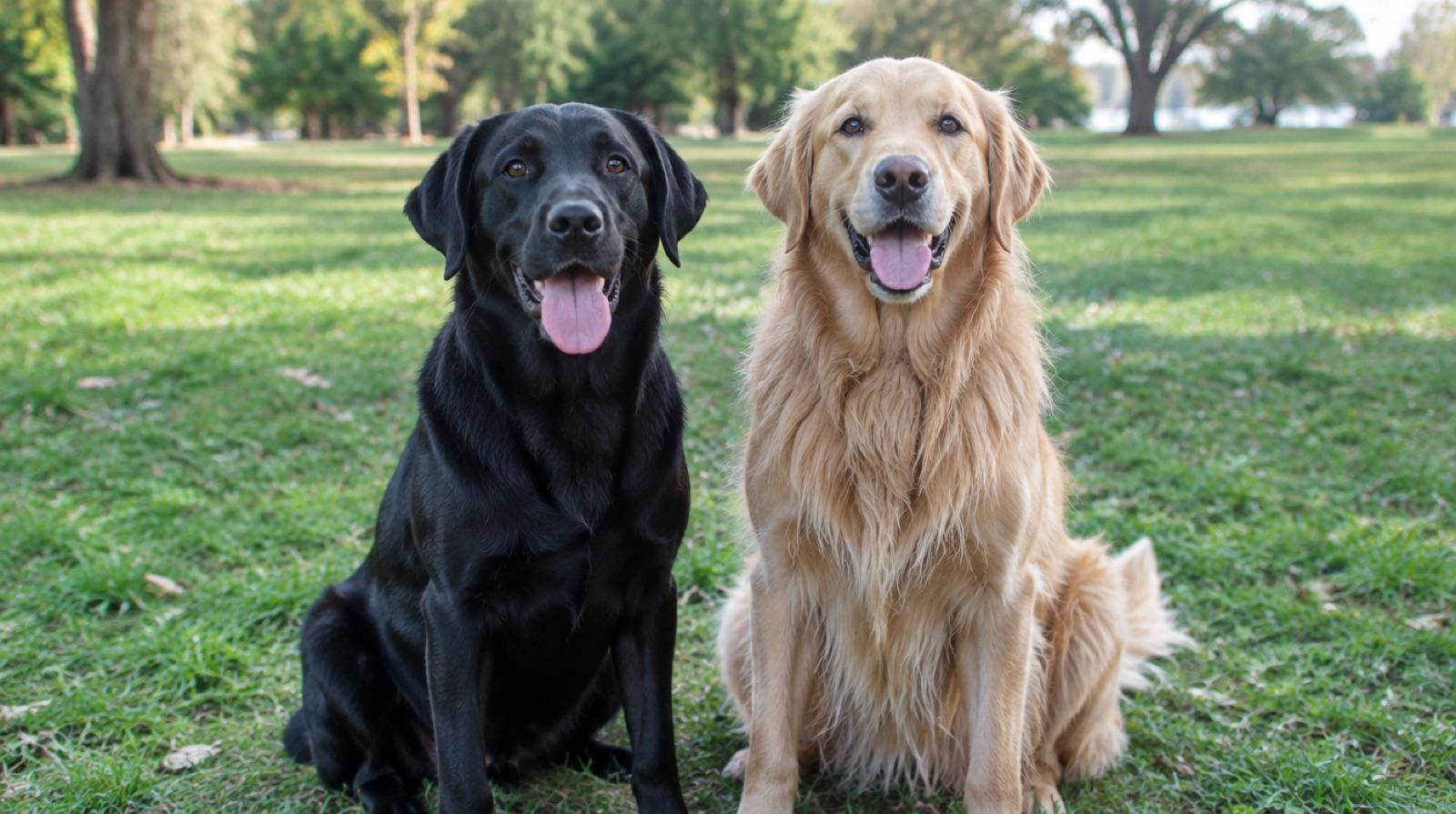
Labrador vs Golden Retriever at a glance
Both breeds sit in the gundog group and were developed to retrieve game for hunters, which is why both love to carry things and both love water. Everything in this table is quoted or summarised from the Dogs Australia breed standards for the Labrador Retriever and the Golden Retriever.
| Trait | Labrador Retriever | Golden Retriever |
|---|---|---|
| Height (dogs) | 56 to 57 cm ideal | 56 to 61 cm |
| Height (bitches) | 55 to 56 cm ideal | 51 to 56 cm |
| Weight | Not set; “very agile (which precludes excessive body weight or excessive substance)” | Not set |
| Temperament | “Intelligent, keen and biddable, with a strong will to please. Kindly nature” | “Kindly, friendly and confident” |
| Character | “Excellent nose, soft mouth, keen love of water” | “Biddable, intelligent and possessing natural working ability” |
| Coat | Short, dense, no wave or feathering; weather-resistant undercoat | Flat or wavy with good feathering; dense water-resisting undercoat |
| Colours | Wholly black, yellow, or liver/chocolate | Any shade of gold or cream, neither red nor mahogany |
| In Australian rescue | Common, especially Lab crosses | Rare |
Breed standard wording checked 9 November 2026 (Labrador standard last updated 2018, Golden Retriever standard 2015). Rescue availability is a general pattern and changes constantly; the breed pages show what is listed right now.
Size: closer than you think
On paper the two breeds overlap almost completely. The Labrador standard gives a narrow ideal band of 56 to 57 centimetres for dogs, while the Golden standard allows 56 to 61 centimetres, so a big male Golden can stand a little taller. Golden bitches can be a touch smaller than Labrador bitches. Neither standard sets a weight.
What you notice in the flesh is shape. The Labrador's short coat shows its build, so it looks stockier. The Golden's feathering makes it look softer and sometimes larger. Either way, you are choosing a large, strong dog that can pull on a lead and knock over a toddler, so plan for training from day one.
Temperament: which is the better family dog?
Neither breed has a clear edge. The Labrador standard asks for a dog that is “intelligent, keen and biddable, with a strong will to please” and has “no trace of aggression or undue shyness”. The Golden Retriever standard asks for one that is “kindly, friendly and confident”. Both were bred to work closely with people, taking direction from a handler.
The difference that matters more is age. A young dog of either breed is bouncy, mouthy and slow to settle, and in big gundogs that stage can run well into the second year. An adult Lab or Golden whose temperament is known is a far more predictable family dog than any puppy. See our best family dogs guide for the questions to ask a rescue about children.
Coat, shedding and grooming
This is the clearest practical difference. A Labrador's coat is short and dense with no feathering, so a brush takes minutes. A Golden's flat or wavy coat has feathering that tangles if it is ignored. Both have a dense undercoat, and RSPCA Australia says double-coated dogs can be prone to matting and should normally be groomed every day to stop dead hair building up.
Both breeds shed. If someone at home has a dog allergy, neither is a good bet: ASCIA says all dog breeds cause allergies, and the only reliable test is time with the specific dog.
Exercise, appetite and weight
Both are active working breeds that need daily exercise and like a job, whether that is fetch, swimming or sniffing games. Both also love food, but the Labrador has a documented reason. A University of Cambridge study found that around one in four Labradors carries at least one copy of a POMC gene variant linked to higher body weight and stronger food motivation; each copy was associated with an average of 1.9 kilograms of extra weight.
In practice that means measured meals, treats counted as part of the daily ration, and regular body condition checks. RSPCA Australia explains how to tell if a dog is overweight. The upside is that a food-driven Lab is very easy to train with treats.
In an Australian summer, both breeds need shade, water and walks early or late. RSPCA Australia's heatstroke advice for dogs applies to both, including never leaving a dog in a vehicle.
Health: what to plan for
Both breeds are large, and both can be affected by hip and elbow dysplasia, so ask any breeder for the parents' hip and elbow scores. The Golden Retriever has one standout concern: an unusually high lifetime risk of cancer, which the Morris Animal Foundation Golden Retriever Lifetime Study has been following in thousands of dogs. Our Golden Retriever health guide covers the signs to watch for, along with ears, skin and heat.
For Labradors, weight is the everyday health issue, because extra kilograms put strain on joints. Whichever breed you choose, pet insurance taken out early and a lean body are the two best investments. This is general information, not veterinary advice; your vet is the right person to talk to about a particular dog.
Which is easier to adopt in Australia?
The Labrador, by a long way. Labradors and Labrador crosses come through Australian rescue far more often than Golden Retrievers; see the Labradors and Golden Retrievers listed right now. Lab crosses in particular turn up regularly, and many have the easy Lab temperament in a slightly different package.
If your heart is set on a Golden, be patient. Set up an alert on the Golden Retriever page, look at Golden crosses such as the Goldador, and be open to an older dog. Doodle crosses such as the Labradoodle and Groodle are a different proposition: a curly coat that needs professional grooming, as our low maintenance dogs guide explains.
RSPCA Australia encourages adopting from the RSPCA or another reputable rescue first, and says RSPCA animals are vaccinated, wormed, microchipped and desexed as appropriate before adoption. Young dogs of both breeds appear on the Labrador and Golden Retriever puppies page when rescues list them.
Find a Labrador or Golden near you
Labradors, Goldens and their crosses listed by the rescues we aggregate in each city.
If you buy a puppy from a breeder
Rescue is not right for everyone, and a registered breeder is a reasonable choice if you want a puppy of one breed. RSPCA Australia advises checking the breeder is registered with the relevant authority in your state, visiting where the puppy was born, meeting the parents, talking to the breeder about the puppy's needs and never buying sight unseen.
Some states let you check a breeder's number before you pay. In NSW, ads for puppies born after 1 December 2025 must show the microchip number and the breeder identification number, which you can check on the NSW Pet Registry (Office of Local Government). In Victoria, ads must show a Pet Exchange Register source number and the microchip number (Agriculture Victoria). In Queensland, anyone who sells or advertises a dog born on or after 26 May 2017 needs a supply number you can look up (Queensland Dog Breeder Register). Other states run different schemes or none, so check your own state before assuming. Our puppies for sale: adopt or buy guide covers scams and breeder checks in more depth.
Still deciding between breeds? Try our what dog breed am I quiz, and run the numbers in the dog cost calculator before you commit to a large dog.
Frequently asked questions
What is the difference between a Labrador and a Golden Retriever?▼
The coat is the biggest difference. Under the Dogs Australia standards, the Labrador has a short, dense coat without wave or feathering, while the Golden Retriever has a flat or wavy coat with good feathering. Both are gundogs of similar height with a kind, biddable temperament. Labradors come in black, yellow and liver or chocolate; Goldens in any shade of gold or cream.
Which is bigger, a Labrador or a Golden Retriever?▼
They overlap closely. The Dogs Australia standards give an ideal height of 56 to 57 centimetres for Labrador dogs and 55 to 56 centimetres for bitches, against 56 to 61 centimetres for Golden Retriever dogs and 51 to 56 centimetres for bitches. Neither standard sets a weight. A Labrador tends to look stockier, partly because of its short coat.
Which is calmer, a Labrador or a Golden Retriever?▼
There is no reliable breed difference to point to. Both standards describe kind, biddable dogs, and both breeds are energetic and boisterous when young. The calm one is usually the older one: an adult dog of either breed is far calmer than a young dog. Ask the rescue how the specific dog behaves at home.
Which sheds more, a Lab or a Golden?▼
Both shed, because both have a dense undercoat. The Golden's longer, feathered coat is more visible and needs more brushing to keep the feathering free of tangles. The Labrador's short coat is quicker to groom but still drops hair. Neither is a good choice if you want a low-shedding dog.
Are Labradors or Golden Retrievers better with kids?▼
Both have strong family reputations, and the standards back that up. The Labrador standard describes a kindly nature with no trace of aggression or undue shyness, and the Golden standard describes a dog that is kindly, friendly and confident. Both are large and strong, so supervision with young children matters with either.
Which is easier to train?▼
Both are among the easier breeds to train. The Labrador standard calls the breed intelligent, keen and biddable with a strong will to please, and the Golden standard calls it biddable and intelligent with natural working ability. Labradors are often especially food-motivated, which makes treats a powerful training tool.
Why are Labradors always hungry?▼
Some genuinely are hungrier. A University of Cambridge study found that around one in four Labradors carries at least one copy of a POMC gene variant linked to higher body weight and greater food motivation. That makes measured meals and regular body condition checks important. RSPCA Australia explains how to tell if a dog is overweight.
Do Golden Retrievers have more health problems than Labradors?▼
Both breeds share some risks, such as hip and elbow dysplasia, but Golden Retrievers are known for an unusually high lifetime risk of cancer, which the Morris Animal Foundation Golden Retriever Lifetime Study is following in thousands of dogs. Labradors are especially prone to weight gain. Our Golden Retriever health guide covers the breed in detail.
Is a Labrador or Golden Retriever easier to find in rescue?▼
The Labrador, by a wide margin. Labradors and Lab crosses turn up in Australian rescue far more often than Golden Retrievers, so see the Labradors and Goldens listed right now on each breed page. If you are set on a Golden, set up an alert and be patient, and consider a Labrador cross or Goldador with a good foster report.
What is a Goldador?▼
A Goldador is a cross between a Labrador Retriever and a Golden Retriever. It is not a recognised breed with its own standard, so size and coat can fall anywhere between the two parents. Judge an individual Goldador on its actual coat, energy and temperament as described by the rescue or breeder.
Should I buy a Labrador or Golden puppy from a breeder?▼
A registered breeder is a reasonable choice if you want a puppy of a specific breed and cannot find one in rescue. RSPCA Australia advises checking the breeder is registered with the relevant authority, visiting where the puppy was born, meeting the parents and never buying sight unseen. In NSW, Victoria and Queensland an advertisement must show a number you can check on a government register.
Do Labradors and Golden Retrievers cope with Australian heat?▼
Both are large dogs that can overheat, so RSPCA Australia advises shade, water and exercise at the coolest times of day in hot weather, and warns never to leave a dog in a vehicle. Talk to your vet about tick prevention where you live.
Sources
- Dogs Australia: Labrador Retriever breed standard
- Dogs Australia: Golden Retriever breed standard
- University of Cambridge: Genetic variant may help explain why Labradors are prone to obesity (2016)
- RSPCA Australia Knowledgebase: How do I tell if my dog is overweight?
- RSPCA Australia Knowledgebase: Why and how should I groom my dog?
- RSPCA Australia Knowledgebase: How can I protect my dog from heatstroke?
- RSPCA Australia Knowledgebase: I am looking for a new companion animal, where should I go?
- Morris Animal Foundation: Golden Retriever Lifetime Study
- ASCIA: Pet allergy
- NSW Office of Local Government: Mandatory breeder identification
- Agriculture Victoria: Pet Exchange Register
- Queensland Dog Breeder Register: Supply numbers
Keep reading
Labradors for adoption
Labradors and Lab crosses listed by rescues across Australia, refreshed regularly.
Golden Retrievers for adoption
Goldens and Golden crosses in Australian rescue. Fewer of them, so set an alert.
Golden Retriever health issues
Cancer risk, hips and elbows, ears, skin and heat: what to plan for with a Golden.
Best family dogs in Australia
Why an assessed adult often beats a puppy, and how the classic family breeds compare.