The short answer
Choose a Husky if you want a lighter, sociable, medium-sized running companion: Dogs Australia sets males at 53.5 to 60 cm and 20 to 27 kg. Choose a Malamute only if you are ready for a powerful, heavy-boned dog, around 63.5 cm and 38.5 kg for a male, with strong lead manners to teach early. Both shed heavily, both need a lot of exercise and a secure fence, and both need a real plan for Australian heat: shade, water, a cool room and exercise only at the coolest times of day.
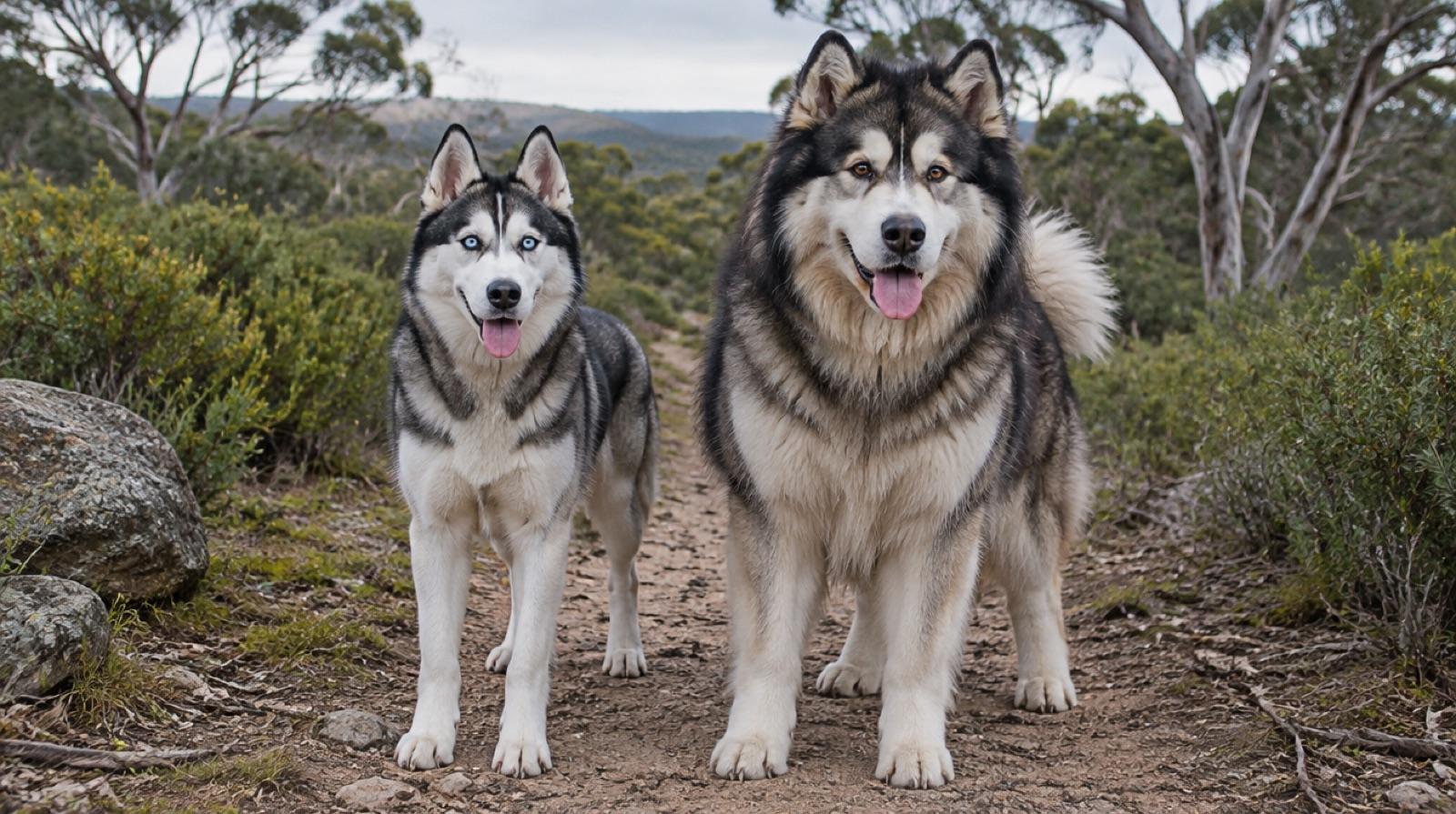
How are a Husky and a Malamute different?
They were bred for different jobs. The Dogs Australia Siberian Husky standard describes a medium-sized working dog that “performs his original function in harness most capably, carrying a light load at a moderate speed over great distances.” It adds that the Husky should never look “so heavy or coarse as to suggest a freighting animal.”
The Alaskan Malamute standard is the opposite. It calls the Malamute “one of the oldest Arctic sled dogs”, a “powerful and substantially built dog” whose function as “a sledge dog for heavy freighting in the Arctic must be given consideration above all else.” It says plainly that the Malamute “is not intended as a racing sled dog designed to compete in speed trials.”
Put simply: the Husky is the endurance runner, the Malamute is the weightlifter. Dogs Australia places both in the Utility group (Group 6).
Husky vs Malamute side by side
Every figure and quote in this table comes from the two Dogs Australia breed standards, checked 9 November 2026.
| Siberian Husky | Alaskan Malamute | |
|---|---|---|
| Bred for | A light load at moderate speed over great distances | Heavy freighting in the Arctic; strength and endurance |
| Height (male) | 53.5 to 60 cm | 63.5 cm (desirable freighting size) |
| Weight (male) | 20 to 27 kg | 38.5 kg |
| Height and weight (female) | 51 to 56 cm, 16 to 23 kg | 58.5 cm, 34 kg |
| Temperament | “Friendly and gentle, but also alert and outgoing”; not a guard dog | “an affectionate, friendly dog, not a ‘one man’ dog”; playful on invitation |
| Coat | Double, medium length; soft, dense undercoat | Thick, coarse guard coat; oily, woolly undercoat 2.5 to 5 cm deep |
| Eyes | Brown or blue, one of each, or particoloured | Brown; blue eyes are a disqualifying fault |
| Tail | Fox-brush shape, carried in a sickle curve | Well furred, carried over the back like a “waving plume” |
| Colours | Black, grey, agouti, sable, red and white; many patterns | Light grey to black, sable to red, or all white; white underbody and face markings |
Breed standards describe the ideal show dog. Individual dogs, and especially rescue crosses, vary a lot, so judge the dog in front of you.
Which is easier to live with?
For most households, the Husky, mainly because of size. A 20 to 27 kg dog that pulls is a nuisance; a 38 kg dog that pulls can pull an adult over. If you choose a Malamute, loose-lead training is not optional, and it is far easier to start with a calm adult than to grow a strong puppy into one.
Temperament is closer than people expect. Both standards describe friendly, people-oriented dogs rather than guard dogs. The Husky standard says it is not “overly suspicious of strangers or aggressive with other dogs”, while the Malamute is “a loyal, devoted companion, playful on invitation, but generally impressive by his dignity after maturity.” Neither breed is described as a natural obedience dog, and both were bred to run in a team, which is why secure fencing and on-lead walks in open areas matter for both.
- A Husky suits people who run, cycle or hike early in the day, want a sociable dog that likes other dogs, and can build a high, dig-proof fence.
- A Malamute suits experienced owners of large, strong dogs who want a big, affectionate companion and have a cool indoor space for summer.
- Neither suits someone who works long hours with no one home, cannot fence securely, or wants a low-shedding dog. Our low maintenance dog breeds guide and the what dog breed am I quiz are better starting points.
Escape and exercise are the two problems behind many Husky surrenders. The Husky escape and exercise guide covers fencing and safe running in detail, and the same fence advice applies to a Malamute.
Can a Husky or Malamute cope with Australian heat?
Yes, if you plan for it, and heat is the single biggest welfare question for either breed here. The RSPCA Knowledgebase on heatstroke calls it a life-threatening emergency and lists the risk factors, including body weight, exercise when heat generation exceeds heat loss, and hot, humid environments with too little shade and water. It also warns that ground temperatures can be unsafe for dogs. It advises exercising dogs at the coolest times of day and giving constant access to a cool, shaded, well-ventilated area.
For a northern breed that means:
- Walk or run only early in the morning or late in the evening in summer, and skip it on very hot days.
- Check the ground. The RSPCA warns that ground temperatures can be unsafe, including bare ground and grass (especially brown grass).
- Give a cool room, shade and water all day, not just a kennel in the yard.
- Never leave the dog in a car, even with the windows down.
The Malamute's heavier build makes this more serious, not less. The breed standard does note that Malamutes “usually have a shorter and less dense coat during the summer months”, which is the coat doing its job. That is also why shaving is the wrong fix: both standards describe a double coat, and the Husky health guide explains why the coat is brushed out, not clipped. If you live somewhere with long, humid summers and no cool indoor space for the dog, choose another breed.
Grooming and shedding: what to expect
Both breeds shed heavily, and both moult hard once or twice a year. The Husky standard says “the absence of the undercoat during the shedding season is normal”, and the Malamute's undercoat is 2.5 to 5 cm deep. Both standards treat trimming as a fault beyond tidying the feet, plus whiskers for the Husky.
In practice that means brushing several times a week, more during a moult, and accepting hair on the floor and furniture. Neither breed is a good choice for someone with dog allergies; see the hypoallergenic dogs guide for why no dog is truly allergy-free.
Adopt or buy a Husky or Malamute?
For most people, adopt an adult. Huskies and Husky crosses appear in Australian rescue regularly; purebred Malamutes are much rarer, and many dogs listed as one are a mix of the two. An adult in foster care has already shown how it copes with heat, fences, cats and time alone, which are the questions that decide whether either breed works in your home. The RSPCA Australia Knowledgebase also points people to rescue first.
A registered breeder is a reasonable choice if you want a puppy with known parents and health results. Check membership of Dogs Australia through your state body, meet the parents, and ask for hip and eye results. Our Husky puppies: adopt or buy guide covers the tests to ask for and the scam warning signs, and the puppies for sale guide has each state's breeder rules.
When you contact a rescue about either breed, ask about the dog's strength on lead, how it handles hot days, whether it has tried to escape, and how it is with children, cats and small pets.
See Huskies and Malamutes for adoption
Many rescue sled dogs are crosses. The listing tells you the dog's real size and energy, which matters more than the label.
See Huskies →See Malamutes →Find a Husky or Malamute near you
- Sydney: Huskies for adoption, Malamutes for adoption, and our Sydney Husky adoption guide and Malamute adoption guide
- Melbourne: Huskies for adoption, Malamutes for adoption, and our Melbourne Husky adoption guide and Malamute adoption guide
- Brisbane: Huskies for adoption, Malamutes for adoption, and our Brisbane Husky adoption guide and Malamute adoption guide
- Perth: Huskies for adoption, Malamutes for adoption, and our Perth Husky adoption guide and Malamute adoption guide
- Adelaide: Huskies for adoption, Malamutes for adoption, and our Adelaide Husky adoption guide and Malamute adoption guide
Before you apply, take the adoption readiness check and run a big dog's first year through the dog cost calculator. Still deciding on a breed? The calm dog breeds guide covers the other end of the energy scale.
Frequently asked questions
What is the difference between a Husky and a Malamute?▼
The Malamute is bigger, heavier and built for hauling; the Siberian Husky is lighter and built for covering distance. The Dogs Australia breed standard describes the Husky as a medium-sized dog carrying a light load at a moderate speed over great distances, and says it should never look heavy enough to suggest a freighting animal. The Malamute standard describes a powerful, heavy-boned sledge dog for heavy freighting that is not intended as a racing sled dog. Eye colour is a quick tell too: blue eyes are allowed in the Husky and a disqualifying fault in the Malamute.
Is a Malamute bigger than a Husky?▼
Yes, clearly. The Dogs Australia standard gives the desirable Malamute size as 63.5 cm at the shoulder and 38.5 kg for males, and 58.5 cm and 34 kg for females. The Husky standard sets limits of 53.5 to 60 cm and 20 to 27 kg for males, and 51 to 56 cm and 16 to 23 kg for females. A typical male Malamute weighs well over the top of the Husky range.
Which is better for a first-time owner, a Husky or a Malamute?▼
Neither is a typical first dog, and the right answer for many first-time owners is a different breed. If you are set on one, a Husky is easier to physically manage because of its size. A Malamute is affectionate and friendly according to its breed standard, but it is a heavy, strong dog, so lead training from day one matters far more. An adult rescue dog whose foster carer can describe its strength on lead and its energy is the safest route with either breed.
Can a Husky or Malamute live in the Australian heat?▼
Yes, with planning, but heat is the biggest welfare risk for both breeds here. The RSPCA Knowledgebase lists body weight, exercise, and hot, humid environments without enough shade and water among the heatstroke risk factors, and advises exercising dogs at the coolest times of day. Both breeds need shade, water, a cool indoor space in summer and walks only early or late on hot days. The Malamute's heavier build and dense coat make the heat question even more serious.
Should I shave my Husky or Malamute in summer?▼
No. Both breed standards describe a double coat, with a dense undercoat under longer guard hairs, and treat trimming as a fault beyond tidying the feet (and whiskers, for the Husky). The Malamute standard notes the breed naturally carries a shorter, less dense coat in summer. Regular brushing to clear shed undercoat, plus shade and a cool room, is the safer approach. Ask your vet if you are worried about a particular dog in the heat.
Which sheds more, a Husky or a Malamute?▼
Both shed heavily, so neither suits someone who wants a low-shedding dog. The Husky standard says the absence of the undercoat during the shedding season is normal, and the Malamute standard describes an undercoat 2.5 to 5 cm deep. Expect a lot of hair during the seasonal moult and plan to brush several times a week. If allergies are the concern, read our hypoallergenic dog guide before choosing either breed.
Are Malamutes good with children?▼
Many are friendly with people. The Dogs Australia standard calls the Malamute an affectionate, friendly dog, not a one-man dog. The practical issue is size and strength: a dog of 34 kg or more can knock over a small child in play, so supervision matters. A rescue that knows the individual dog can tell you how it behaves with children, which is more useful than any breed average.
Are Huskies good with other dogs?▼
Usually, according to the breed standard. Dogs Australia describes the Husky as friendly and gentle, not overly suspicious of strangers or aggressive with other dogs. That makes many Huskies sociable at the dog park, though recall is a separate issue: a Husky that slips its lead may not come back. Ask the rescue how a specific dog behaves with other dogs and with cats.
Can a Husky or Malamute be off lead?▼
Many owners keep both breeds on lead or in securely fenced areas, because sled dogs were bred to run and reliable recall is hard to build. Our Husky escape and exercise guide covers fencing that holds a determined dog and safe ways to give a northern breed enough running. The same fencing advice applies to a Malamute, which is even stronger.
Is a Husky or a Malamute a restricted breed?▼
No. Neither the Siberian Husky nor the Alaskan Malamute is a restricted breed in any Australian state or territory. The restricted lists cover breeds such as the American Pit Bull Terrier and Japanese Tosa that cannot be imported into Australia. Council registration, microchipping and any local dog rules still apply as normal.
Where can I adopt a Husky or Malamute?▼
Look at rescue listings for both breeds and for crosses. Huskies and Husky crosses turn up in Australian rescue more often than Malamutes, and many rescue dogs labelled as one are a mix of both. LocalPetFinder lists Huskies and Malamutes from the rescues and pounds we aggregate on the breed pages, and you can filter by city for Sydney, Melbourne, Brisbane, Perth and Adelaide.
Sources
Keep reading
Huskies for adoption
Siberian Huskies and Husky crosses listed by the rescues and pounds we aggregate, by city.
Malamutes for adoption
Alaskan Malamutes and Malamute crosses, when the rescues we track have one listed.
Husky escape and exercise
The fence that holds a sled dog, and how much running a northern breed needs.
Husky puppies: adopt or buy?
Registered breeder or rescue Husky, the health tests to ask for, and scam warning signs.