The short answer
A Husky needs one to two hours of real exercise a day plus mental work, and a securely fenced, escape-proof yard. Almost every Husky surrender traces back to one or both being missing. The breed is a hardwired escape artist that climbs, digs and bolts with an unreliable recall, so containment is a fencing job, not a training one: think 1.8 metres or more, dig-proofed at the base, with an inward-angled top for climbers. Off-lead only in fully fenced areas, a lead or long-line everywhere else. In summer, exercise in the cool hours and never push a Husky in the heat. Meet the exercise and the containment and the destructive, howling, escaping Husky simply does not appear.
Why exercise and escape make or break Husky ownership
Most of what goes wrong with a Husky comes down to these two things, so it is worth understanding them before you adopt rather than after. The Siberian Husky was developed to pull a light sled over long distances for hours at a time, and the breed standard still describes a working dog built for endurance. That history produced enormous stamina, a powerful drive to run and roam, and the athleticism and problem-solving to act on it.
In a home that meets those needs, that heritage is a joy. In a home that does not, it becomes the destruction, howling, digging and escaping that fills rescues with Huskies. The dog is not being difficult. It is a working athlete with nothing to do and a fence it can beat. Across the rescues we aggregate, Huskies and Husky crosses turn up in every state, very often as young adults, and the listing notes ask for a secure yard and an active home more than for almost any other breed.
The reassuring part is how directly the behaviour follows the management. A well-exercised Husky in a secure yard is usually a calm, friendly, easy housemate. The problems appear when the exercise or the containment fall short, and they disappear again when both are fixed. When you adopt, ask how the dog behaved in foster care around fences, gates and time alone, because that history is the best preview you will get.
Why Huskies climb, dig and bolt
Escaping is not one behaviour in a Husky, it is three, and a fence that stops one often fails on another. A Husky climbs because it is light for its height, strong in the back end and happy to use a bin, a kennel or a fence rail as a step. It digs because digging is self-rewarding for a northern breed, cools the dog in warm weather, and happens to open a route under a fence. And it bolts because the drive to run is wired in: an open gate or a slipped collar is simply an invitation, and once moving a Husky does not stop to check where you are.
None of this is spite and very little of it is trainable away. You can teach a Husky to wait at a door and to come when it feels like it, but you cannot train out a drive the breed was selected for over centuries. That is why experienced owners talk about containment as a fencing job rather than a training one. Training reduces the number of attempts. The fence decides whether an attempt succeeds.
How much exercise a Husky truly needs
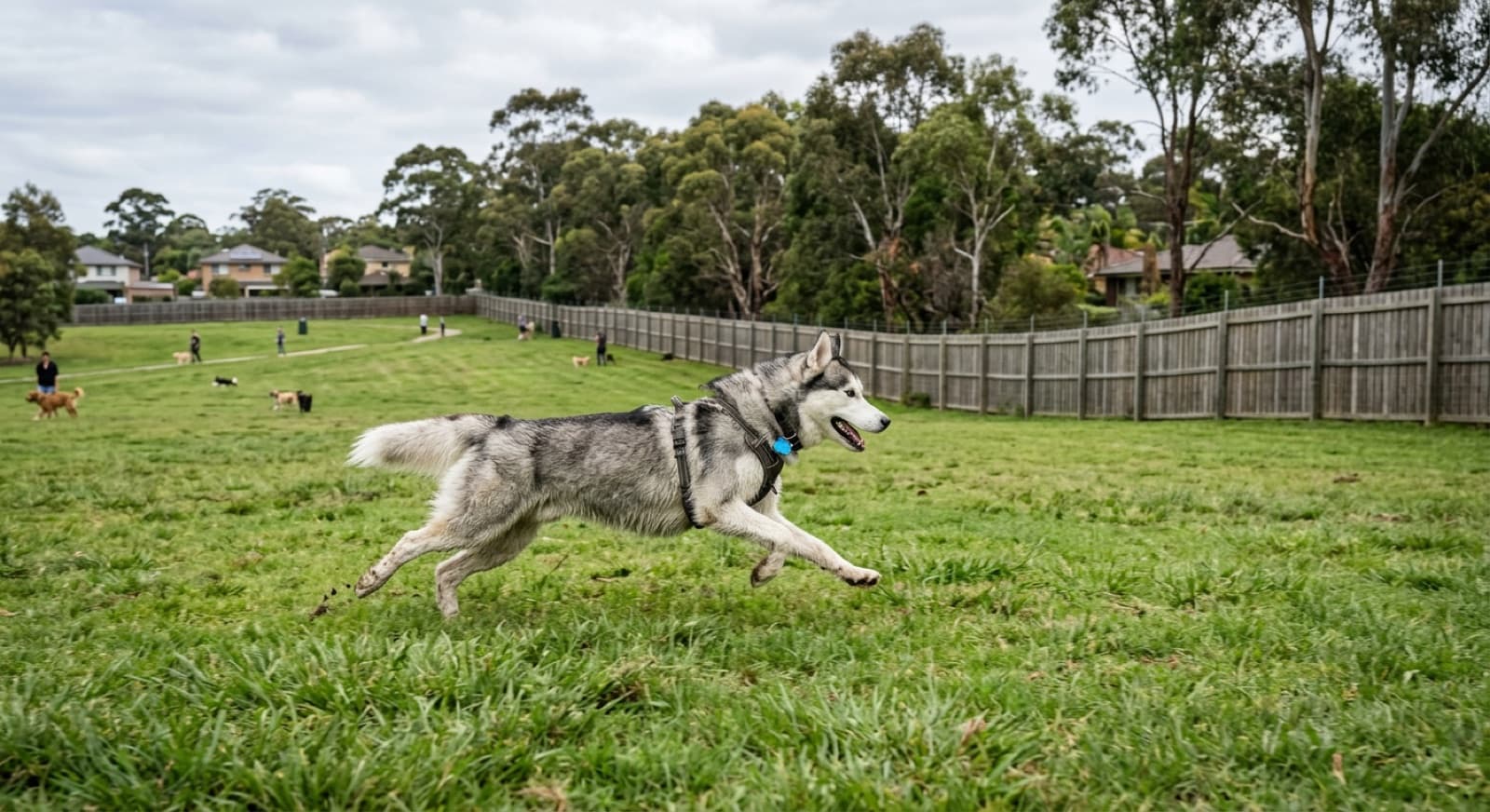
Plan on one to two hours of real activity a day, every day, for an adult Husky, and understand that a slow walk around the block does not touch the sides. The breed needs to move: running in a fully fenced area, brisk walking with purpose, hiking on a long-line, and dog sports that let it stretch out. Many Huskies love activities that tap into their pulling heritage, such as canicross, where the dog runs in a harness attached to a waist belt, or scootering and bikejoring for experienced handlers with a fit adult dog.
Mental exercise matters as much as physical. A Husky is intelligent and gets bored, so short reward-based training sessions, puzzle feeders, snuffle mats, scent games and having a job to do all help drain the energy that otherwise becomes trouble. The RSPCA Australia Knowledgebase is a good plain-language source on enrichment and why a bored dog becomes a destructive one. A good Australian day for a Husky mixes both and bends around the heat:
- Early morning: the main session, while it is coolest. A run in a fenced park, a brisk walk or a bush track on a long-line.
- Middle of the day: rest in a cool spot with a puzzle feeder or a long-lasting chew. In summer this is non-negotiable.
- Evening: a second walk once the heat drops, plus five to ten minutes of training.
A Husky that is properly exercised in body and mind is a different dog from one that is not. If the honest answer is that this routine will not survive your work week, our adoption readiness check is worth ten minutes before you apply for one.
Fencing that actually holds a Husky
Because a Husky will climb, dig, jump and bolt, containment is a serious job and worth getting right before the dog comes home. Walk your yard thinking like an athletic, determined escape artist and address four things:
- Height. Aim for a fence of at least 1.8 metres, and understand that even that is not a guarantee for a keen climber. An inward-angled top section or a lean-in stops a Husky getting a paw over the top, and it is a common addition for the breed.
- The dig line. Huskies dig, and sandy coastal soil or soft ground after rain makes it easier. The base of the fence must be dug in, backed with buried mesh, or run along a concrete or paved strip so the dog cannot tunnel under. This is as important as the height.
- Climb aids. Remove anything near the fence the dog could use as a step: bins, kennels, garden furniture, firewood stacks, pool equipment, low retaining walls. A Husky will use them. On a sloping block, a fence can sit lower than it looks from the uphill side.
- Gates and doors. Gates must be tall, self-latching and flush to the ground with no gap. Deliveries, visitors and tradies are exactly when a Husky shoots out, so manage doors carefully.
Older boundary fences on larger blocks often have gaps you will not notice until the dog does. Supervise a new Husky in the yard until you know what it can do, because rescue dogs sometimes reveal escape skills their foster carer never saw. Shade and water in the yard matter too, since a hot, bored dog is a more motivated escaper. If you rent, raise fencing changes with your landlord first, because tenancy rules on pets and alterations differ by state. And meet the exercise need: a tired, satisfied Husky is far less motivated to spend the day engineering a breakout than a bored one.
Off-lead honesty: recall and the long-line
The rule is simple and firm: a Husky is off-lead only in a fully fenced, secure area, and on a lead everywhere else. The drive to run combined with an unreliable recall means a Husky in open ground will take off, and it can cover distance fast, which near any road is a serious danger. Use fenced off-leash dog parks for free running, and a lead or a long-line on trails, on open beaches, and anywhere the boundary is not solid. Off-leash areas and their rules are set by each council, so check your council's map for fenced parks and confirm an area is fenced before you unclip.
This is not a recall you can train to a level you would trust with the dog's life in an unfenced space. It is a management reality of the breed, and the owners who do best are the ones who accept it early. Their dogs live full, well-exercised lives on long-lines and in fenced parks. A long-line, a light five to ten metre lead clipped to a harness rather than a collar, is the tool that lets a Husky range, sniff and explore safely while you stay in control. Practise a reliable “leave it” with high-value treats in quiet places, but treat it as a bonus, never as the thing standing between your dog and the traffic.
Exercising an Arctic dog in Australian heat
A Husky carries a thick double coat built for the Arctic, and an Australian summer is hot everywhere: humid in the north-east, dry in the south and the west. Humidity makes panting less effective, so a Husky in a humid climate has less margin than the temperature suggests, while dry inland and western heat burns paws and dehydrates fast. Either way, exercise timing is not optional. Do the physical work in the cool of the early morning and evening, keep midday activity to a minimum on hot days, and always carry water. Check the Bureau of Meteorology forecast, including humidity and heatwave warnings, and on the worst days skip the hard running and move the enrichment indoors.
Test the pavement with the back of your hand before a walk, because hot ground burns pads. Water play, secure swimming or a paddling pool are excellent ways to let a Husky burn energy while staying cool. And never shave the coat to beat the heat: the double coat insulates against heat as well as cold, and shaving can leave the dog hotter and sunburnt. Our Husky health guide covers coat care in more detail.
Know the signs of heat stress
Heavy or frantic panting, thick drool, weakness or stumbling, bright red or bluish gums, vomiting or collapse are a veterinary emergency in a Husky. The RSPCA Australia Knowledgebase lists the warning signs and first steps. Move the dog to shade, offer cool (not icy) water, wet the coat with cool water, and get to a vet immediately, ringing ahead on the way. Never leave a Husky in a parked car or a shadeless yard, even briefly.
Bush walks, prey drive and paralysis ticks
A cool-morning hike on a bush track is exactly the kind of exercise a Husky loves, on a long-line. Huskies have a strong chase instinct, and birds, possums, lizards and other wildlife are a serious pull. A Husky that takes off after one may not come back, so keep a firm grip on the line and use a harness so a sudden lunge does not slip a collar.
Bushland in some parts of the country also means paralysis ticks. The risk is year-round on the east coast, from Queensland down the New South Wales coast, and rare in Victoria and Western Australia, so what your vet recommends will depend on where you walk. Where ticks are a risk, keep a vet-recommended prevention current and part the thick Husky coat down to the skin after every walk, checking the head, neck, ears and between the toes. A wobbly back end, a changed bark, gagging or laboured breathing mean a vet straight away. Ask your vet what the risk is in your area rather than assuming either way.
Boredom, destruction and the neighbours
An under-exercised, under-stimulated Husky redirects its considerable energy into chewing furniture and gardens, digging craters, pacing and escaping. It is also a talkative breed, and a bored Husky left alone can howl for long stretches, which does not go down well in close-set suburbs or units. None of this is the dog being bad. It is a working athlete with nothing to do, and the fix is the routine above, not punishment.
Before you leave the house, exercise first. Give a puzzle feeder or a long-lasting chew as you go, and build up time alone in small steps rather than jumping to a full work day. A Husky that has run in the morning and has something to work on will usually sleep through the day. If the howling or destruction continues despite the exercise, talk to your vet, because persistent distress when alone can be separation anxiety rather than boredom, and a vet or a reward-based trainer is the right next step. Never leave a Husky alone in a yard you are not confident holds it: boredom plus a beatable fence is how most of them go missing.
If your Husky gets loose
Even careful owners have a gate left open or a dog slip a lead, so know the response before it happens. The instinct to chase is the wrong one: a Husky treats a chase as a game and runs faster and further, often toward traffic. Instead, get low, turn side-on, and call in a bright, happy voice, or run away from the dog so it chases you. An open car door, a favourite toy, or high-value food shaken loudly can sometimes turn a loose Husky. If the dog is already gone, note the exact direction, start a calm and systematic search, and get help quickly, because a Husky covers ground fast and you may need to widen the search sooner than you would for another breed.
If your Husky is genuinely lost, work several channels at once. Confirm your contact details are current on the microchip registry your state uses, which is what a vet or council pound scans against to reunite you. Ring and physically check your local council pound and nearby vets, and keep checking daily because holding periods are limited. Post a clear recent photo, the location last seen and your number to local community and lost-pet groups, and notify neighbours. Leave your gate and a familiar-smelling item at home, since some dogs circle back to where they escaped. This is the strongest argument for updating your microchip and council registration details the day you adopt, and the rules for both differ by state, so check yours.
With the exercise and the fencing sorted, a Husky is a friendly, funny, devoted companion. Browse adoptable Huskies and Husky crosses across the rescues we aggregate, and read the Husky health guide before you apply.
Frequently asked questions
How much exercise does a Husky really need?▼
Plan on one to two hours of real activity a day for an adult Husky, every day, not a stroll around the block. That means running in a fully fenced area, brisk purposeful walking, hiking on a long-line or a pulling sport, plus mental work such as training and puzzle feeding. The breed was developed to pull a sled for hours, so its stamina is enormous, and an under-exercised Husky channels that energy into digging, howling, destruction and escaping. In an Australian summer all of this has to happen in the cool of the morning and evening. If you cannot commit to serious daily exercise for the life of the dog, this is not the breed for you.
Why are Huskies such escape artists?▼
Because the traits that made them good sled dogs make them good escapers. Huskies were bred to run long distances, so they carry a strong drive to roam, real problem-solving ability and the athleticism to act on both. A Husky will climb a fence, dig under it, squeeze through a gap or shoot out an open gate, and once loose it runs and does not look back. This is not disobedience or a training failure, it is the breed. It is also one of the main reasons Huskies are surrendered, because owners who did not escape-proof the yard lose the dog again and again.
How high does a fence need to be for a Husky?▼
Higher than for most dogs, because Huskies both climb and jump. A minimum of 1.8 metres is a sensible starting point, and even that is not a guarantee for a determined climber, so many Husky owners add an inward-angled top section or a lean-in. The bottom matters as much as the top: Huskies dig, so the fence needs to be dug in, backed with buried mesh, or run along a concrete or paved strip. Remove anything near the fence the dog could use as a step, and fit tall, self-latching gates that sit flush to the ground. Walk the whole perimeter thinking like an athletic, determined escape artist.
Can a Husky ever be trusted off-lead?▼
Only inside a fully fenced, secure area, never in open ground. Huskies have a strong drive to run and a notoriously unreliable recall, so a loose Husky in an unfenced space will take off and can travel a long way fast, often towards a road. Use fenced off-leash dog parks for free running, a secure yard at home, and a lead or a long-line everywhere else, including open beaches and bush tracks. This is not a recall you can train to a standard you would bet the dog's life on. It is a management problem you solve with fencing and leads, and responsible Husky owners simply accept that.
What kind of exercise do Huskies enjoy most?▼
Anything that lets them run and use their bodies and minds together. Secure off-lead running is ideal, and many Huskies love dog sports that tap into their pulling heritage, such as canicross, where the dog runs in a harness attached to a waist belt, or scootering and bikejoring for experienced handlers with a fit adult dog. Long hikes on a long-line, secure runs in the cool hours, and swimming or a paddling pool in summer all suit the breed. Mental work matters as much as physical: training, puzzle feeders, scent games and having a job to do all help tire a Husky.
What happens if a Husky does not get enough exercise?▼
It becomes a problem dog, and this is the root of most Husky surrenders. An under-exercised, under-stimulated Husky redirects its energy into chewing furniture and gardens, digging craters, howling, pacing and escaping. None of this is the dog being bad. It is a working athlete with nothing to do. The reverse is also true: a well-exercised, mentally engaged Husky is usually a calm, friendly, easy housemate. The behaviour follows the exercise, so meeting the need is the single biggest thing you can do for a happy Husky and a happy household.
How do I exercise a Husky safely in the Australian summer?▼
Shift everything to the cool hours and never push a Husky in the heat. The Arctic double coat means the breed heats up fast, and humid air makes panting less effective, so a Husky in the north-east has less margin than the temperature suggests. Exercise in the early morning and the evening, keep midday activity to a minimum on hot days, carry water and test the pavement with the back of your hand. Water play is a good way to burn energy while staying cool. Heavy panting, thick drool, weakness, bright red gums, vomiting or collapse are heat stress and a veterinary emergency. On the hottest days, do the mental enrichment indoors and save the running for later.
What should I do the instant my Husky gets loose?▼
Do not chase, because a Husky treats a chase as a game and runs faster and further, often towards traffic. Instead, get low, turn side-on and call in a happy, excited voice, or run in the opposite direction so the dog chases you. An open car door, a favourite toy or high-value food can sometimes turn a loose Husky. If the dog is already gone, note the exact direction and start a calm, systematic search of that area rather than a frantic one, and get help. Huskies cover ground fast, so act immediately and widen the search sooner than you would for most breeds.
My Husky is lost. How do I get it back?▼
Move fast across several channels at once, and search wider than you would for most breeds. Make sure your contact details are current on the microchip registry your state uses, because that is what a vet or council pound scans against to reunite you. Ring and physically check your local council pound and nearby vet clinics, since found dogs are handed in there, and keep checking daily because holding periods are limited. Post a clear recent photo, the location last seen and your number to local community and lost-pet groups, and tell your neighbours. Leave your gate and a familiar-smelling item at home, as some dogs circle back to where they escaped.
Sources
Keep reading
Huskies and Husky crosses in Australian rescue
Dogs listed as Siberian Husky or Husky cross across the rescues we aggregate, refreshed regularly.
Husky Health Issues to Plan For
Eyes, skin, thyroid and the double coat, and why the coat is never shaved for an Australian summer.
Border Collie Adolescence and Training
The other high-drive working breed that fills rescues at twelve months, and how to get through the teenage phase.
Are you ready to adopt a dog?
An honest check of time, budget, housing and energy before you fall for a pair of blue eyes.