The short answer
If it has to be a Newfoundland puppy, buy from a Dogs Australia registered breeder and ask for both parents' hip and elbow scores, heart check and cystinuria DNA result. No Australian Newfoundland club we found publishes a price, and none of the breeders whose own websites we read in November 2026 published one, so ask several breeders directly. If you are open to an adult or a Newfie cross, adopt: they turn up in general rescue at the standard fee, for example $500 for an adult dog at RSPCA NSW. Fees are reference figures read on 11 November 2026, not quotes; fees change, so check with the rescue. Whichever you choose, plan for drool, daily grooming and a cool place every summer.
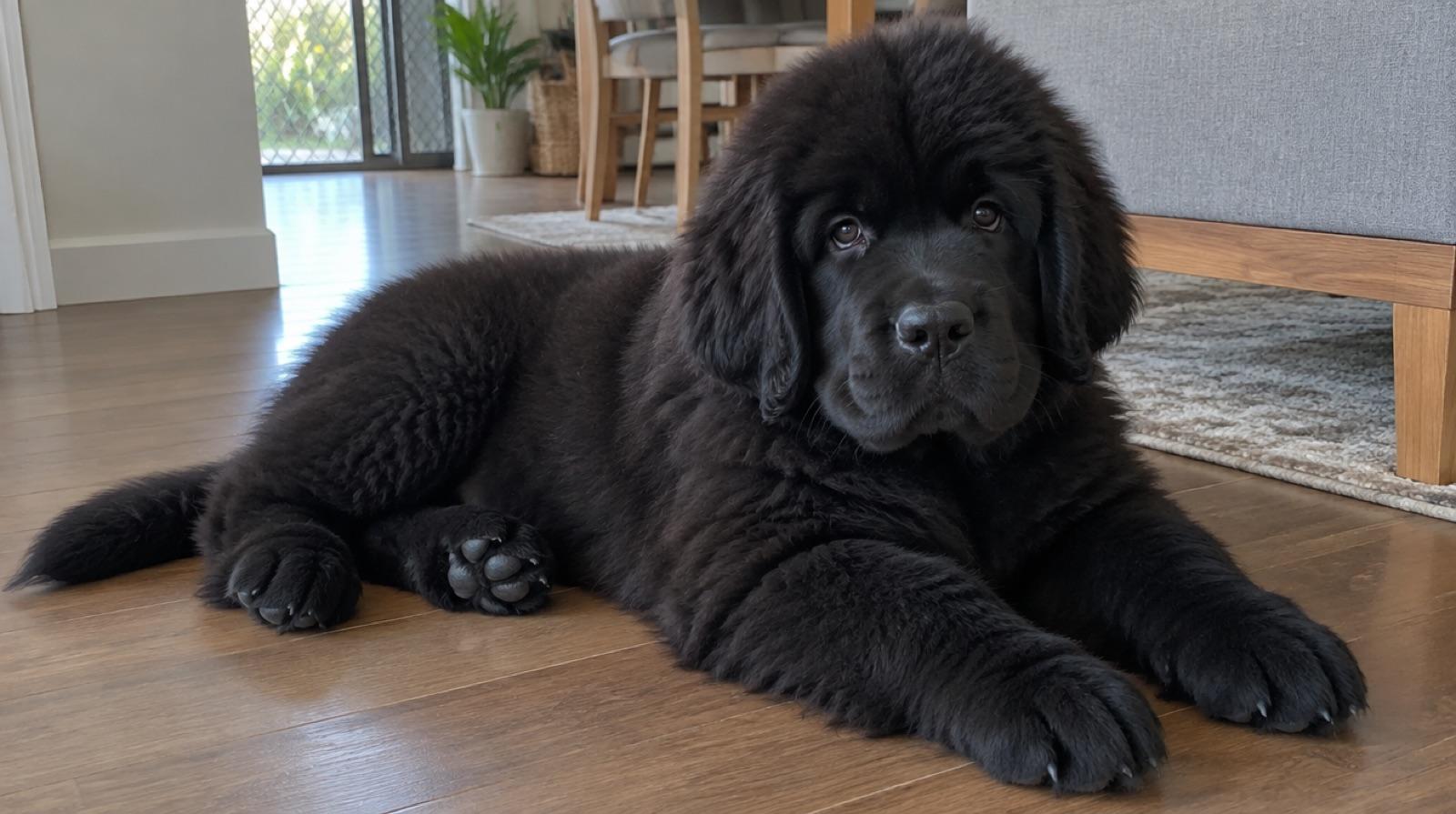
Should you adopt or buy a Newfoundland?
It depends on whether it has to be a puppy. Purebred Newfoundland puppies are rare across the rescues we aggregate, so if you want an eight-week-old Newfie from health-checked parents, or a dog for showing or water work, a registered breeder is the realistic route, usually with a waiting list. If what you want is the dog (the gentleness, the loyalty, the love of water), an adult Newfoundland or Newfie cross from rescue comes with a known size, drool level and record of coping with heat, which matters a great deal in a giant breed.
The RSPCA Australia Knowledgebase suggests the RSPCA or a reputable rescue first, and if you go to a breeder, making sure they are registered, visiting where the puppies were born and meeting the parents. Our guide to adopting a dog in Australia covers the rescue process step by step.
| Route | Reference cost | What you usually get | Main risk |
|---|---|---|---|
| Dogs Australia registered breeder | No breeder website we read publishes a price; ask | A purebred puppy with a certified pedigree, ideally from hip, elbow, heart and cystinuria checked parents | Testing varies, so ask; waiting lists |
| General rescue or pound | The standard fee, for example $500 for an adult dog at RSPCA NSW | Newfoundlands and crosses, desexed, microchipped and vaccinated | Purebreds are rare; unknown parent health |
| Classified ad or social media | Anything | Anything from an untested litter to a puppy that does not exist | Scams, no health guarantee |
Reference only, not quotes. Figures read on 11 November 2026; breeders and rescues set their own prices and change them, so check with them.
How much is a Newfoundland puppy from a registered breeder?
There is no published figure to quote. No Australian Newfoundland club we found publishes a price. The Newfoundland Club of Victoria does say what a fair price should not depend on: reputable breeders will not charge more for different sexes or colours, and the only allowable colours in Australia are black, brown and Landseer (white with black). The club adds that a dog of any other colour should be sold as a pet only.
In November 2026 we read the own websites of 9 Australian Newfoundland breeders, most of them on the Newfoundland Club of Victoria's member list or showing their state body membership. None published a puppy price: most show past litters, photo albums or contact details only, and several litter pages are years old. Prices on listing sites are left out, because we cannot check who is selling. So the honest answer is: ask each breeder, and compare what the price includes, such as vaccinations, microchip, a vet check and puppy insurance.
| Who published it | Reference figure | Read |
|---|---|---|
| Breeders, own websites (9 read) | No price published | 11 Nov 2026 |
| Australian Newfoundland clubs | No price published | 11 Nov 2026 |
| RSPCA NSW, adult dog | $500 | 11 Nov 2026 |
| RSPCA NSW, under 12 months | $620 | 11 Nov 2026 |
Reference only, not quotes. Fees change, so check with the rescue. RSPCA NSW says its fee covers desexing, microchipping, vaccinations and health checks by its veterinary team.
Which health tests should a Newfoundland breeder show you?
Hips, elbows, heart and cystinuria, for both parents. The Newfoundland Club of Victoria says reputable breeders provide health reports for hips, elbows and cystinuria for both parents of a litter. Dogs NSW says parents should be hip and elbow scored and buyers should ask to see the scores, that breeders should supply a clearance form for cystinuria, and that heart problems tend to be a common concern in the breed. The Newfoundland Club of America considers it necessary to test for four disorders: hip dysplasia, elbow dysplasia, cystinuria and heart disease, particularly sub-aortic stenosis (SAS).
| Check | Who asks for it | What to ask for |
|---|---|---|
| Hip score | Newfoundland Club of Victoria, Dogs NSW, Royal Kennel Club, US club | Both parents' scores |
| Elbow score | Newfoundland Club of Victoria, Dogs NSW, Royal Kennel Club, US club | Both parents' results |
| Cystinuria DNA | Newfoundland Club of Victoria, Dogs NSW, Royal Kennel Club, US club | Clear, carrier or affected for each parent, or clear by parentage |
| Heart | US club (exam by a board certified cardiologist); UK club (Echo Doppler scan for SAS and dilated cardiomyopathy) | Whether a cardiologist checked the parents, and the result |
| Eyes | Royal Kennel Club (best practice); US club (recommended) | Recent eye certificates |
| Patellas and thyroid | US club (recommended) | Whether the parents were tested |
Sources: Newfoundland Club of Victoria, Dogs NSW, the Royal Kennel Club (UK), The Newfoundland Club (UK) and the Newfoundland Club of America health statement, read 11 November 2026. This is a buying checklist, not veterinary advice. Our Newfoundland health guide covers what these conditions mean once you own one.
Two of these deserve a plain explanation. Cystinuria is tested with a DNA swab that sorts a dog into clear, carrier or affected, according to The Newfoundland Club in the UK, and the US club says it is the only one of the four core conditions with a simple inheritance and a genetic test that lets breeders avoid producing it completely. The heart test looks for SAS and dilated cardiomyopathy; the UK club says some puppies have an innocent murmur that disappears at around 18 weeks, and that an accurate diagnosis needs a cardiologist. Dogs NSW advises taking a new puppy to the vet for a heart check as early as possible.
Even with every test done, the US club says that only cystinuria can be avoided completely; for hips, elbows and heart, testing lowers the chance of a problem but cannot guarantee against it. The Newfoundland Club of Victoria also says reputable breeders require an independent vet check within a set time, offer a refund or replacement if a serious health issue is found, and offer six weeks of puppy insurance while asking you to keep insurance for at least 12 months.
Bloat needs its own word because it is an emergency. The University of Sydney Veterinary Teaching Hospital names Newfoundlands among the deep-chested dogs at risk of gastric dilatation-volvulus (GDV), in which the stomach fills with gas and rotates, and the Newfoundland Club of Victoria calls bloat a life-threatening illness that needs immediate veterinary care. If your dog retches with nothing coming up, has a swollen belly or drools heavily, call or go to your nearest vet now. Our dog bloat (GDV) guide covers the signs and what to ask your vet about prevention.
See the Newfoundlands listed right now
Newfoundlands and Newfie crosses from the rescues, shelters and council pounds we aggregate, with each rescue's notes on size, children, other dogs and time alone. Every listing links to the rescue, where you apply directly.
Can a Newfoundland cope with an Australian summer?
Constant panting, rapid breathing, pale or red gums, drooling, vomiting, weakness or dizziness on a hot day can be heatstroke. Start cooling the dog with cool or room-temperature water and get to a vet immediately.
Yes, with an owner who plans every summer around the dog. The Dogs Australia standard describes a coat that is flat, dense, of an oily nature and capable of resisting water, and Dogs NSW says the double coat protected the breed from the icy temperatures of the ocean. That is the opposite of an Australian January. Size adds to the risk: in a study of 905,543 dogs under veterinary care in the UK in 2016, dogs weighing over 50 kg had 3.42 times the odds of heat-related illness of dogs under 10 kg (Hall, Carter and O'Neill, 2020), and the breed standard's fair average weight for a male is 64 to 69 kg.
The RSPCA Knowledgebase on heatstroke sets out what to do:
- Walk at the coolest times of day, which in summer usually means early morning or late evening.
- Shade, airflow and water at all times. The RSPCA says a cool, shaded, well-ventilated area should always be available.
- Avoid hot surfaces, including bare ground and brown grass in sunny, dry spots.
- Keep the dog lean. The RSPCA says overweight dogs overheat faster.
- Never leave a dog in a car, even on an overcast day with the windows down.
Two breed points help. Dogs NSW says swimming is a preferred exercise for this water breed, and the Newfoundland Club of Victoria says hot spots (skin infections) can be common, and that regular grooming to remove dead coat and drying the dog thoroughly after swimming or bathing lowers the chance of them. Our dogs in hot weather guide has the full first aid and state hot-car rules.
How much exercise does a Newfoundland need?
Less than most people expect for a dog this size. The Royal Kennel Club in the UK rates the Newfoundland at “up to 1 hour per day”, and lists it as a large dog suited to a large house, a large garden and the country. Dogs NSW says the breed does not need a lot of exercise but will lean towards laziness if allowed, and that a daily 30-minute walk is enough for an adult.
Puppies are different. Dogs NSW says a Newfoundland puppy's exercise should be kept to a minimum to avoid joint damage, and the Newfoundland Club of Victoria says the breed is particularly susceptible to joint and orthopaedic problems and that following your breeder's advice on diet and exercise helps lower the risk. The dog exercise calculator shows the Kennel Club breed ratings side by side, with RSPCA advice for puppies and hot days.
What does a giant dog cost to keep?
More than the purchase price, every year. The Animal Medicines Australia Pets in Australia 2025 release estimated that dog-owning households spent $2,520 a year on average, for dogs of every size. A dog that weighs 50 to 69 kg as an adult (the breed standard's fair average for bitches and dogs) eats more food and needs a bigger bed, crate and car than an average dog. That figure is a national average from a survey, not a quote, and a Newfoundland's bills may well sit above it.
Add the breed's own costs: daily grooming (the Royal Kennel Club rates grooming as every day), the insurance the Newfoundland Club of Victoria asks puppy buyers to keep for at least 12 months, and the possibility of joint, heart or bloat treatment. The dog cost calculator estimates the first year for a large dog, and our giant-breed ownership guide covers space, drool and day-to-day life.
What do Newfoundlands in rescue look like?
Mostly adults and crosses. Across the rescues, shelters and council pounds we aggregate, a purebred Newfoundland is listed only now and then. Because so few come up, an alert on the Newfoundland breed page matters more than checking once.
An adult from a rescue or foster home has finished growing, so you can see its full size, how much it drools and how it copes on a warm day, along with notes on children, other dogs and time alone. For a first-time giant-dog owner, that knowledge is worth a lot. The Newfoundland Club of Victoria also says it may be able to help owners who can no longer keep their Newfoundland, after the original breeder; it is worth asking the club whether it knows of an adult needing a home.
How do Newfoundland puppy scams work?
Never pay a deposit for a Newfoundland puppy you have not seen with its mother. The Newfoundland Club of Victoria says never to put a deposit on a puppy you have not physically seen, with a person you have not personally met.
The Newfoundland Club of Victoria warns of scams offering “non drooling” or “hypoallergenic” Newfoundlands, and of sellers who send pictures of a puppy and offer to freight it to you after an upfront deposit. Scamwatch says scammers set up fake websites and fake social media and marketplace profiles to sell popular breeds and pets that do not exist, and that a very cheap pet is likely a scam.
- No breeder number. The Queensland Government says puppy sale scams are on the rise and not to buy a puppy from a person who does not have a valid breeder identification number (BIN). NSW, Victoria, South Australia and the ACT also require an identifying number in puppy ads. Look it up on the official register, not through a link the seller sends.
- A membership number you cannot check. Ask for the breeder's Dogs Australia membership number and check it with the state body yourself. The Newfoundland Club of Victoria says a reputable breeder provides a certified pedigree issued by the state controlling body.
- “No papers” and no scores. The club says a dog advertised with no papers, or with parents that have no hip and elbow scores, should ring an alarm bell.
- A deposit before you have seen anything. The club says reputable breeders do not ask for a deposit before you have seen the litter or before health checks are done.
- A “rare colour” premium. Black, brown and Landseer are the only allowable colours in Australia, and the club says reputable breeders do not charge more for colour or sex.
Our guide to puppies for sale in Australia has the full state-by-state table of breeder numbers and what to do if you have already paid.
When is a registered breeder the better choice?
Rescue is not right for everyone. A registered breeder makes sense if you want a Newfoundland for showing, water work or carting, if you want a puppy from health-checked parents with a known family history, or if you have watched the rescue listings for months and no adult has suited your home.
- Registration. Check the membership number with Dogs Australia or your state body, and your state's breeder number on the official register.
- A club check. The Newfoundland Club of Victoria lists its member breeders, including some in NSW, SA and Tasmania, and Dogs NSW lists Newfoundland breeders on its breed page.
- Health results for both parents: hips, elbows, cystinuria and a heart check.
- The mother, in person, and where the puppies are raised. The club says a reputable breeder will invite you to visit the litter and meet the parents (at least the dam).
- A written contract covering health, rearing, breeding and breeder support, and whether the breeder will take the dog back. The club says reputable breeders require dogs they bred to be returned if you cannot keep them.
Is a Newfoundland the right dog for you?
The Dogs Australia breed standard describes “a water dog, used for life-saving” that “should have an exceptionally gentle and docile nature”. It gives a fair average height of 71 cm for dogs and 66 cm for bitches, and a fair average weight of 64 to 69 kg for dogs and 50 to 54.5 kg for bitches. Be honest about five things.
| Question | What the sources say |
|---|---|
| Drool and hair | Dogs NSW says the breed is prone to excessive drooling and sheds all year; the Newfoundland Club of Victoria says if you do not like drool and dog hair everywhere, this breed is not for you |
| Grooming | Every day on the Royal Kennel Club rating; Dogs NSW says matting is a common problem without regular brushing |
| Time alone | Dogs NSW says Newfoundlands left in their own company too long can become depressed and destructive |
| Training | Dogs NSW says obedience training is a must from an early age |
| Heat | A dense water-resistant coat (Dogs Australia standard); exercise in the coolest hours and shade at all times (RSPCA) |
Not sure a giant breed fits? The what dog breed is right for me quiz and the adoption readiness check each take a few minutes, and big dog breeds compares the Newfoundland with other large and giant dogs.
Find a Newfoundland near you
Newfoundlands and Newfie crosses listed by rescues, by city:
- Newfoundlands for adoption in Sydney
- Newfoundlands for adoption in Melbourne
- Newfoundlands for adoption in Brisbane
- Newfoundlands for adoption in Perth
- Newfoundlands for adoption in Adelaide
Local guides to adopting a Newfoundland, with the rescues that serve each city: Sydney, Melbourne, Brisbane, Gold Coast, Perth, Adelaide.
Weighing up other giant breeds? Our Saint Bernard, Bernese Mountain Dog, Great Dane and Alaskan Malamute guides cover the same questions. For active gundogs, see the Weimaraner, English Springer Spaniel and German Shorthaired Pointer guides, and for other big dogs the Rhodesian Ridgeback and Bernedoodle guides. The large dogs in Sydney and in Melbourne are worth a look too.
Frequently asked questions
Should I adopt or buy a Newfoundland puppy?▼
Buy from a Dogs Australia registered breeder if it has to be a Newfoundland puppy, because purebred Newfie puppies are rare across the rescues we aggregate, and ask for both parents' hip, elbow, heart and cystinuria results. Adopt if you are open to an adult or a Newfoundland cross: they are listed by rescues and pounds from time to time, and an adult's size, drool and coping with heat are already known. Either way, this is a giant dog that needs space, grooming and a cool place in summer.
How much is a Newfoundland puppy in Australia?▼
No Australian Newfoundland club we found publishes a price, and none of the breeders whose own websites we read in November 2026 published one. Breeders give prices when you ask, so ask several what they charge and what it includes. The Newfoundland Club of Victoria says reputable breeders do not charge more for different sexes or colours. For comparison, RSPCA NSW listed $500 for an adult dog and $620 for a dog under 12 months. These are reference figures read on 11 November 2026, not quotes; fees change, so check with the rescue.
What health tests should a Newfoundland breeder show me?▼
Hip and elbow scores, a heart check and a cystinuria DNA result for both parents. The Newfoundland Club of Victoria says reputable breeders provide health reports for hips, elbows and cystinuria for both parents, and Dogs NSW says buyers should ask to see the hip and elbow scores and that breeders should supply a cystinuria clearance. The Newfoundland Club of America requires hips, elbows, a heart exam by a board certified cardiologist and a cystinuria DNA test.
What is cystinuria in Newfoundlands?▼
It is an inherited condition that breed clubs ask breeders to test for with a DNA swab, which sorts dogs into clear, carrier or affected. The Newfoundland Club of America says cystinuria is the only one of its four core conditions with a simple inheritance and a genetic test that lets breeders avoid producing the disease completely. Ask for both parents' results, or confirmation that a parent is clear by parentage.
Do Newfoundlands get heart problems?▼
Heart disease is one of the conditions breed clubs screen for. Dogs NSW says heart problems tend to be a common concern for the Newfoundland and advises a vet heart check for a new puppy as early as possible. The Newfoundland Club of America names sub-aortic stenosis (SAS) as the heart disease of particular concern and requires a heart exam by a board certified cardiologist. Ask whether the parents were checked by a cardiologist.
Do Newfoundlands get bloat?▼
They can. The University of Sydney Veterinary Teaching Hospital names Newfoundlands among the deep-chested dogs at risk of gastric dilatation-volvulus (GDV), and the Newfoundland Club of Victoria calls bloat a life-threatening illness that needs immediate veterinary care. Signs include retching with nothing coming up, a swollen belly and drooling: if you see them, call or go to your nearest vet now.
Can a Newfoundland live in the Australian heat?▼
Yes, with real care. The breed has a dense, water-resistant double coat. The RSPCA Knowledgebase says to exercise dogs at the coolest times of day, give a cool, shaded, well-ventilated area and water at all times, avoid hot surfaces and never leave a dog in a car. A UK study of dogs under veterinary care found dogs over 50 kg had higher odds of heat-related illness than dogs under 10 kg. Heatstroke is an emergency: see a vet immediately.
How much exercise does a Newfoundland need?▼
Less than many large breeds. The Royal Kennel Club in the UK rates the Newfoundland at up to 1 hour of exercise a day, and Dogs NSW says a daily 30-minute walk is enough for an adult, with swimming a preferred exercise because it puts little pressure on the joints. Dogs NSW also says puppies' exercise should be kept to a minimum to avoid joint damage.
How long do Newfoundlands live?▼
Usually around 8 to 12 years. The Newfoundland Club of Victoria gives an expected lifespan in Australia of between 8 and 12 years or sometimes longer, and the Royal Kennel Club lists the breed's lifespan as under 10 years. Plan for a giant dog's vet and food bills over that time.
Are Newfoundlands good with children?▼
The breed is known for its gentle temperament, but size matters. The Dogs Australia standard asks for an exceptionally gentle and docile nature, and Dogs NSW calls the Newfoundland a true gentle giant. Dogs NSW also says obedience training is a must from an early age, because an untrained giant can do a lot of damage, so supervise children with any dog this big.
Is a Newfoundland that does not drool, or a hypoallergenic Newfoundland, real?▼
Treat it as a red flag. The Newfoundland Club of Victoria warns of scams offering non drooling or hypoallergenic Newfoundlands, and of sellers who send photos and offer to freight a puppy after an upfront deposit. The club says never to put a deposit on a puppy you have not physically seen, with a person you have not personally met.
Where can I see Newfoundlands for adoption right now?▼
The Newfoundland breed page on LocalPetFinder shows Newfoundlands and Newfie crosses listed by the rescues, shelters and council pounds we aggregate, with a page for each major city. Every listing links to the rescue, where you apply directly. Set an alert, because purebred Newfoundlands come up only now and then.
Sources
- Dogs Australia: Newfoundland breed standard
- Dogs NSW: Newfoundland
- Newfoundland Club of Victoria: About the breed
- Newfoundland Club of Victoria: What to look for in a reputable breeder
- Newfoundland Club of Victoria: Where do I get a Newfoundland puppy
- Royal Kennel Club (UK): Newfoundland
- The Newfoundland Club (UK): Health matters and testing schemes
- Newfoundland Club of America: Health statement
- Newfoundland Club of America: Health information for buyers
- University of Sydney Veterinary Teaching Hospital: Surgery FAQs
- RSPCA Australia Knowledgebase: How can I protect my dog from heatstroke?
- Hall, Carter and O'Neill (2020), Scientific Reports: heat-related illness in UK dogs
- Animal Medicines Australia: Pets in Australia 2025 media release
- Queensland Government: Puppy farms and puppy scams
- Scamwatch: Buying and selling scams
- RSPCA NSW: Adoption fees
- RSPCA Australia Knowledgebase: Where should I go for a new companion animal?
Keep reading
Newfoundlands listed by rescues
Newfoundlands and Newfie crosses listed right now by the rescues and pounds we aggregate across Australia.
Living with a giant breed
Space, drool, coat care, heat and the running costs of sharing a home with a Newfoundland.
Newfoundland health issues
Hips, elbows, heart and the other conditions to watch for as a Newfoundland ages.
Dog bloat (GDV)
The signs of bloat, why it is an emergency, and what to ask your vet about prevention.