The short answer
The grey (blue) cat breeds are the Russian Blue (green eyes, silvery double coat), the British Shorthair in blue (gold to copper eyes, solid, powerful build), the Korat (silver-tipped single coat, green eyes, heart-shaped face), the Chartreux (blue-grey woolly coat, copper to gold eyes) and the Nebelung (semi-longhaired, green eyes). All are blue because of the same recessive dilute gene, which also makes ordinary grey moggies. The Russian, British Shorthair and Korat have standards with the CCCA and the Australian Cat Federation; the Nebelung has an ACF standard; the Chartreux appears in the ANCATS breed list but on neither the CCCA nor the ACF standards list. In rescue, almost every grey cat is a blue Domestic Shorthair or Longhair, and fees go by age, not colour.
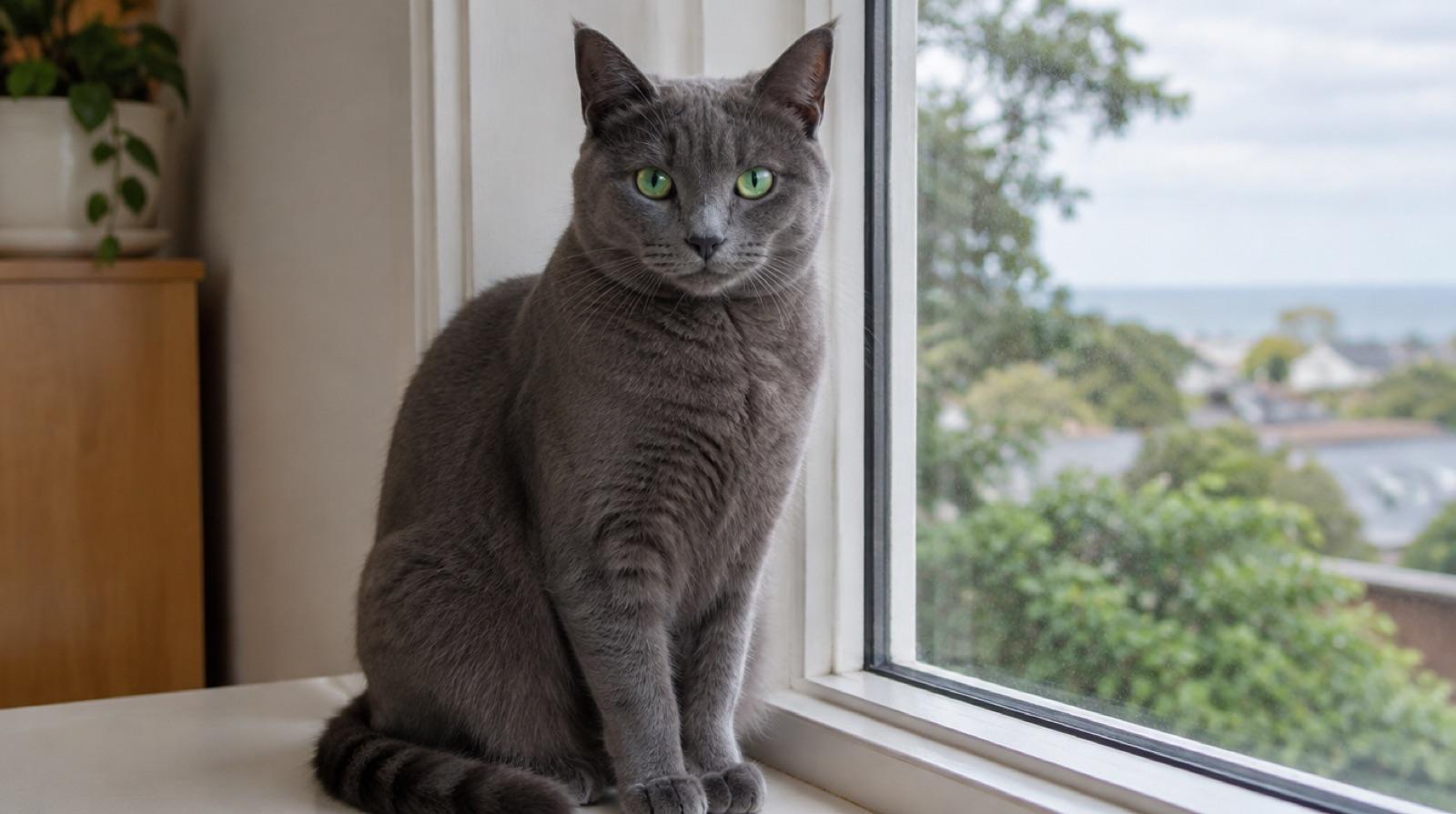
Why are grey cats called blue?
Blue is the cat-fancy name for grey, and genetically a blue cat is a diluted black cat. A 2006 study by Ishida and colleagues describes the dilute phenotype in domestic cats: “black pigmentation combined with dilute appears gray and orange pigments appear cream.” They traced it to a single-letter deletion in a gene called MLPH (melanophilin), one of the proteins that spreads pigment granules evenly. The deletion cuts the protein short, and the coat looks paler.
- It is recessive. A cat must inherit the variant from both parents to be blue, so two black cats that each carry one copy can have blue kittens, and two blue cats have only dilute kittens.
- It is the same gene in every breed. The study found the same variant in 97 unrelated dilute cats from 26 breeds and random-bred cats, and concluded a single mutation event gave rise to dilute in domestic cats. A Russian Blue and a grey moggy are grey for the same reason.
- It affects other colours too. Dilution turns ginger to cream and black-and-orange tortoiseshell to blue-cream. Our moggy colours guide covers those.
What separates the grey breeds is everything else: coat length and texture, silver tipping on the hairs, body shape and, most usefully, eye colour.
Which cat breeds are grey, and how do you tell them apart?
| Breed | Coat | Eyes (adult) | Colours allowed | Australian councils with a standard or listing |
|---|---|---|---|---|
| Russian Blue | Short, plush double coat with a silvery sheen | Clear, vivid green | Blue, white or black (CCCA and ACF) | CCCA, ACF, ANCATS |
| British Shorthair (blue) | Short, dense; blue sound to the roots | Deep gold to orange or copper, no green | Many colours; blue is one | CCCA, ACF, ANCATS |
| Korat | Short single coat, tipped with silver | Luminous green; amber cast acceptable | Silver-tipped blue (the CCCA registers other colours only as AOV Korat) | CCCA, ACF, ANCATS |
| Chartreux | Dense, woolly, water-resistant | Copper to gold; green disqualifies (CFA) | Blue-grey only, ash to slate (CFA) | ANCATS breed list only |
| Nebelung | Semi-long, silky, with silver tipping | Green, as vivid as possible | Solid blue only (ACF) | ACF |
Sources: CCCA Russian, Korat and British Shorthair standards; ACF Russian, Korat and Nebelung standards; CFA Chartreux. Recognition from the CCCA and ACF standards lists and the ANCATS breed list, all read 10 November 2026. Councils add breeds over time; ask a breeder which council registers their cats.
The quick test is the eyes. Green means Russian, Korat or Nebelung. Gold, orange or copper means British Shorthair or Chartreux. Then look at the coat: a long coat is a Nebelung; a single, close-lying coat with obvious silver tips is a Korat; a plush coat that stands out from the body is a Russian.
Russian Blue
The best-known grey breed, called simply the Russian in the Australian standards. The CCCA standard describes a double coat with “a distinct silvery sheen or shimmer in all colours,” and calls that coat the breed's most important characteristic. Its blue is “clear, light to medium,” free from tabby markings in maturity, and the eyes are “clear, vivid green,” with allowance in kittens whose eye colour has not fully developed. The CCCA and the ACF both also accept Russian White and Russian Black, and ANCATS says that originally the Russian cats were blue cats.
Pedigree Russians are uncommon in rescue. Our Russian Blue adopt-or-buy guide covers registered breeders (the Russian Cat Council of Australia lists them), prices, the allergy myth and the look-alikes.
British Shorthair (the British Blue)
The British Shorthair comes in many colours, and blue is the colour behind its nickname: the CFA says these cats were first registered in the United States as “British Blues.” The CCCA standard (December 2024) asks for a light to medium blue, sound to the roots, with darker tones undesirable, and says “silver tipping is a fault,” the opposite of the Russian and Korat. Eyes range from deep gold through orange to copper, with no trace of green. The CCCA describes a solid, powerful cat with a short, level back and short, strong legs, with no tendency to fine legs.
For breeder checks, HCM heart testing and British Blue crosses in rescue, see our British Shorthair adopt-or-buy guide.
Korat
A Thai breed that comes in one colour only. The ACF standard calls it “a rare cat even in Thailand,” regarded there as a “good luck” cat, and describes a silver-tipped blue coat where the hair is lighter at the roots and deepest blue just before the silver tips. The CCCA standard says “the more silver the better” and penalises lack of silver tipping; the CFA disqualifies “any color but silver-tipped blue.”
The eyes are large and prominent, “luminous brilliant green, but amber cast acceptable.” Kittens and adolescents have yellow or amber-green eyes, and the CCCA says full eye colour may not be established until maturity, which can take up to three years. LocalPetFinder has no Korat breed page; a green-eyed grey cat in rescue is far more likely to be a moggy, as explained below.
Chartreux
A French breed with a woolly blue coat and orange eyes. The CFA standard allows “any shade of blue-gray from ash to slate; tips lightly brushed with silver,” with eyes from copper to gold and “a clear, deep, brilliant orange” preferred; green eyes disqualify. The CFA says the coat is dense, woolly and somewhat water-resistant, and that the old story of the Carthusian monks is uncertain: the name may come from a type of Spanish wool instead.
Recognition in Australia is patchy. The Chartreux has no standard on the CCCA or ACF standards lists we read in November 2026. ANCATS includes it in the breed list on its website. Internationally, FIFe names it among the breeds it has recognised since its foundation in 1949. If you are offered a Chartreux kitten here, ask which council registered the litter and check the membership yourself.
Nebelung
A semi-longhaired blue cat with green eyes. The ACF standard (effective 1 January 2020) describes “an elegant cat of foreign type with a semi-longhair coat of soft, silky texture in an attractive, medium blue with a silvery sheen,” asks for “an even, clear, medium blue” with silver-tipped guard hairs, solid pattern only, and green eyes “as vivid as possible.” Its only allowable outcross is the Russian Blue, which is why it is often called a long-haired Russian. The standard also notes Nebelungs are shy and need quiet, gentle handling.
In Australia, the Nebelung has a standard with the ACF but is not on the CCCA standards list or the ANCATS breed list we read.
See the grey cats listed right now
Grey and blue cats from the Australian rescues we aggregate, refreshed regularly. Kittens, adults and seniors.
Which other breeds come in blue?
Many. Because dilute is one widespread recessive gene, plenty of breeds list blue among their colours: the CCCA Burmese standard, for example, recognises blue and blue tortoiseshell, and the Ragdoll has blue points. What makes the five breeds above “grey breeds” is that blue is their signature colour, or their only one.
Is my grey rescue cat a pedigree?
Almost certainly not, and that is fine. In a University of Sydney study, Miller, Ward and Beatty (2019) analysed 2,584 cats adopted from a metropolitan Sydney shelter: 99.1% were mixed breed, and 142 (5.5%) were grey, a category the authors defined to include grey, charcoal, silver and blue. So a grey cat in rescue is usually a blue Domestic Shorthair or Domestic Longhair: a moggy with two copies of the dilute gene. Shelters sometimes describe a grey cat as a Russian Blue or British Blue by its look; without papers, that is a description, not a pedigree.
The same study is good news for grey cats: compared with black cats, grey cats did not stay significantly longer before adoption; only white cats did. Our Domestic Shorthair guide explains the moggy label.
Does a grey coat mean anything for health, allergies or personality?
- Allergies: no. ASCIA says all cat breeds can cause allergies, because all cats have sebaceous glands. A grey coat, and a Russian Blue's reputation, do not change that. See our hypoallergenic cats guide.
- Health: no colour link we found. Dilution is a pigment change. Breed health points belong to the breed: the British Shorthair, for example, is among the breeds believed to be at increased risk of HCM heart disease, as our British Shorthair guide explains.
- Personality: breed and individual, not colour. We found no study linking grey or blue to behaviour in cats. Breed descriptions differ (the ACF calls the Nebelung shy), but every cat is an individual; ask the rescue or foster carer.
How do you adopt a grey cat?
Through rescue, like any cat. Fees go by age and rescue, not colour. RSPCA NSW lists $220 for a cat over six months and $270 for a kitten, and the Cat Protection Society of NSW lists $150 per cat or kitten, or $250 for two (both checked 10 November 2026). These are reference figures, not quotes; check the rescue's own page.
If you want a papered Russian, British Shorthair or Korat, a registered breeder is a reasonable choice; check the council membership yourself, as our adopt-or-buy guides explain. For the wider decisions, see adopting a cat in Australia, types of cats and the what cat breed am I quiz.
Find a grey cat near you
- Sydney: grey cats, Russian Blues, British Shorthairs, kittens
- Melbourne: grey cats, Russian Blues, British Shorthairs, kittens
- Brisbane: grey cats, Russian Blues, British Shorthairs, kittens
- Perth: grey cats, Russian Blues, British Shorthairs, kittens
- Adelaide: grey cats, Russian Blues, British Shorthairs, kittens
- Australia-wide: all grey cats, Russian Blues and British Shorthairs. City guides: Russian Blue adoption in Sydney, British Shorthair adoption in Melbourne.
Not sure yet? The adoption readiness check takes five minutes, and the dog or cat? quiz helps if you are still deciding on the species.
Frequently asked questions
What breeds of cat are grey?▼
The breeds known for grey (called blue by breeders) are the Russian Blue, the British Shorthair in blue (the British Blue), the Korat, the Chartreux and the Nebelung. The Korat and Chartreux come only in blue, the Nebelung only in blue under the Australian Cat Federation standard, and the Russian also in white and black in Australia. Many other breeds, such as the Burmese, have a blue colour among others.
Why do breeders call grey cats blue?▼
It is the cat-fancy word for grey. Genetically a blue cat is a black cat whose pigment has been diluted. A 2006 study by Ishida and colleagues traced dilution to a recessive variant of the MLPH gene, which turns black to grey and orange to cream. The same variant was found in dilute cats of 26 breeds and in random-bred cats.
How can you tell a Russian Blue from a British Blue?▼
Look at the eyes and the build. The Russian has vivid green eyes, a fine-boned, elegant body and a silvery sheen on its coat. The British Shorthair blue has deep gold to copper eyes, a solid, powerful body and an even blue coat, and the Coordinating Cat Council of Australia standard calls silver tipping a fault in a British Blue.
What is the difference between a Korat and a Russian Blue?▼
The Korat has a single coat tipped with silver, a heart-shaped face and very large, prominent green eyes, and comes only in silver-tipped blue. The Russian has a plush double coat that stands out from the body, almond-shaped green eyes and, in Australia, comes in blue, white or black. Korat kittens have yellow or amber-green eyes, and the CCCA says full eye colour can take up to three years.
Is the Chartreux recognised in Australia?▼
Not by every council. The Chartreux has no standard on the CCCA or Australian Cat Federation standards lists we read in November 2026, but Australian National Cats (ANCATS) includes it in the breed list on its website. Internationally, FIFe has recognised it since 1949 and the US Cat Fanciers' Association has a standard: blue-grey from ash to slate, with copper to gold eyes.
What is a Nebelung?▼
A semi-longhaired blue cat with green eyes, sometimes described as a long-haired Russian Blue. In Australia the Australian Cat Federation has a Nebelung standard (effective 1 January 2020), which lists the Russian Blue as an allowable outcross and accepts only solid blue with silver tipping. It is not on the CCCA standards list or the ANCATS breed list we read.
Are grey cats rare?▼
Not especially. In a University of Sydney study of 2,584 cats adopted from a Sydney shelter (Miller and colleagues, 2019), 142 (5.5%) were grey, a category that included grey, charcoal, silver and blue. That was about the same as white cats and fewer than black, red or tabby cats.
Is my grey cat a Russian Blue?▼
Probably not, unless it came with papers. In the 2019 Sydney shelter study, 99.1% of adopted cats were mixed breed. A grey short-haired cat in rescue is far more likely to be a blue Domestic Shorthair, an ordinary moggy, than a pedigree. Green eyes and a fine build are Russian traits, but moggies can have them too.
Do grey cats wait longer to be adopted?▼
Not in the one Sydney study we found. Miller and colleagues compared length of stay by colour against black cats and found no significant difference for grey cats; only white cats differed, staying longer. Results from one shelter may not apply everywhere.
Are Russian Blues or other grey cats hypoallergenic?▼
No. The Australasian Society of Clinical Immunology and Allergy (ASCIA) says all cat breeds can cause allergies, because all cats have sebaceous glands. Coat colour does not change that. Spend time with the individual cat before you commit, and talk to your doctor.
Does a grey coat affect a cat's health or personality?▼
Not that any study we found shows. Dilution is a pigment change. Each breed has its own health points (the British Shorthair, for example, is one of the breeds at increased risk of the heart disease HCM), but those belong to the breed, not the colour. Personality depends on the individual cat.
How much does it cost to adopt a grey cat?▼
The same as any cat at that rescue; fees go by age and rescue, not colour. As reference points, RSPCA NSW lists $220 for a cat over six months and $270 for a kitten, and the Cat Protection Society of NSW lists $150 per cat or $250 for two (checked 10 November 2026). These are references, not quotes.
Sources
- Ishida et al. (2006): A homozygous single-base deletion in MLPH causes the dilute coat color phenotype in the domestic cat, Genomics
- Coordinating Cat Council of Australia: Breed standards list
- CCCA: Russian breed standard (November 2023)
- CCCA: Korat breed standard (November 2023)
- CCCA: British Shorthair breed standard (December 2024)
- CCCA: Burmese breed standard (May 2025)
- Australian Cat Federation: Breed standards
- ACF: Nebelung standard (effective 1 January 2020)
- ACF: Russian standard (effective 1 January 2018)
- ACF: Korat standard (effective 1 January 2018)
- Australian National Cats (ANCATS): breed list
- Fédération Internationale Féline: Breeds
- Cat Fanciers' Association: Chartreux
- Cat Fanciers' Association: Korat
- Cat Fanciers' Association: British Shorthair
- Cat Fanciers' Association: Russian Blue
- Russian Cat Council of Australia: Find a registered Russian breeder
- Miller, Ward and Beatty (2019): Population characteristics of cats adopted from an urban cat shelter, Animals
- ASCIA: Pet allergy
- RSPCA NSW: Adoption fees
- Cat Protection Society of NSW: Cats for adoption
Keep reading
Grey cats for adoption
Grey and blue cats listed by Australian rescues, refreshed regularly.
Russian Blue kittens: adopt or buy?
Registered breeders, the allergy myth, scams and Russian Blue look-alikes in rescue.
British Shorthair kittens: adopt or buy?
Breeder checks, HCM and PKD testing, and British Blue crosses in rescue.
Moggy colours and patterns
Blue, cream, tabby, tortie and more in ordinary rescue cats, with the genes behind each.