The short answer
Ragdolls come in three main patterns (colourpoint, mitted and bicolour) and six main point colours (seal, blue, chocolate, lilac, red and cream), each of which can also be tortoiseshell, tabby (lynx) or both, according to the Coordinating Cat Council of Australia standard. The Australian Cat Federation also accepts caramel, apricot, smoke and silver tabby points. All of them share the colourpoint gene, which is why every Ragdoll has blue eyes and a pale body, and why kittens start almost white and darken for up to three years. Mink and solid (non-pointed) Ragdolls are not accepted by any standard we read. Colour does not change temperament, and rescue fees go by age, not colour.
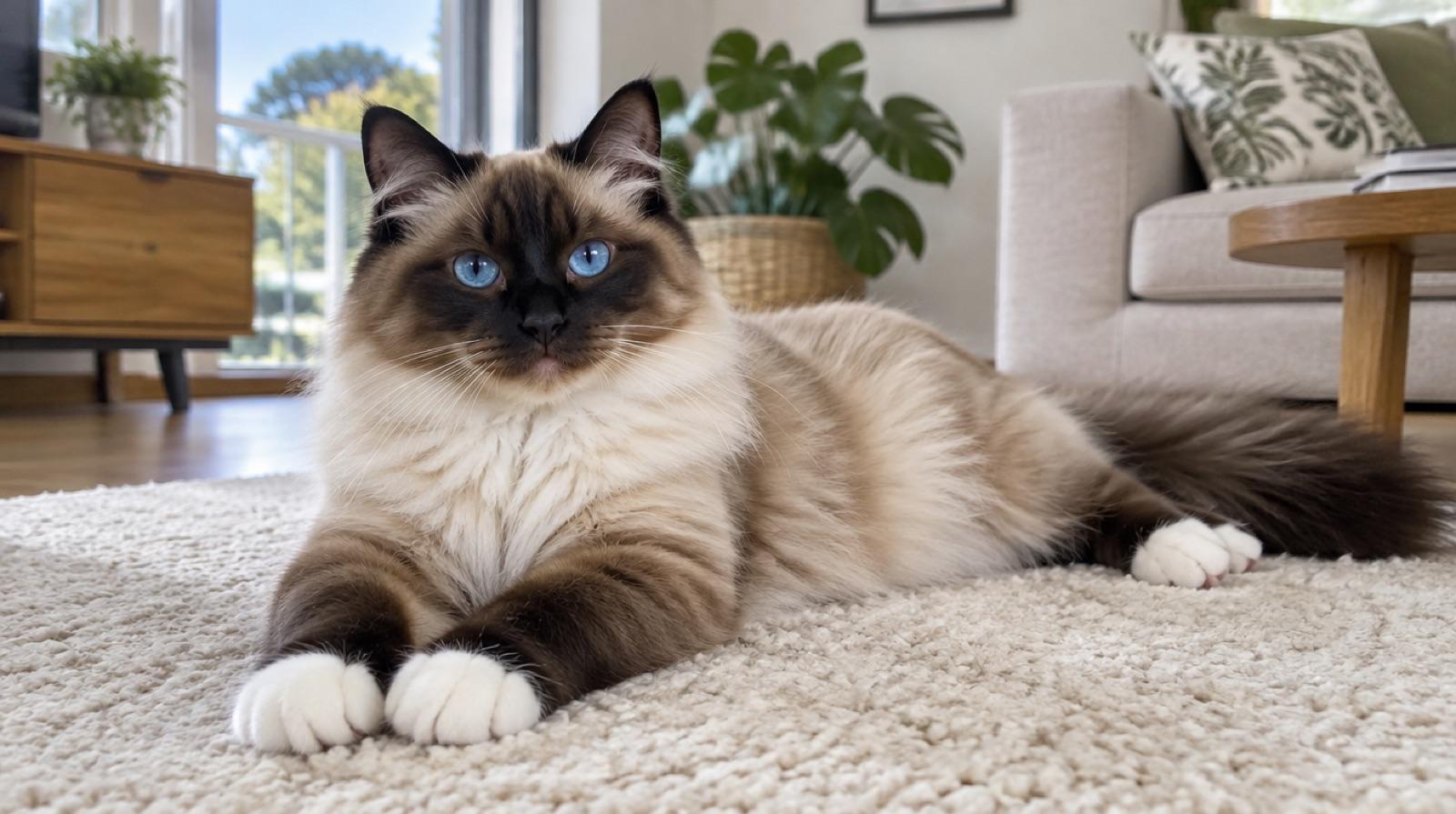
What colours do Ragdolls come in?
Every Ragdoll is pointed: a pale body with darker ears, mask, legs and tail. The Cat Fanciers' Association puts it plainly: “All Ragdolls have the colorpoint gene, meaning that the body is always lighter in color than the head, legs and tail.” Within that, a Ragdoll is described by two things: the colour of its points and the pattern of white over them. A “blue mitted” is blue points with white mittens; a “seal bicolour” is seal points with the bicolour white.
Pedigree cats in Australia are registered through several cat councils, and each has its own Ragdoll standard. The two we read in full differ:
| Group | CCCA (Nov 2023) | ACF (Oct 2023) |
|---|---|---|
| Solid points | Seal, blue, chocolate, lilac, red, cream | The same six, plus caramel and apricot |
| Tortoiseshell points | Seal, blue, chocolate and lilac tortie | The same, plus caramel tortie |
| Tabby (lynx) points | Seal, blue, chocolate, lilac, red and cream tabby | The same, plus caramel and apricot; also silver tabby points in all eight colours, and silver tortie tabbies |
| Tortie-tabby points | Seal, blue, chocolate and lilac | The same, plus caramel |
| Smoke points | Not listed | Seal, blue, chocolate, lilac, red, cream, caramel, apricot and tortie smokes |
| Patterns | Colourpoint, mitted, bicolour | Colourpoint, mitted, bicolour |
| Eyes | “Decidedly blue; the deeper the better” | “Blue, the bluer the better” |
Sources: CCCA Ragdoll standard (issue date November 2023) and ACF Ragdoll standard (updated 11 October 2023), both read 10 November 2026. Other councils (ANCATS, and TICA through its charter club) keep their own standards; ask a breeder which council registers their cats.
In plain colours: seal is a deep brown point on a cream body, blue a cold grey-blue point on a “glacial white” body, chocolate a milk-chocolate point on ivory, lilac a soft pinkish grey on off-white, red a rich apricot and cream a pale cream point, in the CCCA's descriptions. Blue, lilac and cream are the dilute versions of seal, chocolate and red; a 2006 study by Ishida and colleagues traced dilution in cats to a recessive variant of the MLPH gene, the gene that turns black fur grey. The CFA describes the same six point colours and adds that points may be solid, lynx (tabby, including tortie-lynx) or parti-coloured (tortie).
What is the difference between colourpoint, mitted and bicolour?
The amount of white. All three are pointed cats; mitted and bicolour add white spotting on top. The CFA says three of its four Ragdoll patterns “also have the bicolor gene,” and white spotting in cats sits on the KIT gene, according to a 2014 study by David and colleagues. It is a different variant from the dominant white of an all-white cat, which our white cats guide covers.
| Pattern | What you see (CCCA standard) | Disqualifying or withheld (examples) |
|---|---|---|
| Colourpoint | Well-defined points; nose leather and paw pads the colour of the points; “White anywhere is a fault” | White anywhere (CCCA withholds; CFA disqualifies any locket or white spot) |
| Mitted | White chin, bib, chest and underbody; evenly matched white mittens on the front paws; back legs white to at least the hock; a narrow white blaze on the nose allowed | Coloured chin (CCCA); absence of white chin (CFA) |
| Bicolour | An inverted, centred white “V” on the mask; white chest and underbody; completely white front legs; pink nose leather and paw pads | Badly off-centre V, coloured chin (CCCA) |
| Van (CFA only) | Not in the CCCA or ACF standards. The CFA describes a “pure, glistening white” body, legs and feet | Not applicable in Australia under CCCA or ACF |
Sources: CCCA Ragdoll standard; CFA Ragdoll profile and standard, read 10 November 2026.
The bicolour V is the hardest marking to get right: the CCCA says it should start on the forehead and not extend beyond the outer corner of the eyes, and it allows white patches on the body “while not preferred.” Mitted cats are judged on how evenly matched the mittens are. None of this matters to a pet home; it matters to a show judge, and sometimes to a breeder's price.
Why are Ragdolls pointed, and why are their eyes blue?
Because of a temperature-sensitive version of one pigment gene. In 2005, Lyons and colleagues at UC Davis found that the Siamese “pointed” pattern comes from a variant of tyrosinase (TYR), the enzyme that starts melanin production, and that every pointed cat they tested carried two copies. They described the colouration as temperature-sensitive: the enzyme works where the body is cooler (ears, face, paws and tail) and barely works on the warm trunk. The Ragdoll is pointed in the same way, and the CFA says every Ragdoll has the colorpoint gene.
The gene is recessive. A 2006 paper by Imes and colleagues sets out the order at this gene as full colour, then Burmese, then Siamese (pointed), then albino. A cat needs two pointed copies to be pointed, which is also why two Ragdolls always have pointed kittens. The same reduced pigment in the iris gives the blue eyes, and the standards insist on it: the CFA disqualifies “eyes other than blue,” and the CCCA penalises pale eye colour.
Are Ragdoll kittens born white, and when does the colour come in?
They are born very pale. A kitten develops at body temperature in the womb, where the pointed enzyme barely works, so it starts out nearly white. National Geographic, reporting on the Siamese version of the same gene, describes kittens born white whose extremities cool after birth and darken as they mature. The points then keep deepening for years:
- The CCCA tells judges to make allowances for “lack of maturity of colour in kittens and younger cats (under three years)” and for incomplete masks, especially in chocolates and creams.
- ANCATS says Ragdolls are slow maturing, reaching full coat and colour in about three years (ANCATS).
- The CFA says Ragdolls “generally darken with age,” and asks judges to allow for darker colour in older cats.
- Red and cream kittens may show faint ghost barring or tabby marks, which the CCCA says should disappear as the kitten grows; tabby-point leg markings in chocolate and dilute colours can take up to 18 months.
In practice, telling seal from chocolate, or blue from lilac, in a very young kitten can be hard, and a breeder's colour call on a litter is sometimes revised as the kittens grow. If an exact colour matters to you, ask what the parents are. If it does not, an adult cat shows you its finished colour on day one.
See the Ragdolls and Ragdoll crosses listed right now
Pointed, blue-eyed cats from the Australian rescues we aggregate, refreshed regularly. Each listing links to the rescue, where you apply.
What about mink, solid and other non-standard Ragdolls?
Ads sometimes offer “mink,” “sepia” or “solid” Ragdolls, often as rare colours at a higher price. Here is the registry view, from the standards themselves:
- Mink. Mink is the coat the CCCA Tonkinese standard describes, with aqua eyes, and the standard says the Tonkinese was originally the result of a Siamese to Burmese mating. The 2005 Lyons study found the Burmese pattern comes from a different, less temperature-sensitive variant of the same gene, which puts more colour on the body. No Ragdoll standard we read lists mink, sepia or aqua eyes.
- Solid (non-pointed). A cat that is not pointed carries at least one copy of a variant that is dominant over the pointed one, usually full colour (Imes 2006). The CCCA, ACF and CFA standards describe pointed Ragdolls only, and the CFA disqualifies “body and point color other than those listed.”
- Outcrosses. The CCCA Ragdoll standard lists its allowable outcross as “None.”
None of this says anything about the cat as a pet. A mink or solid cat with a Ragdoll-like build may be affectionate and healthy. It means the cat cannot be registered and shown as a Ragdoll under those standards, and a premium charged for a “rare” non-standard colour is buying a sales story. Ask which council registers the litter and check it yourself; our Ragdoll price guide explains how.
Does colour change the price or the personality?
Price: sometimes, by the breeder's choice. When we read the websites of eight cat council member breeders in November 2026 for our Ragdoll price guide, several charged more for bicolour kittens or for particular colours. No cat council sets prices or ranks colours by value. Treat any colour premium as the breeder's pricing, not a measure of quality.
Personality: no evidence. The standards describe one temperament for the whole breed. The CCCA asks for a cat that is “Placid, allowing easy handling at all times” and notes a Ragdoll may flop over on its side, “as suggested by the name.” We found no study linking Ragdoll colour or pattern to behaviour.
Health: no colour link we could source. The health questions that matter for a Ragdoll (the HCM heart mutation and PKD1 kidney test) apply to every colour; they are covered in the price guide and the Ragdoll health guide.
Is that pointed cat in rescue a Ragdoll?
Maybe, but colour cannot prove it. The pointed gene is not exclusive to any breed: the 2005 Lyons study analysed over 200 cats from 12 breeds as well as randomly bred cats, and found the same pointed mutation in different breeds. So a blue-eyed, pointed, semi-longhaired cat in a shelter could be a purebred Ragdoll, a Ragdoll cross, or a moggy that happens to carry two pointed copies. Without papers, careful rescues list it as a Ragdoll cross or a Domestic Longhair.
Clues that point towards Ragdoll ancestry are the ones in the standard: a large, long, heavy-boned cat with a semi-long silky coat, a broad head and a relaxed, easily handled nature. Clues against are a short coat, a fine Siamese-type build, or green or gold eyes. For the look-alikes, see Siamese and Birman, and our moggy colours guide.
How do you adopt a Ragdoll in a particular colour?
Be flexible on colour and set alerts. Purebred Ragdolls usually reach rescue as adults, and a particular colour-and-pattern combination is rarer still, so the useful filter is the cat, not the shade. Fees go by age and rescue, not colour. RSPCA NSW lists $220 for a cat over six months and $270 for a kitten, and the Cat Protection Society of NSW lists $150 per cat or kitten, or $250 for two (both checked 10 November 2026). These are reference figures, not quotes.
Two advantages of an adult: its colour is finished, and its temperament is known. If you want a papered kitten of an exact colour, a registered breeder is a reasonable choice; check the council membership and the parents' HCM and PKD1 results as the price guide explains. Rehoming owners list on our Ragdoll rehoming page. Still choosing a breed? Try the what cat breed am I quiz or the adoption readiness check.
Find a Ragdoll near you
- Sydney: Ragdolls and crosses, long-haired cats, Ragdoll adoption guide
- Melbourne: Ragdolls and crosses, long-haired cats, Ragdoll adoption guide
- Brisbane: Ragdolls and crosses, long-haired cats, Ragdoll adoption guide
- Perth: Ragdolls and crosses, long-haired cats, Ragdoll adoption guide
- Adelaide: Ragdolls and crosses, long-haired cats, Ragdoll adoption guide
- Australia-wide: the Ragdoll breed page, plus cream cats and white cats.
Frequently asked questions
What colours do Ragdolls come in?▼
Every Ragdoll is a pointed cat: a pale body with darker ears, face, legs and tail. The Coordinating Cat Council of Australia (CCCA) standard recognises six point colours (seal, blue, chocolate, lilac, red and cream) in solid, tortoiseshell, tabby (lynx) and tortie-tabby versions. The Australian Cat Federation (ACF) standard also lists caramel, apricot, smoke and silver tabby points.
What are the three Ragdoll patterns?▼
Colourpoint, mitted and bicolour. A colourpoint has no white at all. A mitted Ragdoll has white mittens on the front paws, white back legs, and a white chin, bib and underbody. A bicolour has an inverted white V on the face, white legs and a white underbody. The Cat Fanciers' Association (CFA) in the United States also shows a fourth pattern, van, with a pure white body.
What is the most common Ragdoll colour?▼
No Australian cat council publishes registration counts by colour that we could find, so there is no reliable answer. Seal and blue are the colours listed first in every standard we read, and seal point is the colour most people picture, but that is not a count.
Are Ragdoll kittens born white?▼
They are born very pale and colour in as they grow. The colourpoint gene is temperature-sensitive: pigment forms only where the body is cooler, so a kitten that developed in a warm womb starts out nearly white and its ears, face, legs and tail darken over the following weeks. The standards allow for immature colour for years: the CCCA makes allowance until about three years of age.
Do Ragdolls change colour as they get older?▼
Yes, they usually darken. The CFA says Ragdolls generally darken with age, the CCCA allows for immature colour in cats under three years, and ANCATS says full coat and colour arrive in about three years. Red and cream kittens can show faint tabby barring that the CCCA says should fade as the kitten grows.
Do all Ragdolls have blue eyes?▼
Yes, under every standard we read. The CCCA asks for decidedly blue eyes in all colours, the deeper the better; the ACF says blue, the bluer the better, in all patterns and colours; and the CFA disqualifies eyes other than blue. Blue eyes come with the colourpoint gene, so a cat with green or gold eyes is not a pointed cat.
What is a mink Ragdoll?▼
A cat sold as a Ragdoll with a darker body and aqua eyes. Mink is the coat the CCCA Tonkinese standard describes, and the Tonkinese began as a Siamese to Burmese mating. A 2005 UC Davis study found the Burmese colour pattern comes from a different, less temperature-sensitive version of the same gene. No Ragdoll standard we read accepts mink, and the CCCA standard lists no allowable outcross.
Are solid Ragdolls real Ragdolls?▼
Not under the cat council standards. A solid (non-pointed) cat carries at least one copy of a variant that masks the pointed one, usually full colour, and the CCCA, ACF and CFA standards only describe pointed Ragdolls. The CFA disqualifies body and point colours other than those it lists. A solid cat sold as a rare Ragdoll may be a lovely cat, but it is not a standard Ragdoll.
Does colour change the price of a Ragdoll kitten?▼
Sometimes, by the breeder's choice. In our November 2026 read of eight cat council member breeders' own websites, several charged more for bicolour kittens or particular colours. No cat council sets prices, and colour says nothing about health or temperament. These are reference observations, not quotes.
Does Ragdoll colour affect personality?▼
Not that any study we found shows. The standards describe one temperament for the whole breed: the CCCA asks for a placid cat that allows easy handling at all times. Colour and pattern are cosmetic genes; ask the breeder or rescue how the individual cat behaves.
How can I tell a Ragdoll from a pointed moggy in rescue?▼
You usually cannot without papers. A blue-eyed, pointed, semi-longhaired cat may be a Ragdoll, a Ragdoll cross or a moggy that carries the colourpoint gene, which is not exclusive to any breed. Many rescues list such cats as Ragdoll crosses or Domestic Longhairs. Judge the cat in front of you, not the label.
Where can I adopt a Ragdoll or Ragdoll cross?▼
LocalPetFinder lists Ragdolls and Ragdoll crosses from the rescues we aggregate, refreshed regularly. Open the Ragdoll page for Sydney, Melbourne, Brisbane, Perth or Adelaide and set an alert. Rescue fees go by age, not colour: RSPCA NSW lists $220 for a cat over six months and $270 for a kitten (checked 10 November 2026; a reference, not a quote).
Sources
- Coordinating Cat Council of Australia: Ragdoll breed standard (November 2023)
- Australian Cat Federation: Ragdoll standard (updated 11 October 2023)
- Australian Cat Federation: Breed standards
- Cat Fanciers' Association: Ragdoll breed profile
- Cat Fanciers' Association: Ragdoll show standard (PDF)
- Australian National Cats (ANCATS): breed descriptions
- Coordinating Cat Council of Australia: Tonkinese breed standard (June 2024)
- Lyons, Imes, Rah and Grahn (2005): Tyrosinase mutations associated with Siamese and Burmese patterns in the domestic cat, Animal Genetics
- Imes et al. (2006): Albinism in the domestic cat is associated with a tyrosinase (TYR) mutation, Animal Genetics
- Ishida et al. (2006): A homozygous single-base deletion in MLPH causes the dilute coat color phenotype in the domestic cat, Genomics
- David et al. (2014): Endogenous retrovirus insertion in the KIT oncogene determines white and white spotting in domestic cats, G3
- National Geographic (27 October 2023): How Siamese cats change their colors
- RSPCA NSW: Adoption fees
- Cat Protection Society of NSW: Cats for adoption
Keep reading
Ragdolls for adoption
Ragdolls and Ragdoll crosses listed by Australian rescues, refreshed regularly.
Ragdoll price in Australia
What member breeders charge, the HCM and PKD tests to ask for, and the scam pattern.
White cats
The white gene that hides colour completely, and how it differs from white spotting.
Moggy colours and patterns
Colourpoint, tabby, tortie and dilute in ordinary rescue cats, with the genes behind each.