The short answer
If it has to be a Bullmastiff puppy, buy from a Dogs Australia registered breeder and ask to see both parents' hip and elbow scores, which Dogs Australia requires before a litter can go on the Main Register. Of the 13 breeders whose own websites we read in November 2026, one member breeder listed $4,900 for a Limited Register puppy as its 2027/2028 puppy pricing; one breeder is not a range, so ask several breeders. If you are open to an adult or a Bullmastiff cross, adopt: rescues charge their standard fee, for example $500 for an adult dog at RSPCA NSW. All figures are reference only, read on 11 November 2026, not quotes; prices change, so check with them. Either way, plan for a big guardian with a short life: in Australian vet records the median age at death was 8.5 years.
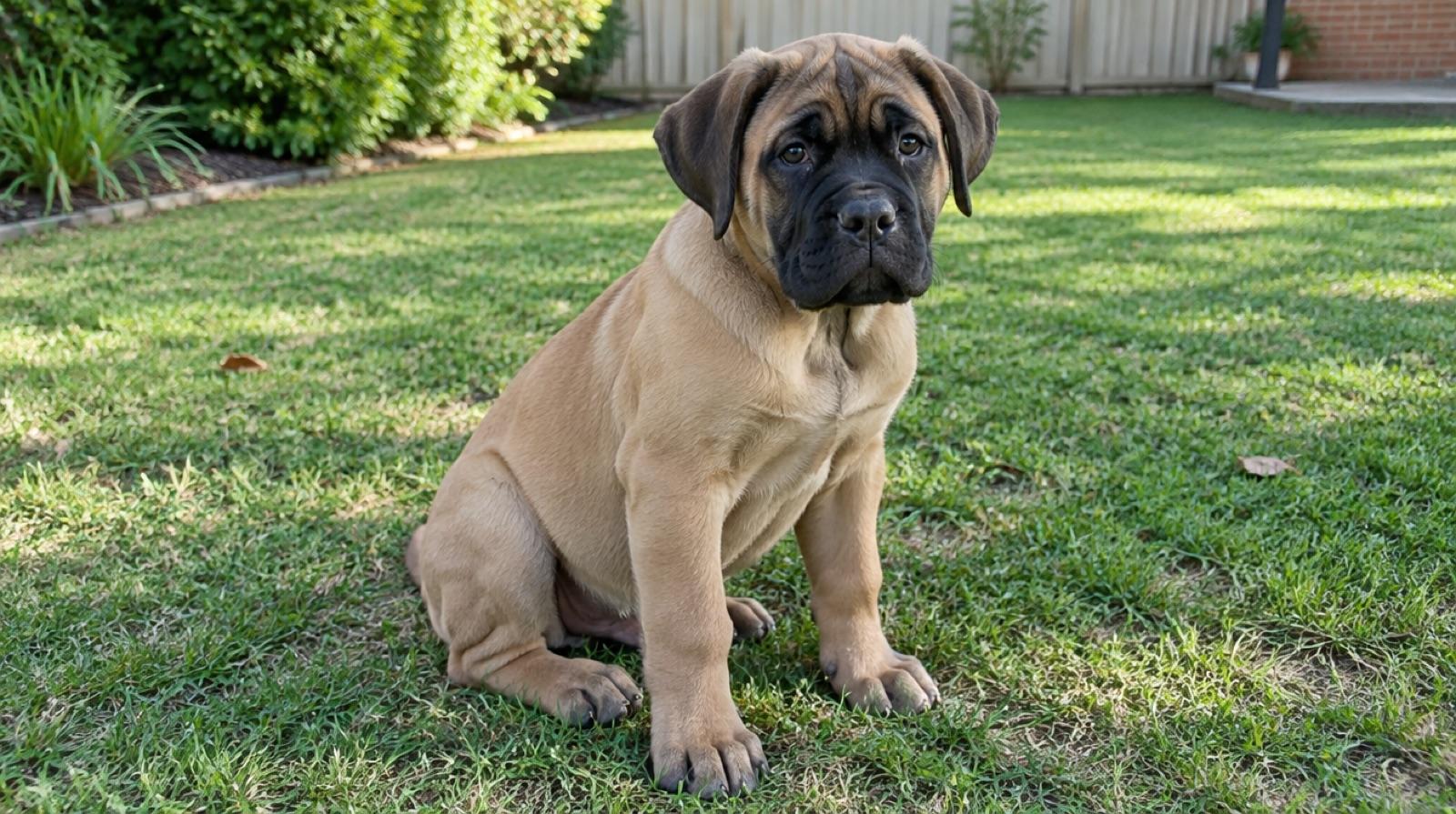
Should you adopt or buy a Bullmastiff?
It depends on whether it has to be a puppy. A registered breeder is the realistic route to a Bullmastiff puppy from hip and elbow scored parents, often with a wait. If what you want is the dog (a calm, devoted guardian that loves its family), adult Bullmastiffs and Bullmastiff crosses do come through rescues and pounds, and an adult comes with a known size, health record and temperament with children and other dogs, which matters a great deal in a powerful guarding breed.
The RSPCA Australia Knowledgebase suggests the RSPCA or a reputable rescue first, and if you go to a breeder, making sure they are registered, visiting where the puppies were born and meeting the parents. Our guide to adopting a dog in Australia covers the rescue process step by step.
| Route | Reference cost | What you usually get | Main risk |
|---|---|---|---|
| Dogs Australia registered breeder | One member breeder listed $4,900 (Limited Register, its 2027/2028 pricing); one breeder is not a range, so ask others | A purebred puppy with a pedigree, from hip and elbow scored parents if it is on the Main Register | Other tests vary, so ask; waiting lists |
| General rescue or pound | The standard fee, for example $500 for an adult dog at RSPCA NSW | Bullmastiffs and crosses, desexed, microchipped and vaccinated | Unknown parent health; purebreds come up only now and then |
| Classified ad or social media | Anything | Anything from an unscored litter to a puppy that does not exist | Scams, no health guarantee |
Reference only, not quotes. Figures read on 11 November 2026; breeders and rescues set their own prices and change them, so check with them.
How much is a Bullmastiff puppy from a registered breeder?
We can give you one published figure, and it is not a range. In November 2026 we read the own websites of 13 Australian Bullmastiff breeders. One member breeder, showing its Dogs NSW membership on its own site, listed $4,900 for a Limited Register puppy regardless of sex, under the heading “Puppy Pricing 2027/2028”. The other sites publish no price, have not been updated for years, or show no membership we could check. No Australian Bullmastiff club we found publishes a guide price.
Prices on listing sites and classified ads are left out, because we cannot check who is selling. One breeder is not a range, so treat $4,900 as one example: ask several breeders what they charge, and compare what the price includes, such as vaccinations, microchip, a vet check, papers and puppy insurance.
| Who published it | Reference figure | Read |
|---|---|---|
| Breeders, own websites (13 read) | One member breeder listed $4,900, Limited Register (its 2027/2028 puppy pricing). One breeder is not a range | 11 Nov 2026 |
| Australian Bullmastiff clubs | No price published | 11 Nov 2026 |
| RSPCA NSW, adult dog | $500 | 11 Nov 2026 |
| RSPCA NSW, under 12 months | $620 | 11 Nov 2026 |
Reference only, not quotes. Prices and fees change, so check with the breeder or rescue. RSPCA NSW says its fees ensure pets are desexed, microchipped, vaccinated and health-checked.
Which health tests should a Bullmastiff breeder show you?
Hip and elbow scores for both parents, every time, because for this breed they are a registration rule. Dogs Australia's registration regulations (clause 8.14) say both parents of every Bullmastiff litter born after 1 January 2013 must be screened for hip dysplasia and elbow dysplasia through an official scheme, where the parents were born after 1 June 2011, with results submitted when the litter is registered. Litters that do not meet this are eligible for the Limited Register only, flagged “NOT TO BE UPGRADED”. The same clause puts litters from a dam under 18 months old at mating on the Limited Register only.
That is why the Bullmastiff Club of NSW says all puppy buyers should be able to view these health reports and make an informed decision. The Bullmastiff Club of South Australia puts it more bluntly: an ethical breeder will have, as a minimum, health tested parents with official hip and elbow scores, and if the breeder cannot or will not show you the scores, “you would be advised to keep your money in your pocket”.
| Check | Who asks for it | What to ask for |
|---|---|---|
| Hip score | Dogs Australia (compulsory for registered litters); NSW and SA clubs; Royal Kennel Club | Both parents' official scores |
| Elbow score | Dogs Australia (compulsory for registered litters); NSW and SA clubs; Royal Kennel Club | Both parents' official results |
| Eyes | Royal Kennel Club (good practice); NSW club names entropion as a breed problem | Recent eye certificates, and whether the parents have had entropion surgery |
| Heart | NSW club health list names sub-aortic stenosis and cardiomyopathy | Whether the parents had a heart check, and by whom |
| Registration | Dogs Australia | Main or Limited Register papers, and the dam's age at mating |
Sources: Dogs Australia, the Bullmastiff Club of NSW and its health list, the Bullmastiff Club of South Australia and the Royal Kennel Club (UK), read 11 November 2026. This is a buying checklist, not veterinary advice. Our Bullmastiff health guide covers what these conditions mean once you own one.
Scores lower the risk of joint disease; they do not cover the breed's other problems. The Bullmastiff Club of NSW says bone and lymphatic cancers can often affect the breed and that lymphatic cancer heavily contributes to premature death, and that the breed can suffer allergies and eye problems such as entropion, where the eyelid rolls inward. Dogs Australia's profile adds the developmental bone diseases that can affect rapidly growing large-breed puppies. The club's health list names valvular disorders, sub-aortic stenosis (SAS) and cardiomyopathy as the most common heart problems, and cystinuria, an inherited disease that forms painful kidney and bladder stones and is more likely to cause serious problems in males.
Bloat is the emergency to know. The club's health list says owners should know the signs of bloat and have a plan for immediate treatment, because early detection and immediate medical care are essential if the dog is to survive. If your dog retches with nothing coming up, has a swollen belly or is restless and drooling, call or go to your nearest vet now. Our dog bloat (GDV) guide covers the signs and what to ask your vet about prevention.
See the Bullmastiffs listed right now
Bullmastiffs and Bullmastiff crosses from the rescues, shelters and council pounds we aggregate, with each rescue's notes on children, other dogs and time alone. Every listing links to the rescue, where you apply directly.
How long do Bullmastiffs live?
Often under 10 years, and there is Australian data on it. A University of Sydney team (Carney, Williamson and Taylor, 2024) reviewed the VetCompass Australia records of 2,771 Bullmastiffs seen at Australian vet practices from 2008 to 2017. Of these, 433 died during the study; their median age at death was 8.5 years, and the most common causes of death were mass lesions (28.2% of deaths), old age (9.9%) and musculoskeletal disorders (9.9%). The study also found that desexing was protective against death from urogenital causes.
The Bullmastiff Club of NSW says most reach 7 to 8 years, with ages in double figures possible, and the Royal Kennel Club lists under 10 years. A puppy gives you the most of those years; an adult from rescue gives you fewer, with the size, health and nature already known. Our senior dog adoption guide covers what to expect from an older dog.
How big does a Bullmastiff get, and how much exercise does it need?
Big, but not the biggest. The Dogs Australia standard sets dogs at 64 to 69 cm and 50 to 59 kg, and bitches at 61 to 66 cm and 41 to 50 kg, with a short, hard, weather-resistant coat in any shade of brindle, fawn or red and an essential black muzzle. It asks for a dog that is “Powerful, enduring, active and reliable”.
Exercise advice differs by source. The Bullmastiff Club of NSW says the breed needs moderate exercise and is happy lazing around and sleeping on the lounge, and that puppies should be kept lean while growing to prevent skeletal disease. The Royal Kennel Club in the UK rates it at more than 2 hours a day. On puppies, every source agrees: Dogs Australia's profile says very little exercise is needed for the first 12 months, because too much can damage rapidly growing joints and ligaments. The dog exercise calculator shows the Kennel Club breed ratings side by side, with RSPCA advice for puppies and hot days.
Can a Bullmastiff cope with an Australian summer?
Constant panting, rapid breathing, pale or red gums, drooling, vomiting, weakness or dizziness on a hot day can be heatstroke. Start cooling the dog with cool or room-temperature water and get to a vet immediately.
With care. Dogs Australia's breed profile says exercise should take place early morning or late evening, because Bullmastiffs can be affected by the heat of the day, and that in high humidity owners need to check the skin for hot spots, which build up where heat and moisture collect, such as around the base of the tail and under the body. The RSPCA Knowledgebase on heatstroke adds a cool, shaded, well-ventilated area and water at all times, avoiding hot surfaces, keeping dogs lean, and never leaving a dog in a car. Our dogs in hot weather guide has the full first aid and state hot-car rules.
Is a Bullmastiff restricted anywhere in Australia?
No state or territory list names the Bullmastiff. The restricted or prohibited breeds named in state law are the American Pit Bull Terrier, Japanese Tosa, Dogo Argentino, Fila Brasileiro and Perro de Presa Canario, and the ACT has no restricted breeds. The Tasmanian Government names the Bullmastiff and Mastiff among breeds that “are not restricted but can look similar to and be mistaken for restricted breed dogs”.
Councils can still assess an individual dog's behaviour and declare a dog dangerous or menacing, whatever its breed. For a 50 kg guardian, early socialisation is the practical answer: the Bullmastiff Club of NSW says even the most laid-back Bullmastiff can be protective when provoked. Our Staffy vs pit bull guide has the state-by-state law in full, and best guard dogs in Australia covers the guardian breeds honestly.
What does a Bullmastiff cost to keep?
More than an average dog. The Animal Medicines Australia Pets in Australia 2025 release estimated that dog-owning households spent $2,520 a year on average, for dogs of every size. A 50 kg dog eats more, needs a bigger bed, crate and car, and costs more at the vet, because many medicines are dosed by weight. That figure is a national survey average, not a quote, and a Bullmastiff's bills may well sit above it, especially if cancer or eye surgery comes up.
The dog cost calculator estimates the first year for a giant dog, and our giant-breed ownership guide covers space, heat and day-to-day life.
What do Bullmastiffs in rescue look like?
Adults and crosses, mostly. Bullmastiffs and Bullmastiff crosses come through the rescues, shelters and council pounds we aggregate, though a purebred is listed only now and then. An alert on the Bullmastiff breed page matters more than checking once.
The Bullmastiff Club of NSW lists a breed rescue contact on its website. If you would take an adult, contact the club as well as watching the listings. An adult from a rescue or foster home comes with notes on children, other dogs, strangers and time alone, which for a guarding breed is worth a great deal.
How do Bullmastiff puppy scams work?
Never pay a deposit for a Bullmastiff puppy you have not seen with its mother, and never buy without seeing both parents' hip and elbow scores.
Scamwatch says scammers set up fake websites and fake social media and marketplace profiles to sell popular breeds and pets that do not exist, and that a very cheap pet is likely a scam. The Bullmastiff Club of South Australia also warns that a newly registered breeder does not have to have any breed knowledge or experience, so registration alone is not proof of good breeding.
- No scores. For this breed, scores are a registration rule. A seller without them is either not registering the litter on the Main Register or not a registered breeder.
- No breeder number. The Queensland Government says not to buy a puppy from a person who does not have a valid breeder identification number (BIN). NSW, Victoria, South Australia and the ACT also require an identifying number in puppy ads. Look it up on the official register, not through a link the seller sends.
- A membership number you cannot check. Ask for the breeder's Dogs Australia membership number and check it with the state body yourself.
- “Rare” colours. The standard allows any shade of brindle, fawn or red. A premium for another colour is a reason to ask more questions.
- Payment before viewing. Scamwatch advises inspecting in person before you pay. A seller who wants a deposit, will only send the puppy and never lets you visit does not let you do that.
Our guide to puppies for sale in Australia has the full state-by-state table of breeder numbers and what to do if you have already paid.
When is a registered breeder the better choice?
Rescue is not right for everyone. A registered breeder makes sense if you want a Bullmastiff puppy from scored parents with a known family history, if you want to show, or if you have watched the rescue listings for months and no adult has suited your home, especially one with young children.
- Registration. Check the membership number with Dogs Australia or your state body, and your state's breeder number on the official register.
- Both parents' hip and elbow scores, from an official scheme.
- Eyes and heart. Ask whether the parents have had eye checks or entropion surgery, and any heart checks.
- The mother, in person, and where the puppies are raised; ask the dam's age.
- A written contract covering health, papers and whether the breeder will take the dog back if you cannot keep it.
Is a Bullmastiff the right dog for you?
The Dogs Australia standard asks for a dog that is “High spirited, alert and faithful”. Dogs Australia's profile describes a dog able to tell acceptable human behaviour from behaviour that warrants suspicion. Be honest about five things.
| Question | What the sources say |
|---|---|
| Guarding | Even the most laid-back can be protective when provoked (Bullmastiff Club of NSW) |
| Training | Can be stubborn and needs proper socialisation (Bullmastiff Club of NSW) |
| Children | Fine with children once they know them, with adult supervision (Dogs Australia profile) |
| Heat and coat | Exercise when cool; check for hot spots in humid weather (Dogs Australia profile) |
| Lifespan | Median age at death 8.5 years in Australian vet records (Carney and others, 2024) |
Not sure a guardian breed fits? The what dog breed is right for me quiz and the adoption readiness check each take a few minutes, and big dog breeds compares the Bullmastiff with other large and giant dogs.
Find a Bullmastiff near you
Bullmastiffs and Bullmastiff crosses listed by rescues, by city:
- Bullmastiffs for adoption in Sydney
- Bullmastiffs for adoption in Melbourne
- Bullmastiffs for adoption in Brisbane
- Bullmastiffs for adoption in Perth
- Bullmastiffs for adoption in Adelaide
Local guides to adopting a Bullmastiff, with the rescues that serve each city: Sydney, Melbourne, Brisbane, Gold Coast, Perth, Adelaide.
Weighing up other big breeds? Our Mastiff, Cane Corso, Great Dane, Newfoundland, Saint Bernard and Irish Wolfhound guides cover the same questions, and the Belgian Malinois guide covers a very different working dog. The large dogs in Sydney and in Melbourne are worth a look too.
Frequently asked questions
Should I adopt or buy a Bullmastiff puppy?▼
Buy from a Dogs Australia registered breeder if it has to be a Bullmastiff puppy, and check both parents' hip and elbow scores, which Dogs Australia requires before a Bullmastiff litter can go on the Main Register. Adopt if you are open to an adult or a Bullmastiff cross: they are listed by rescues and pounds, the Bullmastiff Club of NSW lists a breed rescue contact, and an adult's size, health and temperament are already known.
How much is a Bullmastiff puppy in Australia?▼
There is no reliable range to quote. Of the 13 Australian breeders whose own websites we read in November 2026, one member breeder listed $4,900 for a Limited Register puppy as its 2027/2028 puppy pricing (read November 2026). One breeder is not a range, and no Australian Bullmastiff club publishes a guide price. For comparison, RSPCA NSW listed $500 for an adult dog and $620 for a dog under 12 months. All are reference figures read on 11 November 2026, not quotes; prices change, so check with the breeder or rescue.
Do Bullmastiff breeders have to hip and elbow score?▼
Yes, for registered litters. Dogs Australia's registration regulations say both parents of every Bullmastiff litter born after 1 January 2013 must be screened for hip and elbow dysplasia through an official scheme, where the parents were born after 1 June 2011. Litters that do not meet this can be registered on the Limited Register only, flagged not to be upgraded. Ask to see both parents' scores.
What other health problems do Bullmastiffs have?▼
Cancer, eye problems, bloat and joint disease in growing puppies are the main ones. The Bullmastiff Club of NSW says bone and lymphatic cancers can often affect the breed, and that the breed can suffer allergies and eye problems such as entropion. Its health list names bloat, heart problems including sub-aortic stenosis and cardiomyopathy, and cystinuria. Dogs Australia's breed profile names developmental bone diseases in puppies, entropion, and hip and elbow dysplasia.
How long do Bullmastiffs live?▼
Often under 10 years. In a University of Sydney study of 2,771 Bullmastiffs seen at Australian vet practices from 2008 to 2017 (Carney, Williamson and Taylor, 2024), the median age at death of the 433 dogs that died during the study was 8.5 years. The Bullmastiff Club of NSW says most reach 7 to 8 years, with double figures possible, and the Royal Kennel Club lists under 10 years.
Is a Bullmastiff restricted in Australia?▼
No state or territory list names the Bullmastiff. The Tasmanian Government names it among breeds that are not restricted but can look similar to restricted breeds. Councils can still assess an individual dog's behaviour and declare a dog dangerous or menacing, whatever its breed, so training and socialisation matter.
Are Bullmastiffs good with children?▼
They can be, with supervision. The Bullmastiff Club of NSW says the breed may be ideal if you want a family guardian whose love for children is well known, but that it can be stubborn and needs proper socialisation. Dogs Australia's breed profile says Bullmastiffs are fine with children once they know them, as long as the children have been taught how to behave around a dog, and that adult supervision is always best.
How much exercise does a Bullmastiff need?▼
Moderate exercise as an adult and very little as a puppy. The Bullmastiff Club of NSW says the breed needs moderate exercise and is happy lazing around, while the Royal Kennel Club in the UK rates it at more than 2 hours a day. Dogs Australia's profile says very little exercise is needed for the first 12 months, because too much can damage rapidly growing joints, and that exercise should be early morning or late evening when it is cool.
Can a Bullmastiff cope with Australian heat?▼
With care. Dogs Australia's breed profile says Bullmastiffs can be affected by the heat of the day and should be exercised early morning or late evening, and that owners in high humidity need to check the skin for hot spots. The RSPCA Knowledgebase says to give a cool, shaded, well-ventilated area and water at all times. Heatstroke is an emergency: see a vet immediately.
What is the difference between a Bullmastiff and a Mastiff?▼
They are separate breeds. Dogs Australia's profile says the Bullmastiff was bred from the old English Bulldog and the English Mastiff. Its standard sets heights of 64 to 69 cm and weights of 50 to 59 kg for males and allows any shade of brindle, fawn or red with an essential black muzzle. The Mastiff standard leaves size unspecified and allows apricot, fawn or brindle, and Dogs Australia's Mastiff profile says a Mastiff's body should be longer than a Bullmastiff's.
Where can I see Bullmastiffs for adoption right now?▼
The Bullmastiff breed page on LocalPetFinder shows Bullmastiffs and Bullmastiff crosses listed by the rescues, shelters and council pounds we aggregate, with a page for each major city. Every listing links to the rescue, where you apply directly. Set an alert, and contact the Bullmastiff Club of NSW's breed rescue contact if you would take an adult.
Sources
- Dogs Australia: Bullmastiff breed standard
- Dogs Australia: Bullmastiff breed profile
- Dogs Australia: Regulation Part 6, Registration (Bullmastiff, clause 8.14)
- Bullmastiff Club of NSW: Breed information
- Bullmastiff Club of NSW: Common diseases and conditions in the Bullmastiff
- Bullmastiff Club of South Australia: Buyers beware
- Royal Kennel Club (UK): Bullmastiff
- Carney, Williamson and Taylor (2024), Animals: Bullmastiffs attending veterinary practices in Australia
- Tasmanian Government: Restricted breed FAQs
- RSPCA Australia Knowledgebase: How can I protect my dog from heatstroke?
- Animal Medicines Australia: Pets in Australia 2025 media release
- Queensland Government: Puppy farms and puppy scams
- Scamwatch: Buying and selling scams
- RSPCA NSW: Adoption fees
- RSPCA Australia Knowledgebase: Where should I go for a new companion animal?
Keep reading
Bullmastiffs listed by rescues
Bullmastiffs and Bullmastiff crosses listed right now by the rescues and pounds we aggregate across Australia.
Living with a giant breed
Space, heat, drool and the running costs of sharing a home with a Bullmastiff.
Bullmastiff health issues
Cancer, hips, elbows, eyes and the other conditions to watch for as a Bullmastiff ages.
Mastiff: adopt or buy?
The bigger, older breed the Bullmastiff came from, and how to tell them apart.