The short answer
Choose an Italian Greyhound if you want a tiny, cuddly sighthound (32 to 38 cm, 3.6 to 4.5 kg under the Dogs Australia standard) and can protect a young one's legs from jumps. Choose a Whippet for a medium-sized dog (44 to 51 cm) that sprints outdoors and curls up indoors. Choose a Greyhound (69 to 76 cm; males 30 to 39 kg) if you want a calm, large dog, and know that most states have an official program rehoming retired racers. All three feel the cold and chase what they see. The greyhound muzzle and lead rules apply only to Greyhounds and differ by state.
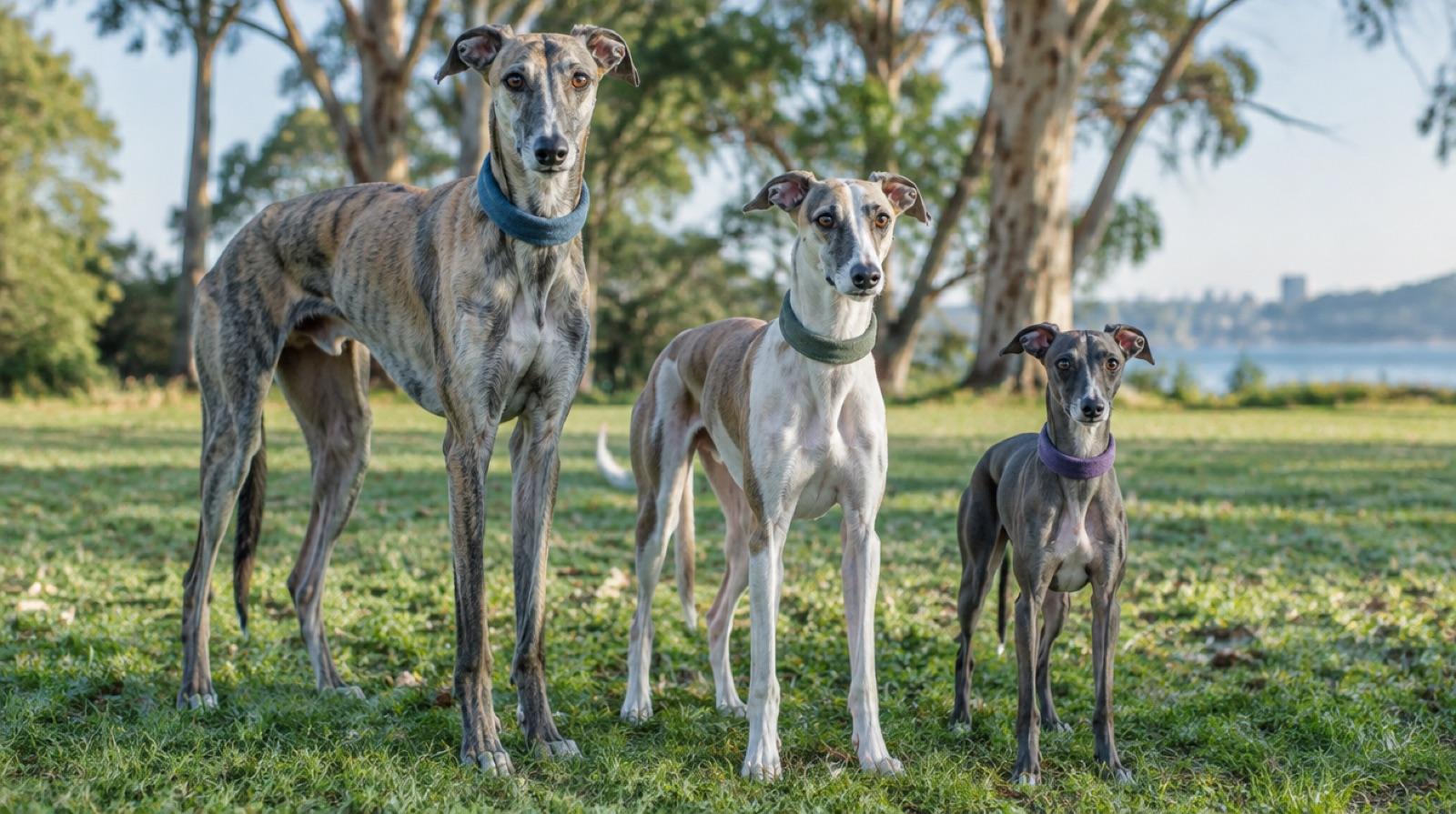
Are they the same breed in different sizes?
No. Each has its own Dogs Australia breed standard, its own breed clubs and, in the case of the Italian Greyhound, a different show group. The family resemblance is real, because all three are sighthounds: dogs that hunt by sight and run down what they see. But the breeds were shaped for different jobs.
- The Greyhound is the original coursing and racing dog. The Dogs Australia breed page calls it a sighthound bred for coursing game and now for racing, able to reach about 73 km/h.
- The Whippet was developed in the United Kingdom, according to the Whippet Club NSW text on the Dogs Australia breed page, first as a poachers' dog and then as the “poor man's Greyhound” for northern miners. Its standard calls it “built for speed and work” and “an ideal companion.”
- The Italian Greyhound has been a companion dog for centuries. Its standard describes “a greyhound in miniature, more slender in all proportions,” and the breed page says plainly that it is not a smaller version of a Whippet.
Italian Greyhound vs Whippet vs Greyhound side by side
Every size, coat, colour and temperament entry below is from the three Dogs Australia breed standards. Weight (where the standard does not give one) and lifespan come from the breed club text on the Dogs Australia breed pages. All read on 10 November 2026.
| Italian Greyhound | Whippet | Greyhound | |
|---|---|---|---|
| Dogs Australia group | Group 1 (Toys) | Group 4 (Hounds) | Group 4 (Hounds) |
| Height at the shoulder | 32 to 38 cm | Dogs 47 to 51 cm; bitches 44 to 47 cm | Dogs 71 to 76 cm; bitches 69 to 71 cm |
| Weight | 3.6 to 4.5 kg (standard) | Not set by the standard or breed page | Males 30 to 39 kg; females 21 to 30 kg (breed page) |
| Temperament (standard) | “Intelligent, affectionate and vivacious, may appear aloof” | “Gentle, affectionate, even disposition” | “Intelligent, gentle, affectionate and even tempered” |
| Coat | Skin fine and supple; hair short, fine and glossy | Fine, short, close in texture | Fine and close |
| Colours | Black, blue, cream, fawn, red, white, or broken with white; black or blue with tan, and brindle, not acceptable | Any colour or mixture of colours, except merle | Black, white, red, blue, fawn, fallow, brindle, or any of these broken with white |
| Lifespan (breed page) | Sometimes 14 to 16 years | Up to 14 to 17 years | 12 to 14 years |
| In Australian rescue | Rare | Rare | Common; official programs in most states |
Standards: Italian Greyhound, Whippet, Greyhound. Breed pages: Italian Greyhound, Whippet, Greyhound. The rescue row is from the listings we aggregate. Standards describe the ideal show dog; ex-racers and crosses vary, so judge the dog in front of you.
The practical gap is bigger than the numbers suggest. An Italian Greyhound weighs about as much as a house cat and can sit on a lap. A Whippet fits on the back seat of a small car. A Greyhound needs the boot of a wagon, a large bed and a good share of the couch, though the Greyhound breed page notes they curl into surprisingly small balls.
How much exercise does each one need?
Less than most people expect, but it has to include a chance to run. These are sprinters, not marathon dogs.
- Greyhound: the RSPCA Knowledgebase says greyhounds are generally content with a daily walk and some play totalling around an hour a day, and that they are “built for speed but tend to lack stamina,” so a jogging partner needs building up slowly. The Dogs Australia breed page calls them “73 kph Couch Potatoes.”
- Whippet: the Dogs Australia breed page says Whippets easily keep up with joggers and love lure coursing and agility, then curl up in your lap in front of the TV.
- Italian Greyhound: the breed page asks for a regular walk on a suitable sighthound lead or a good run in a well fenced yard, and warns that curious IGs can be escape artists that dig under fences.
For all three, a fenced space where the dog can sprint for a few minutes does more than a long, slow walk. If you need a dog that hikes all day, these are not the obvious choice; our easiest dogs to train guide and the what dog breed am I quiz cover other options.
Which copes worst with the cold, and the heat?
All three feel the weather, because all three have thin skin, short coats and little body fat.
| Breed | What the source says |
|---|---|
| Greyhound | RSPCA Australia: very little body fat, prone to cold stress; below 15 degrees Celsius a coat is essential. Greyhounds do not cope well with very hot or very cold weather, so give a cool resting area when it is hot |
| Whippet | Dogs Australia breed page: thin-skinned with little body fat, feels the cold more than most other breeds, needs a coat shaped for a Whippet in the cooler months |
| Italian Greyhound | Dogs Australia breed page: can lose condition quickly from shivering in colder months, needs a variety of warm coats and hates cold draughts; in summer, care is needed so it does not overheat or develop melanomas from sunbaking |
From the RSPCA Knowledgebase and the Dogs Australia Whippet and Italian Greyhound breed pages, read 10 November 2026.
In practice: a fitted coat for winter mornings in Melbourne, Hobart, Canberra or Adelaide, a padded bed off a cold floor, and an indoor life. None of these breeds should live outside. In summer, walk early or late and make sure there is shade and a cool room. If your dog shivers or curls into a tight ball, it is cold; the RSPCA rule of thumb is that if you need a coat, so does your greyhound.
Will they chase cats and small pets?
Possibly. Chasing what moves is what sighthounds were bred for, and how strong that urge is varies from dog to dog, not just from breed to breed.
- Greyhounds: the RSPCA Knowledgebase says some greyhounds have a strong instinct to chase, and that while some live in harmony with small dogs, cats and other small animals, others can never be safely left alone with them. Racing dogs are also encouraged to chase as part of their training. The state programs assess each dog, and the greyhound adoption guide explains how.
- Whippets: the breed page says they happily co-exist with cats introduced at a young age, and that a Whippet will run after something interesting.
- Italian Greyhounds: neither the IG standard nor its breed page says anything about cats, so ask the rescue or breeder about the individual dog.
If you have a cat, rabbit or guinea pig, an adult dog that a foster carer or program has already tested with that animal is the safest choice. A puppy raised with your cat is the other route, and the reason some people choose a registered breeder.
Do the greyhound muzzle and lead laws apply to Whippets and IGs?
The state rules below are written for Greyhounds. We found nothing in them that covers Whippets or Italian Greyhounds, which follow the same council rules as any other dog, including your council's off-leash areas. For Greyhounds, the muzzle rules have relaxed in most places but the lead rules are stricter than for other dogs in several states. These are the rules for pet (retired or non-racing) Greyhounds.
| State or territory | Muzzle in public | Lead and off-leash areas |
|---|---|---|
| NSW | Not required since 1 July 2019 for greyhounds registered as pets on the NSW Pet Registry | Lead in public; muzzle in an off-leash area unless the dog has completed Greenhounds or Greyhounds As Pets |
| Victoria | Not required since 1 January 2019 | Leashed in public, including council off-leash areas, unless a council has set aside a greyhound off-lead space |
| Queensland | Not required by the state Act | GAP Queensland strongly recommends never letting a greyhound off lead |
| South Australia | Not required since 17 November 2025 | A lead of no more than 2 metres whenever away from home; off-leash areas such as dog parks do not apply to greyhounds |
| Western Australia | Not required since 23 December 2021 | Still required to be on a lead in a public place |
| Tasmania | Required unless the dog has passed an approved greyhound suitability program | A lead of no more than 2 metres in public |
| ACT | Not required | Same rules as other dogs; declare the greyhound when you register it |
| Northern Territory | Check with your council | Check with your council |
Sources: NSW Office of Local Government FAQ; Agriculture Victoria; GAP Queensland FAQ; Dog and Cat Management Board SA; WA DLGSC; Tasmania's Dog Control Act 2000; ACT City Services, all re-read 10 November 2026. For the Northern Territory we found no government page on greyhound muzzles, so check with your council. Racing greyhounds stay under the racing rules. General information, not legal advice; council rules can add to these, and our greyhound adoption guide has the full detail.
Even where the law allows a sighthound off lead, think about where. The Dogs Australia Whippet page says most Whippets run a wide circle and come back once they have let off steam, but will chase something interesting, and that recall needs training like any dog. A fully fenced area is the safe place for all three.
What health checks matter for each breed?
The three breeds are generally long-lived, but the things to watch differ, and the size difference shows up most in the legs.
| Breed | What to know | Checks to ask a breeder about |
|---|---|---|
| Italian Greyhound | Young legs break from small falls (see below). The Dogs Australia breed page names epilepsy, progressive retinal atrophy (PRA), luxating patella and dentine degeneration, and says teeth need watching, brushing and scaling | Patellas, eyes, thyroid, hips and a PRA DNA test (Italian Greyhound Club of America health statement) |
| Whippet | The Dogs Australia breed page calls it a very healthy, hardy breed; autoimmune diseases have been linked to Whippets but are not common | Heart (echocardiogram), eyes and a BAER hearing test (American Whippet Club health statement) |
| Greyhound | The Dogs Australia breed page says greyhounds have very little body fat, so your vet must know the breed before any anaesthetic. RSPCA Australia flags hookworm in dogs from racing and training establishments | For an ex-racer, the program's vet check and worming history; ask your own vet about teeth and anaesthesia |
From the Dogs Australia breed pages, the RSPCA Knowledgebase, the Italian Greyhound Club of America and the American Whippet Club health statements, read 10 November 2026. We found no Australian club page setting a testing requirement for either breed, so the US statements are the most detailed published checklists. This is a buying checklist, not veterinary advice.
On the legs: a 2017 case series in the Journal of the American Veterinary Medical Association looked at 102 toy and miniature dogs whose broken forearm was repaired with a bone plate, and Italian Greyhounds were 17 of them, with most fractures caused by a fall from a low height or play with other pets. The Italian Greyhound guide covers ramps, steps and safe play. A Whippet or Greyhound has sturdier legs, but every sighthound benefits from a vet who knows the breed.
Who suits each breed?
No breed here is better than another. Each fits a different home.
- An Italian Greyhound suits a quieter home with older children or none, someone home a lot (the breed page says IGs can be needy), and an owner happy to manage coats, teeth and jumps. The breed page says older children suit the breed better, because accidents happen when young children pick one up.
- A Whippet suits almost anyone who can give it a daily sprint and a warm bed, says the breed page: singles, couples and families, houses, townhouses and apartments. It is a good fit for people who like dog sports such as lure coursing and agility.
- A Greyhound suits people who want a large, calm adult dog quickly, including many apartment dwellers, older adopters and people who work from home. It is a poor fit for a home with a free-roaming rabbit or cat, unless the program has matched that dog as safe with them.
Before you apply, the adoption readiness check takes a few minutes, and the dog cost calculator shows how coats, dental care and food add up over a year. Our best apartment dogs guide puts all three beside other small-space breeds.
Can you adopt one, or do you have to buy?
It depends which one. For a Greyhound, adopting is the normal route. Most states run an official program rehoming dogs leaving the racing industry, including Greyhounds As Pets NSW, the Greyhound Adoption Program in Victoria and Greyhounds As Pets WA, and each program assesses its dogs before rehoming them. The Victorian program's dogs, for example, go home desexed, vaccinated and microchipped, and Greyhounds As Pets WA assesses each dog around small dogs and for homes with cats. Greyhounds are also listed far more often than the other two breeds by the general rescues and pounds we aggregate. The greyhound adoption guide has every state's program and published fee.
Purebred Whippets and Italian Greyhounds rarely reach rescue. The state greyhound programs do not rehome them. So the honest options are a Dogs Australia registered breeder (with a waiting list), a breed club rescue contact, or an adult cross. Our Whippet and Italian Greyhound adopt-or-buy guides cover what member breeders charge, the health results to see, and how to avoid scam ads.
Rescue labels are not always precise. A slim, short-coated dog listed as a “whippet cross” may be part greyhound, part something else entirely; our guide to what breed your rescue dog really is explains why. Judge the dog's size, energy and notes on cats rather than the label.
See sighthounds listed for adoption
Greyhounds, Whippets, Italian Greyhounds and their crosses from the rescues, shelters and council pounds we aggregate. Each listing links to the rescue, where you apply directly.
Greyhounds →Whippets →Italian Greyhounds →Find a Greyhound, Whippet or Italian Greyhound near you
- Sydney: Greyhounds, Whippets and Italian Greyhounds for adoption, plus our Sydney guides to Greyhound, Whippet and Italian Greyhound adoption
- Melbourne: Greyhounds, Whippets and Italian Greyhounds for adoption, plus our Melbourne guides to Greyhound, Whippet and Italian Greyhound adoption
- Brisbane: Greyhounds, Whippets and Italian Greyhounds for adoption, plus our Brisbane guides to Greyhound, Whippet and Italian Greyhound adoption
- Perth: Greyhounds, Whippets and Italian Greyhounds for adoption, plus our Perth guides to Greyhound, Whippet and Italian Greyhound adoption
- Adelaide: Greyhounds, Whippets and Italian Greyhounds for adoption, plus our Adelaide guides to Greyhound, Whippet and Italian Greyhound adoption
Looking for a small dog more generally? The small dogs and apartment-friendly dogs pages for Sydney, and the same pages for each city, show what is listed now. For safe running spots and recall, see our greyhound off-leash and recall guide.
Frequently asked questions
What is the difference between an Italian Greyhound, a Whippet and a Greyhound?▼
Size first, then everything that follows from it. The Dogs Australia standards set the Italian Greyhound at 32 to 38 cm and 3.6 to 4.5 kg, the Whippet at 44 to 51 cm, and the Greyhound at 69 to 76 cm. The Italian Greyhound is in the Toy group; the Whippet and Greyhound are in the Hound group. All three are sighthounds with short, fine coats, gentle temperaments and a chase instinct, and all three feel the cold.
Is an Italian Greyhound a puppy Whippet or a small Greyhound?▼
No. It is its own breed with its own Dogs Australia standard, which describes it as a greyhound in miniature, more slender in all proportions. The breed club text on the Dogs Australia breed page adds that the Italian Greyhound is not an exact replica of a Greyhound nor a smaller version of a Whippet. An adult IG is about 4 kg; a Whippet puppy will keep growing well past that.
How big is a Whippet compared with a Greyhound?▼
A Whippet is roughly two thirds of a Greyhound's height. The Dogs Australia Whippet standard gives a desirable height of 47 to 51 cm for dogs and 44 to 47 cm for bitches, against 71 to 76 cm and 69 to 71 cm in the Greyhound standard. The Greyhound breed page puts males at 30 to 39 kg and females at 21 to 30 kg. Neither the Whippet standard nor its breed page sets a weight.
Which is calmer, a Whippet or a Greyhound?▼
Both are usually calm indoors, and the standards use similar words: gentle, affectionate and even tempered. Retired racing Greyhounds are known for sleeping much of the day, and RSPCA Australia says most are content with about an hour of walking and play daily. Whippets are lively outdoors and sleepy indoors. Energy varies by dog, so an adult whose foster carer can describe it is the surest way to get the calm you want.
Which is best for an apartment?▼
Any of the three can suit an apartment if the dog gets a daily run somewhere safe and fenced. The Dogs Australia Whippet page says Whippets live happily in units and apartments, and Greyhounds As Pets WA says retired Greyhounds adapt well to small homes and apartments. An Italian Greyhound is the smallest, but needs protecting from jumps off furniture while young. Check your strata rules and building size limits first.
Do Whippets and Italian Greyhounds need a muzzle like Greyhounds?▼
The Australian greyhound muzzle and lead rules are written for Greyhounds, and we found nothing in them that applies to Whippets or Italian Greyhounds; those breeds follow the same council rules as other dogs. Pet Greyhounds no longer need a muzzle in public in NSW (if registered as a pet), Victoria, Western Australia, South Australia or the ACT, and Queensland law does not require one. Tasmania still does unless the dog has passed an approved program.
Can Greyhounds, Whippets or Italian Greyhounds go off lead?▼
Greyhounds mostly cannot in public: Victoria, South Australia, Western Australia and Tasmania require a lead in public, and NSW requires a muzzle in off-leash areas unless the dog has done an approved retraining program. Whippets and Italian Greyhounds follow ordinary council off-leash rules, but all three are sighthounds that chase what they see, so a fenced area is the safe place to let any of them run.
Are these breeds good with cats?▼
Some are and some never will be, and it depends on the individual dog. RSPCA Australia says some Greyhounds have a strong instinct to chase and can never be safely left alone with small animals, while others live happily with them. The Dogs Australia Whippet page says Whippets happily co-exist with cats introduced at a young age. Tell the rescue or program about your cat and choose a dog already tested with one.
Which of the three feels the cold most?▼
All three do. RSPCA Australia says Greyhounds have very little body fat and that a coat is essential below 15 degrees Celsius. The Dogs Australia Whippet page says Whippets feel the cold more than most breeds and need a coat in cooler months, and the Italian Greyhound page says IGs can lose condition quickly from shivering and need a variety of warm coats. Plan for coats, warm beds and no long periods outside.
How long do Greyhounds, Whippets and Italian Greyhounds live?▼
All three are long-lived for their size, according to the breed club text on the Dogs Australia breed pages: Greyhounds 12 to 14 years, Whippets up to 14 to 17 years, and Italian Greyhounds sometimes 14 to 16 years. These are breed club figures, not a promise for any individual dog. Regular vet checks and dental care matter for all three.
Which is easiest to adopt in Australia?▼
The Greyhound, by a long way. Most states have an official program rehoming retired racing Greyhounds, and Greyhounds are listed far more often than Whippets or Italian Greyhounds by the rescues we aggregate. Purebred Whippets and IGs rarely reach rescue, so most people who want one go to a Dogs Australia registered breeder or wait for a breed club rescue contact, and many adopt a cross.
Is a retired racing Greyhound a good first dog?▼
For many people, yes. RSPCA Australia describes Greyhounds as generally content with around an hour of exercise a day, and the state programs assess each dog before matching it; Greyhounds As Pets WA, for example, assesses each one around small dogs and for homes with cats. The things to plan for are a settling-in period of several months, a strong chase instinct in some dogs, the cold, and the muzzle and lead rules in your state.
Sources
- Dogs Australia: Greyhound breed standard
- Dogs Australia: Whippet breed standard
- Dogs Australia: Italian Greyhound breed standard
- Dogs Australia: Greyhound breed page
- Dogs Australia: Whippet breed page (Whippet Club NSW)
- Dogs Australia: Italian Greyhound breed page
- RSPCA Knowledgebase: What should I know about owning a greyhound?
- Dog and Cat Management Board (SA): Greyhounds
- Agriculture Victoria: Removal of muzzling requirements for pet greyhounds
- NSW Office of Local Government: Removal of the muzzling requirement for pet greyhounds, FAQs
- WA DLGSC: Greyhounds
- Tasmania: Dog Control Act 2000, section 18
- American Whippet Club: Health statement
- Italian Greyhound Club of America: Health statement
- De Arburn Parent et al. (2017), JAVMA: Distal radius and ulna fractures in miniature and toy breed dogs, 102 cases
Keep reading
Greyhound adoption in Australia
Each state’s official program, fees, and the muzzle and lead rules in full.
Whippet puppies: adopt or buy?
Member breeder prices, heart, eye and hearing checks, and why rescue Whippets are rare.
Italian Greyhound puppies: adopt or buy?
Fragile young legs, the health tests to ask about, and scam red flags.
Whippets for adoption
Whippets and Whippet crosses, when the rescues we track have one listed.