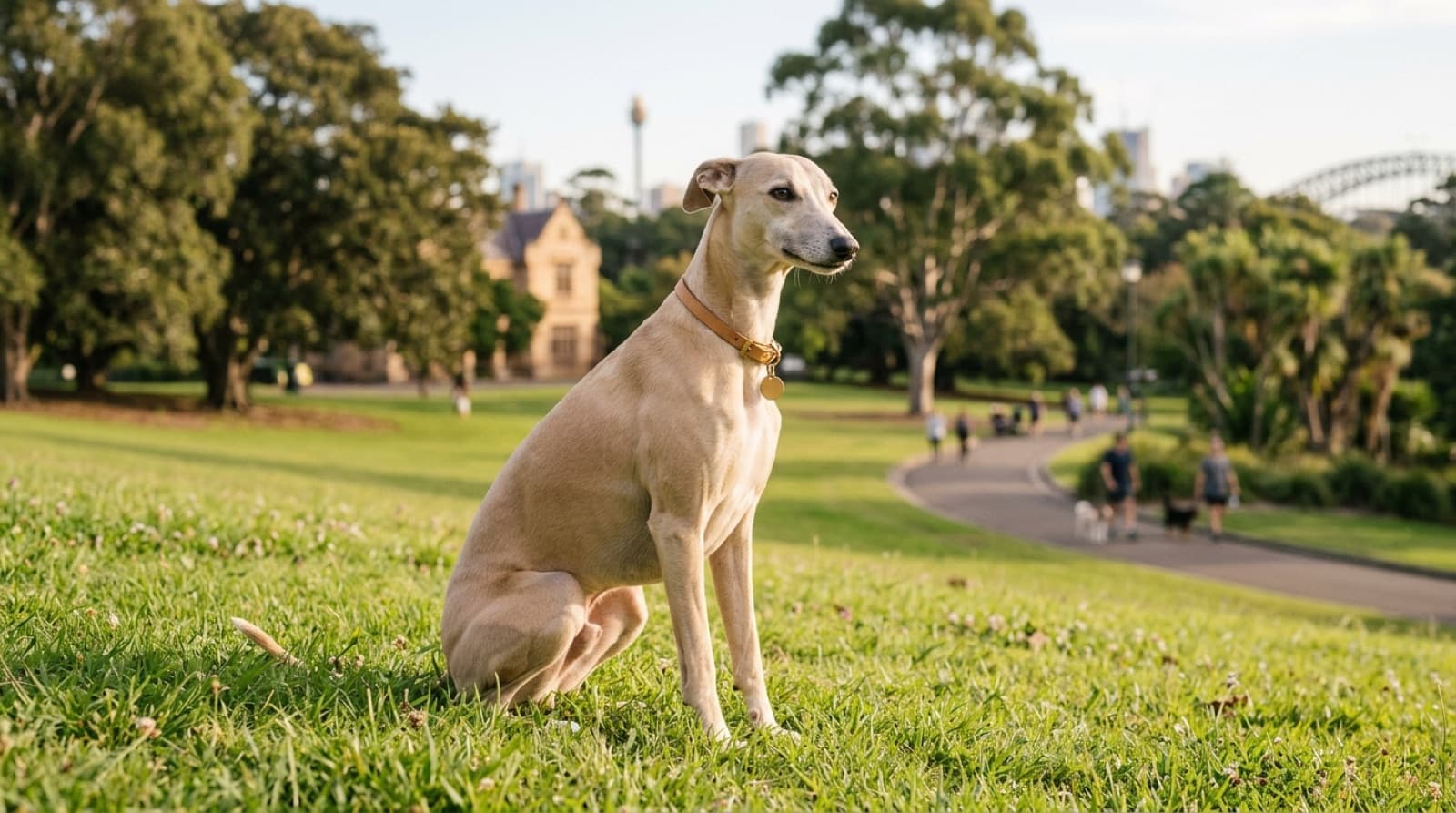
The short answer
You can adopt a Whippet in Sydney, and a calm adult one is a genuinely easy dog. Purebreds are uncommon in rescue, so set alerts across the five main NSW rescues, be application-ready, and stay open to a Whippet cross or an older dog. Adoption runs about $300 to $600 for an adult, all-inclusive, against several thousand dollars from a breeder, and the breed is not restricted in NSW. The honest part is that a Whippet is two dogs in one: a gentle, quiet couch potato indoors, and a fast, prey-driven sprinter outdoors that is not reliable off-lead in unfenced areas. It is thin-skinned and feels the cold, so it needs a coat in a Sydney winter. Give it a securely fenced place to run and a warm spot to sleep and it settles beautifully.
Why Whippets end up in Sydney rescue
Most breed guides open with where to adopt. With the Whippet, it helps to understand why they reach rescue first, because it tells you whether the breed is right for you.
The sprinter side surprises people. Plenty of adopters picture only the couch potato: the gentle, dozy dog that spends the day curled on the lounge. That half is real. But a Whippet is a sighthound, built to chase and to run flat out in short bursts, with a strong prey drive and one of the fastest accelerations of any dog its size. An owner who assumed a small, calm dog needed almost no exercise, or who had no securely fenced space to let it gallop, can end up with a frustrated dog that is harder to live with than expected. The mismatch between the couch-potato picture and the sprinter reality is a common reason the breed is given up.
Prey drive and bolting catch owners out. A Whippet is not reliable off-lead in an open, unfenced area. It will spot a cat, a bird or a small dog and chase, and at that speed it can be a long way away before you can react. Owners who did not plan for secure exercise, or who had a scare when a dog bolted, sometimes decide the breed is too much. The full detail on the prey drive and how to manage it safely belongs in the dedicated guide, linked further down.
Life changes and housing. Many Whippets reach rescue through no fault of their own. A relationship breakdown, a new baby, a move to a rental that will not take a dog, or a change in work hours. The dog is usually lovely and simply lost its home to circumstance.
Crosses and ex-racing dogs. Because purebred Whippets are uncommon in rescue, you will more often see Whippet crosses, frequently blended with a Staffy or another short-coated breed. Some Whippet-types also come through as retired racing or lure-coursing dogs that need to learn to be pets. These dogs can be gems, but their prey drive and exercise needs are worth asking about closely.
What this means for you. A Whippet in rescue is rarely a broken dog. It is usually a gentle companion whose sprinter side or whose owner's circumstances outran the last home. If you can offer a securely fenced place to run and a warm, soft spot to rest, you are looking at one of the easiest, most affectionate dogs you can adopt. If you have no safe space to exercise a fast, prey-driven dog, being honest now saves a dog from being the next surrender.
Where to adopt a Whippet or Whippet cross in Sydney
Because Whippets are uncommon in general rescue, a wide alert net is the right approach. Set listing alerts on every rescue you would consider, and add sighthound and greyhound foster networks. For a fuller directory, see our guide to the Sydney adoption resources hub.
1. RSPCA NSW
The Sydney Adoption Centre at Yagoona plus regional NSW centres. Whippets and Whippet crosses come through occasionally via owner surrender, and every adoption includes desexing, vaccination, microchipping, a vet workup and a behavioural assessment. A surrendered dog often arrives with a known history the team can talk you through, which is worth having for a sighthound where prey drive and how the dog is with small animals really matter. Apply at rspcansw.org.au.
2. Animal Welfare League NSW
AWL NSW runs the Kemps Creek Shelter plus around a dozen volunteer branches across the state. Whippets are uncommon on the roster but do appear, more often as crosses with a short-coated breed. Adoption includes desexing, vaccination, microchipping and a vet check, with staff who can talk through what a sighthound needs. Current listings on awlnsw.com.au.
3. Sydney Dogs and Cats Home
The city's oldest shelter, founded in 1946, at Strathfield South. It takes a broad mix of dogs through owner surrender and council contracts, so a Whippet or Whippet cross turns up from time to time. Adoption includes desexing, vaccination, microchipping, parasite treatment and a vet check. More at sydneydogsandcatshome.org.
4. Monika's Doggie Rescue
No-kill foster-based rescue at Doggiewood in Ingleside on the Northern Beaches. Because the dogs live in foster homes, the notes on a Whippet's energy, prey drive and behaviour with cats, other dogs and children tend to be detailed and honest, which is exactly what you want when matching a sighthound to the right household. Adoption includes a home check. Listings at doggierescue.com.
5. Maggie's Rescue
Inner West rescue based in Marrickville, running a foster-to-adopt model with a trial built into every adoption, which is genuinely useful for checking a Whippet fits your home, your routine and how it settles indoors before you commit. Information and application links at maggiesrescue.org.
Beyond these, sighthound and greyhound foster networks across NSW place dogs of this type, and their carers understand prey drive and secure exercise well. Some adopters search for a dedicated Whippet Rescue NSW, but we cannot verify a currently active organisation by that name, so use the general rescues above, set alerts, and be wary of any group that asks for money before you have confirmed a real address, a current adoptable-dog list and charitable status. Browse the current Whippets and Whippet crosses on the Sydney Whippet listings.
What a Whippet costs: adopt versus buy
Adoption is far cheaper at the outset. A rescue fee for an adult Whippet through a Sydney rescue commonly runs about $300 to $600, and the rare puppy $400 to $800, and that fee already covers desexing, vaccination, microchipping, worm and flea treatment and a vet check.
A Whippet from a breeder in NSW, by contrast, often costs several thousand dollars, with none of that vet work done yet. So adopting is many times cheaper up front, the dog arrives already vetted and desexed, and if you adopt an adult you can see the temperament rather than gamble on a puppy.
The good news on ongoing cost is that the Whippet is one of the healthier purebreds, so you are less likely to meet the big breed-specific vet bills that some popular breeds carry. That is a genuine positive, covered in more depth in the health guide linked below. The sensible ongoing costs to plan for are the ones every Sydney dog needs: year-round paralysis tick and parasite prevention (a vet-recommended monthly product, essential everywhere in coastal NSW), good food, and pet insurance you take out while the dog is young. Council registration through the NSW Pet Registry is a modest one-off, and desexing lowers the lifetime fee.
If you have been searching “Whippet for sale Sydney”
Plenty of people arrive here after searching for a Whippet to buy, and that makes sense: the for-sale listings vastly outnumber the rescue ones, so buying feels like the only route. Reputable breeders do exist, and there is nothing wrong with orienting yourself by them. But before you spend anything, know that the online market for popular purebred puppies is one of the more scam-prone corners of the pet world in Australia. A cheap puppy, or a deposit request for a dog you have not met in person, is a warning sign rather than a bargain, and the ACCC Scamwatch has documented deposit scams for puppies that do not exist.
A seller who will not show you both healthy parents at their property is a red flag rather than a mark of quality. Adoption sidesteps much of that: it costs a fraction of a breeder price, gives a vet-checked dog a home, and an adult rescue Whippet asks far less guesswork about temperament and health than a puppy. Set alerts, stay open to a cross or a senior, and be patient. The RSPCA Australia Knowledgebase has good general guidance on choosing a dog and avoiding poorly bred puppies.
Browse adoptable Whippets in Sydney
Whippets are uncommon in rescue, so crosses and older dogs appear more often than purebred puppies. Browse live NSW listings and set an alert so you hear the moment one comes in.
See Available Whippets →The gentle couch potato, and the sprinter behind it
The Whippet has one of the most appealing temperaments of any dog, and it is genuinely two dogs in one. Indoors it is a famously gentle, calm and quiet companion, an affectionate couch potato that loves a warm, soft spot and asks for very little. Whippets tend not to be big barkers, which is part of why they suit apartments and units so well. For a household that wants a peaceful, cuddly, low-drama dog around the home, few breeds do it better.
The flip side is what defines a sighthound. Outdoors a Whippet is a sprinter with an enormous burst of speed and a strong prey drive. Give it a safe place to run and it will gallop, then flop and rest for hours, which is the natural rhythm of the breed. The important safety point is that a Whippet is not reliable off-lead in unfenced areas: it will chase something it sees and can bolt fast and far before you can call it back. That is not a training failure, it is how the breed is wired, and the answer is secure fencing rather than trusting recall in open ground.
We keep the detail deliberately short here, because it deserves its own guide. Our Whippet exercise and prey-drive guide covers how much running a Whippet actually needs, how to manage the prey drive around cats and small animals, where to find securely fenced off-leash spaces in Sydney, and why off-lead in open parks is a real risk for the breed.
A genuinely healthy breed
Here is a real positive that sets the Whippet apart. As purebreds go, it is one of the healthier and longer-lived breeds, without the long list of serious breed-specific conditions that some popular dogs carry. That means a Whippet is often a lower-risk, lower-cost dog to own over its life, and it is one of the honest reasons the breed is such an easy companion for many homes.
Healthier than average does not mean no care at all, and there are a few breed-relevant things worth knowing, including how a slim, low-fat sighthound handles anaesthetic and what to watch for as the dog ages. Rather than half-cover it here, lean on the cluster. Our Whippet health guide covers the breed-specific points to plan for, plus the Sydney-specific concerns every dog faces here, like year-round paralysis tick and summer heat.
Thin-skinned and feels the cold: a coat in a Sydney winter
A Whippet is built for speed, which means a fine, short coat, thin skin and very little body fat. That gives it the sleek sighthound look, but it also means the breed feels the cold far more than a thick-coated dog. You will notice it: a Whippet seeks out the warmest, softest spot in the house and will happily burrow under a blanket.
Sydney is a mild city with no real winter, so this is a small, easy thing to manage rather than a problem. On cool mornings and cold winter days a Whippet appreciates a warm coat or jumper for walks, and a soft, warm bed away from draughts at home. Give it that and the breed is perfectly comfortable here. It is simply worth knowing before you adopt, so you have a coat ready for the cooler months rather than a shivering dog on the first crisp morning.
Whippets are not restricted in NSW
It is worth stating plainly. The Whippet is not on the NSW restricted-breed list. Under the NSW Office of Local Government, only five breeds are restricted under the Companion Animals Act 1998: the American Pit Bull Terrier, Dogo Argentino, Japanese Tosa, Fila Brasileiro and Perro de Presa Canario. A Whippet is legal to own and rehome normally, and simply needs to be microchipped by 12 weeks and registered with your council by 6 months of age.
Housing is rarely an obstacle either. A Whippet is a small-to-medium, quiet, non-shedding-heavily dog that suits units and rentals well, and many landlords and strata schemes are relaxed about a calm, small sighthound. Confirm dogs are allowed before you apply, and a settled Whippet is one of the easier dogs to vouch for. Whippets are covered by the Australian Veterinary Association welfare guidance that applies to all companion dogs, with nothing breed-specific to clear.
Adult or puppy, and how to choose
For almost every adopter an adult is the better choice, and Whippet puppies are rare in rescue anyway. A calm adult Whippet is one of the most rewarding dogs to bring home: a known temperament the rescue can describe, an established size and energy you can see rather than gamble on, often some training already in place, and a lower adoption fee. With a sighthound that gap matters, because an adult lets the rescue tell you how the dog is with cats, small pets, other dogs, children and being left alone, and lets you meet the actual prey drive you are taking on.
When you choose, read the foster carer's notes closely. They will tell you how a specific dog does with children, cats, other dogs and time apart from its people, and that record predicts the fit far better than the breed average. Ask how the dog is around small animals, whether it has any recall, and how it settles indoors. Older, settled Whippets are often the ones that wait longest and make the steadiest, gentlest, most affectionate companions for a quiet home.
Frequently Asked Questions
Where can I adopt a Whippet near me in Sydney?
Start with the five main NSW rescues: RSPCA NSW (Sydney Adoption Centre at Yagoona), Animal Welfare League NSW (Kemps Creek plus regional branches), Sydney Dogs and Cats Home (Strathfield South), Monika's Doggie Rescue (Ingleside) and Maggie's Rescue (Marrickville). Be realistic about supply. Purebred Whippets are fairly uncommon in rescue, so Whippet crosses, often a Whippet blended with a Staffy or another short-coated breed, show up more often than full purebreds. The best approach is to set listing alerts across every rescue you would consider, have your application and any references ready in advance, and stay open to a cross or an older dog. Sighthound and greyhound foster networks across NSW also rehome dogs of this type. Some adopters search for a dedicated Whippet Rescue NSW, but we cannot verify a currently active organisation by that name, so work through the general rescues, set alerts, and never send money before you have confirmed a real, registered rescue.
Why do Whippets end up in rescue?
Usually because the sprinter side of the breed surprised the owner, or because life changed, not because of any fault in the dog. People picture the gentle couch potato that dozes on the lounge all day and forget the other half: a Whippet is a sighthound with a huge burst of speed and a strong prey drive, and one that has not had a proper run or a secure place to bolt can become frustrated and hard to manage. Owners who assumed a small, calm dog needed almost no exercise, or who could not offer a securely fenced space, sometimes give up. Others reach rescue through no fault of their own, after a relationship breakdown, a new baby, or a move to housing that will not take a dog. Crosses appear often, and some Whippet-types come through as ex-racing or lure-coursing dogs that need a pet home. Most rescue Whippets are lovely, and just need someone who understands the sprinter behind the couch potato.
How much does it cost to adopt a Whippet versus buy one?
Adoption is far cheaper up front. A rescue fee for an adult Whippet through a Sydney rescue commonly runs about $300 to $600, and the rare puppy $400 to $800, and that fee already includes desexing, vaccination, microchipping, worm and flea treatment and a vet check. A Whippet from a breeder in NSW, by contrast, often costs several thousand dollars, with none of that vet work done yet. So adopting is many times cheaper at the outset and the dog arrives already vetted. Where a Whippet is genuinely cheap over its life is health: it is one of the healthier purebreds, so you are less likely to face the big breed-specific vet bills some breeds carry. The ongoing costs to plan for are the sensible ones every Sydney dog needs, mainly year-round paralysis tick and parasite prevention, good food, and pet insurance taken out while the dog is young.
Are there Whippet rescues in NSW?
There is no NSW Whippet-specific rescue we can verify as currently active, so the reliable route is the general rescues. RSPCA NSW, AWL NSW, Sydney Dogs and Cats Home, Monika's Doggie Rescue and Maggie's Rescue all rehome Whippets and Whippet crosses when they come in, and sighthound and greyhound foster networks across NSW take them too. Because purebred Whippets are uncommon in rescue, the winning strategy is a wide alert net rather than one specialist group. Set listing alerts on every rescue you would consider and be application-ready so you can move quickly. If you come across a group calling itself a Whippet rescue, verify it before you engage: a real address, a current list of adoptable dogs, and registered charitable status. Never send a deposit to a group you cannot confirm is genuine.
Are Whippets good apartment dogs?
Yes, Whippets are one of the better apartment and unit dogs, as long as they get a proper run somewhere secure each day. Indoors they are famously calm and quiet couch potatoes that love a warm, soft spot and rarely bark much, which suits close-quarters living and neighbours. The catch is the outdoor half of the breed. A Whippet needs a real chance to sprint in a securely fenced space, because a short lead walk alone will not satisfy a dog built to run. Meet that need and a Whippet settles beautifully into a flat. Skip it and even a small, gentle dog can become restless. So the honest answer is yes to apartments, provided you can get the dog to a fenced off-leash space for a proper gallop.
Are Whippets good family dogs?
They can be excellent family dogs. A Whippet is typically gentle, affectionate and patient, happy to be part of the household and to curl up with people, and their calm indoor nature suits many family homes. As with any dog, supervise young children and let the dog have a quiet retreat, and teach kids to respect a sleeping sighthound. The main things to plan around are the prey drive, so a home with cats or small pets needs care and honest advice from the rescue, and the need for secure exercise so the dog is content. The foster carer's notes on a specific dog with children and other animals predict the fit far better than the breed average, so always ask.
Do Whippets need a lot of exercise?
They need less total exercise than many active breeds, but they do need the right kind, which trips people up. A Whippet is not a dog that wants hours of trotting; it wants short, intense bursts of sprinting followed by long stretches of rest. The key is that those sprints should happen in a securely fenced space, because a Whippet is not reliable off-lead in unfenced areas: a sighthound will chase something it sees and can bolt at high speed before you can react. A couple of good runs in a fenced off-leash area plus normal lead walks usually keeps a Whippet happy and calm at home. For the full detail on the prey drive, off-lead risk and how to exercise the breed safely in Sydney, see our dedicated exercise and prey-drive guide.
Is it safe to buy a Whippet online?
Be careful, because the online market for popular purebred puppies in Australia is one of the more scam-prone corners of the pet world. A cheap puppy, a request for a deposit on a dog you have not met in person, or a seller who will not show you both healthy parents are warning signs rather than bargains. The ACCC Scamwatch has documented deposit scams for puppies that do not exist. If you do buy, insist on seeing the puppy with its mother, at the breeder's property, and never pay before you have met the dog in person. Adoption sidesteps most of that risk: it costs a fraction of a breeder price, the dog is already vet-checked and desexed, and an adult rescue Whippet asks far less guesswork about temperament and health than a puppy.
Should I adopt an adult Whippet or a puppy?
For almost every adopter, an adult is the better choice, and Whippet puppies are rare in rescue anyway. A calm adult Whippet is one of the easiest, most rewarding dogs to live with: a known temperament the rescue can describe, an established size and energy you can see, often some training already in place, and a lower adoption fee. The rescue can tell you how the dog is with children, cats, other dogs and being left alone, which matters for a sighthound with prey drive. Puppies are more work than the sleepy adult image suggests, and you gamble on how the temperament and prey drive develop. Older, settled Whippets are often the ones that wait longest and make the steadiest, most affectionate match.
Keep reading
Adoptable Whippets in Sydney
Live listings of Whippets and Whippet crosses across Sydney and NSW rescues.
Whippet Health Issues in Sydney
Why the Whippet is one of the healthier purebreds, the points to plan for, plus Sydney heat and paralysis tick.
Whippet Exercise & Prey Drive
How much a sprinter really needs, managing prey drive, and why off-lead in open parks is a risk.
All Sydney Adoption Guides
Browse every breed and how-to guide for adopting a rescue dog in Sydney.