The short answer
A Whippet is a sprinter, not a marathoner: short bursts of hard running then rest, and a strong prey drive means secure, fenced exercise and a lead in open areas. They are calm and quiet indoors and do not need endless walking. What they do need is a chance to sprint safely, plus management of a hunting instinct that can make a chasing Whippet deaf to recall in seconds. Run them in a fully fenced space, keep them on a lead near roads, and use secure home fencing. Get that right and a Whippet is a relaxed, easy Sydney companion.
The sighthound sprinter
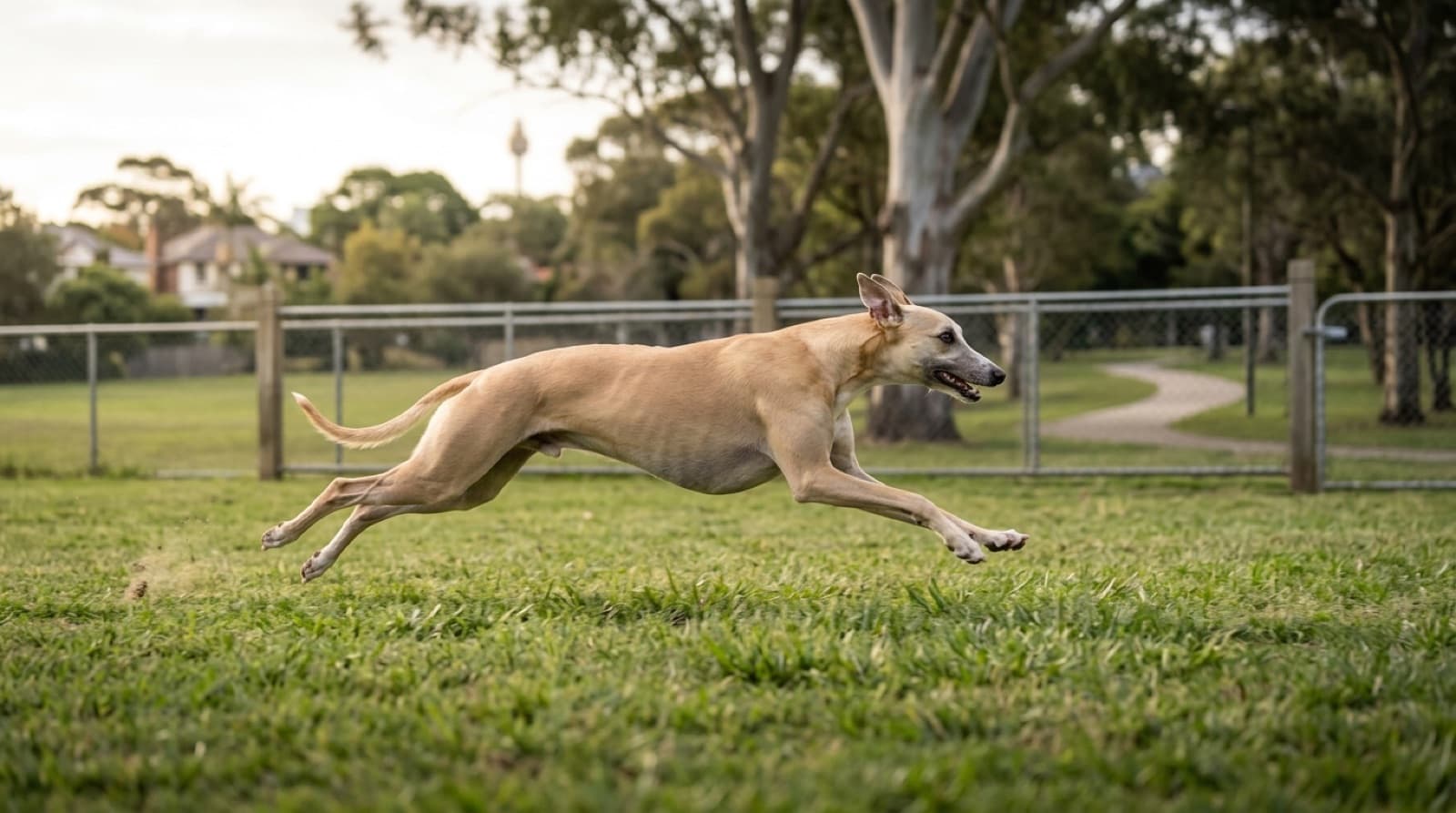
The single most useful thing to understand about a Whippet is that it is a sprinter. This is a sighthound, a dog bred over generations to spot fast-moving prey with its eyes and run it down at very high speed. Everything about the body, the deep chest, the long legs, the whip-thin frame, is built for one job: explosive acceleration over a short distance. A Whippet can reach full speed in a handful of strides.
That shapes how they want to exercise. The pattern is sprint then rest. A Whippet loves to run flat-out for a minute or two, and then it is done, happy to flop down and recover. They are not an endurance dog. You do not need to jog them for an hour or take them on huge bushwalks to tire them out. What they want is the chance to really open up and sprint a few times, then a normal walk on top, and they are content.
The flip side surprises people. Because the exercise need is intense but brief, a Whippet is remarkably calm the rest of the time. Indoors they are quiet, gentle and famously fond of a warm bed, and they sleep a lot. A well-exercised Whippet spends most of the day lounging. So the daily picture is a couple of decent walks, a chance to sprint in a safe space a few times a week, some mental stimulation like sniffing and simple training, and then a very settled dog at home. This is not a high-energy working breed that needs a job every waking hour.
Prey drive, and why it matters
The same breeding that makes a Whippet fast also gives it a strong prey drive. This is the part that catches gentle, sofa-loving Whippet owners off guard, and it is the most important safety point in this whole guide. A Whippet is wired to chase, and that instinct sits under the calm surface waiting for the right trigger.
The trigger is movement. A cat darting across a yard, a rabbit breaking cover, a bird flushing from the grass, or a small dog running away can all flip a Whippet from relaxed to full chase in a heartbeat. It is not aggression and it is not a training failure. It is a hunting reflex, as automatic as flinching. The dog is not choosing to ignore you, it is simply running on hardwired instinct.
Here is why that turns into a genuine safety issue: a chasing Whippet goes deaf to recall. Once the chase is on, the dog is locked onto the target and travelling at speed, and your voice does not reach it. It will run across a road, through a fence gap, or a long way from you without registering danger. That is not a dog being disobedient. It is the reason sighthounds need to be managed rather than simply trained, and it drives every recommendation that follows.
Off-lead safety, the core message
Put the speed and the prey drive together and you get the core rule for owning a Whippet: they are generally not safe off-lead in open or unfenced areas near roads. This is the same position we give Greyhound adopters, because Whippets and Greyhounds share the same sighthound trait. A dog that can reach top speed in seconds and become deaf to recall is one live rabbit away from being hit by a car or lost, no matter how well behaved it usually is.
So the safe way to let a Whippet run free is a securely fenced space. A fully fenced off-lead dog park, or a securely fenced yard, gives the dog room to sprint hard with no road and no way to bolt after prey out of sight. Inside a fence, the worst case is a chase that ends at the fence line. That is the whole point of the fence. Sydney has a good number of fully fenced off-leash areas, and it is worth seeking those out specifically rather than using an open, unfenced park where the boundary is imaginary.
In any open area, keep the Whippet on a lead. That includes unfenced parks, bush tracks, beaches, footpaths near traffic, and anywhere the dog could reach a road. For training and for a bit more freedom in a safe open space, a long-line, a lightweight lead of five to ten metres attached to a well-fitted harness, lets the dog range and sniff while you keep physical control. A long-line is the middle ground between a short lead and true off-lead freedom, and for a prey-driven sighthound it is often the right everyday tool. NSW leash and off-leash rules sit under the Companion Animals Act 1998, and the NSW Office of Local Government explains where dogs must be on lead and how councils set off-leash areas.
Training recall and manners
None of this means you skip recall training. A good everyday recall makes life easier and safer, and Whippets can absolutely learn one. The key is honest expectations: you train recall for manners and control, and you never fully trust it against a live chase. Both things are true at once.
Train it with reward-based, force-free methods. Make coming back to you the best thing that happens, using high-value food and play, so the dog builds a strong, happy habit of turning back to you. Practise on a long-line in safe, low-distraction spaces first, then slowly add mild distractions as the dog gets reliable. The long-line means you can reinforce the recall and prevent a failed one, which is exactly how you build a habit that holds up. Reward-based training is also the approach backed by the welfare evidence, which is why bodies like the Australian Veterinary Association recommend it over harsh or punishment-based methods.
What recall training will not do is override the hunting reflex the instant prey bolts. In that moment the dog is not processing your voice. So the real skill of owning a Whippet is managing the environment so the dog is never in a position where a failed recall ends in disaster. Read the situation, spot the cat or the rabbit before the dog does, keep the lead on near roads, and save the true off-lead sprints for behind a fence. Manage the environment and the recall becomes a useful everyday tool rather than a life-or-death gamble.
Secure fencing at home
The same instinct that makes off-lead risky makes home fencing matter. A Whippet can jump surprisingly well and it can bolt after prey without a second thought, so a low, gappy or unstable fence is a real escape risk. The moment a cat or a possum crosses the yard, a determined Whippet may try to go after it, and a dog loose on a Sydney street is in danger.
Aim for secure, solid fencing with no gaps a slim dog can slip through and enough height that jumping out is not on the table. Check the bottom of the fence too, since a lean, athletic dog can wriggle under a gap you would not expect. If you rent, or your fencing is not up to it yet, that is not an automatic reason to rule out a Whippet, but you do need a clear plan: keep the dog leashed in the yard until the fencing is sorted, and rely on a fully fenced dog park for the dog's real sprints. Secure containment is simply part of responsibly owning a fast, prey-driven breed.
Living with a Whippet in Sydney
Given secure exercise, a Whippet is one of the easiest medium dogs to live with in Sydney, including in an apartment. They are calm, quiet and clean indoors, they do not tend to bark much, and they are devoted, affectionate housemates who will happily share the couch. A well-exercised Whippet in a unit is a relaxed, low-fuss companion. The whole arrangement just hinges on getting the sprints and the daily walks in.
The Sydney climate needs a bit of thought, because a Whippet is thin-skinned with almost no body fat and a very short coat. Heat is the main dog-safety risk in Sydney, so exercise in the cool of early morning or evening and go easy in the middle of a hot, humid summer day, when even a fast dog can overheat. At the other end, a Whippet genuinely feels the cold, so a warm coat on a chilly Sydney winter morning is sensible rather than fussy, and they will always seek out the warmest spot in the house.
One health point applies to every dog in the Sydney region, not just Whippets. Paralysis ticks are a year-round danger across coastal and bushland NSW and can be fatal, so keep your dog on a vet-recommended tick prevention product all year and check the coat after any walk in bushy areas. A short-coated Whippet is at least easy to check over. Talk to your vet about the right product for your dog. The RSPCA Australia Knowledgebase is a good general reference on exercise, heat safety and parasite prevention.
Browse adoptable Whippets in Sydney
A Whippet suits an owner who can provide secure, fenced running and accepts a lead in the open. Browse live NSW listings and set an alert so you hear the moment one comes in.
See Available Whippets →Who a Whippet suits
Put it all together and the right home becomes clear. A Whippet suits someone who can provide secure running, a fully fenced dog park or yard for the sprints, and who accepts that the dog stays on a lead in open areas near roads for its whole life. If you are comfortable with that management, you get a wonderful dog: calm and gentle indoors, low-maintenance, affectionate, and a joy to watch run. That trade, manage the prey drive in exchange for an easy housemate, is the deal with the breed.
A Whippet is a poor fit for someone who has their heart set on a dog they can hike off-lead through open bushland, or who cannot provide any secure space to run and does not want to rely on a fenced dog park. It is also a careful match if you have a cat or a small dog, since prey drive varies by individual and some Whippets will chase. Adoption is a real advantage here, because a rescue that has fostered a dog can tell you honestly how it has gone with cats, small dogs and recall. Rescues like RSPCA NSW, AWL NSW, Sydney Dogs and Cats Home, Monika's Doggie Rescue and Maggie's Rescue take in dogs of all breeds and can match you to a suitable one. Our Whippet adoption guide covers where to look and what adoption involves.
When to get help
Most Whippet behaviour is normal sighthound instinct that the right management, fencing and reward-based training settle into an easy routine. But some things are worth proper help rather than struggling on alone. Get a professional involved if you see persistent bolting or escaping, reactivity to people or other dogs that is getting worse, or a prey drive so strong you cannot safely manage it in daily life. These are common issues that respond well to skilled, humane help, not a sign you have failed.
When you look for help, choose the right kind. A qualified force-free or reward-based trainer is right for recall, manners and general training. For serious anxiety, fear or hard-to-manage reactivity, a veterinary behaviour service is the better call. Steer clear of anyone who leans on punishment, prong or shock tools, which make a sensitive sighthound worse rather than better. And rule out pain or illness first, since a sudden change in behaviour can be a dog telling you it feels unwell, so a vet check comes before you treat any change as purely behavioural. For breed-specific health, our Whippet health issues guide goes into detail, and the full Sydney resources hub is a good next read.
Frequently Asked Questions
How much exercise does a Whippet need?
A Whippet needs a fair bit less structured exercise than most people expect for a running breed. Plan for a couple of decent walks a day plus a chance to really sprint in a safe, fenced space a few times a week. The pattern that matters is short and intense, not long and steady. A Whippet is built to run flat-out for a minute and then rest, so it wants bursts of hard running rather than hours of jogging. Give it that outlet plus normal daily walks and mental stimulation, and a Whippet is genuinely calm and easy the rest of the time. They are not an endurance dog and they do not need to be marched for hours.
Can Whippets be let off the lead?
Only in a securely fenced area, not in open or unfenced spaces near roads. A Whippet is a sighthound bred to chase by sight at very high speed, and when it locks onto a cat, rabbit, bird or fleeing small dog it can hit top speed in seconds and go completely deaf to your recall. In an open park or near traffic, that is how sighthounds get hit by cars or lost. So the honest rule, the same one we give Greyhound adopters, is a fully fenced dog park or yard for off-lead running, and a lead in any open area. Recall training helps a lot for everyday manners, but you never fully trust it against a live chase.
Do Whippets have a strong prey drive?
Yes, Whippets have a strong prey drive because they were bred for generations to spot and chase small fast-moving animals. That instinct is baked in, not a training failure. Fast movement is the trigger: a bolting cat, a rabbit, a bird flushing from grass, or a small dog running away can all switch a Whippet from calm to full chase in an instant. It is not aggression, it is a hunting reflex, but the result is the same safety problem. You manage prey drive with secure fencing, a lead in open areas, and a solid understanding that a chasing Whippet is not being naughty, it is doing exactly what the breed was made to do.
Are Whippets good with cats and small dogs?
It depends entirely on the individual dog, so a careful, honest match matters more than any breed rule. Some Whippets live happily with cats and small dogs they have grown up with and see as family. Others have a prey drive strong enough that a running cat or small dog will trigger a chase, which is dangerous for the smaller animal. A rescue that has fostered the dog can tell you how it has actually gone with cats and small dogs, which is worth far more than a guess. If you have a cat or a small dog, ask directly, introduce slowly and supervised, and never leave them alone together until you are sure.
Can you train a Whippet to have reliable recall?
You can train a good everyday recall, but you can never make it fully reliable against a live chase, and it is important to be clear about that. Reward-based recall training, practised on a long-line in safe spaces, gives you a Whippet that comes back well in ordinary situations. What it does not do is override the hunting reflex when a rabbit bolts across the path. In that moment the dog is running on instinct and your voice does not reach it. So you train recall for manners and control, but you manage the risk with fencing and a lead rather than betting a dog's life on recall holding in the one moment it counts most.
Are Whippets good apartment dogs?
Yes, Whippets are surprisingly good apartment and unit dogs, which catches a lot of people out. They are calm and quiet indoors, they love a soft warm spot to curl up, and they sleep a great deal, so a well-exercised Whippet is a relaxed housemate in a small space. The catch is the word well-exercised: the apartment only works if the dog gets its sprints in a safe fenced area and its daily walks. Give it that outlet and a Whippet is one of the easier medium dogs to live with in a Sydney unit. Skip the exercise and the pent-up energy has nowhere to go.
Do I need a fenced yard for a Whippet?
A securely fenced yard is strongly recommended, and if you do not have one you need a reliable plan for safe off-lead running elsewhere. Whippets can jump and they can bolt after prey, so low or gappy fencing is a real escape risk, especially the moment a cat or bird crosses the yard. If you rent or your fencing is not secure, that is not an automatic no, but you will be relying on a fully fenced dog park for the dog's sprints and keeping it leashed everywhere else. Either way, secure containment is the thing that keeps a fast, prey-driven dog safe near Sydney roads.
Are Whippets high energy?
Not in the way people usually mean, which is one of the breed's best-kept secrets. A Whippet has short bursts of very high energy when it runs, then wants to sleep and lounge for most of the day. It is the opposite of a working dog like a Kelpie or Border Collie that needs constant physical and mental work. So a Whippet is a low-to-moderate energy dog overall, with an intense but brief exercise need. That mix, calm indoors plus a need for real sprinting, is exactly why they suit owners who can provide secure running space but do not want a dog that never switches off.
Keep reading
Adoptable Whippets in Sydney
Live listings of Whippets and Whippet crosses across Sydney and NSW rescues.
Whippet Adoption in Sydney
Where to adopt, why Whippets end up in rescue, and what adoption costs against a breeder.
Whippet Health Issues in Sydney
The thin-skinned sighthound, Sydney heat, warmth in winter and year-round paralysis tick prevention.
All Sydney Adoption Guides
Browse every breed and how-to guide for adopting a rescue dog in Sydney.