The short answer
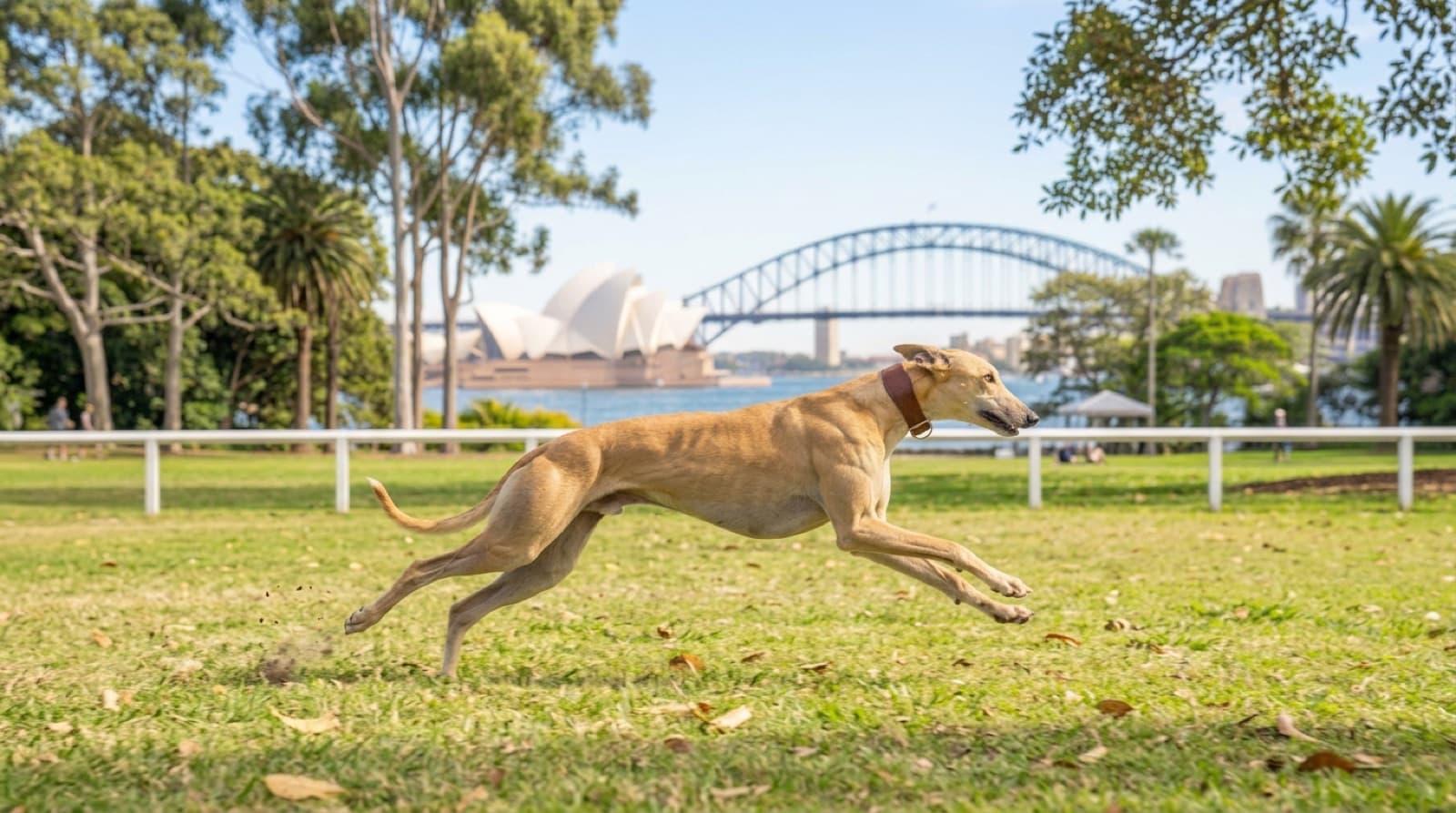
Greyhounds should never be off-leash in unfenced public spaces, including timed-off-leash council parks. The breed's hardwired predatory response cannot be reliably overridden by training; a greyhound that takes off after a cat or possum can be a kilometre away in 30 seconds at speeds up to 60-72 km/h. Sydney has a small number of fully fenced off-leash venues that work for greyhound sprints (Sydney Park, parts of Bicentennial Park, several private fenced fields available for hire). For unfenced exercise, a 10-30 metre long line is the right tool: it gives the dog space to sniff and roam while maintaining a physical connection if prey drive activates. Always use a martingale collar to prevent slipping out, never a regular flat collar.
Why “no off-leash” is the right answer
Greyhounds are sighthounds, a category of dog bred for thousands of years to hunt by sight rather than by scent. Their physical and behavioural traits are concentrated around one single skill: see prey, chase prey, catch prey. The modern racing industry has further refined this, selecting for dogs that respond instantly to a moving lure with maximum acceleration and speed.
Five facts that explain why off-leash is dangerous for greyhounds specifically:
- Speed. A greyhound at full sprint reaches 60-72 km/h within three to four strides. That is faster than most cars in a Sydney suburban street.
- Distance. At sprint speed, the dog can cover 500 metres in 30 seconds. By the time you finish saying their name, they are a block away.
- Prey-drive override. When the chase instinct activates, the greyhound's entire focus narrows to the moving target. Voice commands, treats, familiar people calling them: all become invisible. This is neurological, not disobedience.
- Sight-driven triggers. The prey trigger is anything that moves quickly across the dog's field of vision: a cat, a possum, a rabbit, a small dog, sometimes a fast-moving bicycle or a plastic bag in the wind.
- Recall is not a solution. Many breeds can be trained to recall reliably even under distraction. Greyhounds, by breed-specific physiology, cannot. The very few greyhounds with reliable distraction-recall are statistical exceptions; the rescues we work with do not recommend banking on it.
This is not the opinion of one rescue. The Greyhounds As Pets NSW and greyhound rescue groups widely advise against letting a greyhound off-lead in unfenced spaces. This rule is also embedded in the original racing-industry training: even racing dogs are kept controlled at all times because of how rapidly the predatory response activates.
The “but my greyhound is cat-safe” misconception
Cat-safe means the greyhound has been tested in a calm controlled setting around a confident cat and has shown no predatory response. It does not mean the prey drive is absent. Cat-safe greyhounds can still chase rabbits, possums, small dogs running fast, birds taking off, plastic bags in the wind, and sometimes children running.
The reality test: in a calm indoor environment with a calm cat, your greyhound shows nothing. In an outdoor environment with a sudden movement at full speed, the response may be entirely different. The brain's threat-and-prey assessment depends on visual cues that change with context.
The honest framework: cat-safe is a green light for cohabiting with a calm familiar cat at home. It is not a green light for off-leash in environments with fast-moving small animals, which describes most Sydney parks.
What happens when a greyhound goes
A practical timeline of what an off-leash chase looks like:
- 0 seconds. The dog is standing next to you, calm and apparently engaged.
- 2 seconds. A cat moves across a distant lawn. The dog has seen it. You may not have.
- 3 seconds. The dog is at 50 km/h, heading toward the cat. You shout. The dog does not register your voice.
- 15 seconds. The dog has crossed the park, is on a road, traffic is honking.
- 30 seconds. The dog is a block away, in a direction you cannot easily follow.
- 60 seconds. The cat has gone up a tree. The dog is looking around for the next moving thing. You are running and shouting from 800 metres back.
- 5 minutes. Depending on outcome: best case, the dog has tired and is somewhere you can find them. Worst case, the dog has been hit by a car, has caught and injured a cat, has run into bushland, or is being held by a stranger who has called council.
Most “lost greyhound” stories that end well end well because the dog tired quickly and was found within an hour. Many do not end well. The most preventable problem in greyhound ownership is also the most catastrophic.
Browse adoptable greyhounds in Sydney
Rescue greyhounds arrive with detailed temperament assessment including prey drive. Each profile flags cat and small-dog safety.
See Available Greyhounds →Fenced off-leash venues in Sydney that actually work
The Sydney venues where a greyhound can run safely:
1. Sydney Park, St Peters (Inner West)
Sydney Park has a large fully fenced off-leash dog area in the eastern section of the park, accessible from Sydney Park Road. The fence is full-perimeter and high enough to contain a greyhound. The space is large enough for a real sprint. Weekend mornings tend to be the busiest; weekday afternoons are quieter. Watch the breed mix; in busy periods there are many small dogs that can trigger chase behaviour.
2. Bicentennial Park, Sydney Olympic Park
Bicentennial Park has multiple fenced sections suitable for greyhounds, including some specifically large enough for sprinting. The park is less crowded than Sydney Park and the surfaces are well-maintained. A reasonable drive from most parts of Sydney; worth the trip for the space.
3. Private fenced fields (sniffspots and similar)
Sydney has a growing network of private property owners who rent out fully fenced fields by the hour through services like Sniffspot (sniffspot.com) or similar listings. These spaces are private (no other dogs), fully fenced, and often have acres of open space for a real sprint. Costs $20 to $60 per hour. The single best off-leash option for many greyhound owners; particularly good for cat-not-safe dogs that cannot use shared dog parks.
4. Greyhound playgroups and meetups
Several Sydney greyhound owner groups book fenced fields for greyhound-only meetups. Because all dogs present are greyhounds with assessed temperaments, the prey-drive trigger from small dogs is absent and the sprint dynamics are well-matched. Find these through GAP NSW community, Sydney greyhound Facebook groups, and rescue networks. Typically weekend morning or afternoon sessions, $5-$15 per dog.
5. Inside the home and yard
If you have a fully fenced yard of any reasonable size (at least 200 square metres with a six-foot fence), short backyard sprints serve as legitimate off-leash time. Many greyhound owners with smaller properties rely mostly on yard time plus a weekly fenced-venue trip.
One legal point before you use any off-leash area: in NSW a pet greyhound must wear a muzzle in an off-leash area unless it has completed an approved retraining program (Greenhounds or Greyhounds As Pets), shown by a green collar. Outside off-leash areas a registered pet greyhound no longer needs a muzzle, but must be on a lead. The NSW Office of Local Government sets out the rules on its greyhounds page.
What does not work as an off-leash option
- Council timed-off-leash zones. Centennial Parklands, Bondi Beach off-lead times, harbour foreshore reserves. These are unfenced. The fact that other people's dogs are off-leash there does not make it safe for a greyhound.
- Quiet local parks with no perimeter fence. A quiet park is not a fenced park.
- Open bushland. Maximum prey-drive territory (rabbits, native fauna), maximum recall difficulty, hardest place to retrieve a lost dog.
- Beaches. Even off-leash dog beaches like Sirius Cove are unfenced. Sand makes it harder for the dog to gain traction (slightly slower sprint) but the prey-drive risks remain.
- Sporting fields outside scheduled hours. Unfenced and the dog can be on a road within seconds of leaving the field.
The long-line: the unfenced-space solution
A long line is a 10 to 30 metre nylon lead that lets the dog roam, sniff and explore in unfenced spaces while maintaining a physical connection if prey drive activates. For greyhounds in unfenced parks and reserves, it is the right tool.
How to use a long line:
- Attach to a martingale collar, not a harness for the long line specifically. Harnesses can twist or rotate awkwardly on a long line; the martingale collar gives clean control. Use a harness for everyday walks if your dog pulls; switch to martingale-plus-long-line for exploration sessions.
- Hold the end loosely and walk with the dog at their pace. The long line is meant to be loose most of the time, just there as insurance.
- Manage the line carefully. 20-30 metres of nylon line wrapped around your legs at sprint speed becomes a rope burn or a fall. Loop excess in your hand or use a clip-belt system.
- Use gloves. If the dog sprints into the line, the friction burn through bare hands can be serious.
- Avoid heavily wooded areas where the line will tangle in bushes constantly.
- The dog still feels off-leash. A 30-metre long line gives the dog meaningful space to roam, sniff and decompress. It is not a leashed walk; it is a structured off-leash equivalent.
Good long-line gear: a 10-15mm flat nylon line, 15-30 metres long, with a stainless steel snap clip and a hand loop. Available from greyhound-specific suppliers, working-dog suppliers and outdoor stores for $40 to $90. Avoid retractable leads; they are not strong enough or long enough.
Why the martingale collar matters
Greyhound neck anatomy is unusual: the head is narrow and the neck is broad. A standard flat collar that fits comfortably around the neck will slip over the head if the dog pulls backward or panics. A martingale collar (sometimes called a limited-slip or greyhound collar) is designed for this anatomy: it tightens when the dog pulls back to a controlled extent that prevents escape, but does not choke.
The practical reality:
- Every Sydney greyhound rescue provides one with the dog. Use it.
- Fit is critical. The collar should sit high on the neck (just behind the ears) and, when tightened by pulling, should leave room for two fingers between collar and neck. Tight enough to not slip off, loose enough to not choke.
- Some owners use a martingale plus a harness on walks with the lead clipped to the harness for everyday control and the martingale as backup if the harness fails.
- For long-line use, attach to the martingale, not the harness. Harnesses can twist awkwardly under long-line tension; martingale stays clean.
How much exercise does a greyhound actually need
Surprisingly little. Greyhounds are sprint athletes, not endurance dogs. Their athletic biology is concentrated around explosive short-burst power followed by long recovery. The breed sleeps 16 to 18 hours a day in normal conditions.
A workable exercise routine for most adult Sydney greyhounds:
- Morning walk: 20 to 30 minutes on lead. Sniff-friendly local neighbourhood walk. This is the social and decompression walk; the dog stretches their legs, takes in the day, has a bathroom break.
- Evening walk: 20 to 30 minutes on lead. Often a slightly longer walk with the social benefit of seeing other dogs at a distance (on lead, no greetings if the dog is reactive).
- Weekly off-leash sprint session: 30-60 minutes at a fenced venue. The dog will do two or three short sprints, then sniff around, then maybe one more sprint. Total sprint time: a few minutes. The session covers the physical conditioning need for the week.
- Mental stimulation: 10-15 minutes daily. Food puzzles, scent games, training sessions, lick mats. Mental tiredness is real tiredness for a dog.
That is genuinely enough for most adult greyhounds. Some owners find their dog content with even less; some young high-drive dogs need more. The biggest exercise mistake is over-exercising a greyhound expecting them to behave like a working breed; the second is under-exercising and assuming a 20-hour-sleeping dog is depressed.
If your greyhound does get loose
Despite best practices, accidents happen: a gate left open, a slipped harness, a moment's distraction. If your greyhound gets loose, the response in the first 10 minutes determines the outcome.
Do:
- Stay calm. Panic in your voice will make the dog less likely to come back.
- Crouch low and call calmly with familiar words and treats.
- If the dog is far away, do not chase. Sit down or lie on the ground if safe; some greyhounds respond to “what happened to my owner” by approaching.
- Use a familiar food smell if you have something with you.
- Call council ranger services and local greyhound rescue networks immediately. They have search experience and may be able to help.
- Post on social media in Sydney greyhound owner groups; the community responds fast to lost greyhound posts.
Do not:
- Chase the dog at speed. They will read it as a game and run further.
- Yell. Voice tension means stay away.
- Wait too long to call council. Lost greyhounds picked up by a stranger are returned to council pounds quickly; if you have not registered the loss they may be processed before you reach them.
- Drive looking for the dog if you have anyone else with you. Have the second person stay where the dog was last seen, because greyhounds sometimes return to the exact spot.
For ongoing prevention: GPS trackers attached to the collar (Tractive, Fi, AirTag in a holder) have improved enormously in recent years and are genuinely useful for greyhounds. The investment is $100-$300 plus a subscription; the peace of mind is significant.
Frequently Asked Questions
Can I train my greyhound to be reliable off-leash?
Almost never to a degree that is safe in unfenced public spaces. Greyhounds are sighthounds bred for centuries to chase moving prey at high speed. When prey drive activates (a cat, a possum, a rabbit, a small dog, even a plastic bag in the wind), the response is fast, instinctive and not interruptable by voice. The dog can be 500 metres away in 20 seconds. This is not a training failure; it is a hardwired predatory response. The honest answer the rescues we work with give is: never off-leash in unfenced spaces, ever.
Where can I let my greyhound run off-leash safely in Sydney?
Only in fully fenced areas. The main options: Sydney Park in St Peters has a fully fenced large off-leash area. Centennial Parklands has timed off-leash zones but they are not fenced; not suitable for greyhounds. Bicentennial Park at Sydney Olympic Park has some fenced sections. Several private dog parks and "sniffspots" in Sydney rent out fully fenced acreage by the hour, which suits greyhound sprints well. Many greyhound owners join Sydney greyhound playgroups that book fenced fields specifically for off-leash sessions with other greyhounds.
What is a long line and is it a real off-leash alternative?
A long line is a 10 to 30 metre nylon lead that gives the dog more space to roam, sniff and decompress without the risks of true off-leash. For greyhounds it is genuinely the right tool for unfenced spaces. You hold the end (or stake it down for short stretches), the dog has room to move, and if prey drive activates you have a physical connection to stop the chase. The trick is matching long-line length to the venue and keeping a clean line away from your legs.
Why do I need a martingale collar instead of a regular collar?
Greyhound necks are wider than their heads, which means a regular flat collar will slip off if the dog pulls backward or panics. Greyhounds also have thin sensitive skin that chokes against a typical pulling collar. A martingale collar (sometimes called a greyhound collar or limited-slip collar) tightens when the dog pulls but only to a point that prevents escape, not strangulation. Every greyhound rescue we work with provides one with the dog at adoption.
What happens if my greyhound gets loose in Sydney?
A loose greyhound running at full speed is dangerous to itself and others. Most greyhounds that escape are killed by cars or get injured before owners can recover them. The greyhound's 60 km/h+ sprint means it can be in heavy traffic within seconds. If your dog does get loose, do not chase (they will run further); instead crouch low, call calmly and use familiar food smells if possible. Contact local council and rescue groups immediately; lost greyhounds usually need a coordinated search.
Are Sydney dog parks safe for greyhounds?
Fully fenced dog parks are usually safe for socialised greyhounds, with two caveats. First, watch the breed mix; very small dogs can trigger prey drive even in cat-safe greyhounds, particularly in a chase situation. Second, watch the activity level; an over-aroused greyhound running with other dogs can collide hard at speed (35 km/h+ in a park sprint) and either greyhound or another dog can be injured. Greyhound-only meetups in fenced fields are safer than general dog park time for most greyhounds.
How much off-leash exercise does my greyhound actually need?
Less than people expect. Greyhounds are sprint athletes, not endurance dogs. One or two short sprints (60 to 120 seconds of full-speed running) once or twice a week is plenty of off-leash physical exercise for most adult greyhounds, supplemented by daily on-leash walks of 20 to 40 minutes. The leashed walks are actually more about sniffing, social experience and routine; the off-leash sprints are about physical conditioning. Many greyhound owners get by with no off-leash time at all if the dog is content on lead.
Keep reading
Adoptable Greyhounds in Sydney
Live listings with temperament assessment including prey drive.
Greyhound Adoption in Sydney
GAP NSW, the rescues, ex-racing dog reality, first-week routine.
Greyhound Health Issues
Osteosarcoma, bloat, dental, anaesthesia sensitivity. Sydney specialty vets.
Best Dog Rescues in Sydney
The 5 main Sydney rescues compared: process, fees, specialties.