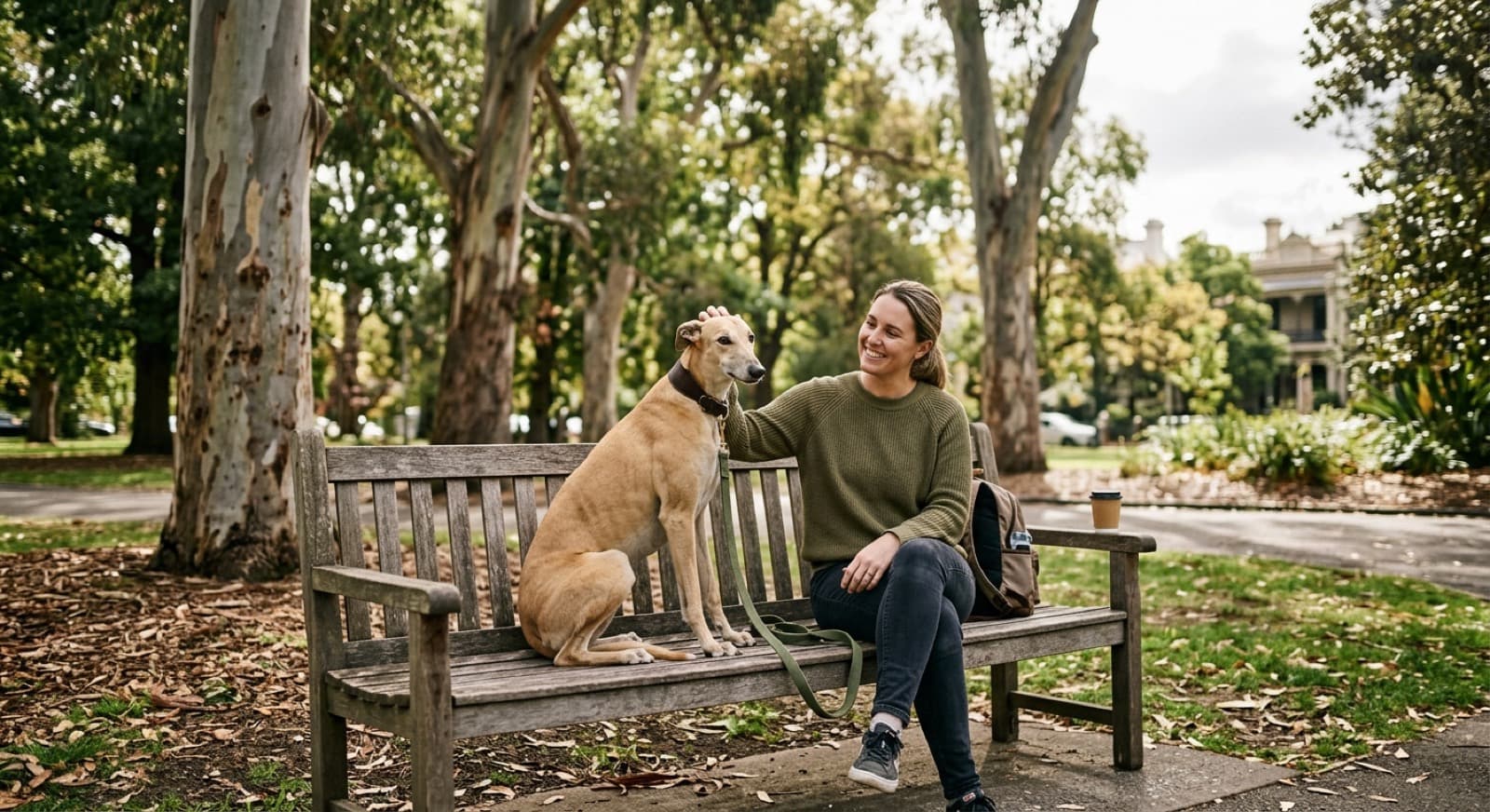
The short answer
Most adoptable greyhounds in Melbourne are retired racing dogs, and the main pathway is the Greyhound Adoption Program (GAP), run by Greyhound Racing Victoria since 1996. The GAP adoption fee is around $100 and already covers desexing, microchipping, vaccination and a full temperament test, including cat and small-animal assessment. Bigger shelters like RSPCA Victoria, Lort Smith, The Lost Dogs' Home and Save-A-Dog Scheme list greyhounds from time to time too, usually $500 to $850. Two Victorian rules are worth knowing up front: pet greyhounds do NOT need a muzzle in public (that requirement ended on 1 January 2019), but a greyhound must stay on-lead at all times in public, including council off-lead areas. Ex-racing dogs are calm and gentle, but the first week is unusual, because most have never seen stairs, glass doors, a television or carpet.
The Melbourne greyhound rescue landscape
Victoria has more adoptable greyhounds at any given time than almost any other breed. The reason is the size of the racing industry: hundreds of dogs retire from Victorian tracks each year, and rehoming is now the standard pathway rather than the exception. Greyhound Racing Victoria runs the largest rehoming operation, the Greyhound Adoption Program, and the general Melbourne shelters add capacity on top of that.
The main pathways for finding an adoptable greyhound in Melbourne:
1. The Greyhound Adoption Program (GAP)
Run by Greyhound Racing Victoria since 1996, GAP is the main pathway for retired racing greyhounds in Victoria and rehomes large numbers of dogs each year. The program fosters and assesses each dog before adoption, includes thorough cat and small-animal testing, and hands over a dog that is already desexed, vaccinated, microchipped, wormed and flea-treated.
Adoption fee: around $100.
Process: Apply online, meet available dogs, take home a dog that has already been temperament-assessed.
Website: gap.grv.org.au.
2. RSPCA Victoria
The state body runs adoption centres at Burwood East and RSPCA Peninsula at Pearcedale, and takes in greyhounds and greyhound crosses through the year alongside its wider intake. Every adoption already covers desexing, vaccination, microchipping, a vet workup and a behavioural assessment.
Adoption fee: typically $500 to $850 for an adult dog, all-inclusive.
Process: Apply online, meet the dog, complete the adoption at the centre.
Website: rspcavic.org.
3. Save-A-Dog Scheme
A Melbourne-based no-kill rescue running since 1985, with a mix of shelter and foster placements. Smaller and more matched than the big metro shelters, and a good option if you want a slower, more personal process. Greyhounds and greyhound crosses turn up on their list from time to time.
Adoption fee: typically $350 to $600, all-inclusive.
Process: Application and a good deal of matching, so the fit is right before you take the dog home.
Website: saveadog.org.au.
4. The big Melbourne shelters
Lort Smith at Campbellfield, The Lost Dogs' Home in North Melbourne, Animal Aid at Coldstream and the Australian Animal Protection Society at Keysborough each take in greyhounds occasionally. They are not greyhound-specialty operations, so the rate of greyhound listings is lower than GAP, but the dogs are fully vetted and the adoption process is straightforward. See our guide to adopting in Melbourne for the wider rescue list.
5. National aggregators
A fast way to scan many Victorian rescues at once is PetRescue, a national aggregator that lists animals from hundreds of member rescues in one searchable place. It is useful for a broad look at what is available across the state, though for greyhounds specifically GAP will almost always have the deepest and best-assessed list.
The muzzle and lead rules in Victoria
This is where Victoria differs from what a lot of adopters expect, and from the rules in other states. Two separate points, and it is easy to mix them up.
Muzzle: not required.
- Pet greyhounds in Victoria do not need to wear a muzzle in public. The requirement was removed for all pet greyhounds on 1 January 2019, and the old Green Collar scheme was retired at the same time.
- Your greyhound is treated like any other dog on this point. No exemption paperwork, no special collar, nothing to arrange.
- You may still choose to muzzle. Some owners prefer a muzzle around wildlife, on a busy path, or while the dog settles in. That is a personal choice, not a legal one.
Lead: required at all times in public.
- A greyhound must be on-lead at all times in public, including a council off-lead area. A pet greyhound legally cannot be let off the lead in a public off-lead park in Victoria.
- Off-lead running happens only in a secure, fully fenced space. A hired private dog paddock or a fenced backyard is where your greyhound gets to open up and sprint safely.
- The lead rule is about the greyhound's speed and prey drive, not its temperament. A calm, friendly greyhound can still be gone in seconds after a cat or a possum, and at 60 km/h that is a serious risk near roads.
Council registration still applies like any other dog: under the Domestic Animals Act 1994, a dog 3 months or older must be registered with your local council and microchipped before that first registration, with the registration renewed each year by 10 April. A desexed and microchipped greyhound gets a substantially reduced fee, set by your local council. For safe recall and long-line work in a fenced space, see our greyhound off-lead safety guide, and Parks Victoria lists dog-friendly parks across the state.
The honest cost comparison
The economics of greyhound adoption are unusual. Because most dogs come through a regulated rehoming program, the GAP fee is kept deliberately low, around $100, to encourage adoption. Ongoing costs are similar to other large breeds with two adjustments: greyhounds need less food than most large breeds (calm dogs use fewer calories), and the lean body type means a warm coat and warm bedding are real budget items in a Melbourne winter.
| First-year cost | Range |
|---|---|
| Adoption fee (GAP) | around $100 |
| Initial gear (martingale collar, lead, bed, warm coat, raised feeder) | $300 to $500 |
| Year 1 food | $900 to $1,400 |
| Parasite prevention (fleas, intestinal worms, heartworm) | $250 to $450 |
| Annual vet check and vaccinations | $300 to $500 |
| Council registration | Set by your local council (reduced when desexed and microchipped) |
| Pet insurance (genuinely recommended for the breed) | $900 to $1,500 a year |
| Year 1 total (excluding council fee) | $2,750 to $4,450 |
Pet insurance for greyhounds is genuinely worth it. The breed carries a higher risk of osteosarcoma (bone cancer), gastric dilatation volvulus (bloat) and a few other expensive conditions, covered in our greyhound health guide.
“Greyhound for sale Melbourne”: the safer path
Some people start their search typing “greyhound for sale Melbourne” or scroll Gumtree and Facebook Marketplace for a private resale. Worth a quick reality check. A GAP greyhound at around $100, already desexed, vaccinated, microchipped and temperament-tested, is cheaper and safer than almost any private sale, and you get a dog whose behaviour around cats, kids and other dogs has actually been assessed.
Victoria also gives you a strong extra check. Every advertisement to sell or give away a dog must display the animal's microchip number and a Pet Exchange Register (PER) source number. A listing with neither is a clear red flag, and you can verify a source number on the Pet Exchange Register before you hand over any money. If budget is the worry, a rehomed greyhound with a full vet workup already done is genuinely cheaper than a “free” dog whose first vet visit lands on you.
Browse adoptable greyhounds in Melbourne
Live listings from the Greyhound Adoption Program and Melbourne rescues. Each profile includes the cat-test result and temperament assessment.
See Available Greyhounds →What ex-racing greyhounds are actually like
The stereotype most people carry is wrong in both directions. Greyhounds are neither high-energy racing machines nor traumatised, damaged dogs. The reality is much simpler. They are calm, sweet-natured dogs that have lived a very specific kind of life and now need to learn a different one.
The temperament reality:
- Calm and quiet. Greyhounds rarely bark and sleep 16 to 18 hours a day. Most apartment neighbours never know there is a greyhound next door. They are nicknamed the 45 mph couch potato for a reason.
- Low energy at home. Two short walks a day, 20 to 30 minutes each, suit most adult greyhounds. They are sprinters, not endurance runners.
- Affectionate but independent. Greyhounds bond with their family but are not typically clingy. They like being near you, not necessarily on you.
- Friendly with other dogs. Racing greyhounds spend their working lives in kennels around other greyhounds and are generally well-adjusted socially.
- Gentle with children. Most ex-racing greyhounds are lovely with kids but should be supervised, because the large size and thin skin mean accidental injuries can happen.
The settling-in reality:
Ex-racing greyhounds usually arrive in the home having never experienced what other dogs take for granted. Things they have not seen and need to learn:
- Stairs (some have never used them, so teach slowly with treats and a non-slip surface)
- Glass doors (they will walk into them, so close curtains for the first week)
- Slippery indoor flooring (rugs and runners help a lot)
- Mirrors (they may bark at their reflection at first)
- Television (sudden noises and visuals can startle)
- Carpet (some lie on it gingerly the first day, then love it forever)
- Being alone (most have spent their lives surrounded by other dogs)
- Household sounds (washing machine, dishwasher, vacuum cleaner)
None of this is difficult. Greyhounds learn home life within one to four weeks with calm, patient handling. But knowing it is coming makes the first days much smoother.
The first week home: a realistic plan
Day 1:
- Bring the dog home during quiet daytime hours, not in the evening
- Show them their bed, food and water area straight away
- Keep the dog on-lead inside for the first day to learn the layout safely
- Skip the extended-family visit, and let the dog meet only the people it will live with
- Expect a long sleep within the first few hours, because transition exhaustion is real
- If you have stairs, carry the dog up and down the first time, then teach slowly
Days 2 to 3:
- Short, calm on-lead walks (15 to 20 minutes) in the local neighbourhood
- Slow introduction to family routines (mealtimes, work-from-home patterns)
- Begin basic commands (sit can be hard for greyhounds, because their body shape makes it less natural)
- Establish the rest spot the dog will use
- Close internal doors at night so the dog stays in a familiar, small area
Days 4 to 7:
- Slightly longer on-lead walks, slowly introducing different surfaces (grass, sand, asphalt)
- Short periods of being left alone (5 to 30 minutes), built up gradually
- Meet one or two extended family members in calm settings
- First vet visit if not already scheduled: baseline weight, dental check, parasite prevention
- Begin a feeding and toileting routine that fits your work pattern
Weeks 2 to 4:
- Begin meeting other dogs in calm, on-lead settings
- Take the dog to a secure, fully fenced space for a supervised sprint
- Build up time alone toward a normal workday pattern
- Real personality begins to emerge (the 3-3-3 rule: 3 days to decompress, 3 weeks to settle, 3 months to feel at home)
Cat compatibility and small-animal testing
This is the single most variable thing about a greyhound. Prey drive is bred into racing lines, because the dogs were selected to chase a mechanical lure, and individual dogs vary from completely safe with cats to genuinely dangerous around small animals.
The Greyhound Adoption Program cat-tests and small-animal-tests every greyhound before adoption. The test usually places the greyhound in a calm, controlled setting around a confident cat, and the dog's reaction is observed and recorded:
- Cat-suitable. The greyhound shows no real interest, and may glance then ignore. These dogs can live with cats and small pets with a normal introduction.
- Cat-trainable. The dog shows interest but responds to redirection. With careful introduction and management, these dogs can sometimes live with cats, and the rescue will guide you.
- Not cat-suitable. A strong prey response. These dogs should not be placed in homes with cats or small pets.
The result is recorded on the dog's profile. If you have a cat or a small pet at home, apply only for greyhounds marked cat-suitable. Do not assume an untested greyhound will be fine, because the consequences when prey drive triggers can be severe and irreversible.
Greyhounds and the Melbourne climate
Greyhounds have thin coats, very little body fat and a large surface-area-to-mass ratio, so they feel both heat and cold more sharply than most breeds. Melbourne's temperate oceanic climate is cooler and more variable than the warmer states, which means the cold end of the scale matters as much as the hot.
Melbourne winter:
- A warm dog coat for outdoor walks is standard through the cooler months
- A sleeping spot away from draughts, with a warm bed or blankets, matters from day one
- Indoors, the dog will seek out warm spots, so expect it to claim the sunny patch or the space near the heater
Melbourne summer:
- On a 40-degree heatwave day, walk before 7 AM and after 7 PM, and skip the middle of the day
- The seven-second footpath test: press the back of your hand to the pavement, and if you cannot hold it there comfortably for seven seconds, it is too hot for the dog's paws
- Keep aircon or a fan available during the hottest hours, and never leave the dog in a parked car
- Watch for early heatstroke signs: heavy panting that does not settle, bright red gums, glazed eyes
Fleas and intestinal worms are a year-round concern in Melbourne, and heartworm (spread by mosquitoes) is present in Victoria, so ask your vet about a prevention plan. Paralysis ticks are a low risk in metropolitan Melbourne, but they are a real danger on the NSW coast and in East Gippsland, so add tick prevention if you travel there with the dog. General guidance on Victorian dog ownership is available from Agriculture Victoria.
Frequently Asked Questions
Where do most adoptable greyhounds in Melbourne come from?
Most are retired racing dogs. The main pathway in Victoria is the Greyhound Adoption Program (GAP), run by Greyhound Racing Victoria since 1996. GAP dogs come desexed, vaccinated, microchipped, wormed, flea-treated and temperament-assessed, including cat and small-animal suitability. Beyond GAP, the large Melbourne shelters and rescues take in greyhounds from time to time: RSPCA Victoria, Lort Smith, The Lost Dogs' Home, Save-A-Dog Scheme, Animal Aid and the Australian Animal Protection Society. A smaller number come from family surrenders.
How much does it cost to adopt a greyhound in Melbourne?
The Greyhound Adoption Program fee is around $100, and that already covers desexing, microchipping, vaccination, worming, flea treatment and a full temperament assessment. General rescues that occasionally list greyhounds, such as RSPCA Victoria or Save-A-Dog Scheme, charge more like $500 to $850 for an adult dog with similar inclusions. Either way the fee covers a fraction of what the rescue has actually spent getting the dog ready for you.
Do adopted greyhounds need to wear a muzzle in Victoria?
No. Pet greyhounds in Victoria have not needed to be muzzled in public since 1 January 2019, when the requirement was removed for all pet greyhounds and the old Green Collar scheme was retired. Your greyhound is treated the same as any other dog on this point. An owner who prefers to muzzle, for the dog's comfort around wildlife or in a busy space, is still free to do so, but it is a choice rather than a legal requirement.
Can a greyhound go off-lead at a Melbourne off-leash park?
No. In Victoria a greyhound must be on-lead at all times in public, and that includes a council off-lead area, so a pet greyhound legally cannot be let off the lead in a public off-lead park. Off-lead running for a greyhound happens only inside a secure, fully fenced space, such as a hired dog paddock or a private yard. Parks like Royal Park in Parkville and Yarra Bend Park in Kew are excellent for a long on-lead walk. Our companion guide covers safe recall and long-line options in detail.
Can a greyhound live with cats?
Some can, some cannot. Prey drive varies enormously between individual dogs. The Greyhound Adoption Program cat-tests and small-animal-tests every greyhound before adoption, using a calm animal in a controlled setting, and records the result on the dog's profile. Cat-suitable greyhounds are marked as such. Dogs that show a strong prey response should not be placed in homes with cats or small pets. Even a cat-suitable greyhound needs a slow, careful introduction, and rushing it is the most common reason these placements fail.
What is the first week with an ex-racing greyhound like?
Quieter than you expect, with a few surprises. The dog has likely never seen indoor flooring, stairs, glass doors, television, a washing machine, mirrors or carpet. Most ex-racers settle within a week or two with calm, patient handling. Plan to keep the dog on-lead inside for the first day or two while it learns the layout, keep introductions to family members slow and quiet, and expect a lot of sleep in the first few weeks while the dog decompresses. Melbourne's cool nights also mean a warm bed matters from day one.
Keep reading
Adoptable Greyhounds in Melbourne
Live listings from the Greyhound Adoption Program and Melbourne rescues with cat-test results.
Greyhound Off-Lead Safety in Melbourne
Why greyhounds stay on-lead in Victoria, prey drive, and fenced long-line options.
Greyhound Health Issues
Osteosarcoma, bloat, dental and anaesthesia sensitivity, plus Melbourne specialty vets.
How to Adopt a Dog in Melbourne
The full Melbourne adoption process, paperwork, vet questions and home-check tips.